Traditions & vernacular · 1968–present · Sub-Saharan Africa
Tingatinga Painting
Also known as Tinga Tinga, Tinga-tinga, Tingatinga school
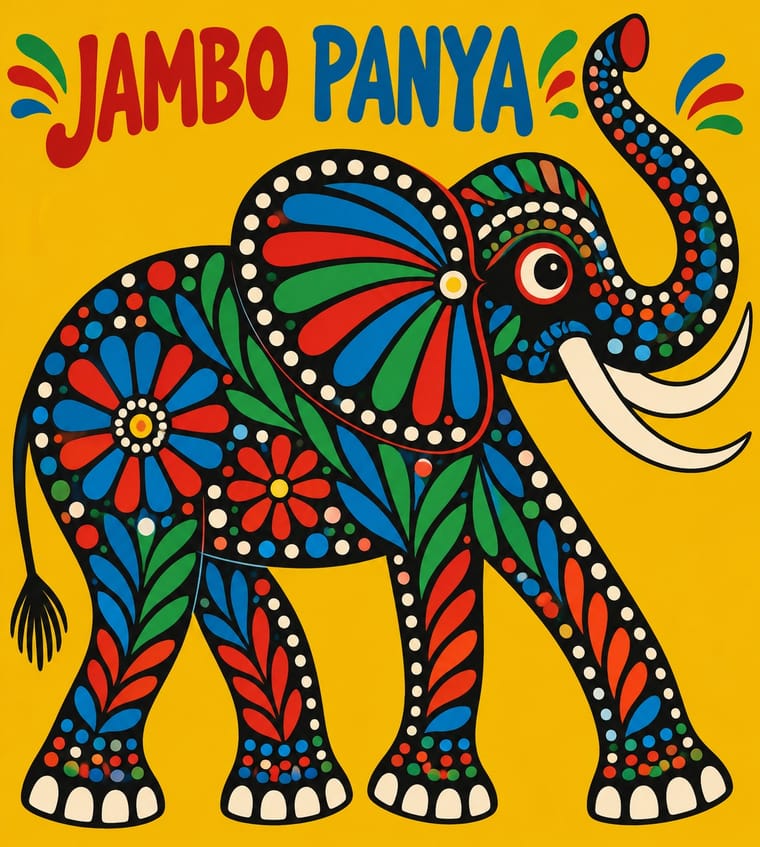
A Tanzanian popular painting school begun in Dar es Salaam by Edward Tingatinga (1932–1972), who from 1968 painted animals, birds and village scenes in glossy bicycle enamel on square hardboard ceiling boards for residents and tourists. One flat ground colour carries black-outlined, caricatural animals with patterned bodies. Its roots are debated: Makua and Makonde hut-wall painting, Congolese pictures sold in the city. Relatives and pupils carried it on, moving to canvas from 1989, organising as the Tingatinga Arts Cooperative Society in 1990 and adding crowded city scenes and spirit themes.
Make something in this styleGet advice in this styleMix it with another style
Use it with care
Tingatinga is the living livelihood of named Tanzanian painters, many in the Tingatinga Arts Cooperative Society in Dar es Salaam, and its market has long been undercut by fakes: copies of the founder's lion, peacock, leopard and buffalo were sold signed 'E. S. Tingatinga'. Never add Tingatinga's or any painter's signature, or a cooperative name, to generated work, and never present it as an original painting; commission, buy from or credit the painters by name instead. Do not call it generic 'African' or 'tribal' art, or dismiss it as 'airport art'. Its roots are debated, so do not present it as rootless or as a mere copy of Makua and Makonde hut-wall painting, and do not repeat the disputed claim that Tingatinga was Mozambican, which his family and the cooperative reject. Shetani and witchcraft scenes draw on Makua and Makonde belief; picture them as the brief's community understands them, not as spooky decoration.
01
How it works
- Lay the whole ground first in one flat, glossy colour, brushed coarsely and sometimes paled toward the top, then build every figure on top of it.
- Set one animal, a pair or a flock against that ground with no horizon, cast shadow or modelling, and let the bare colour around them be the space.
- Draw each shape in black with a fine brush, fill it with pure, unmixed enamel brights, restate the black line once the colour is dry, and pattern the bodies with dots, stripes, scales or rosettes.
- Exaggerate for humour: give animals mask-like faces, comic poses and simplified, naive anatomy rather than wildlife-guide accuracy.
- For a busier panel, fill the square edge to edge with repeated birds, trees, villagers or city street life, all drawn flat and at a similar scale.
- Close the square with a frame: early boards had a narrow wooden frame nailed on from behind and painted, its inner edge in a second colour; from the move to canvas in 1989 until about 2010 a painted black frame, often with a thin white inner line, was usual. Sign in painted capitals in a lower corner, in a colour that stands out from the ground.
Oyster Bay, Dar es Salaam, Tanzania (Tingatinga Arts Cooperative Society, near Morogoro Stores), spreading across Tanzania, Kenya and East Africa
02
Its design choices
From Stylogeny’s vocabulary of design choices: defining choices make the style, characteristic ones are usual, occasional ones turn up now and then.
- Layout & composition
- Space & hierarchy
- Colour
- Form & shape
- Ornament
- Medium & production
- Tone & intent
- Avoids
- Illusion of depth, Naturalistic depiction, Non-representational, Straight photography, Pastel, Monochrome, Ornament-free, Rational & objective
Palette
#f2b705#111111#d7261e#1c75bc#2e9e48#f5f1e6
Typefaces
Enamel-painted block-capital artist's signatures along the lower edge of the panel
e.g. 'E. S. TINGATINGA'
Irregular hand-painted capitals for any Swahili or English title or caption that must accompany Tingatinga-derived graphics
Known for
Edward Saidi Tingatinga, Bat in a Tree (1971), enamel on board, 62 × 61 cm, signed 'E. S. TINGATINGA' lower left
Edward Saidi Tingatinga's recurring subjects, much copied and faked under his signature
the lion, the peacock (Peacock on the Baobab Tree), the leopard and the buffalo
Simon G. Mpata, Birds and Mosquitoes
c. 1980
Abbas Wasia Mchisa, Hornbills in a Tree (1980), and Damian B. Msagula, Four Hornbills in a Tree
c. 1980
Omary Amonde, called the last of the first-generation painters
Snake amid the Guinea Fowl and Cape Buffalo and Bird (2013)
Issa Saidi Mitole, Muhimbili National Hospital (c. 2010) and Bush Hospital
2013
Mohamed Wasia Charinda, Shetani I–III (2005), oil on canvas; in 1989 he was the first of the school to switch from board to stretched canvas
Daudi Tingatinga (the founder's son), Leopard (2006), acrylic bicycle paint on canvas, 73.66 × 73.66 cm, cover of Emerging Infectious Diseases, September 2006
03
Make something in this style
Say what you need, and Stylogeny’s image studio draws it from Tingatinga Painting’s design choices and checks it against them. It takes about a minute, and you get a link to share.
04
Where it comes from, and what it’s close to
Before it
The style it grew out of, and the styles it borrowed from.
Nothing earlier is recorded: in the atlas it is a starting point.

After it
The styles that grew out of it.
No later style in the atlas grew out of it yet.
Alike in its design choices
Styles that make many of the same choices, related or not, besides those above.


05
Sources
- Wikipedia, 'Tingatinga (painting)' (https://en.wikipedia.org/wiki/Tingatinga_(painting))
- Wikipedia, 'Edward Tingatinga' (https://en.wikipedia.org/wiki/Edward_Tingatinga)
- Wikipedia (German), 'Tingatinga-Malerei' (https://de.wikipedia.org/wiki/Tingatinga-Malerei)
- Polyxeni Potter, 'He Who Dines with the Leopard Is Liable To Be Eaten', Emerging Infectious Diseases 12(9), 2006, pp. 1474–1475, doi:10.3201/eid1209.ac1209 (https://wwwnc.cdc.gov/eid/article/12/9/AC-1209_article) (note: calls Tingatinga Mozambican, a claim his family and the cooperative reject)
- Indigo Arts Gallery, 'Tinga Tinga Today: Tanzanian Popular Art in Transition' (exhibition, 9 April–30 September 2015) (https://indigoarts.com/exhibitions/tinga-tinga-today-tanzanian-popular-art-transition)
- Julie Mellby, 'Tingatinga School of Art', Graphic Arts Collection, Princeton University Library, 18 September 2019 (https://graphicarts.princeton.edu/2019/09/18/tingatinga-school-of-art/)
- Art Auction East Africa 2022, lot 30: E. S. Tingatinga, Bat in a Tree, 1971 (https://artauctioneastafrica.com/auctions/auction-2022/lot-30-2022/)
- Tingatinga Arts Cooperative Society, 'The Tingatinga African Painting Style' (https://www.tingatingaart.com/blogs/articles/the-tingatinga-african-painting-style)
- Tingatinga Arts Cooperative Society, 'Materials and Techniques in Tanzanian African Paintings' (https://www.tingatingaart.com/blogs/articles/materials-techniques-african-art)
- Red Hill Art Gallery, 'The Tingatinga Collection' (https://redhillartgallery.com/the-tingatinga-collection.html)
- Wikipedia, 'Tinga Tinga Tales' (https://en.wikipedia.org/wiki/Tinga_Tinga_Tales)
- Tine Thorup and Cuong Sam, Tingatinga – Kitsch or Quality (thorupArt, Copenhagen, 2010; ISBN 978-87-992635-1-6), as cited by German Wikipedia; English Wikipedia lists a 2011 edition, ISBN 978-87-992635-2-3
- Tingatinga Arts Cooperative Society, Tingatinga, 2nd ed. (Mture Educational Publishers, Dar es Salaam, 2005; ISBN 9976-967-34-9), as cited by German Wikipedia; English Wikipedia lists the same ISBN as 'Tingatinga' (1998)
How Stylogeny researches and checks a style: where the facts come from.