Traditions & vernacular · 1975–2010 · Middle East & North Africa
Syrian Cassette Cover Vernacular
Also known as Syrian cassette J-cards, Syrian cassette-era sleeve design
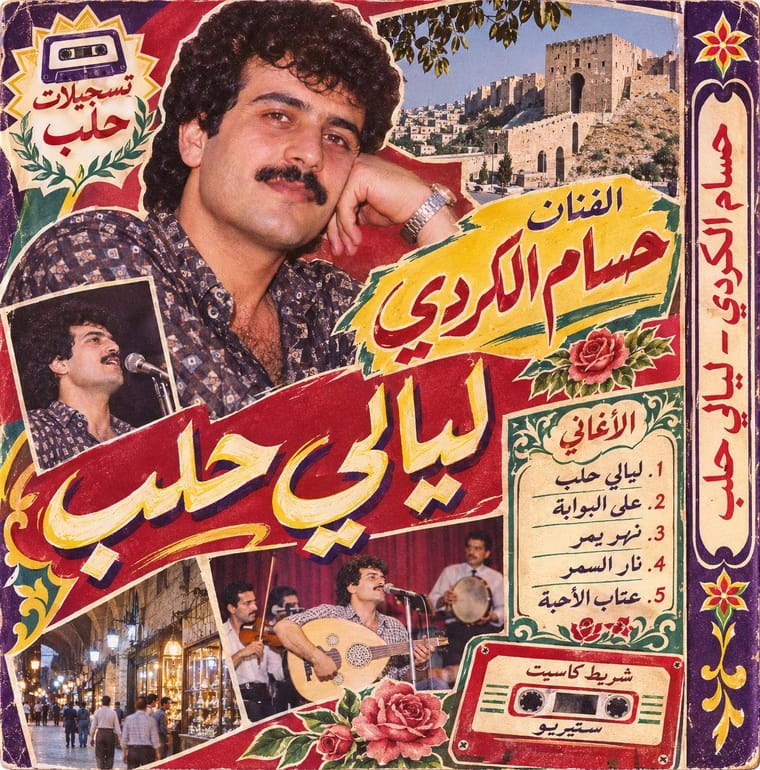
Syria's cassette-era J-card design, from archive scans of Aleppo-label tapes: a photographed performer, Arabic title lettering and a practical insert. Made first as hand-cut, watercolour-painted boards with hand-lettered titles, then offset printing, then a computer from 1994 (about a year to finished designs; in-house design from the late 1990s, he says, possibly earlier). The archive pages give no written description of the artwork, so visual traits are provisional.
Make something in this style Get advice in this style Mix it with another style
Use it with care
This is a living communities' commercial heritage, made by Arab, Kurdish and other Syrian musicians, labels and designers (the Kurdish mawal compilation SMA_0079 is one sign of this; no Assyrian or Armenian attribution is claimed here). Credit identified makers and labels; the Syrian Cassette Archives (Mark Gergis) is a curated collection to cite as a source, not the origin of the style. Do not equate Syrian with exclusively Arab, do not imitate real singers' likenesses or pass generated sleeves off as historical artefacts, and do not borrow sacred or devotional text as generic decoration.
01
Its picture in other colours
Change a colour and every picture on this page follows. It happens in your browser, from the same pictures: nothing new is made or saved.
Choose a colour to change it
-
#2b1a4a -
#c8323c -
#e6b93c -
#f1e6d0 -
#2f7f6b
A faded colour isn’t in these pictures, so changing it changes nothing.
Light and dark stay where they are; greys hardly move.
More colours: any style’s, or your own
The pictures show the style’s own colours.
02
Make something in this style
Say what you need, and Stylogeny’s image studio draws it from Syrian Cassette Cover Vernacular’s design choices and checks it against them. It takes about a minute, and you get a link to share.
03
How it works
Palette
-
#2b1a4anot in its pictures -
#c8323cink · 17% -
#e6b93cground · 14% -
#f1e6d0accent · 10% -
#2f7f6bnot in its pictures
Shares measured from its 2 pictures. The ground is what the pictures sit on (of the colours covering most, the most neutral), the ink stands out from it most, the rest are accents.
Typefaces
-
Hand-painted Arabic title lettering
earlier period
-
Digital Arabic display faces
after computers, from the mid-1990s
- Put the performer's photograph at the front so the buyer recognises the singer before reading anything.
- Letter the title and singer's name in Arabic, hand-painted in the earlier period and with digital faces once computers entered the workshop.
- Give practical information its own panel on the insert: track list, label and spine text.
- Let the label's mark and name identify the tape on a shop shelf.
With an idea put on it
-
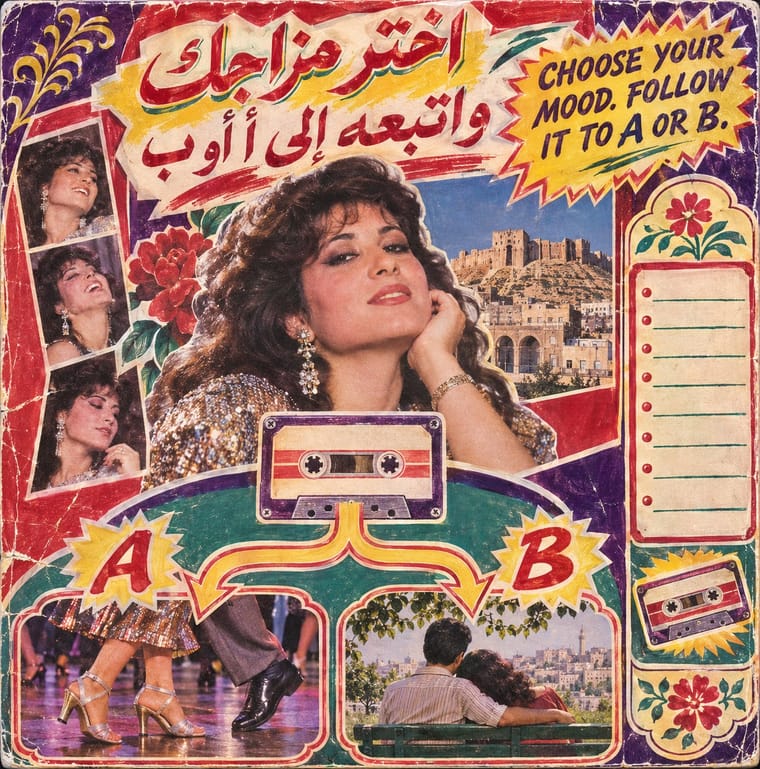
Something to do Below a fictional adult singer's portrait, a route from a cassette forks to dancing feet marked A and a couple on a bench marked B, so tracing a chosen mood selects which side to play.
AI-generated: Syrian Cassette Cover Vernacular with an idea put on it. Not a real or historical work.
Where and when Syria's cassette labels and cover-design workshops, especially in Aleppo (for example Sallama, founded there in 1975 by Muhammad Rizq Al Sakkal).
Syria's cassette labels and cover-design workshops, especially in Aleppo (for example Sallama, founded there in 1975 by Muhammad Rizq Al Sakkal). Sallama's Bashar Sakkal says it moved to offset printing to match the quality of cassettes coming from Egypt and the Gulf; no atlas style stands for that Egyptian and Gulf cassette design, so influences is left empty. The 1975-2010 bounds are approximate research bounds, not a claim that the style began or ended in those years.
Change it with an idea. Any of the 73 moves that make a design say something can go on this style.
04
Its design choices
From Stylogeny’s vocabulary of design choices: defining choices make the style, characteristic ones are usual, occasional ones turn up now and then.
- Layout & composition
- Space & hierarchy
- Typography
- Form & shape
- Surface & texture
- Medium & production
- Avoids
- Generous white space, Ornament-free, Typography only, Grotesque & neo-grotesque, Monochrome, Modular grid
How its pictures are made Photographic, light, viewpoint, lens, pose, finish
Kind of picture: Photographic How they are made, from the questions Stylogeny asks of that kind:
- Light
-
- Flat form characteristic
- Rounded, modelled form characteristic
- Direct on-camera flash occasional
- Prominent catchlights occasional
- Viewpoint
-
- Eye level characteristic
- Close & intimate characteristic
- Flattened planes characteristic
- Lens
-
- Normal lens characteristic
- Pose
-
- Three-quarter turn characteristic
- Eyes to the lens characteristic
- Looking away characteristic
- Smiling occasional
- Theatrical & acted occasional
- Finish
-
- Composite & montage characteristic
- Text & graphics on the image characteristic
Known for
-
Radwan Sarmini, Afrah Halab (Aleppo Weddings), Sawt Al Hafez; Syrian Cassette Archives SMA_0219, catalogued to the 1980s
-
Various Artists, Mawalat Kurdiya (Kurdish Mawal) '96, Shahba, Aleppo, 1996; Syrian Cassette Archives SMA_0079
-
Naim Al Sheikh, Tahet Al Dawali (Beneath the Grapevine), Music Phan, 2006; Syrian Cassette Archives SMA_0124
05
Where it comes from, and what it’s close to
Nothing earlier is recorded: in the atlas it is a starting point.
Syrian Cassette Cover Vernacular 1975–2010
No later style in the atlas grew out of it yet.
Alike in its design choices
06
Combine it with
Styles Syrian Cassette Cover Vernacular pairs well with or plays against, from the research. Each is worked out as a combination: which style gives the type, the colours and the forms.
- Arabic Calligraffiti Pairs well · Also builds on Arabic calligraphic lettering, but as street art rather than a commercial sleeve; keep sacred text out of decorative use.
- Contemporary Arabic & Dual-Script Type Design Pairs well · Another Arabic-script lettering practice in the atlas; this one is commercial cassette lettering, not type-design pairing.
07
Often taken for
Stylogeny checks the choices recorded in each of Syrian Cassette Cover Vernacular’s 4 real works against all 702 styles. All 4 fit its own choices best, so these are its nearest styles by choices, with the choices that tell them apart.
-
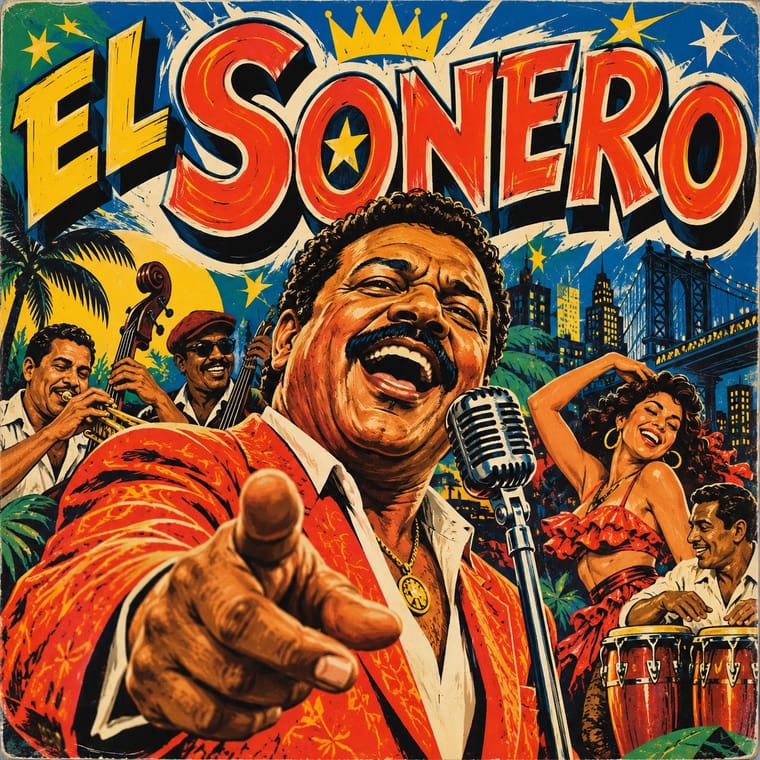
Fania and Nuyorican Salsa LP Sleeves
Fania and Nuyorican Salsa LP Sleeves is one of Syrian Cassette Cover Vernacular’s nearest styles by choices; no real work of either fits the other better.
Choices that tell Syrian Cassette Cover Vernacular and Fania and Nuyorican Salsa LP Sleeves apart Choice Syrian Cassette Cover Vernacular Fania and Nuyorican Salsa LP Sleeves Brush & pen calligraphy characteristic — Distortion & exaggeration — characteristic Rotated & vertical setting characteristic — Comic & cartoon — characteristic Desktop publishing characteristic — No shared descent in the atlas: they reached these choices separately.
-
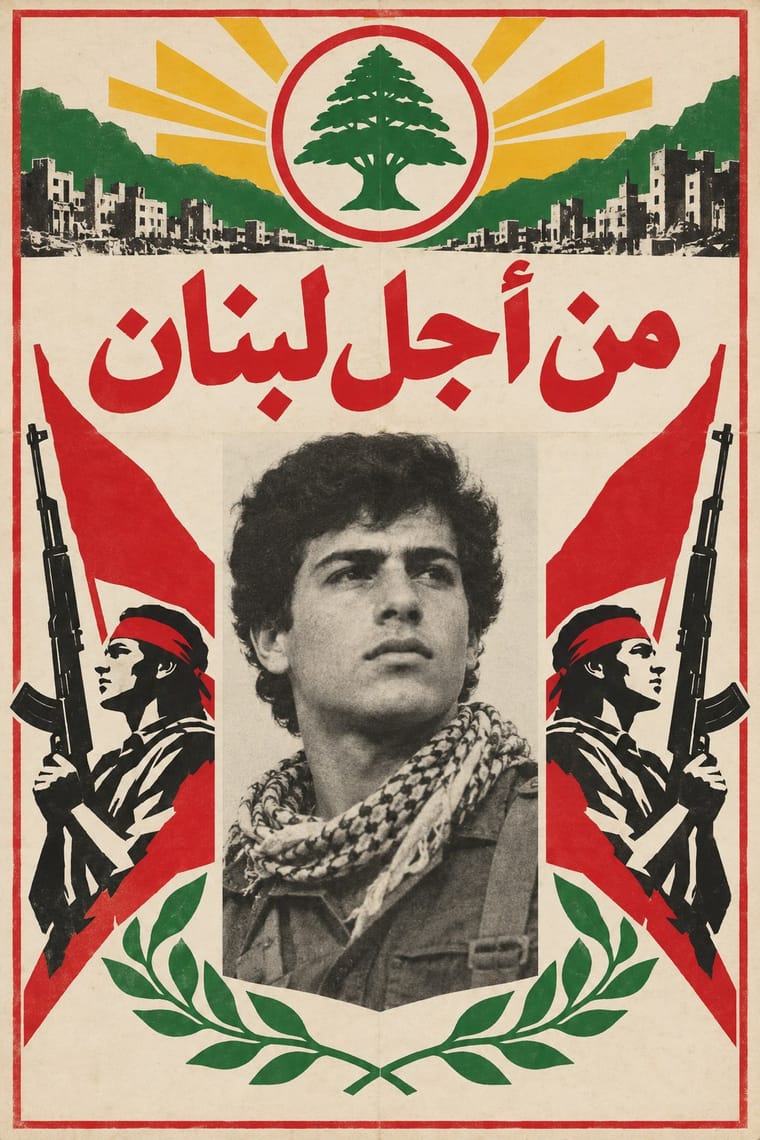
Lebanese Civil War Party Poster
Lebanese Civil War Party Poster is one of Syrian Cassette Cover Vernacular’s nearest styles by choices; no real work of either fits the other better.
Choices that tell Syrian Cassette Cover Vernacular and Lebanese Civil War Party Poster apart Choice Syrian Cassette Cover Vernacular Lebanese Civil War Party Poster Collage & layering defining occasional Central symmetry — defining Ornamented display characteristic — Monochrome avoids occasional Rotated & vertical setting characteristic — No shared descent in the atlas: they reached these choices separately.
-
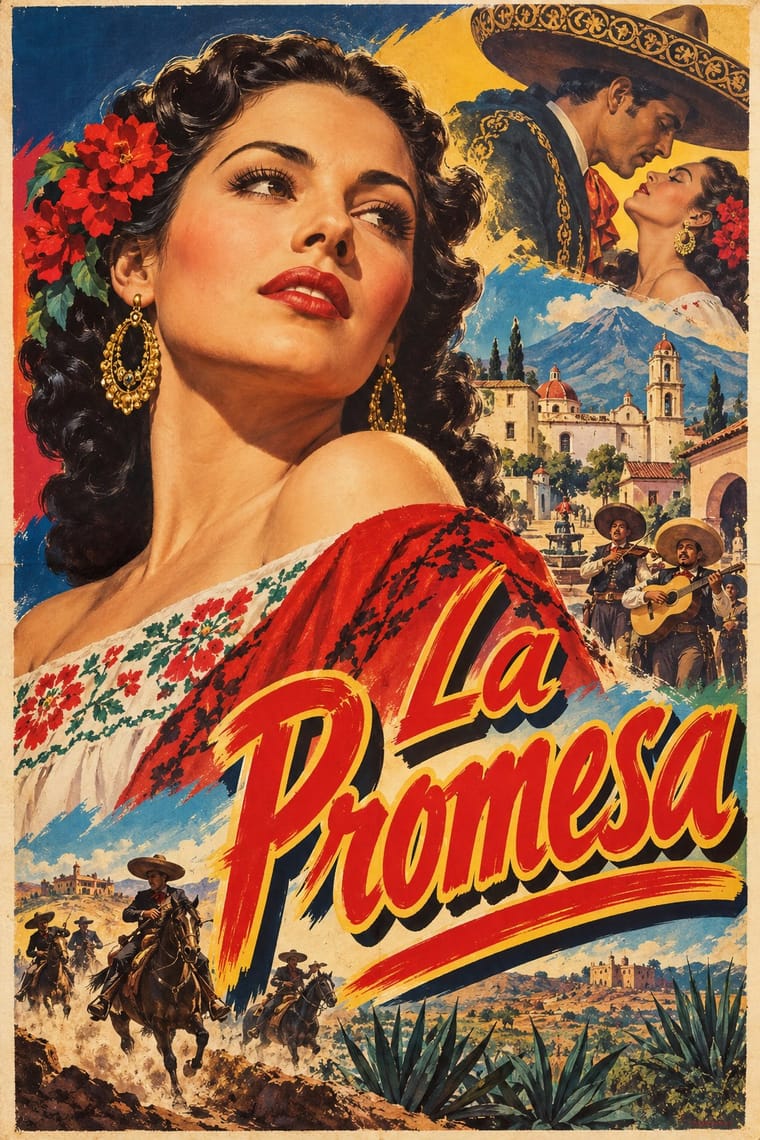
Mexican Golden Age Film Poster
Mexican Golden Age Film Poster is one of Syrian Cassette Cover Vernacular’s nearest styles by choices; no real work of either fits the other better.
Choices that tell Syrian Cassette Cover Vernacular and Mexican Golden Age Film Poster apart Choice Syrian Cassette Cover Vernacular Mexican Golden Age Film Poster Straight photography defining — Painterly illustration — defining Framed panels characteristic — Restrained accents — characteristic Emblems & badges characteristic — No shared descent in the atlas: they reached these choices separately.
-
Iranian Revolutionary & Sacred Defence Poster
Iranian Revolutionary & Sacred Defence Poster is one of Syrian Cassette Cover Vernacular’s nearest styles by choices; no real work of either fits the other better.
Choices that tell Syrian Cassette Cover Vernacular and Iranian Revolutionary apart Choice Syrian Cassette Cover Vernacular Iranian Revolutionary Layered information characteristic — Painterly illustration — defining Ornamented display characteristic — Folk & sacred symbols — defining Rotated & vertical setting characteristic — No shared descent in the atlas: they reached these choices separately.
— means the choice isn’t among the style’s recorded choices. Critics recorded each work’s choices with the styles’ descriptions in view, so this shows whether the descriptions hold together, not proof that they are right.
08
Real works
Artefacts in museums, libraries and archives that show the style, linked at their source.
- Ya Man Hawaho Azaho Wa Azalane (My Love to You Rewarded You and Insulted Me) Abdel Rahim Al-Touhi (cover design), for Layali Al-Shark · 1970s (archive's decade) · Syrian Cassette Archives
- Awel We Akher Habeeb (The First and Last Lover) Damascus Sound Recordings (label; cover designer unidentified) · 1984 · Syrian Cassette Archives
- Attaba & Sweihli Sawt Al Hafez (label; cover designer unidentified) · 1992 · Syrian Cassette Archives
- Layali Malekat Alhob (Nights of the Love Queen) Shahba (label; cover designer unidentified) · 2002 · Syrian Cassette Archives
09
Sources
- Syrian Cassette Archives, About: https://syriancassettearchives.org/about?lang=en
- Syrian Cassette Archives, The Sound of Sallama (Yamen Mekdad interviewing Bashar Sakkal): https://syriancassettearchives.org/features/FEAT_0036?lang=en
- Syrian Cassette Archives tape records SMA_0219, SMA_0079, SMA_0124: https://syriancassettearchives.org/tapes/SMA_0079?lang=en
1 more source
- Photo credit 'Mark Gergis' appears on SMA_0219 and may refer to the archive scan rather than the cover, so no photography credit is claimed.
How Stylogeny researches and checks a style: where the facts come from.