Pictorial & machine age · 1975–1990 · Middle East & North Africa
Lebanese Civil War Party Poster
Also known as Lebanese political posters 1975–1990, Lebanese wartime party posters, Lebanese martyr posters
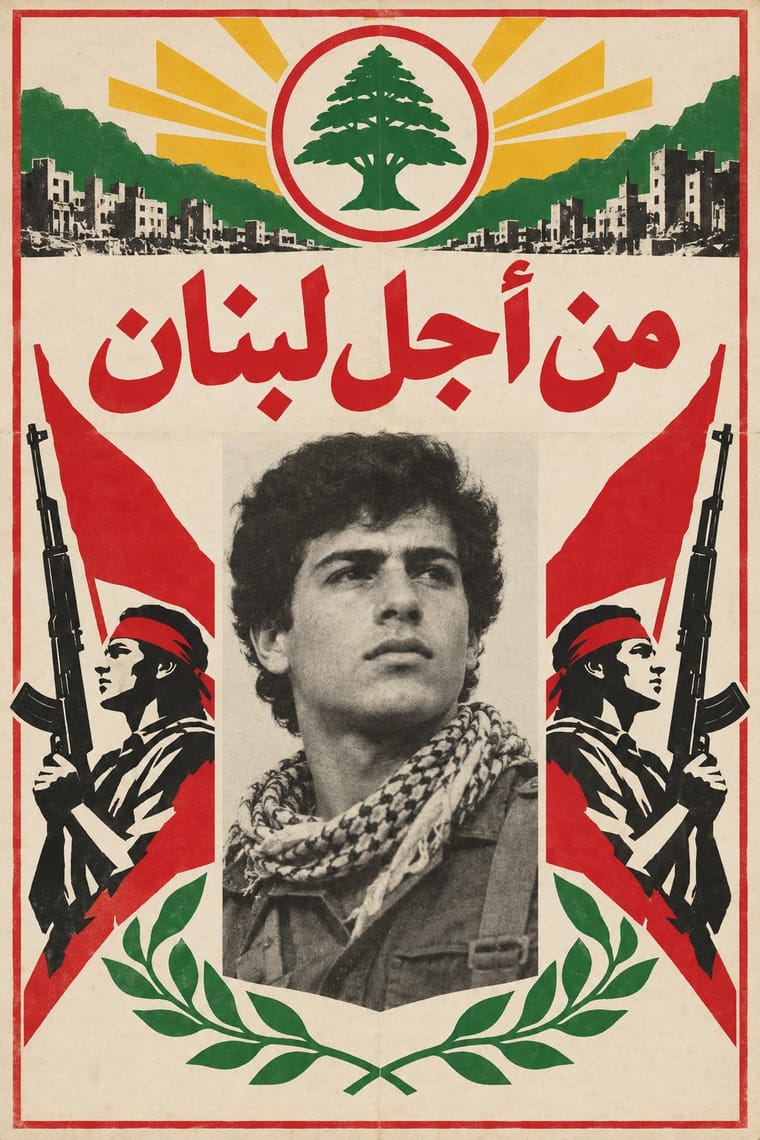
The posters that some twenty parties and militias pasted on the walls of Beirut and other towns between 1975 and 1990, marking each quarter as one faction's territory. With no state style, every party branded its sheets with its own name, emblem, colours, leader and slogans. The staple was the martyr poster: a public obituary with the fallen partisan's straight photograph, name and dates under a header naming the party, often with its emblem, issued in series. Leftist parties also commissioned painters, and Hizbullah and Amal had martyrs painted into symbolic scenes.
Make something in this styleGet advice in this styleMix it with another style
Use it with care
These posters show real people who were killed, many of them young partisans whose families are alive, and some glorify attacks carried out as 'martyrdom operations'; most of the parties that issued them are still active and the war's memory remains contested in Lebanon. Do not use martyr portraits, party emblems or Shiʿa devotional imagery as edgy 'war poster' decoration: cite the posters as historical documents with their archive, have every Arabic line read by a fluent reader, and remember that a party's colours and symbols still align a design with one camp. Hizbullah is banned in several countries, for example the UK (proscribed in full in 2019) and Germany (a 2020 ban on its activity that covers its symbols), where displaying its emblem can itself be an offence. The collections and Maasri's book also lean towards the Left and its Palestinian allies, while the Christian right fought its image war mainly on television, so the leftist look is not the whole war.
01
How it works
- Name the party (or its front, such as the Lebanese National Resistance Front) in the header, usually with its emblem at the head, the foot or in a corner, and print in the party's own colours, so a wall reads as one faction's territory.
- Centre a straight, ID-style photograph of the fallen partisan and set the name, epithet and dates of birth, joining the party and death beneath it, as a public obituary.
- Hand-letter the Arabic headline (a slogan, a Qur'anic verse, a leader's saying or the martyr's last words) and set the biography in plain Naskh text type.
- Issue in series: one template for each fallen partisan, or many faces in a grid on one sheet for collective martyrs, and paste the sheets side by side.
- Tie the other posters to the party calendar (founding day, the leader's birth or death, battles and massacres) with the za'im's portrait or the party's own symbols: cedar, map, fist, dove or the Dome of the Rock.
- For anniversaries and celebrated martyrs, swap the photograph for painting: leftist parties commissioned painters' expressive drawings, while Hizbullah and Amal had the martyr's portrait painted from his photograph, often with airbrushed modelling, into a symbolic scene of red tulips, rifles, explosions or the Dome of the Rock under a Qur'anic verse or an epithet.
Media offices and commissioned artists of Lebanon's warring parties and militias, mainly in Beirut: the Kataeb and Lebanese Forces, the Progressive Socialist Party, the Lebanese Communist Party, the SSNP, Nasserist and Baʿathist groups, Amal, Hizbullah and the PLO in Lebanon
02
Its design choices
From Stylogeny’s vocabulary of design choices: defining choices make the style, characteristic ones are usual, occasional ones turn up now and then.
- Layout & composition
- Space & hierarchy
- Colour
- Form & shape
- Surface & texture
- Ornament
- Imagery
- Medium & production
- Tone & intent
- Avoids
- Ironic & self-aware, Playful & witty, Luxurious & glamorous, Abundant decoration, Fluorescent & neon, Pastel, Gloss & highlights, Non-representational
Palette
#f3eee2#151515#cf2027#2f8a3c#f2c12e#77736d
Typefaces
Hand-lettered Arabic headlines in Naskh, Thuluth and Ruqʿa styles for martyr names, epithets, slogans and Qur'anic verses
Typeset Arabic Naskh text for the martyr's biography and dates
Occasional French, English or Spanish lines in plain sans-serif
e.g. 'Parti Communiste Libanais' on Abdelké's 1984 anniversary posters, or the condensed capitals of El-Touni's French, English and Spanish title lines
Known for
Emile Menhem, 60 Years in the Production of Joy
Lebanese Communist Party, 1984
Youssef Abdelké (Syrian artist; credited as Abdelkeh), 60th Anniversary 1924–1984
Lebanese Communist Party, 1984
Paul Guiragossian, Glory to the Heroes of the Beaufort Castle
Lebanese Communist Party, 1980
Roger Sawaya, 8 July, commemoration of Saadeh's martyrdom
'I die yet my party remains' (SSNP, 1980)
Tammouz Knayzeh & Camil Baraka, A singing heroism, and a martyr soul
Sanaa Mhaidle (SSNP, 1985; a tall 42 × 98 cm strip)
Lebanese National Resistance Front and SSNP posters quoting partisans' recorded statements before martyrdom operations, e.g. 'I am now planted in the south, I soak its earth with my blood' (Sana'a Mehaidli, 1985)
Adel Selman, God's victorious lion. The martyr hajj Nassar Nassar
Hizbullah/Islamic Resistance, undated; painted portrait with a rifle and the Dome of the Rock, 48 × 69 cm
Hizbullah/Islamic Resistance, Toumat Niha's high-quality operation
1987; four martyrs' photographs in a row
03
Make something in this style
Say what you need, and Stylogeny’s image studio draws it from Lebanese Civil War Party Poster’s design choices and checks it against them. It takes about a minute, and you get a link to share.
04
Where it comes from, and what it’s close to
Before it
The style it grew out of, and the styles it borrowed from.


After it
The styles that grew out of it.
No later style in the atlas grew out of it yet.
Alike in its design choices
Styles that make many of the same choices, related or not, besides those above.
- Ethiopian Revolutionary Poster (Derg Era)70% alike
- Roots Reggae Sleeve Art & Rasta Iconography67% alike
- Senegalese Sufi Devotional Imagery (Souwère Glass Painting and Amadou Bamba Portraits)65% alike


05
Sources
- Zeina Maasri, Off the Wall: Political Posters of the Lebanese Civil War (London: I.B. Tauris, 2009), foreword by Fawwaz Traboulsi
- Zeina Maasri, Signs of Conflict: exhibition produced by Ashkal Alwan for Home Works IV (Beirut, April 2008) and online annotated archive (signsofconflict.org; themes, designer and poster records consulted via Internet Archive captures)
- Kaelen Wilson-Goldie, 'Off the Wall', Bidoun (Spring 2009), bidoun.org/articles/off-the-wall
- Sarah A. Rogers, review of Maasri, Off the Wall, MERIP (November 2009), merip.org/2009/11/maasri-off-the-wall/
- AUB Jafet Library, Political posters collected between the 1960s and the 1980s (Digital Documentation Center at AUB with Al Mashriq, Høgskolen i Østfold)
- Heinrich Böll Stiftung Middle East, Signs of Conflict: Political Posters of the Lebanese Civil War (Beirut: Furat, 2010), lb.boell.org
- UK Home Office, Proscribed terrorist groups or organisations (gov.uk): Hizballah proscribed in its entirety, March 2019; Terrorism Act 2000 s.13 display and image offences
- Associated Press, 'Germany raids sites linked to Hezbollah, extends ban' (30 April 2020): the ban covers the use of its symbols
How Stylogeny researches and checks a style: where the facts come from.