Pictorial & machine age · 1978–1988 · Middle East & North Africa
Iranian Revolutionary & Sacred Defence Poster
Also known as Islamic Revolution posters, Sacred Defence (Defāʿ-e Moqaddas) posters, Iran–Iraq War posters, Tehran martyr murals
Posters, murals and stamps of the 1978–79 Iranian Revolution and the 1980–88 war with Iraq, which fused the red-white-black international revolutionary poster with Persian miniature and coffeehouse narrative painting. Shiʿa martyrdom imagery (red tulips from martyrs' blood, Karbala, white shrouds) and calligraphed slogans, Qur'anic verses and the shahada carry the message, and the same image moves between postage stamp, poster and multi-storey wall.
Use it with care
This tradition is built on sacred text and devotional imagery: Qur'anic verses, the shahada, the names of God, the Prophet's family and Imam Husayn, and the Karbala martyrdom narrative at the heart of Shiʿa mourning practice. Never use the calligraphy or martyr imagery as decorative texture, never crop or distort sacred text, and do not imitate Arabic-script lettering without a fluent reader. Martyr portraits show real people, and the posters are also state propaganda of a government still in power, so cite them as historical sources rather than a neutral look, and work with Iranian calligraphers and designers.
01
How it works
- Combine the revolutionary poster's single red-white-black idea with miniature-style narrative scenes in richer colour.
- Encode sacrifice through the Karbala lexicon: red tulips, white shrouds, Imam Husayn's standard, a rising red sun.
- Let calligraphy carry slogans and verses, and shape it into fists, flames or flags when the word must become the image.
- Use colour symbolically: red for blood and victory, green for Islam, black for mourning.
- Design each image to scale from postage stamp to poster to building-high mural.
Tehran and other Iranian cities: revolutionary factions in 1978–80, then the cultural and propaganda bodies of the Islamic Republic during the Iran–Iraq War
02
Its design choices
From Stylogeny’s vocabulary of design choices: defining choices make the style, characteristic ones are usual, occasional ones turn up now and then.
- Layout & composition
- Space & hierarchy
- Typography
- Form & shape
- Surface & texture
- Ornament
- Imagery
- Medium & production
- Tone & intent
- Avoids
- Ironic & self-aware, Playful & witty, Ornament-free, Pastel, Fluorescent & neon, Gloss & highlights, Found & vernacular imagery
Palette
#b31b1b#1e7b45#151515#f2eee4#c9a03c#3a7ca5
Typefaces
Nastaʿlīq
Persian slogans and poetry
Thuluth and Naskh
Qur'anic verses and the shahada
Hand-drawn heavy Persian display lettering for slogans
Known for
Kazem Chalipa, Iṯār (Altruism), a mural adapted as a poster and a postage stamp
Kazem Chalipa, The Guards of the Anemone Fields
Iran–Iraq War poster
Kazem Chalipa, depiction of the Black Friday massacre at Zhaleh Square, Tehran
8 September 1978
Mojahedin-e Khalq May Day poster of a worker breaking his chains
c. 1979–81
Ministry of Islamic Guidance poster showing the United Nations as a foot
Peter Chelkowski's poster collection, published in Staging a Revolution
with Hamid Dabashi, 1999
03
Where it comes from, and what it’s close to
Before it
The style it grew out of, and the styles it borrowed from.


After it
The styles that grew out of it.
No later style in the atlas grew out of it yet.
Alike in its design choices
Styles that make many of the same choices, related or not, besides those above.
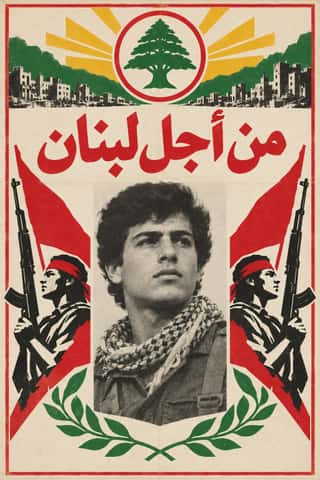
- Palestinian Resistance Poster75% alike
- Ethiopian Revolutionary Poster (Derg Era)74% alike
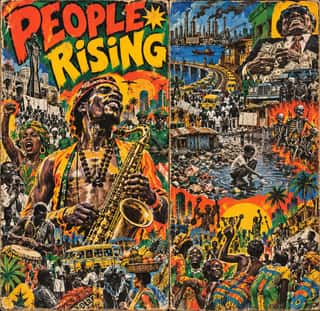
- Italian Fascist Graphics (Romanità & Exhibition Photomontage)64% alike
- Senegalese Sufi Devotional Imagery (Souwère Glass Painting and Amadou Bamba Portraits)64% alike


04
Real works
Artefacts in museums, libraries and archives that show the style, linked at their source.
- Khomeini above the revolutionary crowds (poster)Hasan Isma'ilzadeh · 1979 · Victoria and Albert Museum, London
- Three books and revolutionary slogans (Azadi)Hossein Norouzian · painting signed and dated 7 Dey 1357 (28 December 1978); sheet printed in 1979 or later (its recto carries a Norouzian painting dated 9 May 1979) · Fonds Christian Bromberger, Phonothèque de la MMSH, Aix-en-Provence (via MédiHAL, CNRS); original at La Contemporaine, Nanterre
- Dove with a tulip under the emblem of the Islamic Republic (22 Bahman anniversary)Isfahan ceremonies headquarters (publisher); designer unknown · 1981 · Fonds Christian Bromberger, Phonothèque de la MMSH, Aix-en-Provence (via MédiHAL, CNRS); original at La Contemporaine, Nanterre
- The Imam Has Come (Emam amad): poster for the fourth anniversary of the Islamic RevolutionMinistry of Islamic Guidance (Vezarat-e Ershad-e Eslami), Iran (named under the state emblem); designer unknown · 1983 · Fonds Christian Bromberger, Phonothèque de la MMSH, Aix-en-Provence (via MédiHAL, CNRS); original at La Contemporaine, Nanterre
05
Sources
- Peter Chelkowski & Hamid Dabashi, Staging a Revolution: The Art of Persuasion in the Islamic Republic of Iran (NYU Press, 1999)
- Mehdi Abedi & Michael M. J. Fischer, 'Revolutionary Posters and Cultural Signs', Middle East Report (MERIP), July 1989
- Encyclopaedia Iranica, 'Graphic Arts ii. In the 1978–79 Revolution and Iran–Iraq War' (iranicaonline.org)
How Stylogeny researches and checks a style: where the facts come from.