Counterculture · 1990–1999 · North America
1990s Skateboard Parody & Appropriation Graphics
Also known as Early-1990s rip-off deck graphics, World Industries / Blind / 101 satire graphics
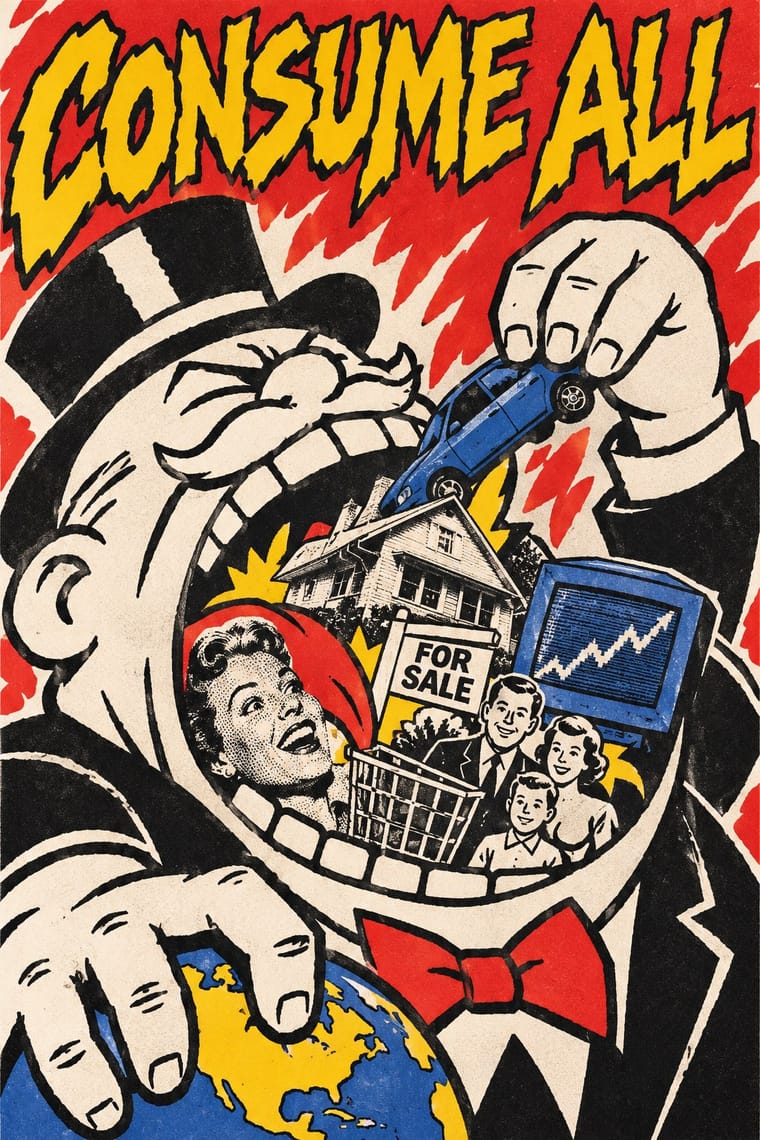
Deck graphics of the early 1990s that quote a familiar cartoon, celebrity, brand or national symbol and alter it into an irreverent joke or social accusation. Unlike its parent skateboard-graphics (1973-1989), which is built on a hand-lettered house monster or logo emblem, here recognition of the borrowed source carries the image; much of it was made by hand, with brand names often left off.
Make something in this style Get advice in this style Mix it with another style
Use it with care
Much of this work appropriated living artists' and companies' copyrighted and trademarked characters, and McKee recalls cease-and-desist letters (Disney, Burger King, Dr. Seuss, Scientology); copying it risks infringement. It also quotes offensive material for satire: murderer imagery (Charles Manson), nudity (the World Industries Nude Beach board, adult imagery, do not reproduce), and racial or religious imagery. Handle such material in context and never repeat stereotypes as decoration. Cliver names Jason Lee's American Icons and the Real Hanging Klansman board (1990, credited to Natas Kaupas and Kevin Whitehead) among the graphics that capture the spirit of the 90s; so the anti-Klan image is accusation, not endorsement.
01
Its picture in other colours
Change a colour and every picture on this page follows. It happens in your browser, from the same pictures: nothing new is made or saved.
Choose a colour to change it
-
#111111 -
#f2efe6 -
#d8261f -
#f0c419 -
#2c5ea8
A faded colour isn’t in these pictures, so changing it changes nothing.
Light and dark stay where they are; greys hardly move.
More colours: any style’s, or your own
The pictures show the style’s own colours.
02
Make something in this style
Say what you need, and Stylogeny’s image studio draws it from 1990s Skateboard Parody & Appropriation Graphics’s design choices and checks it against them. It takes about a minute, and you get a link to share.
03
How it works
Palette
-
#111111ground · 18% -
#f2efe6ink · 18% -
#d8261faccent · 11% -
#f0c419accent · 7% -
#2c5ea8accent · 5%
Shares measured from its picture. The ground is what the pictures sit on (of the colours covering most, the most neutral), the ink stands out from it most, the rest are accents.
Typefaces
-
Hand-drawn rider-name lettering
-
Borrowed cartoon and commercial logo lettering
- Borrow a recognisable source (cartoon cast, celebrity, commercial graphic, national symbol) and change its meaning with one pointed substitution.
- Keep the borrowed source's own visual voice so the altered scene, not a company logo, carries recognition.
- Fill the whole deck with one self-contained scene or portrait rather than a single mascot emblem.
- Draw or cut the image by hand in flat black and off-white with a few spot colours (red, yellow or blue in the palette, which is inferred rather than sourced), so it survives screenprinting on a board.
- Set the rider's name small and plain; leave the company name off if the joke does not need it.
The US independent skateboard-company scene, particularly Steve Rocco's World Industries, Blind and 101, where Marc McKee and Sean Cliver were the core documented makers. The 1990-1999 span is a boundary of convenience: 1999 is not an end of parody on boards, which continued after it.
Change it with an idea. Any of the 73 moves that make a design say something can go on this style.
04
Its design choices
From Stylogeny’s vocabulary of design choices: defining choices make the style, characteristic ones are usual, occasional ones turn up now and then.
- Layout & composition
- Space & hierarchy
- Typography
- Surface & texture
- Ornament
- Imagery
- Medium & production
- Tone & intent
- Avoids
- Modular grid, Central symmetry, Generous white space, Grotesque & neo-grotesque, Authoritative & institutional, Calm & contemplative, Rational & objective, Gloss & highlights
How its pictures are made Drawn & painted, Synthetic & found
Kind of picture: Drawn & painted · Synthetic & found
Known for
-
Marc McKee, Blind Jason Lee American Icons
1990
-
Sean Cliver, Blind Claudia Schiffer series
made after his November 1991 Powell layoff
-
Sean Cliver, 101 Adam McNatt Charlie Manson Brown
early 1990s
05
Where it comes from, and what it’s close to
Grew out of
Borrowed from
1990s Skateboard Parody & Appropriation Graphics 1990–1999
No later style in the atlas grew out of it yet.
Alike in its design choices
06
Combine it with
Styles 1990s Skateboard Parody & Appropriation Graphics pairs well with or plays against, from the research. Each is worked out as a combination: which style gives the type, the colours and the forms.
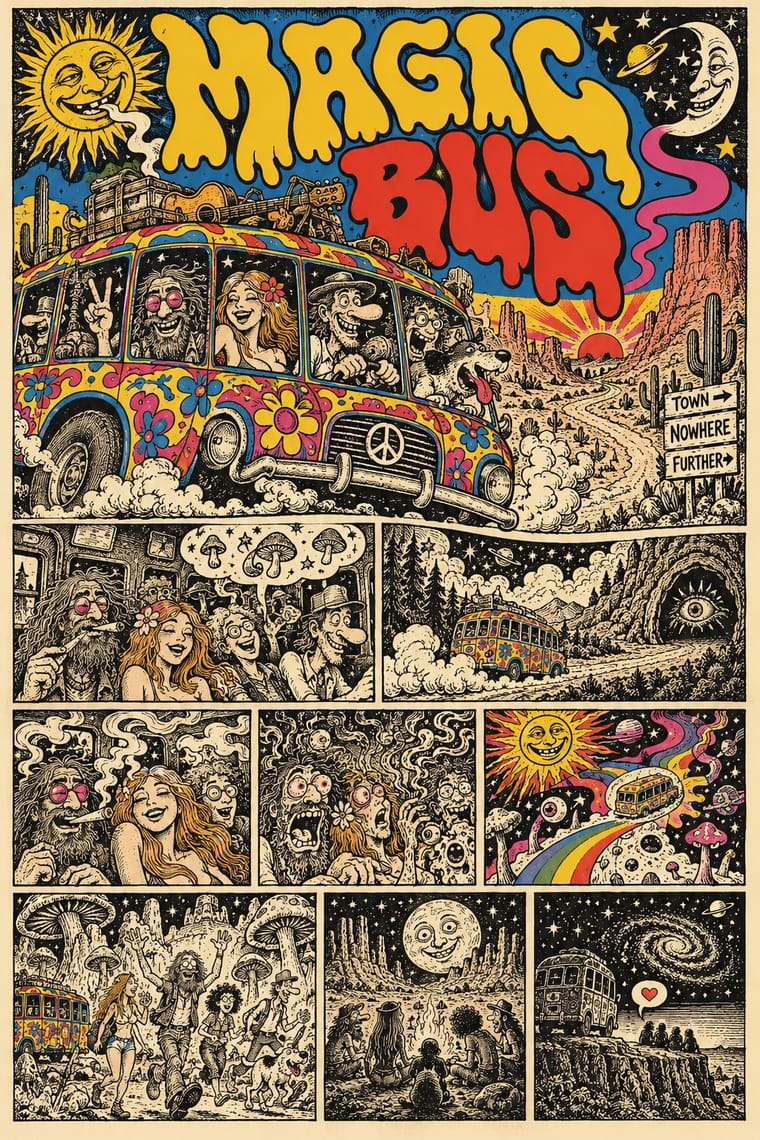
- Underground Comix Pairs well · Borrows comix draughtsmanship and line, compressed into a single product graphic.
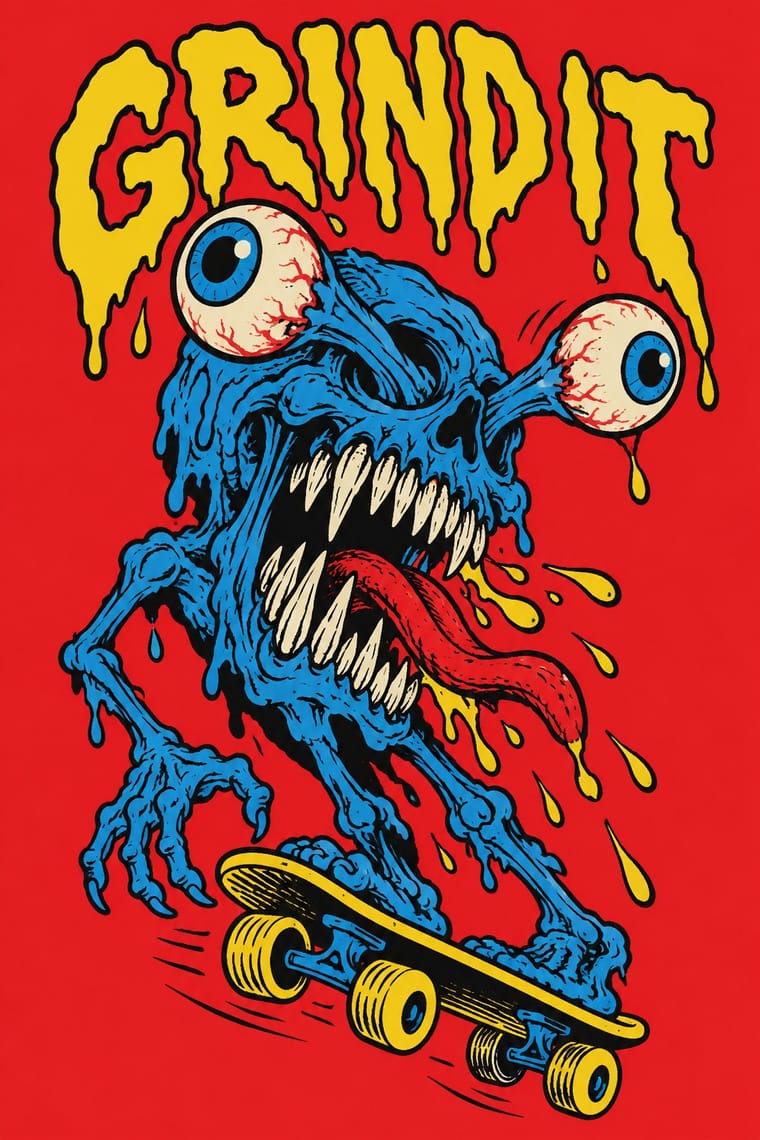
- Skateboard Deck Graphics Pairs well · Descends from the parent: keeps the deck as a printed canvas but replaces its hand-lettered house emblem with a quoted, altered source.
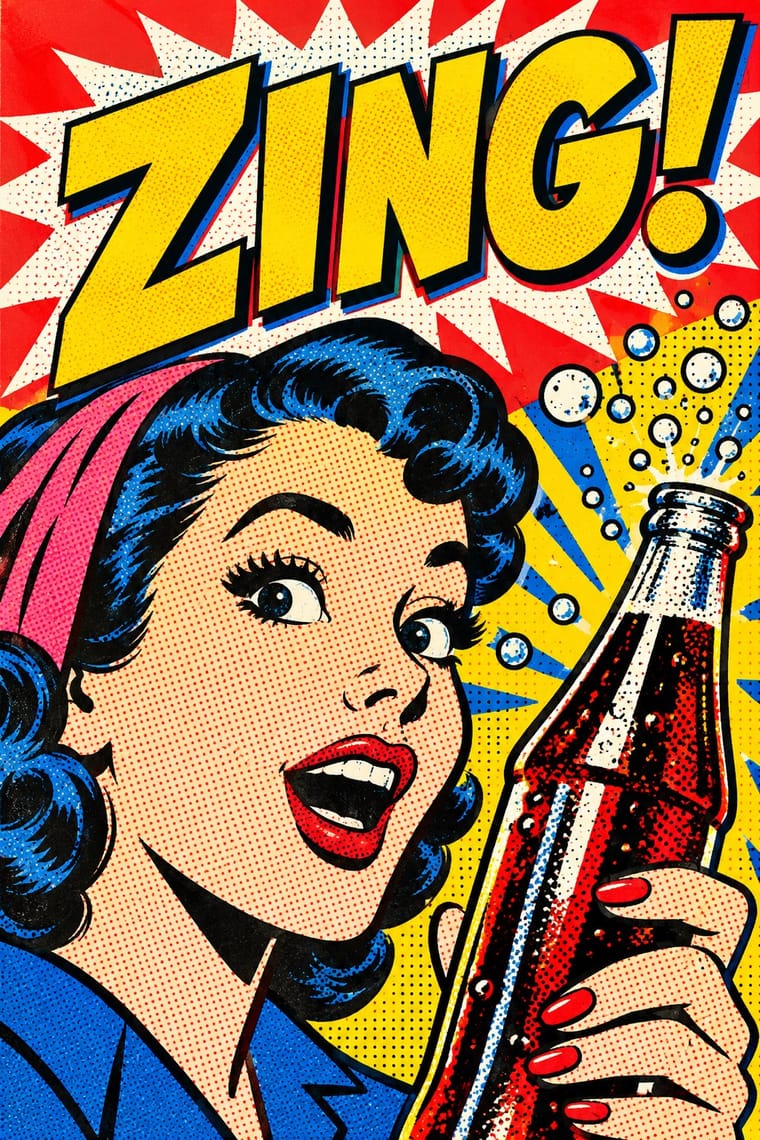
- Pop Art Graphics Pairs well · Quotes mass imagery as Pop did, but alters it into a pointed accusation.
- Hype Streetwear Graphics (Box Logo to Quotation Marks) Contrasts · Swap the scarce status logo for a narrative joke where the altered scene, not the lockup, carries recognition.
07
Often taken for
Stylogeny checks the choices recorded in each of 1990s Skateboard Parody & Appropriation Graphics’s 2 real works against all 702 styles. One fits its own choices best.
One fits a close style’s choices as well or better, as below. That means the two styles share those choices, not that the work is misfiled.
-
Amul Topical Hoardings
1 of its 2 real works fits Amul Topical Hoardings’s choices slightly better than its own: Chris Branagh pro model, WB Ripoff Series.
Choices that tell 1990s Skateboard Parody and Amul Topical Hoardings apart Choice 1990s Skateboard Parody Amul Topical Hoardings Found & vernacular imagery defining — Rounded & pill — characteristic Horror vacui occasional avoids Isolated object — characteristic Distortion & exaggeration characteristic — No shared descent in the atlas: they reached these choices separately.
-
Skateboard Deck Graphics
Skateboard Deck Graphics is one of 1990s Skateboard Parody & Appropriation Graphics’s nearest styles by choices; no real work of either fits the other better.
Choices that tell 1990s Skateboard Parody and Skateboard Deck Graphics apart Choice 1990s Skateboard Parody Skateboard Deck Graphics Found & vernacular imagery defining — Isolated object — defining Ironic & self-aware defining occasional Emblems & badges — characteristic 1990s Skateboard Parody & Appropriation Graphics descends from Skateboard Deck Graphics: a shared line, so the likeness is inherited.
-
Bitterkomix (Afrikaans Underground Comics)
Bitterkomix is one of 1990s Skateboard Parody & Appropriation Graphics’s nearest styles by choices; no real work of either fits the other better.
Choices that tell 1990s Skateboard Parody and Bitterkomix apart Choice 1990s Skateboard Parody Bitterkomix Found & vernacular imagery defining — Modular grid avoids characteristic Full bleed characteristic — Framed panels — defining Sequential narrative — defining No shared descent in the atlas: they reached these choices separately.
-
Gezi Park Protest Graphics (Turkey, 2013)
Gezi Park Protest Graphics is one of 1990s Skateboard Parody & Appropriation Graphics’s nearest styles by choices; no real work of either fits the other better.
Choices that tell 1990s Skateboard Parody and Gezi Park Protest Graphics apart Choice 1990s Skateboard Parody Gezi Park Protest Graphics Distortion & exaggeration characteristic — Full polychrome — characteristic Line illustration characteristic — Pictogram — characteristic Single focal point characteristic — No shared descent in the atlas: they reached these choices separately.
— means the choice isn’t among the style’s recorded choices. Critics recorded each work’s choices with the styles’ descriptions in view, so this shows whether the descriptions hold together, not proof that they are right.
08
Real works
Artefacts in museums, libraries and archives that show the style, linked at their source.
- Chris Branagh pro model, WB Ripoff Series (Jr. Chickenhawk on a stack of books) Marc McKee · 1992 (design) · Deckslog; Marc McKee's archive
- Gabriel Rodriguez pro model, Superhombre Marc McKee · 1992 (design) · Deckslog; Marc McKee's archive
09
Sources
- Sean Cliver interview, Slam City Skates blog: https://blog.slamcity.com/sean-cliver-interview/
- Two World Industries Men: Marc McKee and Sean Cliver interview, Memory Screened, 2011: https://memoryscreened.wordpress.com/2011/03/29/two-world-industries-men-the-full-length-marc-mckee-sean-cliver-interview/
- Sean Cliver interview, VHSMAG: https://www.vhsmag.com/voice-of-freedom/sean-cliver-en/
2 more sources
- Sean Cliver profile and interview, Pragmatic Prints (source for the Chico Brenes Nude Beach attribution, an adult-imagery board not reproduced here): https://pragmaticprints.com/sean-cliver/
- Sean Cliver, Disposable: A History of Skateboard Art (2004)
How Stylogeny researches and checks a style: where the facts come from.