Counterculture · 1968–1982 · North America, Western Europe
Underground Comix
Also known as Comix, Head comix, San Francisco underground comix
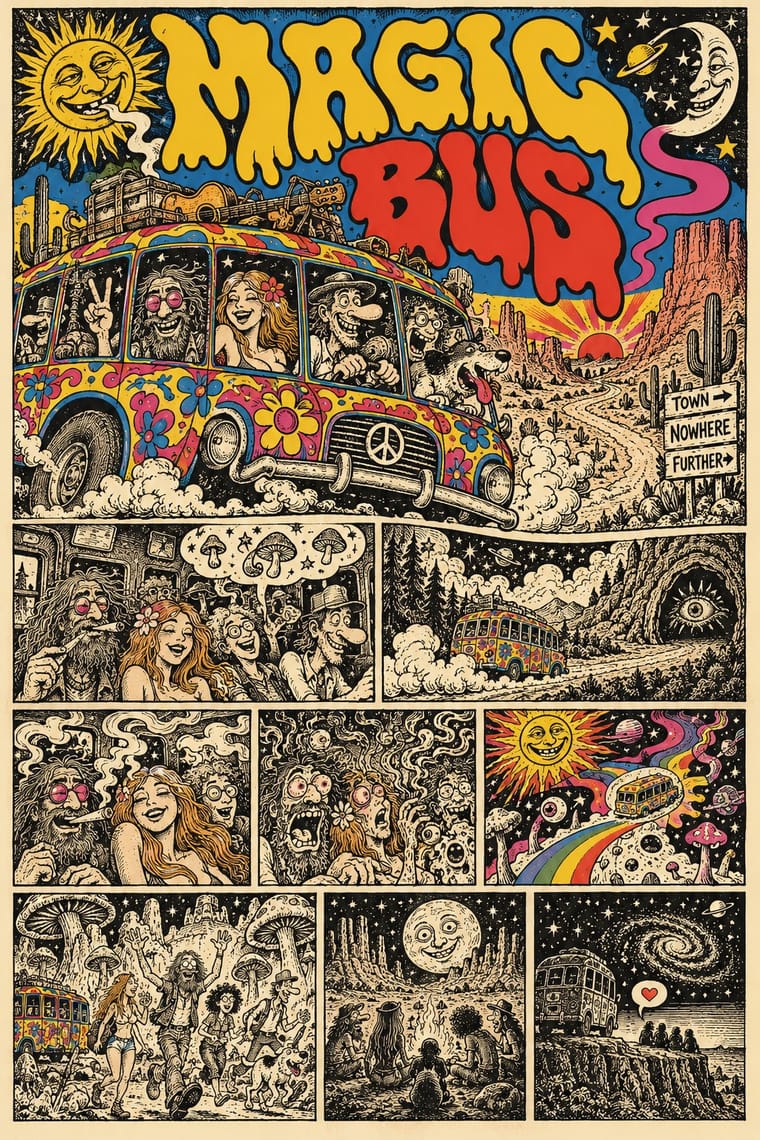
Self-published, adults-only comic books from the San Francisco counterculture, made outside the Comics Code on the newsstand comic's format. Inside, pages of black pen-and-ink line on white paper, often heavily cross-hatched, crowded with big-footed caricatures and hand-lettered balloons, parody the look of 1940s children's comics while showing sex, drugs and violence; colour is kept for the cover, some of it drawn by psychedelic poster artists.
Make something in this styleGet advice in this styleMix it with another style
Use it with care
Much of the canon trades in racial caricature, such as a Black woman drawn as an 'African native' caricature, and in graphic sexual violence against women and casual misogyny, which the women's comics of 1970 and 1972 answered in their own books: borrow the hatched line, the crowded panel and the candour, not the stereotypes, and give every character the same anatomy and drawing care. The characters and mastheads (Mr. Natural, Fritz the Cat, the Freak Brothers, the Checkered Demon, the Zap logo) still belong to their makers and estates: draw your own, never ask an image model for a named cartoonist's hand, living or dead, and never present a generated page as a vintage comic.
01
How it works
- Print the interior in black ink only and build tone by hand: model figures, rooms and street scenes with pen hatching and cross-hatching, often dense, instead of colour separations.
- Put colour on the cover only and keep the inside to black ink alone; make the cover sell like a newsstand comic or a ballroom poster: a drawn masthead, a warning banner, a crowded scene in a few loud flat inks.
- Borrow the friendly look of 1940s and 1950s children's comics and newspaper strips, with big floppy noses, huge feet and anthropomorphised animals, then turn it on the reader with exactly the sex, drugs and violence the Comics Code forbade.
- Fill the panel to its borders with detail, figures and lettering; let the drawing grow wobbly, grotesque or exaggerated whenever the story does.
- Letter every balloon, caption, title and parody advertisement by hand, mostly in the cartoonist's own capitals, and let the cartoonists write, draw and own their stories, alone or passing panels back and forth in a jam.
San Francisco and Berkeley, where the comic book that made the underground market went on sale in February 1968 (Robert Crumb's Zap Comix #1, imprint dated November 1967, published by Don Donahue's Apex Novelties and printed by the Beat poet Charles Plymell in a run of about 3,500 copies). Self-published strips and the underground papers came first (Frank Stack's The Adventures of Jesus, begun 1962; Jack Jackson's God Nose, Texas, 1964; East Village Other, Berkeley Barb, Yarrowstalks). The scene grew around a few small publishers and a comic shop, with a second centre in the Midwest (Print Mint in Berkeley; Rip Off Press, San Francisco, 1969; Ron Turner's Last Gasp; Gary Arlington's San Francisco Comic Book Company; Kitchen Sink, first Krupp Comic Works; Jay Lynch's Bijou Funnies), and titles were sold mainly through head shops. Its strongest years were 1968–1975: after a 1973 Supreme Court ruling let local communities set obscenity standards (Miller v. California) and drug-paraphernalia sales were banned, distribution collapsed, and by the early 1980s alternative comics and the direct market took over. A British scene ran through the London underground press (International Times, Oz, Cyclops from 1970, Nasty Tales from 1971, cOZmic Comics 1972–1975)
02
Its design choices
From Stylogeny’s vocabulary of design choices: defining choices make the style, characteristic ones are usual, occasional ones turn up now and then.
- Layout & composition
- Space & hierarchy
- Typography
- Colour
- Form & shape
- Surface & texture
- Medium & production
- Tone & intent
- Avoids
- Generous white space, Gradients, Gloss & highlights, Flat, Straight photography, Non-representational, Authoritative & institutional, Calm & contemplative
Palette
#f1e9d4#141210#d4302a#f2c12e#2d6fb0#c9307a
Typefaces
Pen-drawn balloon capitals
each cartoonist's own hand on the page, in the same pen as the drawing
Mock-vintage comic masthead lettering
cover logos drawn in imitation of 1940s and 1950s children's comic books, with warning banners such as Zap #1's 'Fair Warning: For Adult Intellectuals Only'
Melting psychedelic display letters
on some covers and pages, after Victor Moscoso's vibrating colours and near-illegible letters
Hand-lettered parody ad copy
fake advertisements and gag 'topper' strips at the top or foot of the page, after MAD and the Sunday newspaper comics
Known for
Zap Comix #1 (Robert Crumb, Apex Novelties, San Francisco, on sale February 1968, imprint dated November 1967; about 3,500 copies printed by…
…Charles Plymell): a colour cover marked 'Fair Warning: For Adult Intellectuals Only' over a black-and-white interior, with the publishing debut of 'Keep on Truckin'' and an early appearance of Mr. Natural
Zap Comix from #2 (1968) as a shared anthology
S. Clay Wilson's violent, crowded panoramas of pirates, bikers and the Checkered Demon, Rick Griffin and Victor Moscoso alternating panels, and later Gilbert Shelton, Spain Rodriguez and Robert Williams
Zap Comix #4 (Print Mint, Berkeley, August 1969), whose Crumb incest story led the Berkeley police to arrest Print Mint's Don and Alice Schenker on pornography charges, later dropped
Gilbert Shelton, Feds 'n' Heads (self-published, spring 1968), the Fabulous Furry Freak Brothers' first comic-book appearance; they also ran in Austin's underground paper The Rag from May 1968, and their own title followed from Rip Off Press in 1971
It Ain't Me, Babe (Last Gasp, July 1970), a 36-page one-shot co-produced by Trina Robbins and Barbara 'Willy' Mendes, the first comic book produced entirely by women, and Wimmen's Comix #1 (Last Gasp, November 1972), edited by Patricia Moodian
Spain Rodriguez, Subvert Comics #1 (Rip Off Press, 1970), and Robert Williams, Coochy Cooty Men's Comics #1 (Print Mint, 1970)
colour covers over black-and-white interiors
Funny Aminals (Apex Novelties, 1972), with the three-page story from which Art Spiegelman's Maus grew
Arcade
The Comics Revue (Art Spiegelman and Bill Griffith, seven issues, 1975–1976), one of the last major underground titles
03
Make something in this style
Say what you need, and Stylogeny’s image studio draws it from Underground Comix’s design choices and checks it against them. It takes about a minute, and you get a link to share.
04
Where it comes from, and what it’s close to
Before it
The style it grew out of, and the styles it borrowed from.


After it
The styles that grew out of it.
No later style in the atlas grew out of it yet.
Alike in its design choices
Styles that make many of the same choices, related or not, besides those above.
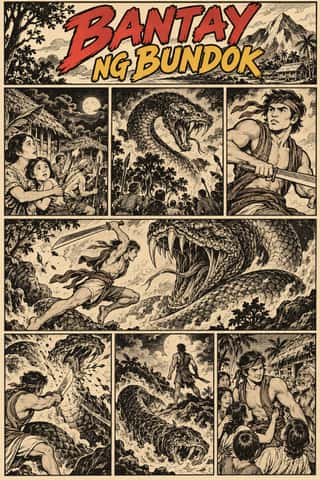
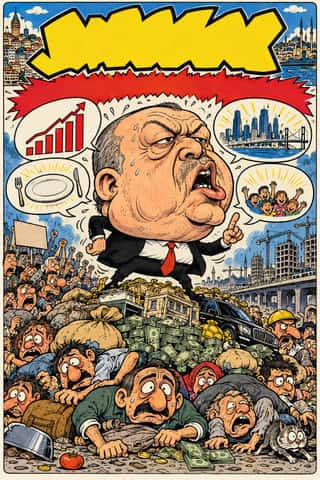
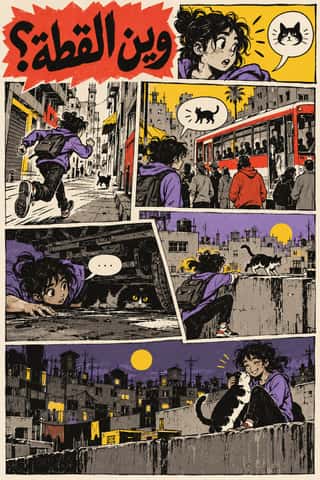
- Bitterkomix (Afrikaans Underground Comics)68% alike


05
Sources
- 'Underground comix', Wikipedia, https://en.wikipedia.org/wiki/Underground_comix (small-press or self-published comics on content forbidden by the Comics Code; 'comix' to differ from mainstream comics and to stress X-rated content; precursors from 1962 and 1964; Zap #1 in February 1968 with Charles Plymell and Don Donahue; distribution 'primarily through head shops'; covers imitating LSD-inspired posters; strongest years 1968–1975; Miller v. California, 1973, which 'ruled that local communities could decide their own First Amendment standards with reference to obscenity', and the mid-1970s paraphernalia bans; the publishers Apex Novelties, Print Mint, Rip Off Press, Last Gasp, San Francisco Comic Book Company, Krupp Comic Works/Kitchen Sink; Bijou Funnies 'heavily influenced by Mad'; the British scene from IT and Oz to Cyclops, Nasty Tales and cOZmic Comics; Funny Aminals and Maus; Arcade, 1975–1976)
- 'Zap Comix', Wikipedia, https://en.wikipedia.org/wiki/Zap_Comix (Zap #1, Apex Novelties, February 1968, about 3,500 copies printed by Charles Plymell; 'the publishing debut' of 'Keep on Truckin'' and 'an early appearance' of Mr. Natural; cover label 'Fair Warning: For Adult Intellectuals Only'; Wilson, Griffin and Moscoso joining with #2; a group jam from issue #3 on, 'where the cartoonists would pass a story around'; Zap #4, Print Mint, August 1969, the arrest of Don and Alice Schenker and the dropped charges; later contributors)
- Adler Archive of Underground Comix, Fleet Library Special Collections, Rhode Island School of Design, https://digitalcommons.risd.edu/specialcollections_books_comics/ (catalogue records noting 'Color illustrations on covers, b&w interiors' for Zap Comix nos. 0–15, https://digitalcommons.risd.edu/specialcollections_adlerarchive_undergroundcomix/10 , and colour covers with black-and-white interiors for Subvert Comics no. 1, Rip Off Press, 1970, https://digitalcommons.risd.edu/specialcollections_adlerarchive_undergroundcomix/25 , and Coochy Cooty Men's Comics no. 1, https://digitalcommons.risd.edu/specialcollections_adlerarchive_undergroundcomix/128 , a copy of the Keith Green / Industrial Realities printing, which the record notes was 'First printed, also in 1970, by the Print Mint, Berkeley'; Zap #1 imprint dated November 1967)
- 'Robert Crumb', Lambiek Comiclopedia, https://www.lambiek.net/artists/c/crumb.htm (Zap as 'a mature parody of traditional family-friendly comic books'; characters with 'big floppy noses and huge feet'; comics that 'look like typical 1940s-1950s era children's comic books'; imitators copying 'the black-and-white, cross-hatched lines'; Kurtzman and the MAD artists as models; fake advertisements and topper strips)
- 'Robert Crumb', Wikipedia, https://en.wikipedia.org/wiki/Robert_Crumb ('a heavily crosshatched pen-and-ink style inspired by late 19th- and early 20th-century cartooning'; Fritz the Cat in his work from the late 1950s and Mr. Natural as his characters; Angelfood McSpade, a 'large-built black woman drawn as an African native caricature'; criticism of his 'recurring themes of graphic sexual and violent abuse of women')
- 'Victor Moscoso', Lambiek Comiclopedia, https://www.lambiek.net/artists/m/moscoso.htm (in Zap from 1968: Lambiek says from the first issue, while Wikipedia's Zap issue guide has him joining with #2; 'vibrating colors, illegible lettering and vintage graphics'; alternating panels with Rick Griffin)
- 'S. Clay Wilson', Wikipedia, https://en.wikipedia.org/wiki/S._Clay_Wilson ('aggressively violent and sexually explicit panoramas of lowlife individuals'; the Checkered Demon; in every Zap from #2)
- 'The Fabulous Furry Freak Brothers', Wikipedia, https://en.wikipedia.org/wiki/The_Fabulous_Furry_Freak_Brothers (in The Rag, Austin, 'beginning in May 1968'; their 'first comic book appearance' in Feds 'n' Heads, self-published 'in the spring of 1968', the two dates given in no order; Rip Off Press founded 1969; issue #1 dated February 1971)
- 'It Ain't Me, Babe (comics)', Wikipedia, https://en.wikipedia.org/wiki/It_Ain%27t_Me,_Babe_(comics) (36-page one-shot, Last Gasp, July 1970; Trina Robbins and Barbara 'Willy' Mendes; the first comic book produced entirely by women; against 'the casual misogyny typical of those stories')
- 'Wimmen's Comix', Wikipedia, https://en.wikipedia.org/wiki/Wimmen%27s_Comix (issue #1, November 1972, edited by Patricia Moodian; Last Gasp 1972–1985)
- 'R. Crumb's Underground', Frye Art Museum, Seattle, exhibition 26 January–27 April 2008, https://fryemuseum.org/exhibitions/r-crumbs-underground (Crumb as 'a pioneer of underground comix' who self-published the first Zap in 1968)
- 'Charles Plymell', Wikipedia, https://en.wikipedia.org/wiki/Charles_Plymell (he printed 'only the first printing of Robert Crumb's Zap Comix #1', which Don Donahue took over 'when he purchased his Multilith 1250 printing press soon after'); for the Multilith as Addressograph-Multigraph's small offset duplicator, Howard Iron Works, 'AM Multilith Mod. 1211 Offset Duplicator', https://howardironworks.org/assets/img/collection/hiw-op-ammultilith.html
- 'Mattt Konture', Wikipedia, https://en.wikipedia.org/wiki/Mattt_Konture (a founder of L'Association who 'later discovered 1960s American underground cartoonists such as R. Crumb and Gilbert Shelton, who inspired him to create psychedelic and autobiographical comics')
How Stylogeny researches and checks a style: where the facts come from.