Pictorial & machine age · 1951–1989 · South Asia
Sinhala Chithra Katha ( Popular Narrative Comics )
Also known as Chithra katha, Chitra katha, Sri Lankan Sinhala picture stories
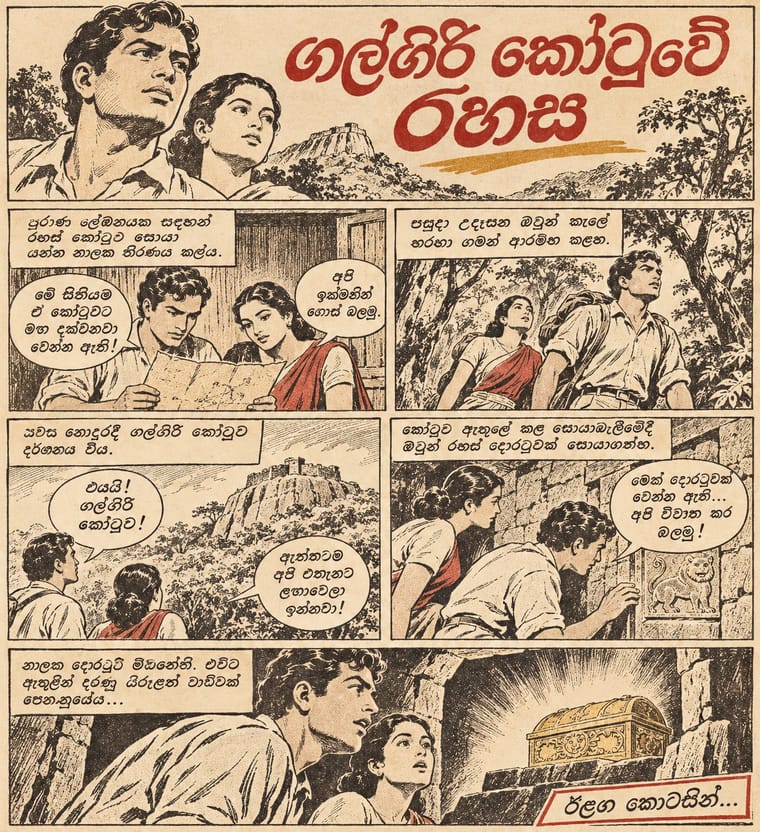
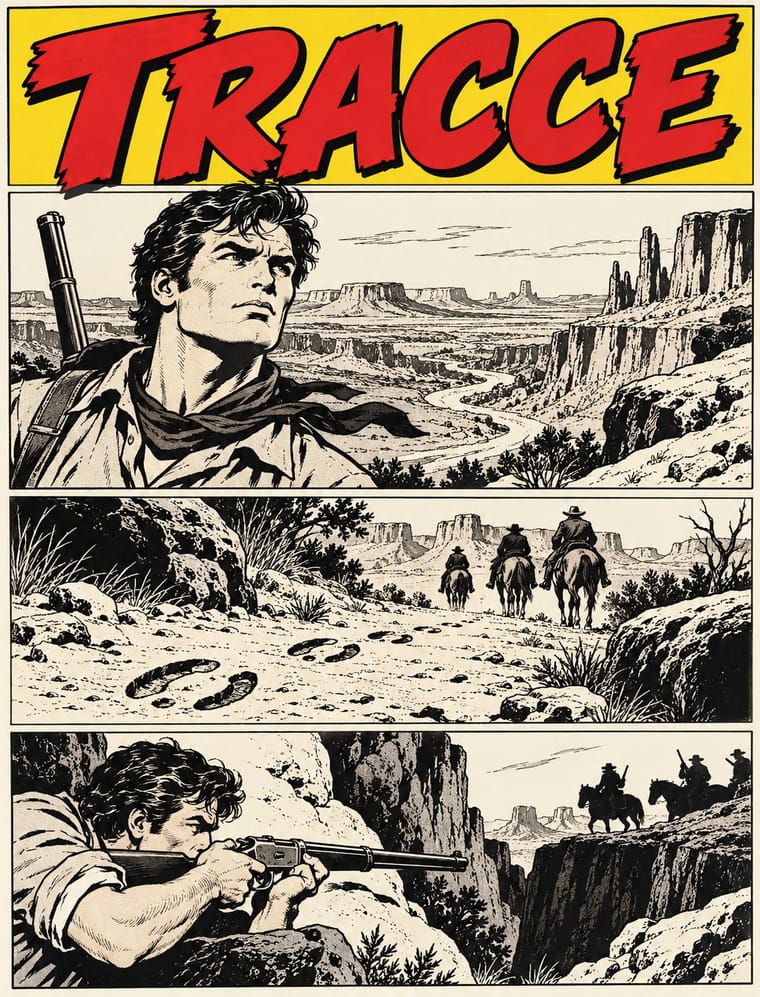
Serialised picture stories in Sinhala, begun in Colombo newspapers with Neela (Lankadeepa, October 1951, G. S. Fernando, reportedly modelled on Tarzan stories) and carried by artists such as Susil Premaratne into adventure and melodrama. Realistic ink-drawn figures run in framed newspaper strips under hand-lettered Sinhala captions with rounded Brahmic letterforms, later gathered into picture books. Its adventure grammar was likely learned from imported American comics, but its stories and faces are local.
Make something in this style Get advice in this style Mix it with another style
Use it with care
Rights in these strips are uncleared and living artists' families and publishers hold them; learn from the page grammar, do not copy characters or pages. Reproduce no stereotyped depiction of any people should one turn up in period strips.
01
Its picture in other colours
Change a colour and every picture on this page follows. It happens in your browser, from the same pictures: nothing new is made or saved.
Choose a colour to change it
-
#e9dfc6 -
#1a1613 -
#8a7f6a -
#b5382c -
#d8a93b
A faded colour isn’t in these pictures, so changing it changes nothing.
Light and dark stay where they are; greys hardly move.
More colours: any style’s, or your own
The pictures show the style’s own colours.
02
Make something in this style
Say what you need, and Stylogeny’s image studio draws it from Sinhala Chithra Katha (Popular Narrative Comics)’s design choices and checks it against them. It takes about a minute, and you get a link to share.
03
How it works
Palette
-
#e9dfc6ground · 32% -
#1a1613not in its pictures -
#8a7f6aaccent · 18% -
#b5382cink · 3% -
#d8a93bnot in its pictures
Shares measured from its picture. The ground is what the pictures sit on (of the colours covering most, the most neutral), the ink stands out from it most, the rest are accents.
Typefaces
-
Hand-lettered Sinhala captions and balloons
-
Metal-type Sinhala newspaper text
-
Hand-drawn title lettering for serial names
- Tell the story in a run of framed panels, one beat per frame, so each weekly instalment ends on a hook.
- Draw people in believable proportion with expressive faces and gestures, as the carrier of adventure and melodrama.
- Set the Sinhala text in captions and balloons beside the action, hand-lettered rather than set.
- Build panel depth with inked hatching and strong blacks, and keep colour to newsprint black or a few flat inks.
- Fill each strip densely enough to give value for the price of a newspaper, but leave one clear focal figure per panel.
Colombo, Sri Lanka: Sinhala newspaper serials, beginning in Lankadeepa
Change it with an idea. Any of the 73 moves that make a design say something can go on this style.
04
Its design choices
From Stylogeny’s vocabulary of design choices: defining choices make the style, characteristic ones are usual, occasional ones turn up now and then.
- Layout & composition
- Space & hierarchy
- Colour
- Form & shape
- Surface & texture
- Medium & production
- Tone & intent
- Avoids
- Broken grid, Collage & layering, Experimental & distorted, Fluorescent & neon, Gradients, Non-representational, Ironic & self-aware
How its pictures are made Drawn & painted
Kind of picture: Drawn & painted
Known for
-
G. S. Fernando, Neela
Lankadeepa, October 1951, per Ariyaratne 2007 as cited by Gunawardene
-
Susil Premaratne, Ran Dupatha
first picture storybook, per the Sunday Times
-
Anura Wijewardana, Sathuta
called the country's first picture story publication by the Sunday Times
05
Where it comes from, and what it’s close to
Borrowed from
Sinhala Chithra Katha (Popular Narrative Comics) 1951–1989
No later style in the atlas grew out of it yet.
Alike in its design choices
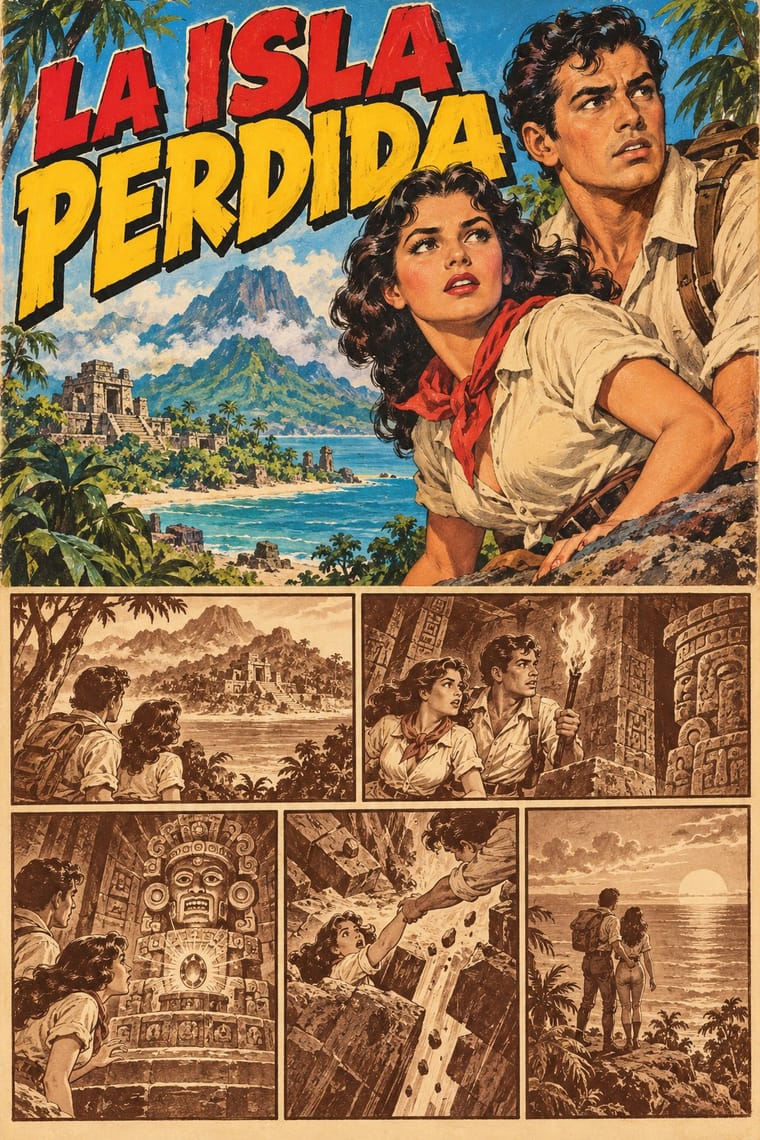
06
Combine it with
Styles Sinhala Chithra Katha (Popular Narrative Comics) pairs well with or plays against, from the research. Each is worked out as a combination: which style gives the type, the colours and the forms.
- Amar Chitra Katha Comics Contrasts · Colour, mythological and edifying where chithra katha is monochrome, secular adventure and melodrama.
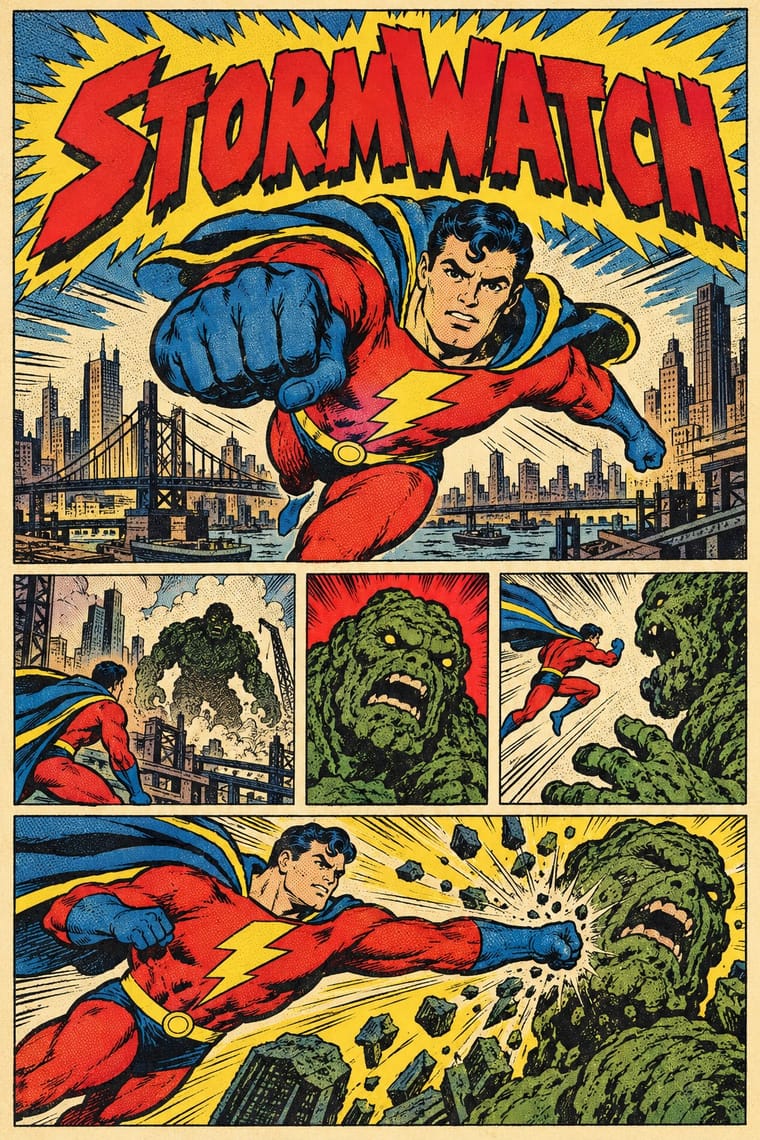
- American Four-Colour Comic Book (Golden to Bronze Age) Contrasts · A likely, unproven model for its adventure grammar, but newsprint strips in a local script, not four-colour pamphlets.
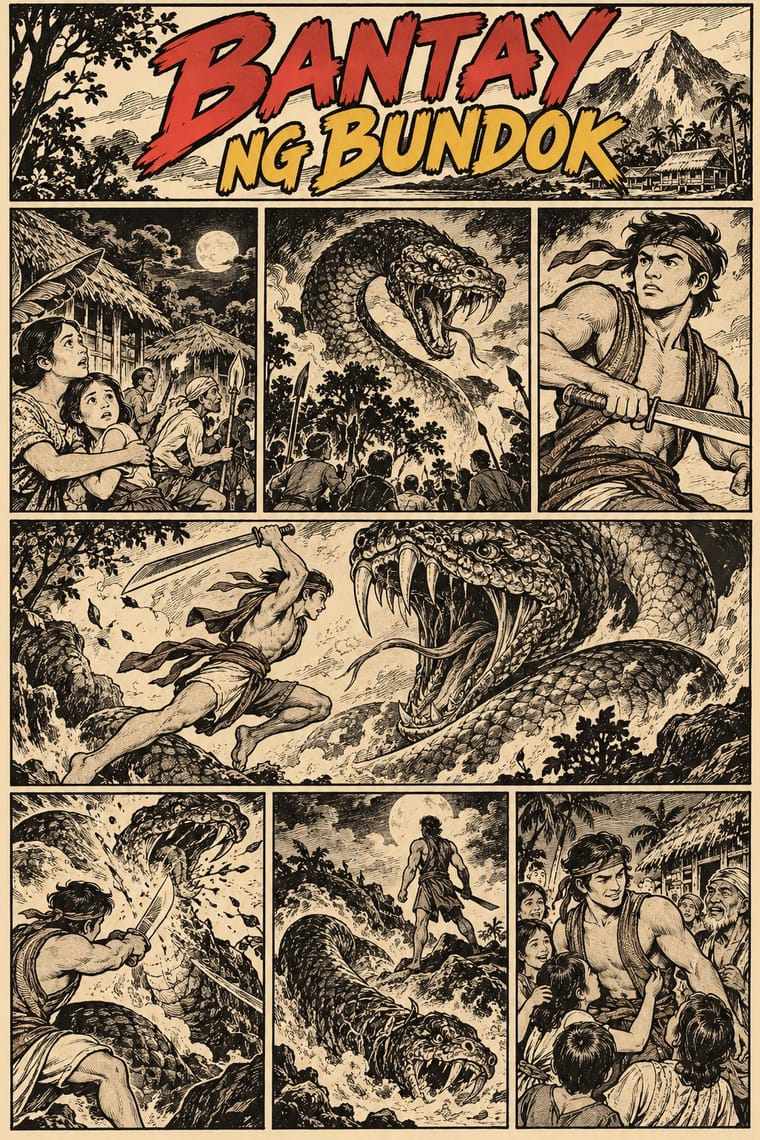
- Filipino Komiks Pairs well · Another newspaper-born, realist black-and-white serial tradition in a non-Latin or local-language market; borrow its dense inked drama.
07
Often taken for
Sinhala Chithra Katha has no real works recorded yet, so these are its nearest styles by its choices alone, with the choices that tell them apart.
-
Filipino Komiks
Filipino Komiks is one of Sinhala Chithra Katha’s nearest styles by choices; no real work of either fits the other better.
Choices that tell Sinhala Chithra Katha and Filipino Komiks apart Choice Sinhala Chithra Katha Filipino Komiks Halftone & Ben-Day dots occasional avoids Horror vacui — defining Measured density characteristic — All caps — characteristic Single focal point characteristic — No shared descent in the atlas: they reached these choices separately.
-
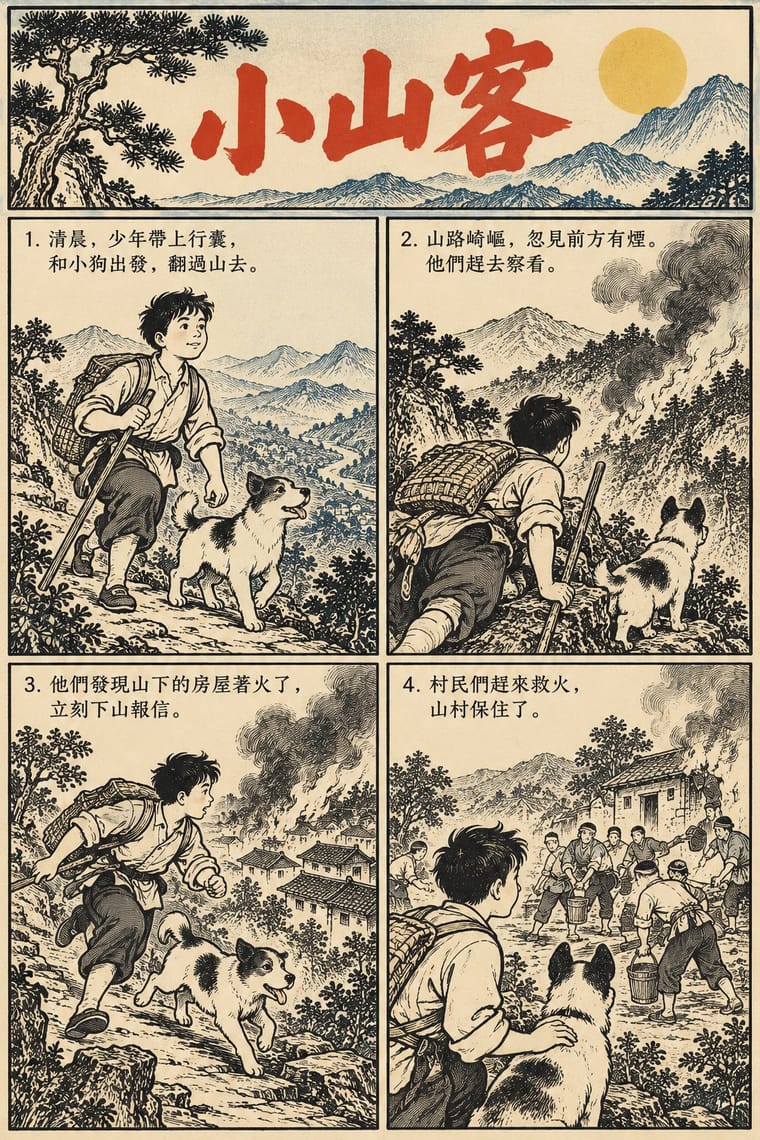
Lianhuanhua Picture-Story Books
Lianhuanhua Picture-Story Books is one of Sinhala Chithra Katha’s nearest styles by choices; no real work of either fits the other better.
Choices that tell Sinhala Chithra Katha and Lianhuanhua Picture-Story Books apart Choice Sinhala Chithra Katha Lianhuanhua Picture-Story Books Single focal point characteristic — Stylised figuration — characteristic Letterpress characteristic — Layered information — characteristic Flat — characteristic No shared descent in the atlas: they reached these choices separately.
-
Bonelli Fumetto (Italian Popular Adventure Comics)
Bonelli Fumetto is one of Sinhala Chithra Katha’s nearest styles by choices; no real work of either fits the other better.
Choices that tell Sinhala Chithra Katha and Bonelli Fumetto apart Choice Sinhala Chithra Katha Bonelli Fumetto Halftone & Ben-Day dots occasional avoids All caps — defining Restrained accents characteristic — Modular grid occasional defining Letterpress characteristic — No shared descent in the atlas: they reached these choices separately.
-
Mexican Historieta (Pepines to Sensacionales)
Mexican Historieta is one of Sinhala Chithra Katha’s nearest styles by choices; no real work of either fits the other better.
Choices that tell Sinhala Chithra Katha and Mexican Historieta apart Choice Sinhala Chithra Katha Mexican Historieta Measured density characteristic — Collage & layering avoids occasional Rational & objective occasional avoids Earth & mineral — characteristic Letterpress characteristic — No shared descent in the atlas: they reached these choices separately.
— means the choice isn’t among the style’s recorded choices. Critics recorded each work’s choices with the styles’ descriptions in view, so this shows whether the descriptions hold together, not proof that they are right.
08
Sources
- Nalaka Gunawardene, 'Long Shadow of Pulp' presentation (citing Sunil Ariyaratne, Chitra Kathawe Wansa Kathawa, 2007), https://www.slideshare.net/slideshow/long-shadow-of-pulp-science-fiction-popular-culture-for-promoting-science-and-imagination/36671549
- Sunday Times (Sri Lanka), 'Portraying the heroes behind picture stories', 11 November 2007, https://www.sundaytimes.lk/071111/TV/tv-times000014.html
How Stylogeny researches and checks a style: where the facts come from.