Style combination · Pairs well
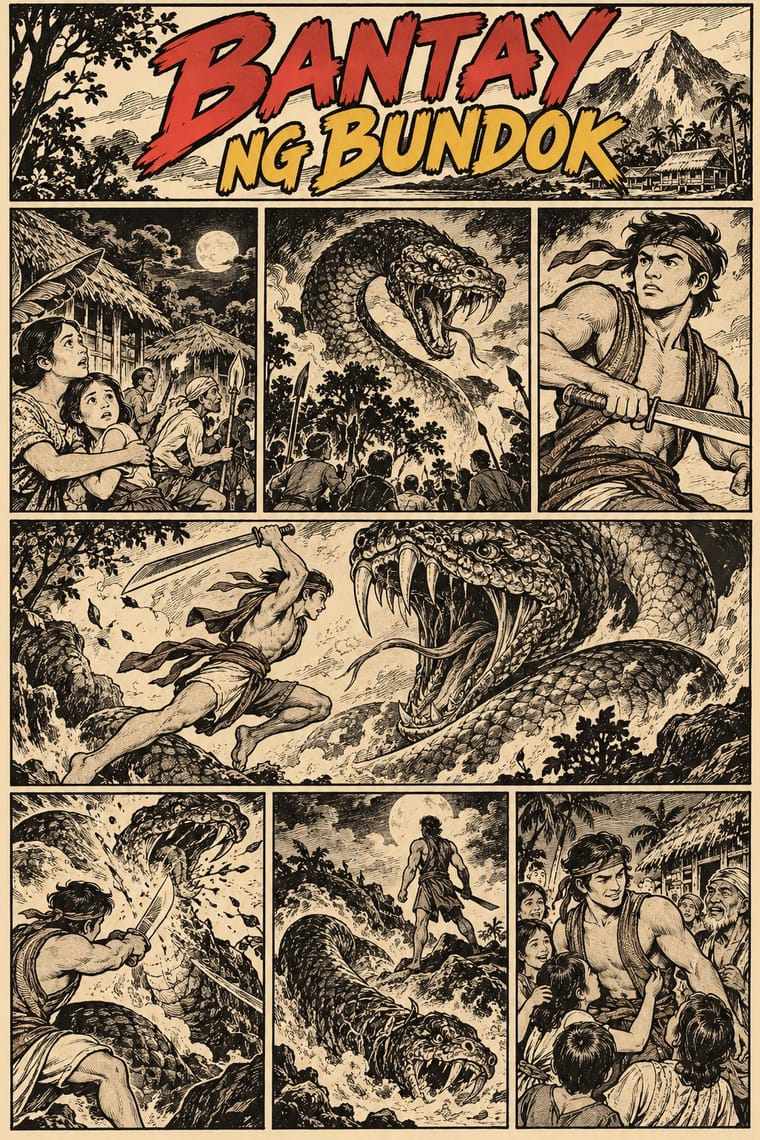
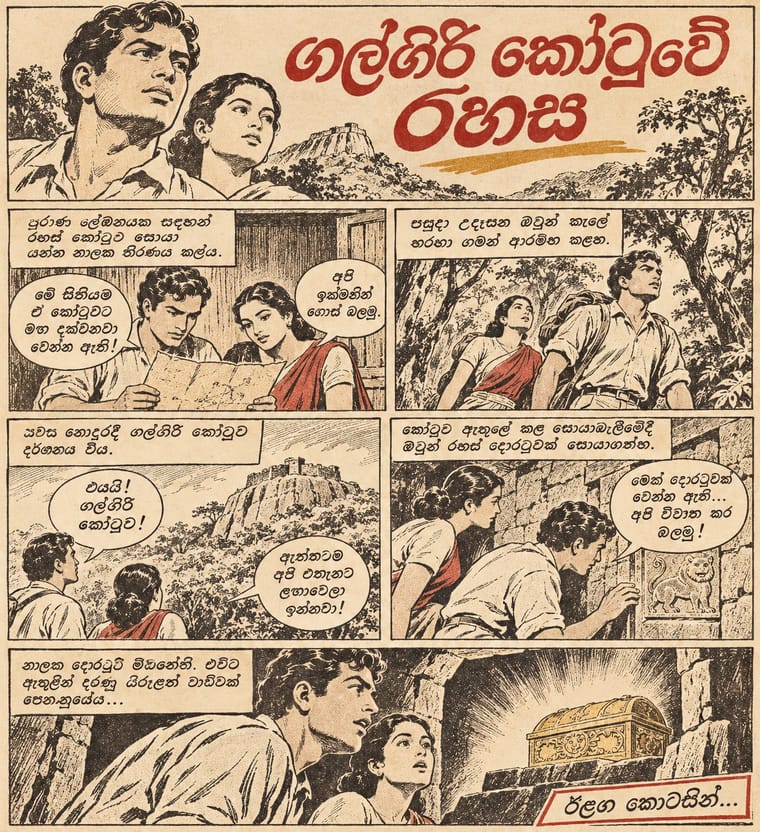
Filipino Komiks × Sinhala Chithra Katha
Another newspaper-born, realist black-and-white serial tradition in a non-Latin or local-language market; borrow its dense inked drama.
Mix them and make something Filipino Komiks Sinhala Chithra Katha
01
What each style brings
Each part of the design comes from the style with the stronger say in it, and each style gives at least two.
Filipino Komiks Sinhala Chithra Katha (Popular Narrative Comics)
- Type from Filipino Komiks
- Colour from Sinhala Chithra Katha
- Form from Sinhala Chithra Katha
- Composition from Filipino Komiks
- Surface from Filipino Komiks
02
The type
Open fonts standing in for each style’s own type, which is often hand-drawn or commercial.
Display · Filipino Komiks
Together
Comic Neue, standing in for Hand-lettered Tagalog balloons (captions in boxes; capitals on the 1946 Halakhak Komiks cover; mixed-case pen lettering in Velasquez's 1929 Kenkoy strip, which mixed Tagalog, Spanish and English; Tony DeZuniga started at Liwayway as a letterer at 16)
Text · Sinhala Chithra Katha
Serialised picture stories in Sinhala, begun in Colombo newspapers with Neela (Lankadeepa, October 1951, G. S. Fernando, reportedly modelled on Tarzan stories) and carried by artists such as Susil Premaratne into adventure and melodrama. Realistic ink-drawn figures run in framed newspaper strips under hand-lettered Sinhala captions with rounded Brahmic letterforms, later gathered into picture books. Its adventure grammar was likely learned from imported American comics, but its stories and faces are local.
Newsreader; Sinhala Chithra Katha used Hand-lettered Sinhala captions and balloons and Metal-type Sinhala newspaper text
03
The colours
The ground and leading colours come from Sinhala Chithra Katha, with a counter-accent from Filipino Komiks. The ink reads on the ground at 4.5:1 or more.
Filipino Komiks Sinhala Chithra Katha (Popular Narrative Comics)
-
#e9dfc6ground · 39% -
#1a1613ink · 15% -
#d8a93baccent · 20% -
#b5382caccent · 15% -
#8a7f6aaccent · 11%
As CSS
:root {
  --ground: #e9dfc6;
  --ink: #1a1613;
  --accent-1: #d8a93b;
  --accent-2: #b5382c;
  --accent-3: #8a7f6a;
  --font-display: "Comic Neue", cursive;
  --font-text: "Newsreader", serif;
}
Use it with care
Filipino Komiks: Darna, Pedro Penduko and other komiks characters are still in copyright and keep being adapted for film and television, and the artists' pages belong to them and their estates: draw your own heroes, mastheads and roundels in the shared idiom, never ask an image model for these characters or for a named artist's hand, and label generated pages as AI-made. Publishers shredded thousands of original pages and few issues were archived or reprinted, so a fake 'vintage komiks' page easily pollutes a thin record. Aswang, amulets and the other creatures and figures of Philippine folk belief belong to living communities, and pre-colonial warriors stand for a national self-image: draw them with the dignity and research the tradition gave them, never as exotic decoration. Aswang lore has stigmatised a real province, Capiz, many of whose people object to its name as the 'hometown of Aswang', and village gossip has branded real neighbours, such as a widow with no one to help her, as aswang: never tie a monster to a named province, town or community. Do not costume living Indigenous peoples (the Igorot, Lumad, Aeta and others) as pre-colonial warriors or as creatures.
Sinhala Chithra Katha (Popular Narrative Comics): Rights in these strips are uncleared and living artists' families and publishers hold them; learn from the page grammar, do not copy characters or pages. Reproduce no stereotyped depiction of any people should one turn up in period strips.
04
The two styles
05
More combinations
With Filipino Komiks
- American Four-Colour Comic Book (Golden to Bronze Age) Contrasts · Postwar komiks took over the American comic book's format, and from 1971 DC recruited Nestor Redondo, Alfredo Alcala and Alex Niño. Choose the American comic book for flat four-colour dot tints over a keyline; choose komiks for black-and-white pages modelled entirely in hatched and feathered brush ink.
- Jeepney Art Pairs well · Both are Manila's popular street graphics from the same postwar decades. Put a komiks hero, drawn in black brush line, on a jeepney's polychrome panel, chrome trim and shaded sign-painter lettering for a piece that reads as Manila.
- Ligne Claire (Franco-Belgian Clear Line) Contrasts · Both tell stories in ruled panels with hand-lettered balloons, but ligne claire closes forms with one even, unhatched line and flat colour. Komiks swell the brush line and build light and volume from hatching in black and white.
- Story Manga (Postwar Japanese Comics) Contrasts · Manga gets its greys from dot screentone and simplifies faces into big-eyed types; komiks model naturalistic figures with brush hatching. Gerry Alanguilan criticised Filipino professionals for adopting a style so closely tied to Japanese identity.
- Lianhuanhua Picture-Story Books Contrasts · Both are cheap black-line picture stories rented and read at street-level shops. Lianhuanhua give each palm-sized page one framed picture with a caption beneath; komiks pack several panels with speech balloons onto an anthology magazine page.
- Amar Chitra Katha Comics Contrasts · Both retell local myth and history as comics in Asian languages. Amar Chitra Katha prints flat colour on every page in an educational, authoritative voice; komiks keep black-and-white interiors for melodrama, fantasy and folk heroes.
- Underground Comix Contrasts · Both put black-and-white hatched interiors behind colour covers, but komiks drew naturalistic folk heroes and romances for the country's most widely read periodicals, while comix push big-footed caricature into adult taboo for a head-shop audience.
- Argentine Adventure Historieta (Oesterheld–Breccia) Contrasts · Both are black-and-white anthology magazines of long serials with colour kept for the cover; komiks model romantic, naturalistic figures in hatched and feathered brush on a light page, while the historieta builds its pages from black masses, hard light and, in its darkest work, distorted faces.
With Sinhala Chithra Katha
- Amar Chitra Katha Comics Contrasts · Colour, mythological and edifying where chithra katha is monochrome, secular adventure and melodrama.
- American Four-Colour Comic Book (Golden to Bronze Age) Contrasts · A likely, unproven model for its adventure grammar, but newsprint strips in a local script, not four-colour pamphlets.