Style combination · Contrasts
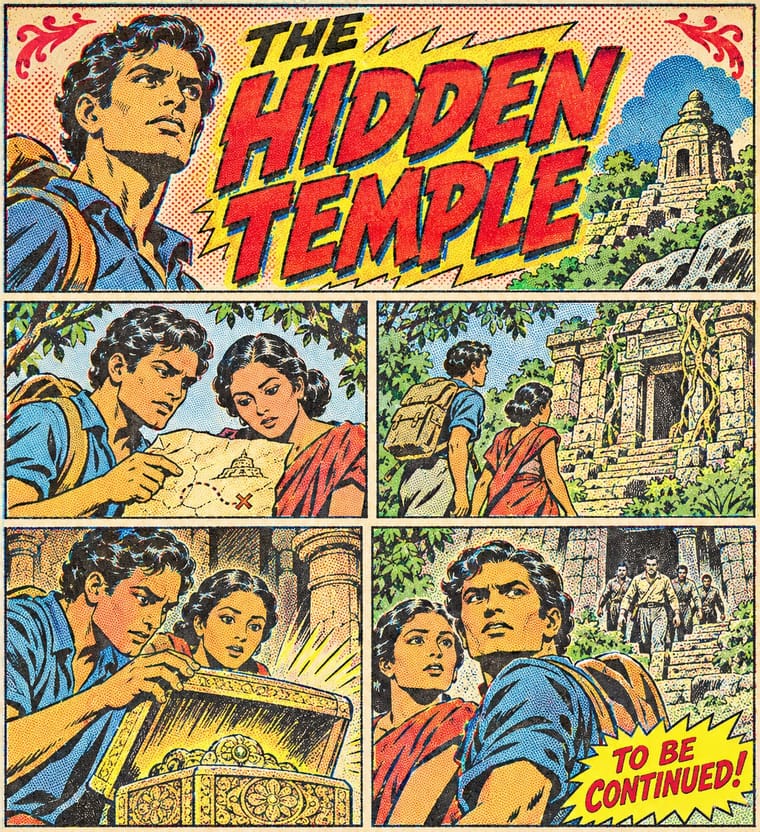
American Four-Colour Comic Book × Sinhala Chithra Katha
A likely, unproven model for its adventure grammar, but newsprint strips in a local script, not four-colour pamphlets.
Mix them and make something American Four-Colour Comic Book Sinhala Chithra Katha
01
What each style brings
Each part of the design comes from the style with the stronger say in it, and each style gives at least two.
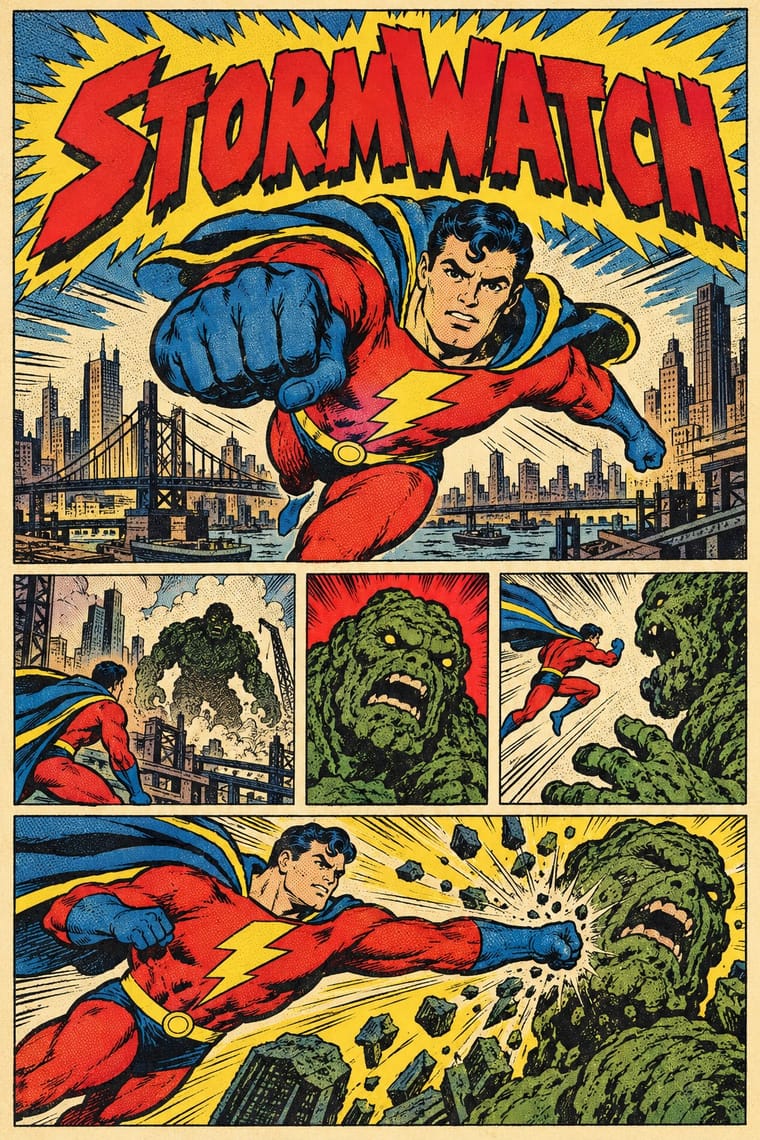
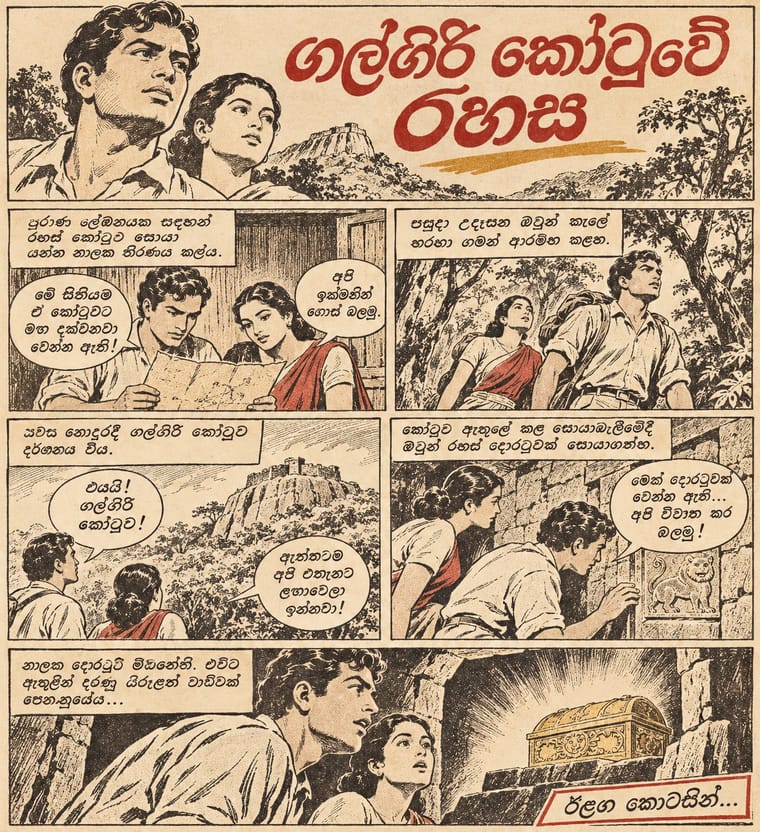
American Four-Colour Comic Book (Golden to Bronze Age) Sinhala Chithra Katha (Popular Narrative Comics)
- Type from American Four-Colour Comic Book
- Colour from American Four-Colour Comic Book
- Form from Sinhala Chithra Katha
- Composition from Sinhala Chithra Katha
- Surface from American Four-Colour Comic Book
02
The type
Open fonts standing in for each style’s own type, which is often hand-drawn or commercial.
Display · American Four-Colour Comic Book
Square
Bangers, standing in for Pen-lettered comic-book capitals (balloons and captions drawn with pen or brush and a lettering guide, traditionally all in upper case: Sam Rosen, Ben Oda, Artie Simek, John Costanza, Gaspar Saladino)
Text · Sinhala Chithra Katha
Serialised picture stories in Sinhala, begun in Colombo newspapers with Neela (Lankadeepa, October 1951, G. S. Fernando, reportedly modelled on Tarzan stories) and carried by artists such as Susil Premaratne into adventure and melodrama. Realistic ink-drawn figures run in framed newspaper strips under hand-lettered Sinhala captions with rounded Brahmic letterforms, later gathered into picture books. Its adventure grammar was likely learned from imported American comics, but its stories and faces are local.
Newsreader; Sinhala Chithra Katha used Hand-lettered Sinhala captions and balloons and Metal-type Sinhala newspaper text
03
The colours
The ground and leading colours come from American Four-Colour Comic Book, with a counter-accent from Sinhala Chithra Katha. The ink reads on the ground at 4.5:1 or more.
American Four-Colour Comic Book (Golden to Bronze Age) Sinhala Chithra Katha (Popular Narrative Comics)
-
#f3e9cfground · 36% -
#1b1a1aink · 14% -
#d9262caccent · 18% -
#d8a93baccent · 14% -
#2160adaccent · 10% -
#4f9a3eaccent · 8%
As CSS
:root {
  --ground: #f3e9cf;
  --ink: #1b1a1a;
  --accent-1: #d9262c;
  --accent-2: #d8a93b;
  --accent-3: #2160ad;
  --accent-4: #4f9a3e;
  --font-display: "Bangers", sans-serif;
  --font-text: "Newsreader", serif;
}
Use it with care
American Four-Colour Comic Book (Golden to Bronze Age): The characters and logos of this tradition (Superman, Batman, Captain America, Spider-Man, the Fantastic Four) are still in copyright and trademarked by their publishers: draw your own heroes, logos and seals in the shared idiom, never ask an image model for these characters or for named artists such as Kirby, Ditko or Eisner, and never present a generated picture as a vintage comic. The period also traded in racial caricature, such as Ebony White in Will Eisner's The Spirit, whose blackface features Eisner later admitted were a conscious stereotype, and its wartime issues drew Japanese people as 'powerful monsters or incompetent subhumans' and, at the Writers' War Board's urging late in the war, Germans as a people who embraced aggression and violence. Give every character, enemies and foreigners included, the same anatomy, dignity and drawing care as the hero; never use skin tint, teeth, eyes or dress as ethnic markers, and do not revive the war cover's enemy caricature in a pastiche.
Sinhala Chithra Katha (Popular Narrative Comics): Rights in these strips are uncleared and living artists' families and publishers hold them; learn from the page grammar, do not copy characters or pages. Reproduce no stereotyped depiction of any people should one turn up in period strips.
04
The two styles
05
More combinations
With American Four-Colour Comic Book
- Victorian Letterpress & Wood Type Pairs well · Both are cheap letterpress print that shouts to passers-by; borrow the playbill's stacked display capitals, banners and rules for a comic cover's blurbs and price box, while keeping the comic's hand-drawn letters and keyline art.
- Risograph & Indie Print Culture Pairs well · Riso's few flat inks, grain and overprint suit a small-press homage to four-colour comics; keep the black keyline, panel grid and hand lettering, and let riso's misregistration stand in for newsprint's.
- Pop Art Graphics Contrasts · Roy Lichtenstein enlarged the comic book's Ben-Day dots and single panels into ironic gallery icons; choose the comic book itself when the picture must tell a story across a page of panels at printed size, sincerely, with the dots as small colour tints rather than the subject.
- Push Pin Style Contrasts · Push Pin also drew outlined figures in flat colour in New York, but as single illustrations with revived Victorian and Art Nouveau display faces and witty ornament; switch to the comic book for sequential panels, balloon lettering and dot-screen tints on newsprint.
- Googie & Atomic Age Pairs well · Silver Age artists drew in the same postwar key: Arlen Schumer calls Carmine Infantino's Flash as sleek and streamlined as Detroit's tail fins; add Googie's boomerangs, starbursts and atomic motifs to a science-fiction cover or splash page.
- Lianhuanhua Picture-Story Books Contrasts · Both tell stories in inked drawings; lianhuanhua gives each pocket-sized page one framed monochrome picture with a caption beneath, while the American comic book packs a page with ruled panels, balloons, sound effects and flat four-colour tints.
- Ligne Claire (Franco-Belgian Clear Line) Contrasts · Both tell stories in ruled panels with balloon lettering and flat colour; ligne claire closes every form with a clear contour and no hatching, and keeps its colour free of dot screens and misregistration, while the American comic book models with feathered brush blacks and prints dot tints slightly off register on newsprint.
- Korean Webtoon Graphics Contrasts · Webtoon's single vertical phone-scroll strip, open gutters and digital gradients belong to the era that replaced hand separations; return to the newsstand comic for a dense page grid of panels, dot tints on newsprint and no gradients.
With Sinhala Chithra Katha
- Amar Chitra Katha Comics Contrasts · Colour, mythological and edifying where chithra katha is monochrome, secular adventure and melodrama.
- Filipino Komiks Pairs well · Another newspaper-born, realist black-and-white serial tradition in a non-Latin or local-language market; borrow its dense inked drama.