Pictorial & machine age · 1948–present · Southern Europe
Bonelli Fumetto (Italian Popular Adventure Comics)
Also known as Formato Bonelli, Bonellide, Fumetto bonelliano, Bonelliani, Formato quaderno
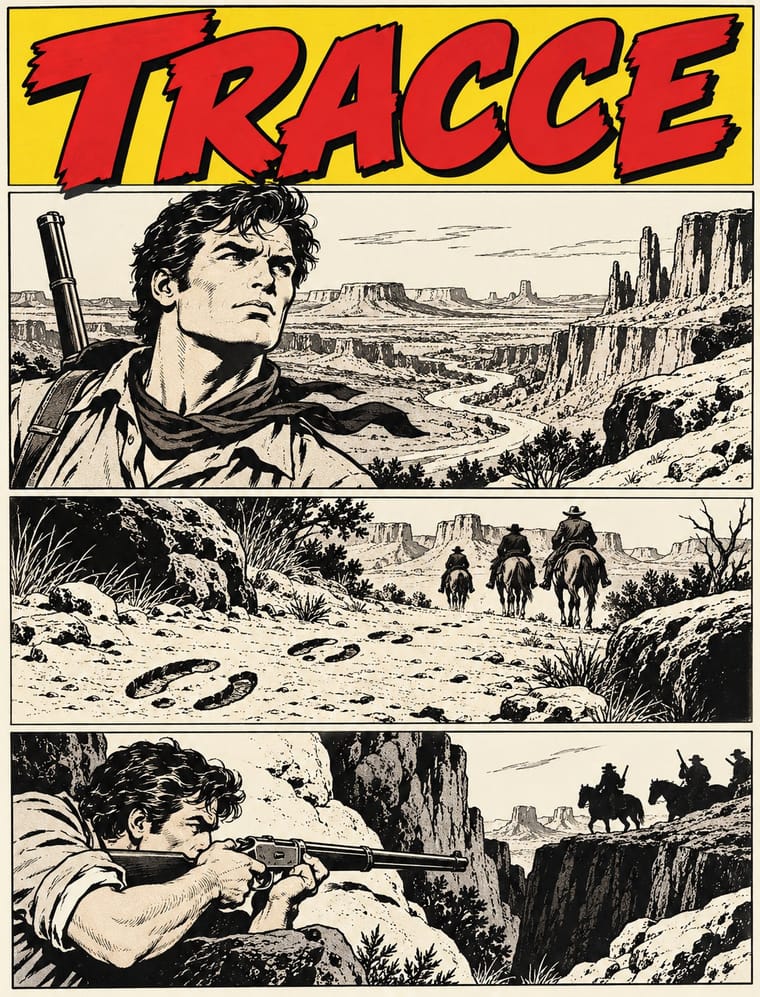
The house format of Milan's Bonelli publishing house and its imitators (Tex, Zagor, Dylan Dog, Nathan Never): monthly newsstand paperbacks of 16 x 21 cm with about a hundred black-and-white pages, each a long episode of a serial hero. Every page is a fixed cage of three strips, remounted from the oblong strip booklets in which Tex began in 1948, drawn in naturalistic pen and brush ink and lettered by hand in capitals. Only the cover is in colour, under a constant masthead. Tex alone sold up to 700,000 copies a month; the monthly series together sold over 500,000 in 2014.
Make something in this styleGet advice in this styleMix it with another style
Use it with care
Tex, Zagor, Dylan Dog, Nathan Never, Julia and their mastheads belong to Sergio Bonelli Editore and are still published and licensed: draw your own hero, masthead and cover bands in the shared format, never ask an image model for these characters or for a named artist's hand (Galep, Ferri, Villa, Stano), nor for a real person's likeness (Dylan Dog was drawn after Rupert Everett, Julia after Audrey Hepburn), and label generated pages as AI-made, never as vintage Bonelli issues. Tex is 'supreme chief of all the Navajo tribes' under the name Aquila della Notte, and his blood brother Tiger Jack is a Navajo warrior: these are an Italian western's inventions, not Diné culture. The Diné (Navajo) are a living nation; do not borrow their ceremonial imagery, sandpaintings or weaving designs as western decor, and do not dress a page's generic 'Indians' as Diné.
01
How it works
- Publish each series as a newsstand monthly of about a hundred black-and-white pages in a 16 x 21 cm perfect-bound paperback, with one serial hero, one long episode per issue and one adventure genre: western, horror, mystery or science fiction.
- Build every page from three horizontal strips, each a single panel or split in two, up to six panels, divided by white gutters of about 5 mm, and keep the same cage page after page so the story reads at an even, cinematic pace. The cage comes from the strip booklets: until 1967 (Tex) and 1970 (Zagor) new stories came out first in small oblong 16.5 x 8 cm booklets with one strip of at most three panels per page, and the book remounts three such strips per page, which is why it has three tiers.
- Draw in black pen and brush ink with naturalistic anatomy, researched settings, hatching and spotted solid blacks, in the manner of the American adventure strip that Gallieno Ferri learned from (Hal Foster, Alex Raymond), and put no grey tone or colour inside.
- Hand-letter generous dialogue in capitals inside the balloons, with bold words for emphasis and trailing ellipses; let captions and talk spell out what the pictures already show, and voice noises in English-sounding onomatopoeia, as Tex does.
- Wrap every issue in the same colour trade dress: a drawn masthead across the top, usually in heavy, black-outlined capitals (Julia's is a yellow script), one dramatic scene of the hero by the series' regular cover artist, and the episode title in typeset capitals on a band at the foot (white out of black on Dylan Dog no. 62, Nathan Never no. 1 and Martin Mystère no. 315, yellow out of black on Julia), with the price in a roundel or under the masthead. Only the masthead is lettered by hand; straplines are typeset as well, like Martin Mystère's serif I GRANDI ENIGMI DI.
Milan. Gian Luigi Bonelli took over the magazine L'Audace from Mondadori (his first issue, no. 331, is dated 18 January 1941), and the house passed through Edizioni Audace (1946, run by Tea Bertasi Bonelli), Araldo, CEPIM and Daim Press to Sergio Bonelli Editore (1988). Tex came out on 30 September 1948, with Il totem misterioso, as a weekly strip booklet of 16.5 x 8 cm that ran to 1967 (973 issues). The Albi d'Oro (from 1952) and the Serie Gigante (from October 1958) remounted the strips three to a page, and after Sergio Bonelli took the reins in the early 1960s the 16 x 21 cm book of about a hundred pages replaced the strip for new stories: Tex from no. 96 (October 1968), and Zagor, whose strip series ran to November 1970, from no. 119 (February 1971). Other publishers' copies were called 'bonellidi', at first as a put-down.
02
Its design choices
From Stylogeny’s vocabulary of design choices: defining choices make the style, characteristic ones are usual, occasional ones turn up now and then.
- Layout & composition
- Space & hierarchy
- Typography
- Colour
- Surface & texture
- Medium & production
- Tone & intent
- Avoids
- Broken grid, Collage & layering, Halftone & Ben-Day dots, Experimental & distorted, Straight photography
Palette
#f4f1e8#141414#d3242b#f2cf1d#2a6db5#c47a3a
Typefaces
Hand-lettered pen capitals in balloons, with bold for emphasis and trailing ellipses
a Dylan Dog panel of the villain Xabaras: 'HO UNITO IL VELENO DEGLI ZOMBI AL VIRUS...', with VELENO and VIRUS in bold
Heavy hand-drawn masthead capitals in a thick black outline or shadow
(the slanted yellow TEX logo; ZAGOR in italic red with a black shadow; DYLAN DOG in red across a white band; NEVER in blue under a small black NATHAN; MARTIN MYSTÈRE in red; a small MISTER over a huge yellow NO), though Julia's masthead is a yellow script
Typeset capitals, not hand lettering, for the episode title on a band at the foot of the cover and for straplines
heavy sans reversed out of black for I VAMPIRI (Dylan Dog no. 62) and AGENTE SPECIALE ALFA (Nathan Never no. 1), beside the price in a roundel (L. 2300); serif for CON LA CODA DELL'OCCHIO and the straplines I GRANDI ENIGMI DI and DETECTIVE DELL'IMPOSSIBILE (Martin Mystère no. 315)
Known for
Tex (Gian Luigi Bonelli and Aurelio Galleppini, 'Galep', 1948)
the slanted yellow TEX masthead in a thick black outline and the hero in his yellow shirt (it.wikipedia File:Logo tex Willer.png, en.wikipedia File:Texwiller.jpg, an Arf! Festival display of 2019), and Galep's black-ink drawing of Tex crouched with a rifle, modelled in hatching and signed GALEP; Galep drew every cover up to no. 400 (February 1994), Claudio Villa from no. 401
Zagor (Guido Nolitta, i.e. Sergio Bonelli, with Gallieno Ferri, 1961)
a 'fantawestern' set in the imaginary Darkwood forest around 1825-1830 and the last series the house launched in the strip format: Ferri's panel of Zagor clinging to a tree as an arrow strikes beside him, the foliage worked to the frame in solid brush black, and on a newspaper reprint cover Ferri's hero in a red sleeveless shirt with a black eagle on a yellow disc under the italic red ZAGOR masthead shadowed in black; the publisher credits Ferri with 'the entire range of Covers'
Mister No (Guido Nolitta, 1975)
an ink vignette of the hero beside a jaguar in the jungle with a small plane overhead, and a logo of a small MISTER over a huge NO in black-outlined yellow capitals; Ferri drew the first story and the covers up to no. 115 (December 1984)
Martin Mystère (Alfredo Castelli and Giancarlo Alessandrini, 1982)
cover of no. 315, Con la coda dell'occhio, with the red masthead between the typeset serif straplines I GRANDI ENIGMI DI and DETECTIVE DELL'IMPOSSIBILE and the title in white serif capitals on a black band
Dylan Dog (Tiziano Sclavi)
no. 1, L'alba dei morti viventi (October 1986, on sale 26 September), drawn by Angelo Stano, whose style was inspired by Egon Schiele; Claudio Villa designed the hero after Rupert Everett and drew covers 1-41, Stano from no. 42 (1990); the cover of no. 62, I vampiri, sets the hero's screaming face before a bat-eared vampire under the red DYLAN DOG masthead; with no. 69 (1991) it outsold Tex
Nathan Never (Michele Medda, Antonio Serra and Bepi Vigna, 1991), black-and-white science fiction after Blade Runner and Asimov's Foundation
no. 1, Agente speciale Alfa, cover by Claudio Castellini: the hero in a long white coat lunges past a tower drawn in steep, tilted perspective as a mechanical hand reaches in, under a blue outlined NEVER
Julia (Giancarlo Berardi, October 1998)
the cases of the criminologist Julia Kendall, drawn after Audrey Hepburn, in issues of 128 pages, later 116 and then 80; the cover of La grande burla sets the Julia masthead in a yellow script with the strapline LE AVVENTURE DI UNA CRIMINOLOGA in white capitals on a black band, and the title in yellow capitals on a black band at the foot
Lazarus Ledd (Ade Capone, Star Comics, 1992-2017), a bonellide from another publisher
96-page black-and-white issues of adventure and science fiction set mainly in New York; the cover of no. 145, Correndo nel vuoto, keeps the trade dress, with an orange LAZARUS LEDD masthead across the top, number and price beneath it (N.145 - € 2,50), the Star Comics badge at the foot and the title in white capitals on an orange band
03
Make something in this style
Say what you need, and Stylogeny’s image studio draws it from Bonelli Fumetto (Italian Popular Adventure Comics)’s design choices and checks it against them. It takes about a minute, and you get a link to share.
04
Where it comes from, and what it’s close to
Before it
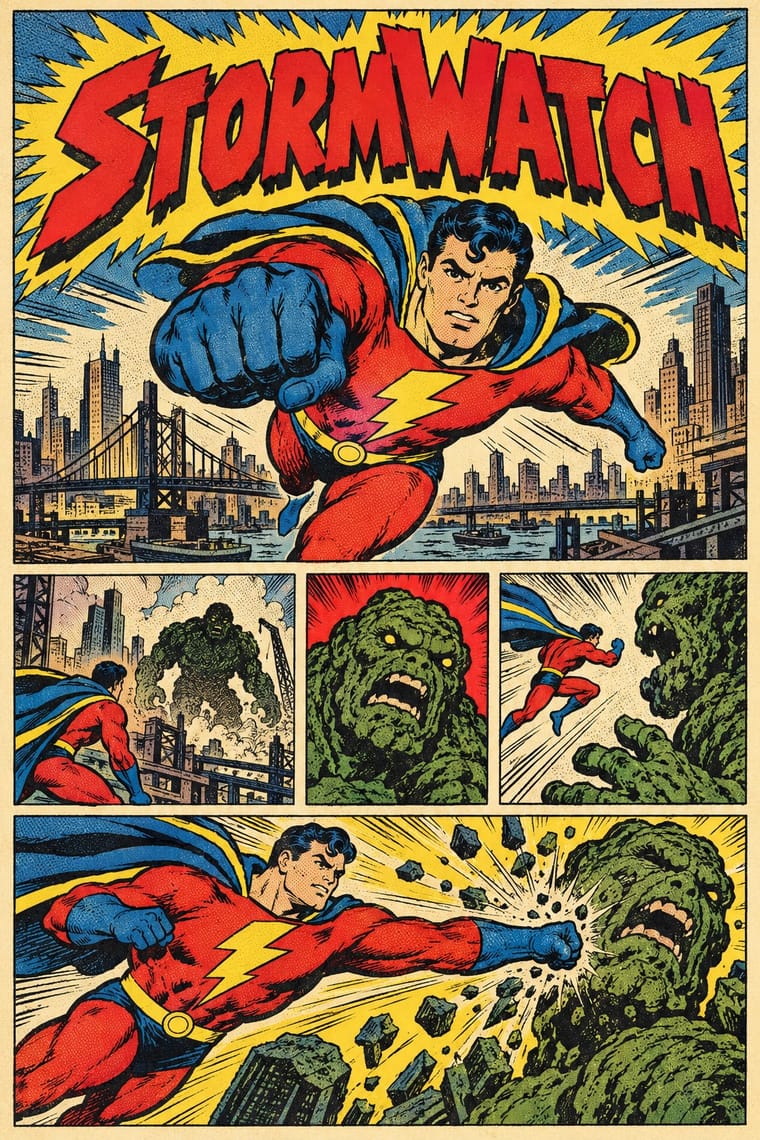
The style it grew out of, and the styles it borrowed from.
After it
The styles that grew out of it.
No later style in the atlas grew out of it yet.
Alike in its design choices
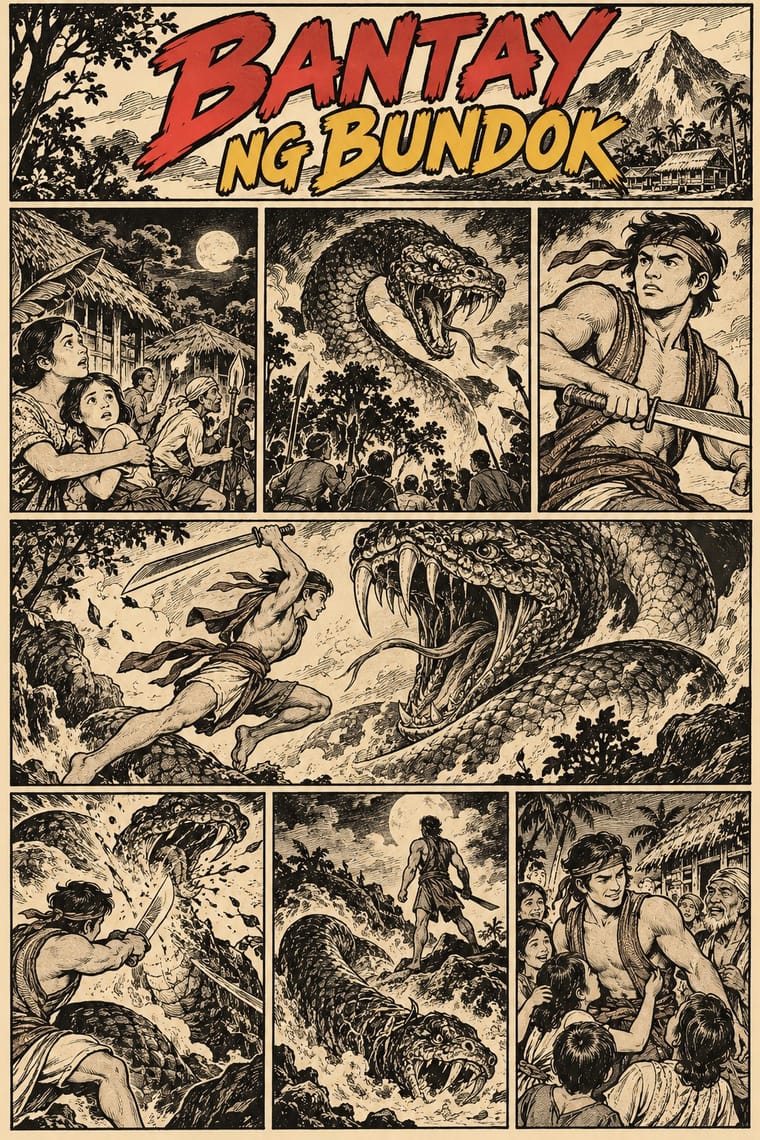
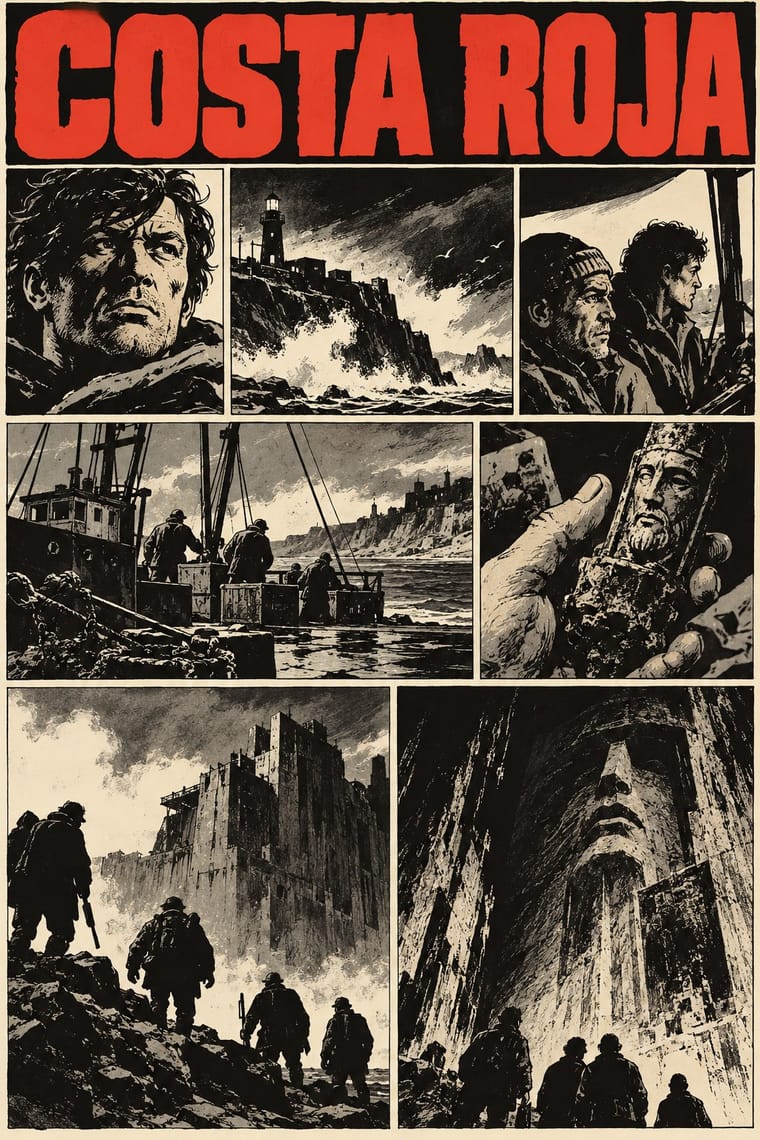
Styles that make many of the same choices, related or not, besides those above.
05
Sources
- Wikipedia (it): 'Sergio Bonelli Editore' (https://it.wikipedia.org/wiki/Sergio_Bonelli_Editore: Redazione Audace from Bonelli's first L'Audace, no. 331, dated 18 January 1941; Edizioni Audace handed to Tea Bertasi after the 1945 separation; the names Edizioni Audace, Edizioni Araldo, CEPIM, Daim Press and Sergio Bonelli Editore from 1988, with conflicting dates for Araldo and CEPIM; the format developed from the strip in the late 1950s as 'albi in bianco e nero, con vignette su tre strisce' of about a hundred pages; Tex Gigante, 1958; series and launch years; 'vendendo mensilmente oltre 500 000 copie delle serie regolari mensili' in April 2014)
- Wikipedia (it): 'Bonellide' (https://it.wikipedia.org/wiki/Bonellide: '16 × 21 centimetri di lato, brossurati', usually 96 pages; the strip format of 16.5 × 8 cm with at most three panels a page; the book format 'ottenuto rimontando tre strisce per tavola', devised in 1952 for the Collana del Tex reprint, reprinted in 1958 and used for new stories from 1968; the term first a put-down for other publishers' imitations, later neutral; its 'Esempi' table of about a hundred bonellidi from other publishers, among them Lazarus Ledd (Star Comics, then Editoriale Cosmo, 1992-2017), John Doe (Eura Editoriale, 2002-2012) and Dago (Eura Editoriale, 1995-2013))
- Wikipedia (it): 'Tex (fumetto)' (https://it.wikipedia.org/wiki/Tex_(fumetto): Il totem misterioso on sale 30 September 1948; strip format (16,5 × 8 cm) weekly from 1948 to 1967, 973 issues in 36 series; Albi d'Oro 1952-1960; Serie Gigante from October 1958, new stories from page 69 of no. 96, October 1968; 16 × 21 cm, black and white except no. 100 and its multiples; Galep the sole cover artist to no. 400, February 1994, Claudio Villa from no. 401; 'arrivando a vendere anche 700 000 copie al mese', and a print run above 200,000 in 2010; Tex 'capo supremo di tutte le tribù Navajos', called Aquila della Notte; Tiger Jack 'guerriero Navajo'; the GM (Garanzia Morale) self-censorship mark)
- Wikipedia (en): 'Tex Willer' (https://en.wikipedia.org/wiki/Tex_Willer: Gian Luigi Bonelli and Aurelio Galleppini, 30 September 1948, Edizioni Audace; the strip format (16.5 × 8 cm); the Gigante collection with three strips per page from 1958; Tex Willer series from 2018)
- Treccani, 'Bonelli, Sergio', Lessico del XXI Secolo (https://www.treccani.it/enciclopedia/sergio-bonelli_(Lessico-del-XXI-Secolo)/: 'Nei primi anni Sessanta del 20° secolo B. assunse le redini della casa editrice'; the switch from the 'formato a striscia' of 'albetti piccoli e oblunghi' to 'il formato quaderno o formato Bonelli, un centinaio di pagine che propongono tre strisce ciascuna'; Zagor 1961, Mister No 1975, Un uomo un'avventura 1976)
- Fabio Rossi, 'fumetti, linguaggio dei', Enciclopedia dell'Italiano, Treccani, 2010 (https://www.treccani.it/enciclopedia/linguaggio-dei-fumetti_(Enciclopedia-dell'Italiano)/: comics 'spesso caratterizzati da ridondanza e prolissità', with a Tex caption as example, put down to publishers wanting readers to understand everything; lettering devices such as bold type for loud speech or emphasis)
- Stefano Priarone, 'The Patriarch of Italian Comicdom: Sergio Bonelli Dies at 79', The Comics Journal, 18 October 2011 (https://www.tcj.com/the-patriarch-of-italian-comicdom-sergio-bonelli-dies-at-79/: the early strip format; the Tex reprints in the 'formato Bonelli', 'Softcover, 5-1/4” x 8-3/4”, black & white, 96-plus pages', which 'soon became standard, as Italian readers liked having long novel-like comics'; Zagor 1961, Mister No 1975, Martin Mystère by Alfredo Castelli 1982, Dylan Dog by Tiziano Sclavi 1986, Nathan Never by Serra, Vigna and Medda 1991; Tex over 300,000 copies a month. TCJ's inch dimensions, about 13.3 x 22.2 cm, conflict with the 16 x 21 cm given by it.wikipedia 'Bonellide', it.wikipedia 'Tex' and Pixartprinting; the draft follows the latter)
- Wikipedia (en): 'Sergio Bonelli Editore' (https://en.wikipedia.org/wiki/Sergio_Bonelli_Editore: complete stories in 98 black-and-white pages in a pocket-book format; adventure 'whether Western, horror, mystery, or science fiction') and 'Italian comics' (https://en.wikipedia.org/wiki/Italian_comics: Tex as the model for the 'Bonelliano' line, 100+ black-and-white pages in a pocket-book format; its claim that the bonelliani are the country's most popular comics is uncited and is not used here)
- Candido Romano, 'How to create Italian-style comics in "bonellide" format: from page layout to printing', Pixartprinting blog, 6 November 2021 (https://www.pixartprinting.co.uk/blog/create-italian-style-comics/: 16 × 21 cm; 'the page is divided into three horizontal strips, which can also be split in half vertically, thus creating a maximum of six panels'; gutters of about 5 mm; 96 pages, 94 of story; always perfect bound, usually black and white)
- FyG Consultores, 'Comic Course, Topic 1, Lesson 2: From strip to page', Erasmus+ lesson on Universitat Politècnica de València PoliformaT, 2021 (https://poliformat.upv.es/access/lessonbuilder/item/8458401/group/OCW_CUR1157407_2020/II.03%20Comic%20Course/Topic%201/Lesson%20Content_Topic1_Lesson2.pdf: Sergio Bonelli Editore 'invented a six-panel grid, influencing the entire Italian market', a standard grid 'created not by choice but by technical requirements related to printing')
- Sergio Bonelli Editore, 'The creators of Zagor' (https://www.sergiobonelli.it/en/blog-the-creators-of-zagor/: Ferri met Nolitta in 1960; Ferri credited with 'the entire range of Covers' of Zagor and the first 115 covers of Mister No) and the Sergio Bonelli biography (https://www.sergiobonelli.it/en/?p=154516: born 1932, the pen name Guido Nolitta, died 26 September 2011)
- Lambiek Comiclopedia, 'Gallieno Ferri' (https://www.lambiek.net/artists/f/ferri_gallieno.htm: 21 March 1929 - 2 April 2016; Zagor with Sergio Bonelli, 1961; first Mister No story, 1975, and the covers of its first 115 issues; influences Phil Davis, Lyman Young, Ray Moore, Hal Foster and Alex Raymond) and 'Galep (Aurelio Galleppini)' (https://www.lambiek.net/artists/g/galeppini_aurelio.htm: 17 August 1917 - 10 March 1994; Collana del Tex from 1948)
- UBC Fumetti, 'Sergio Bonelli Editore' chronology, text by Fabrizio Gallerani, translated by Ron Harris (https://ubcfumetti.magazineubcfumetti.com/data/bonelli_en.htm: Zagor 'the last to be presented in the now-old-fashioned strip format', published in the Collana Lampo strip series 'up until issue 94 of the fourth series, in November 1970'; its reprint in the Collana Zenith Gigante (from no. 52, 1965), in the 'book' format of Tex's 2a Serie Gigante, with all-new stories 'beginning with page 77 of issue 119, February 1971 (shortly before the end of the strip-format series)'; in 1961 the youngest readers were 'monopolized' by other publishers' best-sellers, Torelli's Il Piccolo Sceriffo and Dardo's Capitan Miki and Il Grande Blek; Ferri drew Mister No's first episode and 'all the covers until issue 115, December, 1984')
- Wikipedia (en): 'Zagor (comics)' (https://en.wikipedia.org/wiki/Zagor_(comics): Sergio Bonelli and Gallieno Ferri, 1961; the Darkwood forest, around 1825-1830; Ferri 'illustrated all the covers of the series'); Wikipedia (it): 'Zagor' (https://it.wikipedia.org/wiki/Zagor: 'un fantawestern'; Alessandro Piccinelli also listed as cover artist)
- Wikipedia (en): 'Dylan Dog' (https://en.wikipedia.org/wiki/Dylan_Dog: October 1986, L'alba dei morti viventi; Villa shaped the look after Rupert Everett and drew the first 41 covers, Stano drew no. 1 and later covers; 'Dylan Dog (like all Sergio Bonelli comic books) is printed in black and white', anniversary issues in colour; Color Fest from 2007; horror with black humour) and Wikipedia (it): 'Dylan Dog' (https://it.wikipedia.org/wiki/Dylan_Dog: on sale 26 September 1986; no. 69, 1991, outsold Tex)
- Wikipedia (it): 'Angelo Stano' (https://it.wikipedia.org/wiki/Angelo_Stano: born 1953; drew Dylan Dog no. 1; style 'ispirato a quello del pittore Egon Schiele'; cover artist from no. 42, 1990) and 'Claudio Villa (fumettista)' (https://it.wikipedia.org/wiki/Claudio_Villa_(fumettista): designed Dylan Dog in 1986 and drew covers to no. 41; Tex cover artist from no. 401, 1994, praised for keeping Galep's covers 'nel classico alveo della tradizione figurativa western')
- Wikipedia (en): 'Martin Mystère' (https://en.wikipedia.org/wiki/Martin_Myst%C3%A8re: Alfredo Castelli and Giancarlo Alessandrini, 1982; cover of no. 315 reproduced as File:Martin Mystère 315.jpg) and 'Nathan Never' (https://en.wikipedia.org/wiki/Nathan_Never: Medda, Serra and Vigna, monthly since 1991, 'black-and-white, science fiction'; Blade Runner and Asimov's Foundation as sources; cover of no. 1 by Claudio Castellini reproduced as File:Nathan Never 1.jpg)
- Wikipedia (it): 'Julia (fumetto)' (https://it.wikipedia.org/wiki/Julia_(fumetto): Giancarlo Berardi, monthly from October 1998; Julia Kendall modelled on Audrey Hepburn; 128 pages, 116 from no. 271, 80 from no. 329)
- Wikipedia (en): 'Fabio Civitelli' (https://en.wikipedia.org/wiki/Fabio_Civitelli: 'highly skilled with ink drawings'; his Tex 'respects the old tradition set by Aurelio Galleppini')
- Fiorenzo Toso, 'Saggio di onomastica texiana', il Nome nel testo XI, 2009, pp. 437-448 (https://innt.it/innt/article/view/335: the language of Tex 'fatto spesso di parole-chiave in inglese, di frasi a effetto ricalcate sulla tradizione hollywoodiana, di onomatopee anglicizzanti', with Spanish exclamations; references in the 2007 colour reprint given by page, strip 'su tre' and panel)
- Wikipedia (it): 'Lazarus Ledd' (https://it.wikipedia.org/wiki/Lazarus_Ledd: created by Ade Capone; Star Comics, the last story from Editoriale Cosmo; n. 0 in October 1992, regular series July 1993 to November 2006, no. 152 in October 2017; 'albi da 96 pagine in bianco e nero'; 'di genere avventuroso e fantascientifico', set mainly in New York; Alessandro Bocci the 'disegnatore e copertinista storico')
- Images examined for the cover trade dress, the drawing and the lettering: en.wikipedia File:Dylan Dog.jpg (cover of Dylan Dog no. 62, I VAMPIRI, L. 2300), File:Dylan Groucho.jpg, File:Xabaras.jpg (an interior panel with bold words in hand-lettered capitals), File:Nathan Never 1.jpg, File:Martin Mystère 315.jpg (typeset serif straplines and title), File:Zagor.jpg (a Ferri interior panel in brush ink), File:Tex Willer by Aurelio Galleppini.jpg (a black-ink drawing signed GALEP), File:Texwiller.jpg (Tex in his yellow shirt), File:Mister No.jpg (an ink vignette with a jaguar and a plane) and File:Julia (comics).jpg (cover of La grande burla); it.wikipedia File:Logo tex Willer.png, File:Francobollo Tex Willer.JPG (the 1996 'Invito alla filatelia' stamp, 750 lire), File:Zagor panini comics.jpg (a Ferri cover for a reprint sold with the Gazzetta dello Sport and the Corriere della Sera), File:Mister No logo.png and File:Lazaruscover.jpg (Lazarus Ledd no. 145, Correndo nel vuoto); Wikimedia Commons File:Tex - 70 anni di un mito 01.jpg (the TEX masthead and the yellow-shirted hero on a display at the Arf! Festival, 2019). No interior Tex action page was available to check how sound effects are angled, so the draft makes no claim about it
- Stylogeny atlas entries for Amar Chitra Katha, Filipino komiks, ligne claire, the American comic book, story manga, the fotoromanzo and Penguin paperback design, for the affinity notes
How Stylogeny researches and checks a style: where the facts come from.