Pictorial & machine age · 1925–1990 · East Asia
Lianhuanhua Picture-Story Books
Also known as Linked pictures, Xiaorenshu (little people's books), Chinese serial-picture storybooks
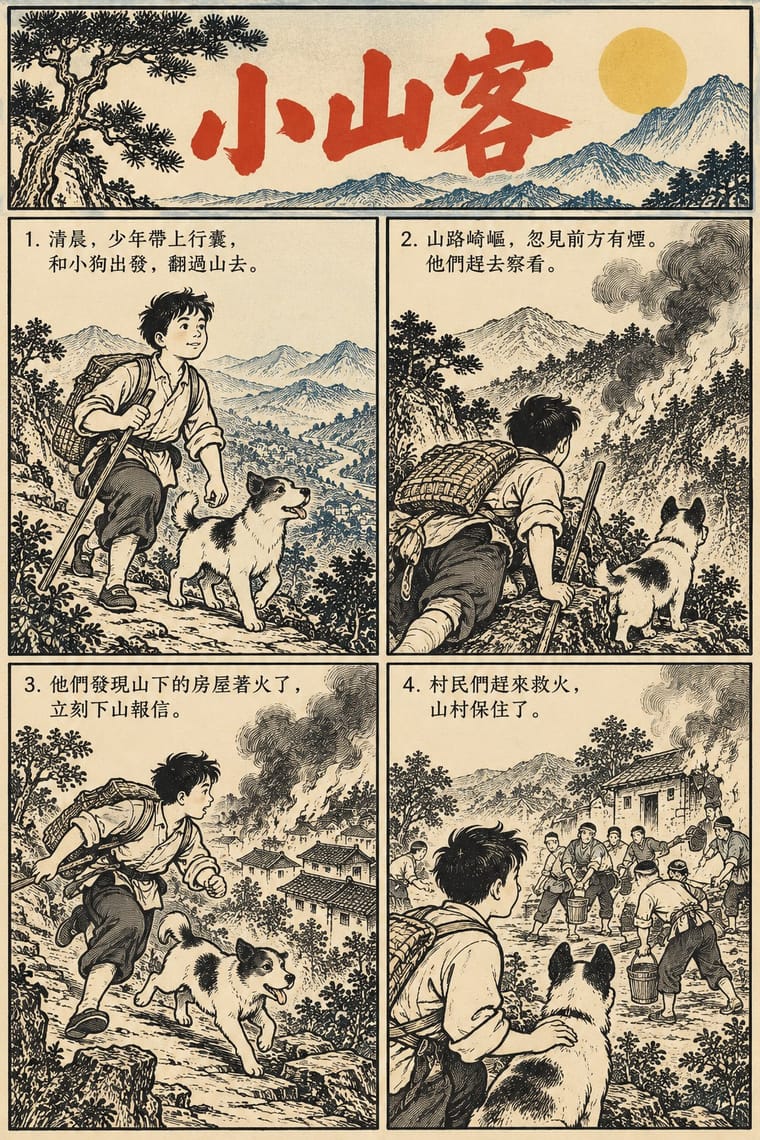
Palm-sized Chinese picture books, about three by five inches, that tell a novel, opera, film or revolutionary story in hundreds of single framed drawings, one to a page, each with a short caption. Interiors are black ink line drawings, from fine classical-costume outline to realist sketching, with colour kept for the cover. Rented and read at street stalls, they were the most popular reading of 20th-century China until television and manga displaced them from the late 1980s.
Make something in this styleGet advice in this styleMix it with another style
01
How it works
- Give each page one framed picture and a short caption block above, below or beside it; avoid multi-panel grids.
- Draw the interior in black ink line, from fine outline for classical subjects to hatched realism for modern ones.
- Stage the story cinematically, varying viewpoint, distance and close-up from page to page.
- Keep colour for the cover, where a painted scene sits under a hand-drawn title.
- Make the format small, cheap and rentable, so a story runs across hundreds of frames in a pocket-sized book.
Shanghai, where Shijie Shuju (World Book Company) adopted the name in 1925 and street-stall publishers multiplied; after 1949 state presses such as the People's Fine Arts Publishing House and Shanghai People's Fine Arts Publishing House
02
Its design choices
From Stylogeny’s vocabulary of design choices: defining choices make the style, characteristic ones are usual, occasional ones turn up now and then.
- Layout & composition
- Space & hierarchy
- Surface & texture
- Imagery
- Medium & production
- Tone & intent
- Avoids
- Typography only, Collage & layering, Full bleed, Experimental & distorted, Non-representational, Fluorescent & neon, Ironic & self-aware
Palette
#1b1b1b#f0ead8#c23b2e#3d6e8f#e2b84a
Typefaces
Songti (Ming) and Kaiti printing types for captions
Hand-drawn meishuzi ('art lettering') cover titles
Brush calligraphy titles on classical-story covers
Known for
Shen Manyun, Arrest of the Orchid
Republican-era Shanghai
Zhao Hongben and Qian Xiaodai, Sun Wukong Thrice Defeats the White-Bone Demon
1962
He Youzhi, Great Changes in a Mountain Village
Shanxiang jubian, 1961–65
Ding Bingzeng and Han Heping, Railway Guerrillas
Tiedao youjidui; nearly 4 million copies
Shanghai People's Fine Arts Publishing House
03
Make something in this style
Say what you need, and Stylogeny’s image studio draws it from Lianhuanhua Picture-Story Books’s design choices and checks it against them. It takes about a minute, and you get a link to share.
04
Where it comes from, and what it’s close to
Before it
The style it grew out of, and the styles it borrowed from.


After it
The styles that grew out of it.
No later style in the atlas grew out of it yet.
Alike in its design choices
Styles that make many of the same choices, related or not, besides those above.


05
Real works
Artefacts in museums, libraries and archives that show the style, linked at their source.
- 刘胡蘭 Liu Hulan (picture-story poster, one of two sheets: six panels)Li Jiyuan, Meng Qingjiang, Wang Jiao and Zhang Guanghe (pictures); Zheng Yongpei (verse) · 1973 · Royal Danish Library (Det Kgl. Bibliotek), Copenhagen, Chinese poster collection (kob_kin_pl_0042, shelf mark Kob-kin-42/43)
- 学习雷锋好榜样 Learn from the Good Example of Lei Feng (picture-story poster, panels 1–2)He Youzhi · 1973 (3rd printing, August 1973; 1st printing July 1973) · Royal Danish Library (Det Kgl. Bibliotek), Copenhagen, Chinese poster collection (kob_kin_pl_0046, shelf mark Kob-kin-46/47)
- 司马懿诈病赚曹爽 (Sima Yi Feigns Illness to Trick Cao Shuang), panel from the Romance of the Three Kingdoms lianhuanhuaFeng Monong (冯墨农), as named by the uploader · 1957 (edition named by the uploader; the scan's source edition is unidentified and may be a later reprint) · Wikimedia Commons (no holding institution identified)

06
Sources
- Wikipedia, 'Lianhuanhua' (https://en.wikipedia.org/wiki/Lianhuanhua)
- Huntington Archive, Ohio State University, 'Literature in Line: Picture Stories in the Chinese Tradition' (https://huntingtonarchive.org/Exhibitions/litInLine.php)
How Stylogeny researches and checks a style: where the facts come from.