One of our own styles · made in 2026
Patched Up
Working people pieced from the work clothes they wore out: lime and safety-orange hi-vis, royal-blue overall denim, chef's whites and check, cut up and sewn onto black cloth, with reflective tape set where light would catch a face. Photographed flat with one flash, the tape burns white and the cloth stays matt: from across a room a figure drawn in light on black, up close seams, frayed edges and a pocket flap where a brow should be. For builders, couriers, garages, kitchens, cleaners and festival crews.
Make something in this style Get advice in this style Mix it with another style
Use it with care
It honours people who do hard, often unseen jobs: never use it to mock a worker, a trade or a body, never make anyone a mascot or a costume, and show no real person, company name, logo, or any real company's uniform or house colours, and no police, ambulance, fire or army markings. A picture of hi-vis is not safety clothing and must never be sold as or mistaken for it. Its pictures are made by an image model: label them as generated and never pass one off as a hand-sewn original.
01
More pictures in this style
2 pictures, AI-generated from its design choices: none is a real or historical work.
Try other colours
Change a colour and every picture on this page follows. It happens in your browser, from the same pictures: nothing new is made or saved.
Choose a colour to change it
-
#121212 -
#d4ff00 -
#ff5f00 -
#1f3fbf -
#f2f1ec
A faded colour isn’t in these pictures, so changing it changes nothing.
Light and dark stay where they are; greys hardly move.
More colours: any style’s, or your own
The pictures show the style’s own colours.
02
Make something in this style
Say what you need, and Stylogeny’s image studio draws it from Patched Up’s design choices and checks it against them. It takes about a minute, and you get a link to share.
03
How it works
Palette
-
#121212ground · 28% -
#d4ff00accent · 3% -
#ff5f00accent · 16% -
#1f3fbfaccent · 6% -
#f2f1ecink · 10%
Shares measured from its 4 pictures. The ground is what the pictures sit on (of the colours covering most, the most neutral), the ink stands out from it most, the rest are accents.
Typefaces
-
Big Shoulders
-
capitals cut from reflective tape
Who is in it. Working adults from twenty to seventy, women and men of every build and background, each pieced from the worn-out clothes of their own trade, skin and hair included. They hold themselves like people after a good shift: upright or at ease, calm-faced, looking at us or at their work, never clowning, flexing, pitied or posed like a model. A scene has only the figures and things it names, all pieced from that one trade's cloth, and a scene that names nobody has nobody in it.
Direction
- What it says
- Clothes made to keep a worker seen are cut up and sewn into their likeness, so the people who do the hard jobs are seen whole, and shine where light finds them.
- Performance
- Whoever the scene names holds still after the work or between jobs, at ease and calm-faced, weight settled, eyes on us or on the job; never straining, clowning or posing for a brand. Each is pieced from the clothes of their own trade and nobody else's.
- Set
- Only the place the scene names, pieced from the same worn cloth and laid on black cloth that stands for the dark around it and for every deep shadow; whatever the scene does not name stays black.
- Light
- One flash from the camera's own position and no other light: the cloth stays matt and true in colour, every strip of reflective tape burns white with a soft halo, and the black cloth drinks the rest. Whatever glows in a scene is orange or lime cloth, never a lamp.
- Camera
- The finished panel lies flat and is photographed square on with a normal lens, so every patch is seen face on and depth comes only from how the pieces are cut. Within the panel the scene is seen from the height and distance the shot gives.
- Frame
- The cloth runs off every edge, with no hem, border or binding. The subject takes the part of the sheet the shot gives it, and black cloth fills at least a third of the sheet; given words are cut from reflective tape and sewn on small in the black, never across a face.
- Moment
- A pause in the work: a shift just over, a job just done, or the second before the doors open. Tools are at rest, and nobody strains, falls or is hurt.
- Finish
- Real worn workwear, cut and sewn: hi-vis gone soft but still loud, denim worn pale, raw frayed edges, coarse stitches in a contrasting thread, a patch over a patch, pockets and press studs where they fit. Every thread is sharp and the tape burnt white, with no paint, print, gradient or filter on top.
- A set of pictures
- Seven pictures, each in one trade's clothes at its own distance: a rail worker's face close, a road crew of five wide, a mechanic's two hands in detail, a cook in her food truck's hatch medium, a yard dog close at its own height, a workshop front wide at night, one mended helmet small in a field of black.
- Never
- No photographed or painted skin and no real person in front of the cloth; no name, logo, number or brand on any cloth; no police, ambulance, fire or army markings; no quilt border, sewing machine or hands sewing; no beige, brown, grey or pastel cloth; nothing that makes a worker a joke or a mascot.
- Piece every picture, people, animals, places and things alike, from the real worn-out work clothes of the trade the scene names, cut up and sewn onto black cloth, with silver reflective tape. Skin and hair are cut from those clothes too, a cheek from a sleeve and its shadow side from a darker cloth of the same trade, with the deepest shadows left as the black ground, so no face, skin or hair anywhere is painted, printed, drawn or photographed: it is all cloth.
- Cut the pieces with straight scissor cuts into planes that follow the form, lay each one over its neighbour's frayed edge and sew it down with coarse stitches you can see, so the figure is pieced edge to edge on the black. Sew reflective tape where light would catch: along a cheekbone, the bridge of the nose, the rim of an ear, the glint in an eye, the top of a shoulder, the edge of a thing. Keep a pocket flap, a button or a press stud where it fits the form, a flap for a brow, a stud for an earring.
- Photograph the finished panel flat with one flash from the camera, so every strip of tape blazes white with a soft halo while the cloth stays matt and true in colour. Use only the cloth of the one trade the scene names, in the colours the scene gives, and give every picture at least one large patch of fluorescent lime or safety orange. Black cloth fills at least a third of the sheet and runs off every edge with no border, hem or binding, and no cloth is beige, brown, grey or pastel.
- Give every picture two readings. From across a room it is a figure drawn in blazing white lines and loud colour on black; up close it turns into cloth, and the seams, the frayed edges, the patch over a patch and the worn knee of a pair of overalls are what make the face.
- Vary the trade, the number and the distance: one face close, a crew in a row seen wide, two hands in detail, a worker beside their van, a yard dog at its own height, a workshop front at night, one helmet alone in a field of black. Each picture leads with a different trade's cloth.
- For a client, piece the picture from the client's own trade, so a hiring poster, a van side, a bag or a thank-you print is made of the jackets the crew wore out. In print the tape can be real reflective ink, so the poster lights up in headlights as the clothes did.
A studio style: made by Stylogeny, not a documented movement.
With an idea put on it
-
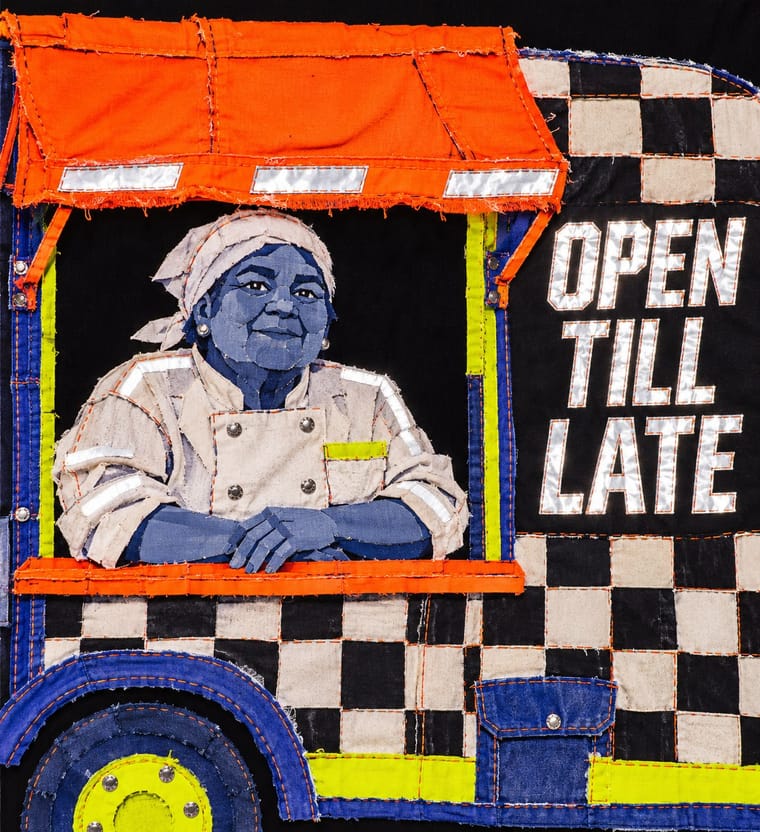
Frame within a frame The open hatch frames her like a lit portrait in the dark street, so the cook herself is the sign that the truck is open. -
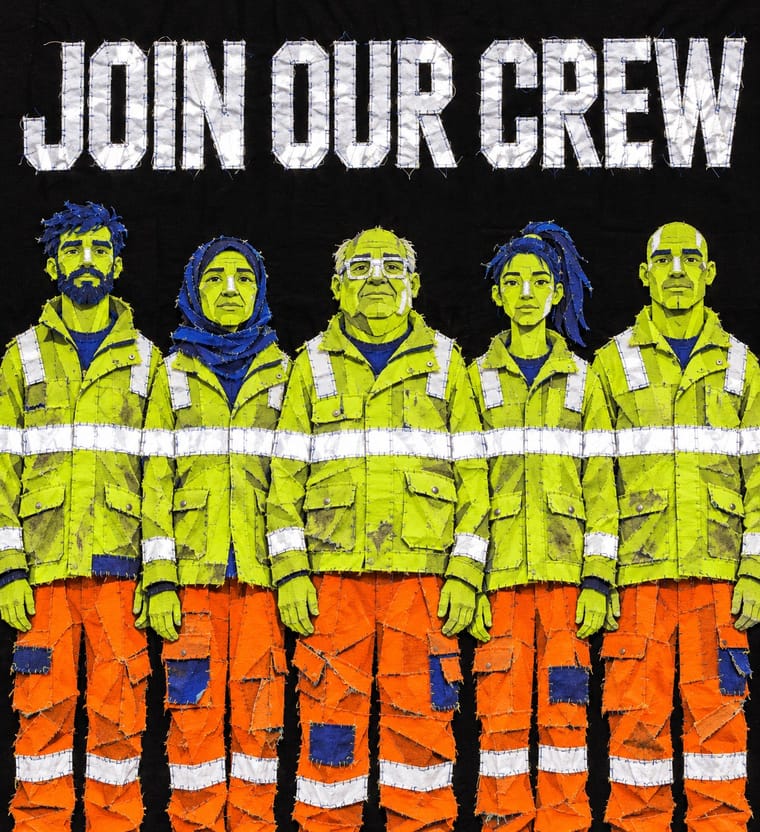
Line-up Five people of different age, build and look stand in one row in the same pose, and their chest bands of tape join into one line of light, so the crew reads as one.
AI-generated: Patched Up with an idea put on it. Not a real or historical work.
Change it with an idea. Any of the 73 moves that make a design say something can go on this style.
04
Its design choices
From Stylogeny’s vocabulary of design choices: defining choices make the style, characteristic ones are usual, occasional ones turn up now and then.
- Layout & composition
- Space & hierarchy
- Typography
- Colour
- Surface & texture
- Ornament
- Medium & production
- Tone & intent
- Avoids
- Flat vector illustration, 3D render, Comic & cartoon, Painterly illustration, Painterly brushwork, Gradients, Pastel, Earth & mineral, Light ground, Abundant decoration
How its pictures are made Photographic, light, viewpoint, lens, pose, finish
Kind of picture: Photographic How they are made, from the questions Stylogeny asks of that kind:
- Light
-
- Direct on-camera flash defining
- Flat form characteristic
- Blown highlights characteristic
- Low-key & chiaroscuro occasional
- Viewpoint
-
- Flattened planes defining
- Eye level characteristic
- Close & intimate occasional
- Middle distance occasional
- Lens
-
- Normal lens characteristic
- Deliberate stillness characteristic
- Deep focus occasional
- Pose
-
- Relaxed & natural characteristic
- Neutral face characteristic
- Eyes to the lens occasional
- Standing straight occasional
- Finish
-
- Hyper-detailed characteristic
- Straight print characteristic
What new pictures of it show
Subjects Stylogeny draws it with, each taken from a kind of real work the style was made for.
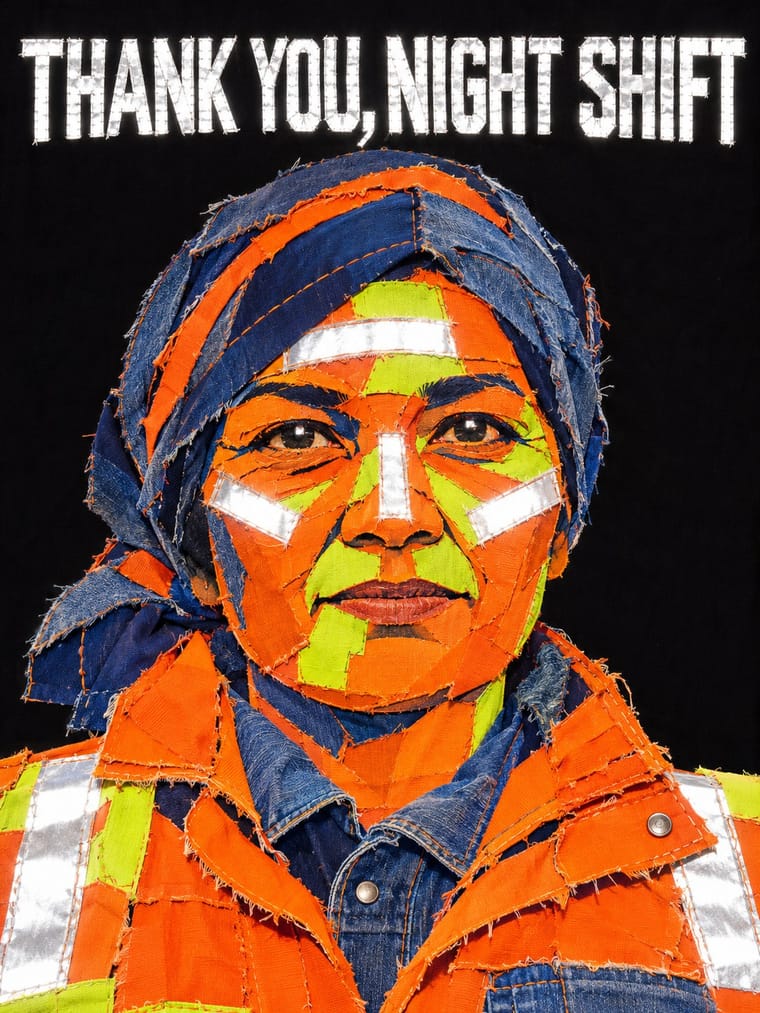
- poster A rail track worker's face, a slight woman in her forties in a headscarf, pieced from her own worn safety-orange jacket and blue denim, reflective tape on her cheekbones, nose and brow
- flyer A road crew of five in lime jackets and orange trousers: a bearded man of 25, a woman of 50 in a headscarf, a stout man of 60 in tape glasses, a slim woman of 20 with a ponytail, a bald man of 40
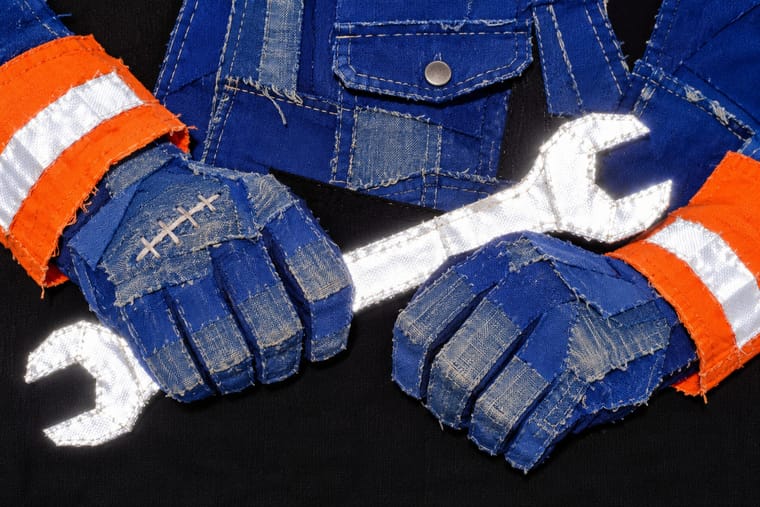
- postcard A mechanic in his fifties seen only by his two broad, worn hands holding a spanner cut from reflective tape, pieced from his royal-blue overalls worn pale, a knuckle scar in white stitches
- menu cover A cook of sixty, short and round, in a white chef's jacket and white headscarf, leaning out of her food truck's hatch under an orange awning, the truck cut from her black-and-white check trousers
- social media post A builders' yard dog, a scruffy mongrel with one ear up, sitting at the site gate at night, pieced from the crew's worn orange and lime vests, reflective tape for its collar and a glint in each eye
- invitation The front of a small joinery workshop at night, nobody in sight, its roller shutter half up, pieced from worn orange and blue overalls, lime cloth for the light under the shutter, tape along the kerb
- packaging label One safety helmet alone on black cloth, pieced from a worn lime hi-vis jacket, a crack across its crown mended with big white stitches, a band of reflective tape round it
05
What it’s close to
One of our own styles: Stylogeny made it from its own design choices, so no earlier style is claimed.
Patched Up Made 2026
No later style in the atlas grew out of it yet.
Alike in its design choices
06
Often taken for
patched-up has no real works recorded yet, so these are its nearest styles by its choices alone, with the choices that tell them apart.
-
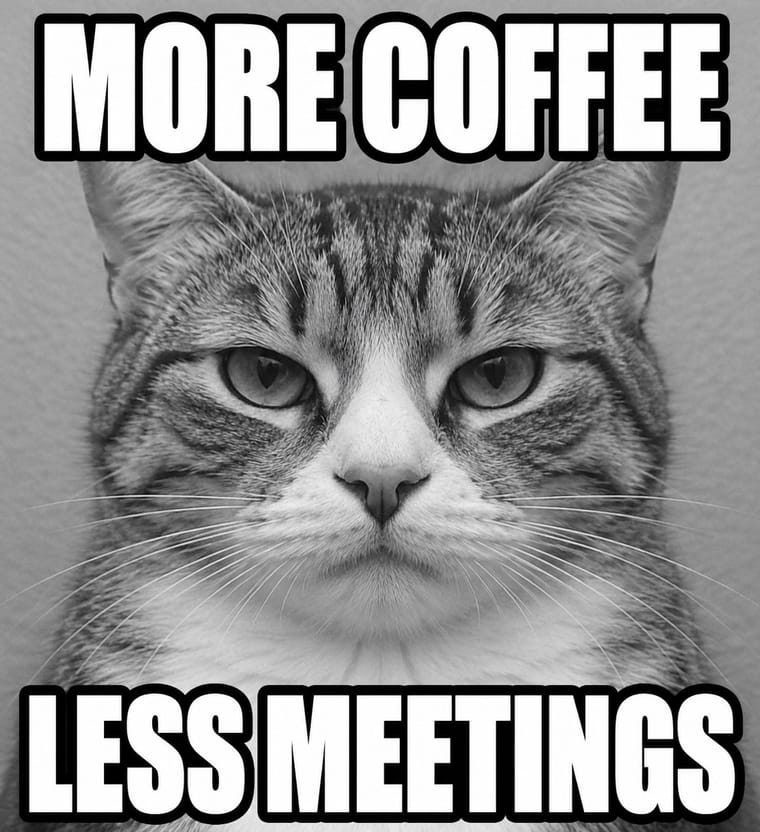
Image Macro (Impact Meme Format)
Image Macro is one of patched-up’s nearest styles by choices; no real work of either fits the other better.
Choices that tell Patched Up and Image Macro apart Choice Patched Up Image Macro Dark ground defining — Found & vernacular imagery — defining Fluorescent & neon defining — Central symmetry — defining Stylised figuration defining — No shared descent in the atlas: they reached these choices separately.
-
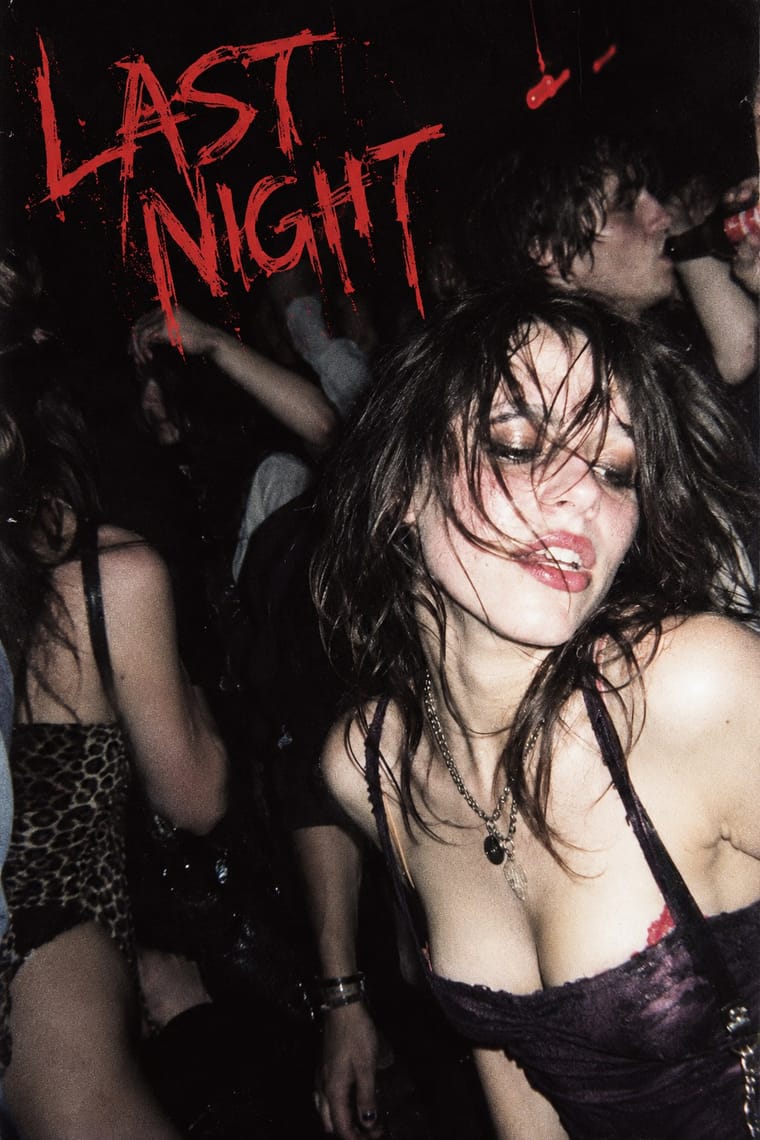
Indie Sleaze
Indie Sleaze is one of patched-up’s nearest styles by choices; no real work of either fits the other better.
Choices that tell Patched Up and Indie Sleaze apart Choice Patched Up Indie Sleaze Fluorescent & neon defining — Naturalistic depiction — characteristic Stylised figuration defining — Found & vernacular imagery — characteristic Complementary clash characteristic — No shared descent in the atlas: they reached these choices separately.
-
Bandung Distro Graphics
Bandung Distro Graphics is one of patched-up’s nearest styles by choices; no real work of either fits the other better.
Choices that tell Patched Up and Bandung Distro Graphics apart Choice Patched Up Bandung Distro Graphics Fluorescent & neon defining — Flat — defining Stylised figuration defining occasional Limited spot colours — characteristic Complementary clash characteristic — No shared descent in the atlas: they reached these choices separately.
-
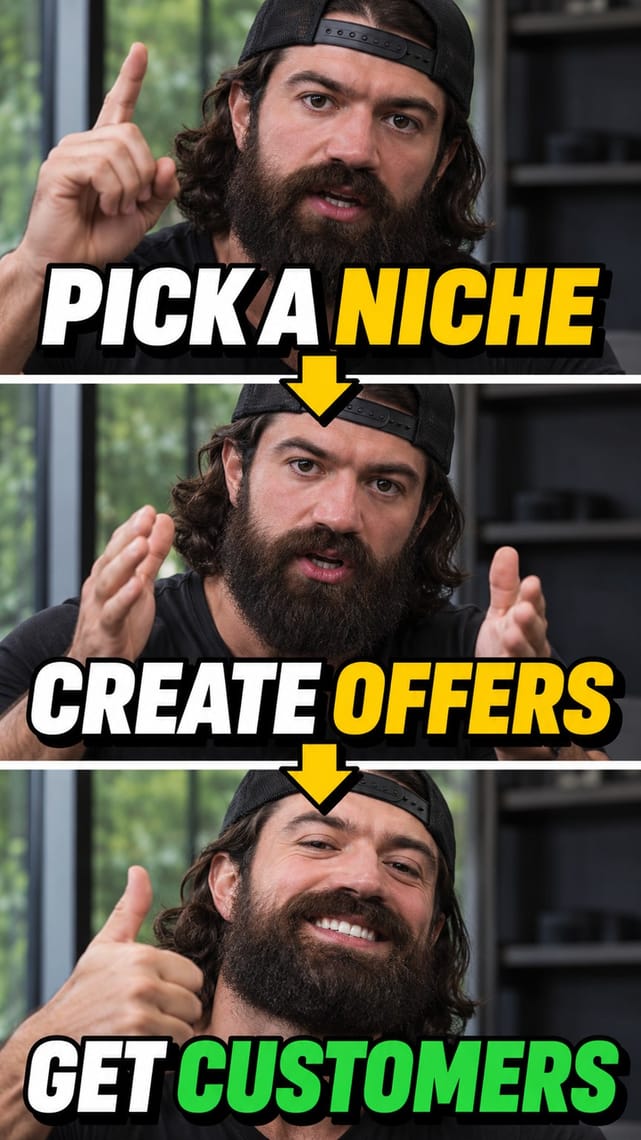
Short-Form Creator Captions (Hormozi-Style Subtitles)
Short-Form Creator Captions is one of patched-up’s nearest styles by choices; no real work of either fits the other better.
Choices that tell Patched Up and Short-Form Creator Captions apart Choice Patched Up Short-Form Creator Captions Skeuomorphic material characteristic avoids Sequential narrative — defining Dark ground defining — Hard offset shadow — defining Fluorescent & neon defining — No shared descent in the atlas: they reached these choices separately.
— means the choice isn’t among the style’s recorded choices. Critics recorded each work’s choices with the styles’ descriptions in view, so this shows whether the descriptions hold together, not proof that they are right.