One of our own styles · made in 2026
Stereo Skate
Skaters shot through a fisheye in hard sun and printed as an old 3D comic was: a red image and a cyan image of the same photograph, slipped apart, on cheap grey newsprint. Every edge has a red fringe on one side and a cyan one on the other, the dots are coarse and the ink sinks into the paper. The skater is large, bent by the lens and frozen in the air, and the ground curves away on both sides.
Make something in this style Get advice in this style Mix it with another style
Use it with care
Skating hurts: show a fall with humour and never an injury. Put no brand on a board or on clothes, and show no real skater or known spot. Its pictures are made by an image model: label them as generated and never pass one off as a photograph; the 3D is a look and will not work through glasses.
01
More pictures in this style
9 pictures, AI-generated from its design choices: none is a real or historical work.
1 of 8
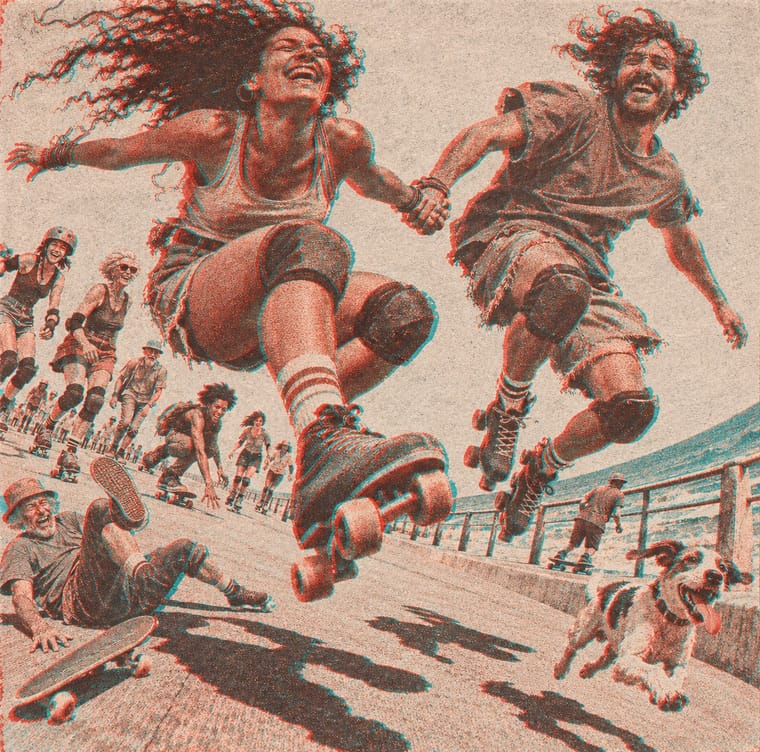
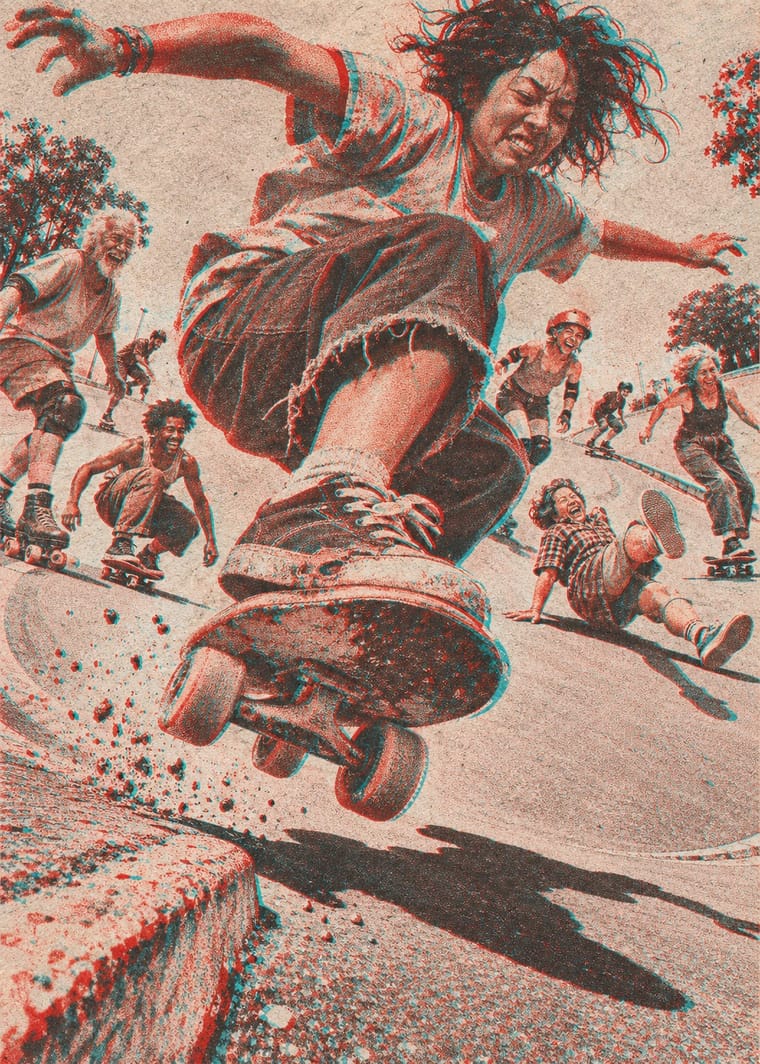
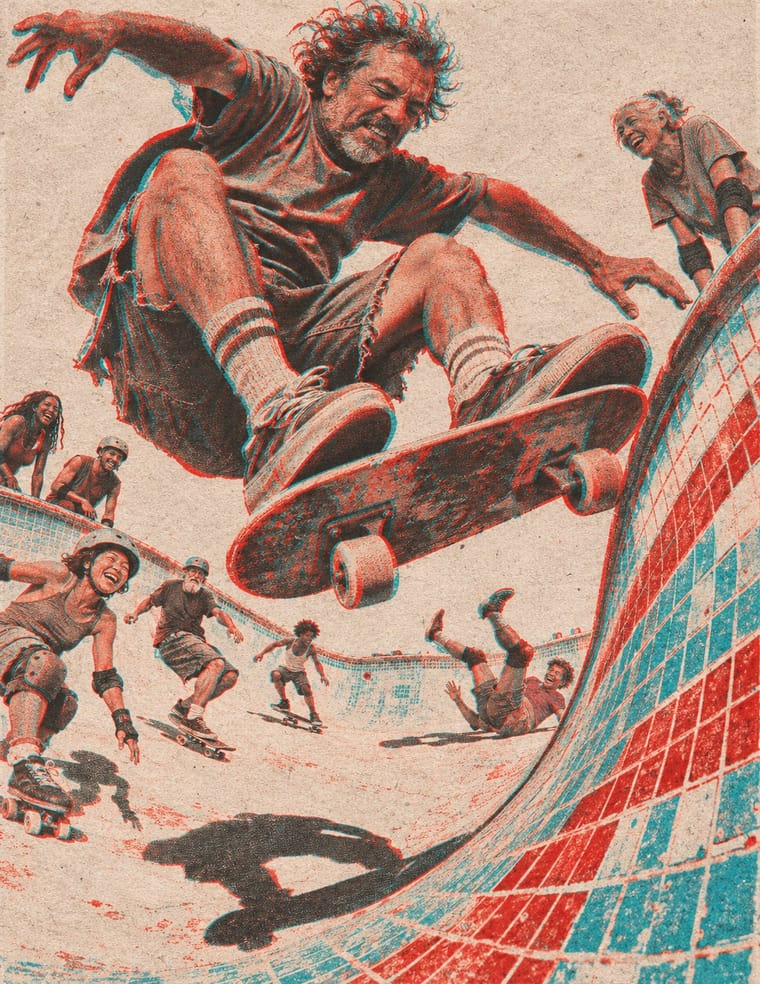
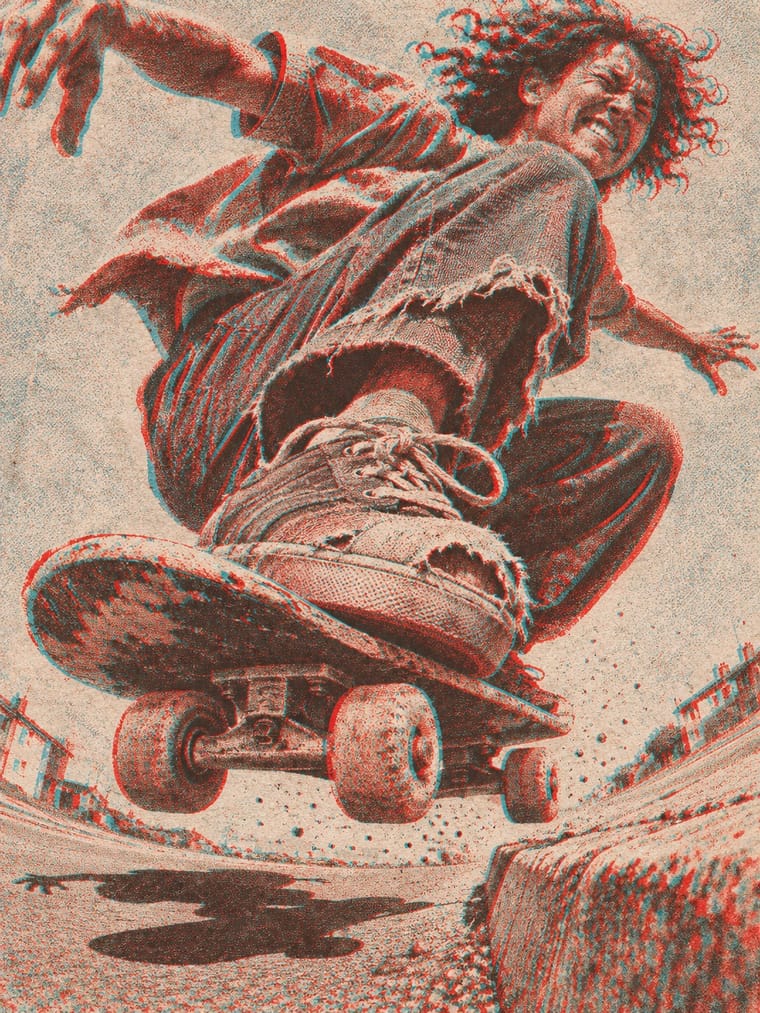
Try other colours
Change a colour and every picture on this page follows. It happens in your browser, from the same pictures: nothing new is made or saved.
Choose a colour to change it
-
#d9d4c7 -
#e0281f -
#16b7c9 -
#1a1a1a -
#f2efe6 -
#7a1f1a
A faded colour isn’t in these pictures, so changing it changes nothing.
Light and dark stay where they are; greys hardly move.
More colours: any style’s, or your own
The pictures show the style’s own colours.
02
Make something in this style
Say what you need, and Stylogeny’s image studio draws it from Stereo Skate’s design choices and checks it against them. It takes about a minute, and you get a link to share.
03
How it works
Palette
-
#d9d4c7ground · 22% -
#e0281faccent · 4% -
#16b7c9accent · 1% -
#1a1a1aink · 1% -
#f2efe6accent · 9% -
#7a1f1aaccent · 1%
Shares measured from its 14 pictures. The ground is what the pictures sit on (of the colours covering most, the most neutral), the ink stands out from it most, the rest are accents.
Typefaces
-
Anton
-
A heavy condensed face for one word of a zine's title, in red or cyan, slipped like the picture
Who is in it. Skateboarders and roller skaters of every age from twenty to seventy and of every background, in pads and helmets or none, in their own worn clothes. Caught mid-trick or mid-fall, grinning, grimacing or concentrating, never posing and never a model. Plain clothes and boards, with no logos or brand marks. A different skater every time.
Direction
- What it says
- The air belongs to whoever leaves the ground, at any age and on any wheels.
- Performance
- Caught mid-trick or mid-fall: grinning, grimacing or lost in concentration, arms out for balance, clothes flapping. Nobody poses, nobody is cool about it, nobody looks at the lens unless they are about to land on it.
- Set
- Only the place the scene names: ordinary ground in full sun, with nothing brought in from another scene.
- Light
- Hard midday sun from high up and no flash: a black shadow of skater and board on the ground directly below, bright sky, squinting faces.
- Camera
- A fisheye at the height and distance the shot names, most often on or just above the ground and an arm's length from the action, so the horizon bends.
- Frame
- The skater fills the frame off centre with a limb reaching into a corner, and the ground is a curved band along the bottom.
- Moment
- The instant of least contact with the ground that the scene allows, frozen sharp.
- Finish
- One red print and one cyan print of the same photograph slipped a few millimetres apart, coarse halftone dots, ink sunk into grey newsprint.
- A set of pictures
- A set has one jump seen from underneath, one at a pool's lip, one pair coming at the lens, one slide down a rail, one fall, one ring of skaters round the lens, and one detail of wheels.
- Never
- No logo, no model, no posed portrait, no skate park with a crowd, no third colour, no gloss, no clean white paper.
- Print every picture as a red image and a cyan image of the same photograph, slipped a few millimetres apart, so each edge has a red fringe on one side and a cyan fringe on the other and the overlap goes near black, as in an old 3D comic.
- Print it on cheap grey newsprint: coarse halftone dots, ink that sinks in and spreads, paper grain showing through, nothing glossy, and no colour other than the red, the cyan and their dark overlap.
- Shoot it through a fisheye held low and close in hard sun: the skater large and bent by the lens, frozen in the air, the ground and the horizon curving away, a hard shadow under the board.
- Vary the place and the move: a car park, a drained pool, a seafront, a roller rink, a flight of steps; a jump, a grind, a turn at speed, a fall taken laughing.
- Put one ordinary thing in the air or at the edge of each picture: a hat, a dog, a shopping trolley, a dropped ice cream.
A studio style: made by Stylogeny, not a documented movement.
With an idea put on it
-
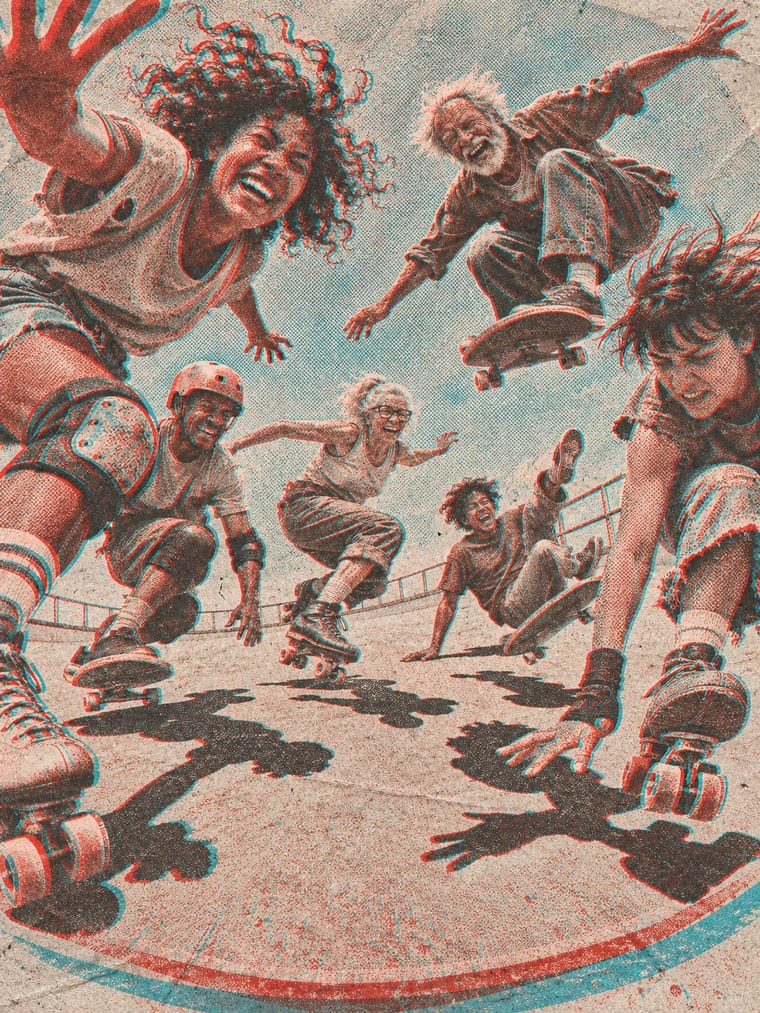
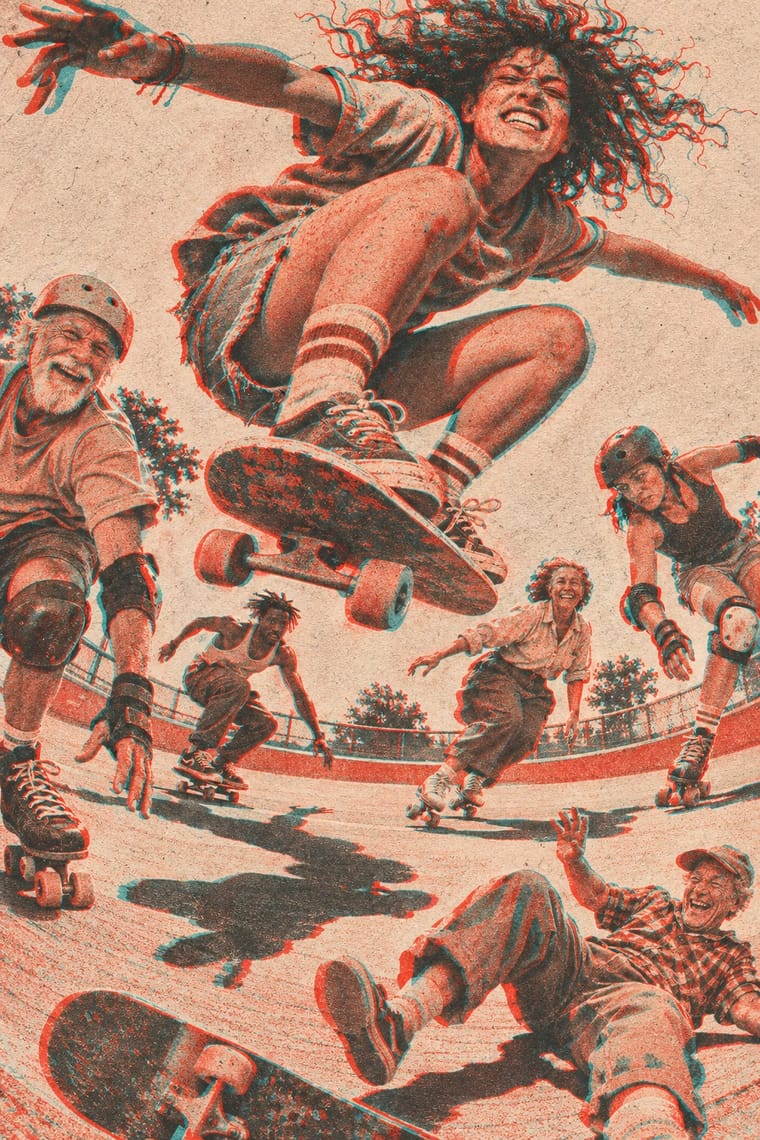
Composite figure The lens bends six skaters into one ring, so the rink is a wheel and we are its hub. -
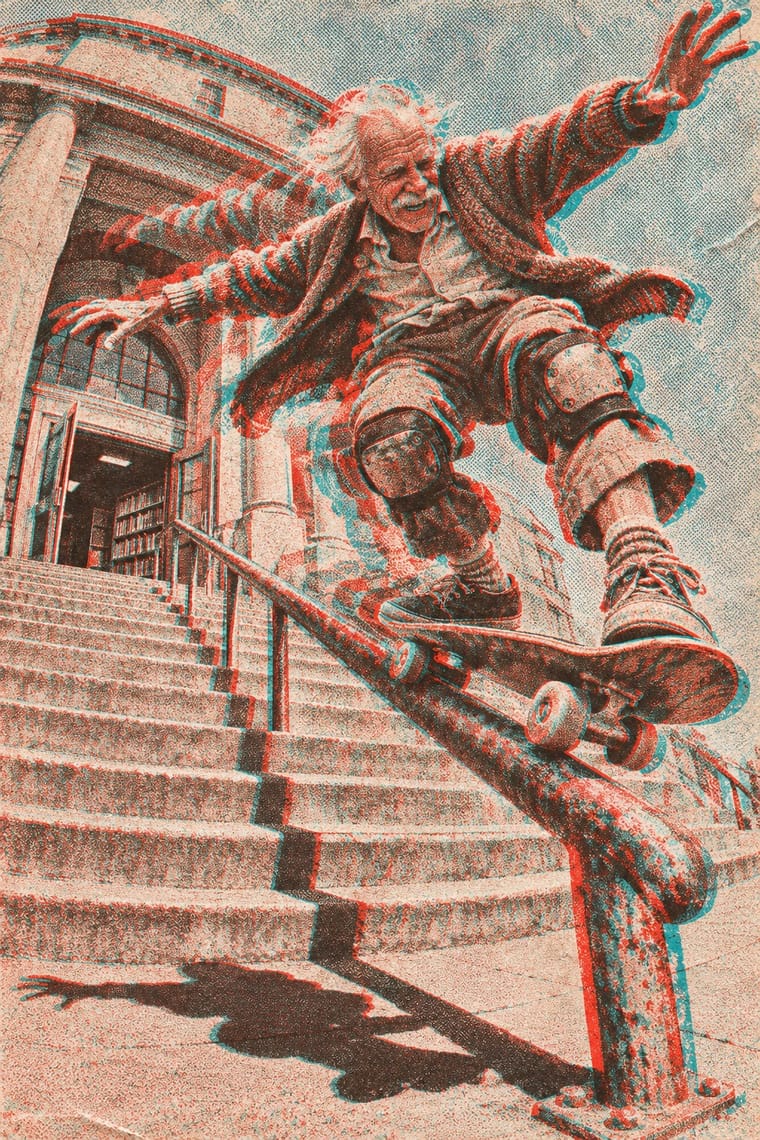
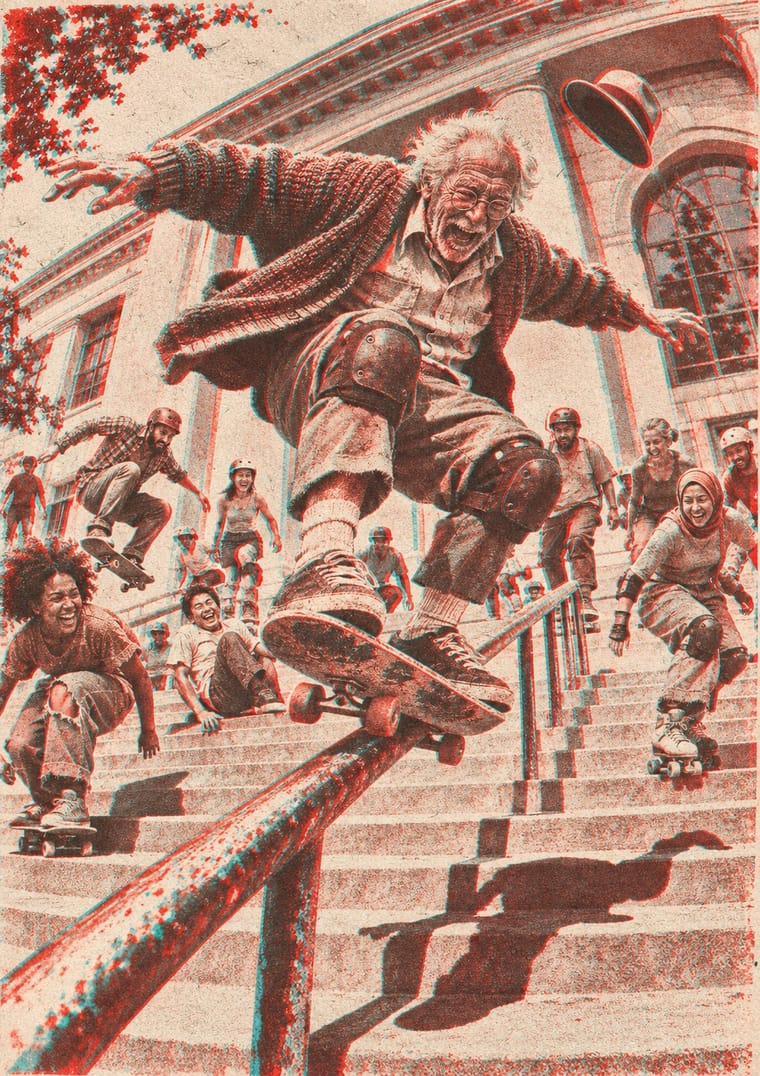
Movement in a still The hat still hangs where he set off, so the picture holds the start of the slide and the middle of it. -
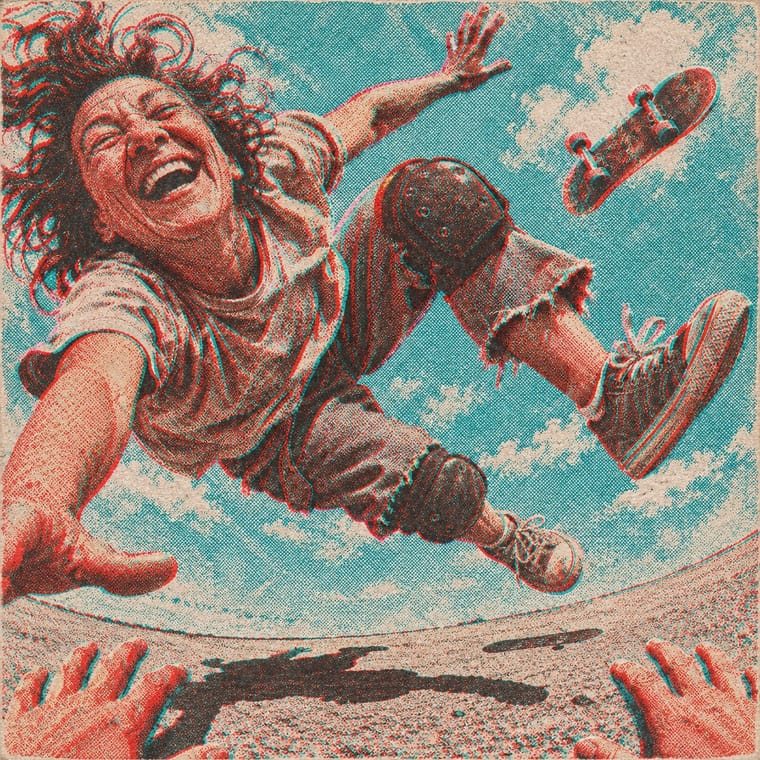
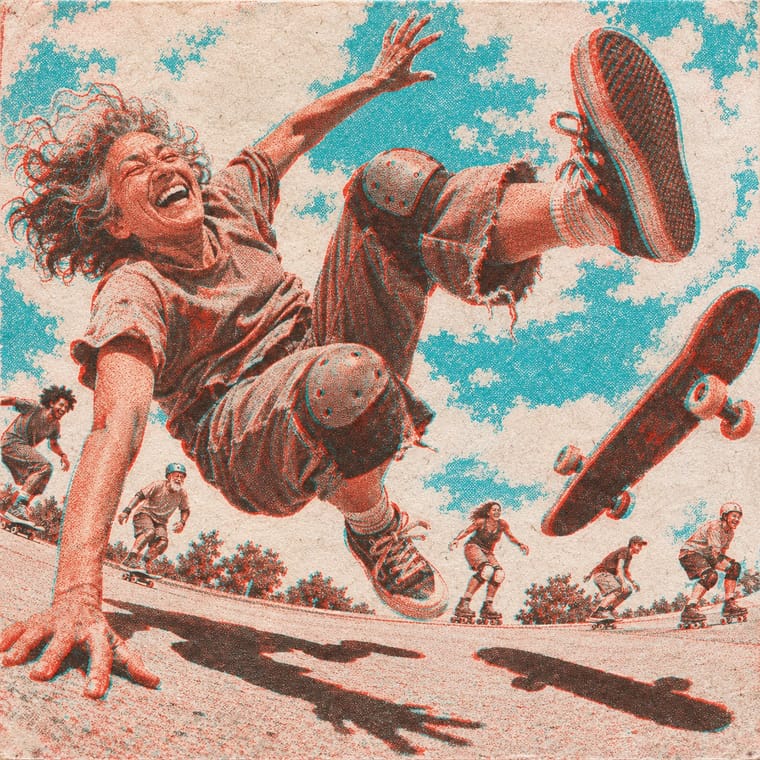
Point of view We lie where the skater is about to land, and the skater is laughing, so the fall is the good part. -
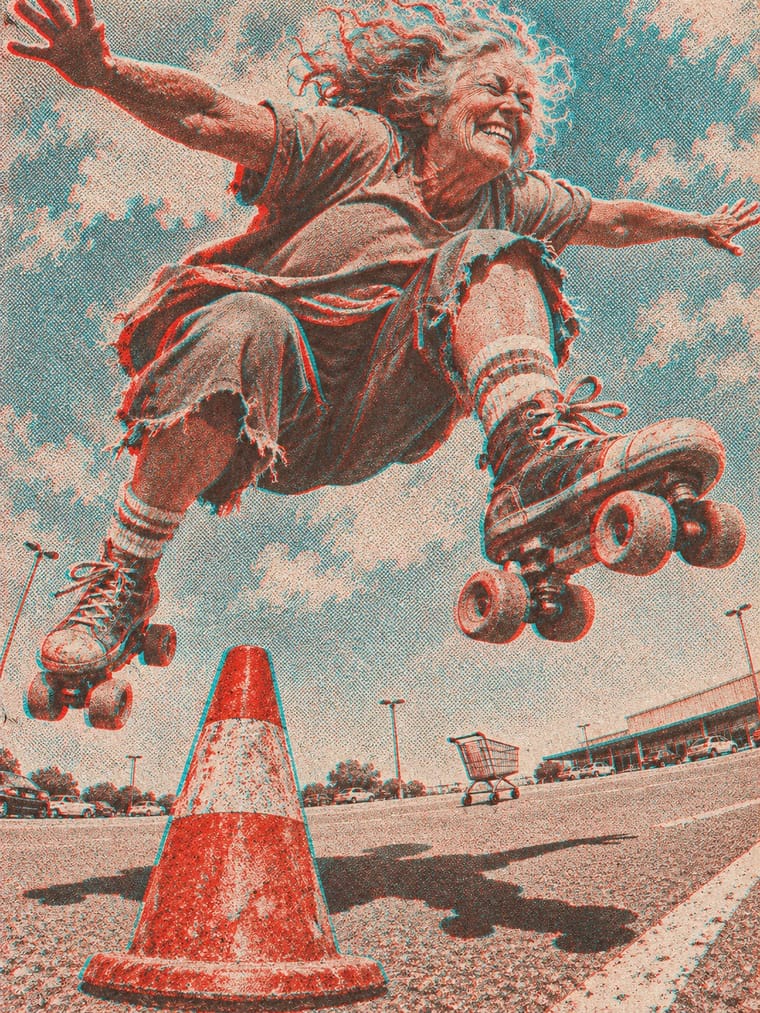
Power angle Seen from the tarmac she fills the sky, and the trolley she left behind rolls away small at the horizon. -
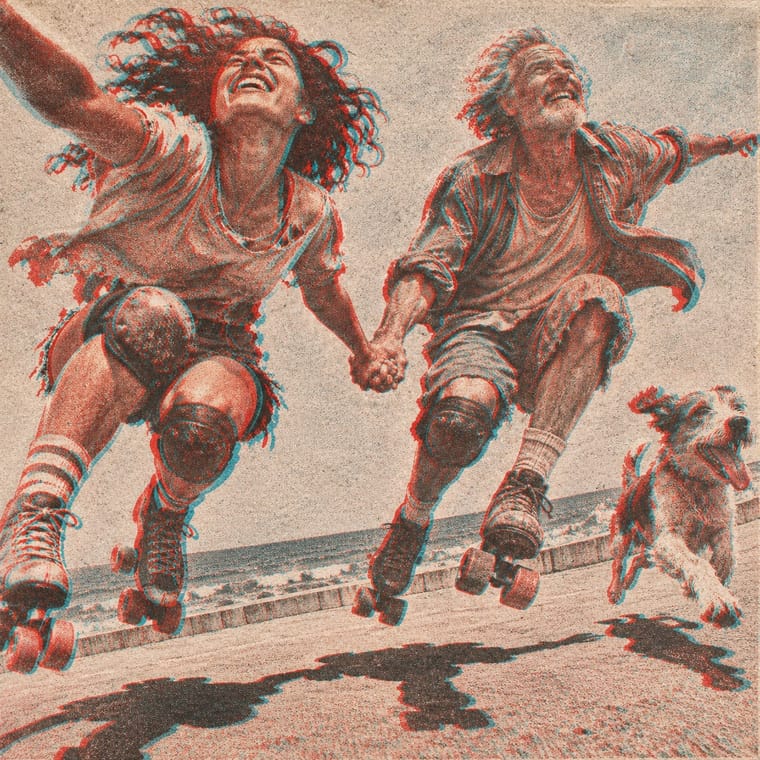
Looking ahead Both look past the lens at what is coming, so we stand where they are about to be.
AI-generated: Stereo Skate with an idea put on it. Not a real or historical work.
Change it with an idea. Any of the 73 moves that make a design say something can go on this style.
04
Its design choices
From Stylogeny’s vocabulary of design choices: defining choices make the style, characteristic ones are usual, occasional ones turn up now and then.
- Layout & composition
- Space & hierarchy
- Surface & texture
- Ornament
- Imagery
- Medium & production
- Tone & intent
- Avoids
- Full polychrome, Gradients, Gloss & highlights, Flat vector illustration, Comic & cartoon, Abundant decoration, Luxurious & glamorous
How its pictures are made Photographic, light, viewpoint, lens, pose, finish
Kind of picture: Photographic How they are made, from the questions Stylogeny asks of that kind:
- Light
-
- Hard, direct sun defining
- Hard-edged shadows characteristic
- Cast shadows as shapes characteristic
- Viewpoint
-
- Low angle defining
- Close & intimate characteristic
- Tilted angle occasional
- Lens
-
- Fisheye defining
- Frozen instant defining
- Deep focus occasional
- Pose
-
- Jumping & mid-air defining
- Fast, full-body movement characteristic
- Emotion shown openly occasional
- Crouching, squatting & kneeling occasional
- Finish
-
- Visible grain characteristic
- Scratches, dust & decay occasional
What new pictures of it show
Subjects Stylogeny draws it with, each taken from a kind of real work the style was made for.
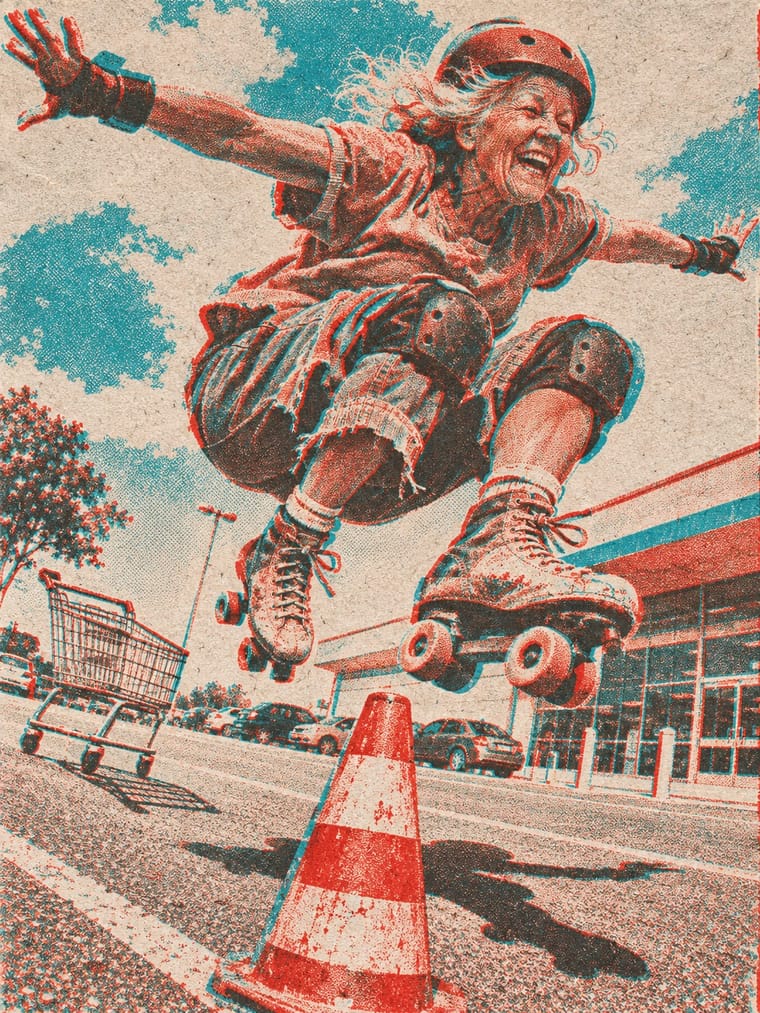
- poster A woman of sixty on roller skates jumping a traffic cone in a supermarket car park, arms out, a shopping trolley rolling away behind her
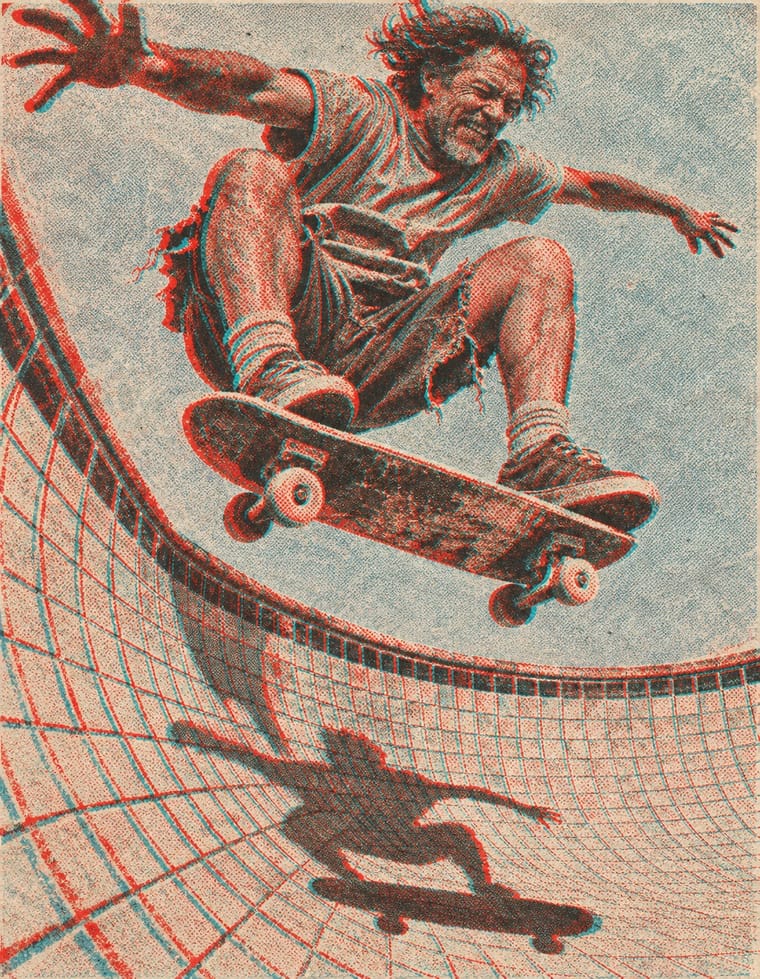
- magazine cover A skateboarder in his forties at the lip of a drained swimming pool, board in the air under his feet, the pool tiles bending round him
- record sleeve Two roller skaters holding hands at speed along a seafront promenade, hair flying, a dog running beside them
- event flyer A skater of seventy in a cardigan and knee pads sliding a handrail down a library's steps, his hat in mid-air behind him
- album cover A fall taken laughing: a skateboarder mid-tumble, board spinning away, seen from the ground with the sky filling the lens
- poster A roller rink from the middle of the floor, six skaters of all ages leaning into the turn around the lens
- zine Close on four wheels and a worn shoe leaving a kerb, grit flying, the street curving off on both sides
05
What it’s close to
One of our own styles: Stylogeny made it from its own design choices, so no earlier style is claimed.
Stereo Skate Made 2026
No later style in the atlas grew out of it yet.
Alike in its design choices
06
Often taken for
stereo-skate has no real works recorded yet, so these are its nearest styles by its choices alone, with the choices that tell them apart.
-
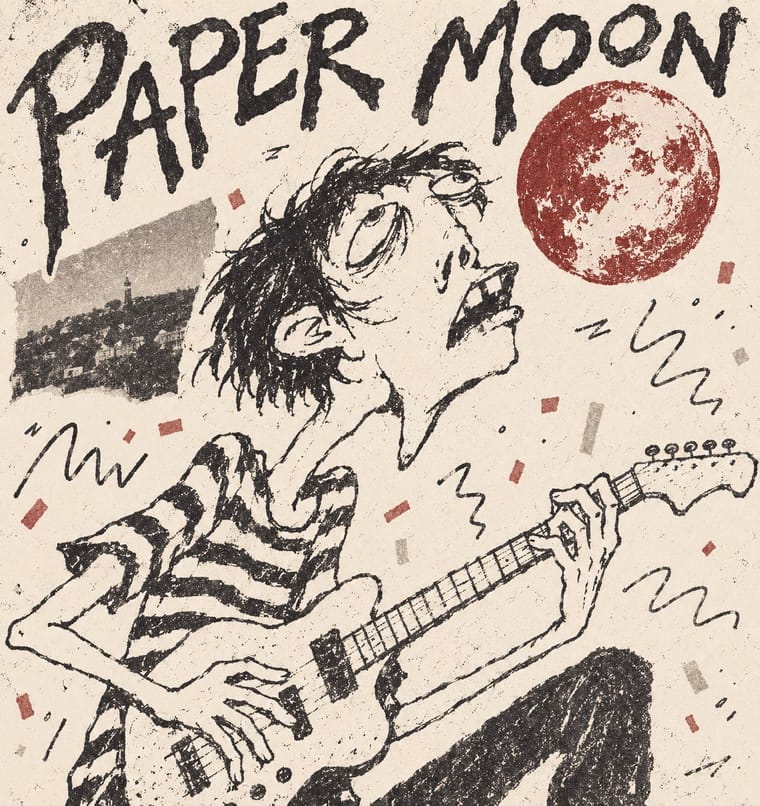
Flying Nun DIY Sleeves (Dunedin Sound Cover Art)
Flying Nun DIY Sleeves is one of stereo-skate’s nearest styles by choices; no real work of either fits the other better.
Choices that tell Stereo Skate and Flying Nun DIY Sleeves apart Choice Stereo Skate Flying Nun DIY Sleeves Complementary clash defining — Comic & cartoon avoids characteristic Misregistration & overprint defining — Line illustration — defining Full bleed defining occasional No shared descent in the atlas: they reached these choices separately.
-
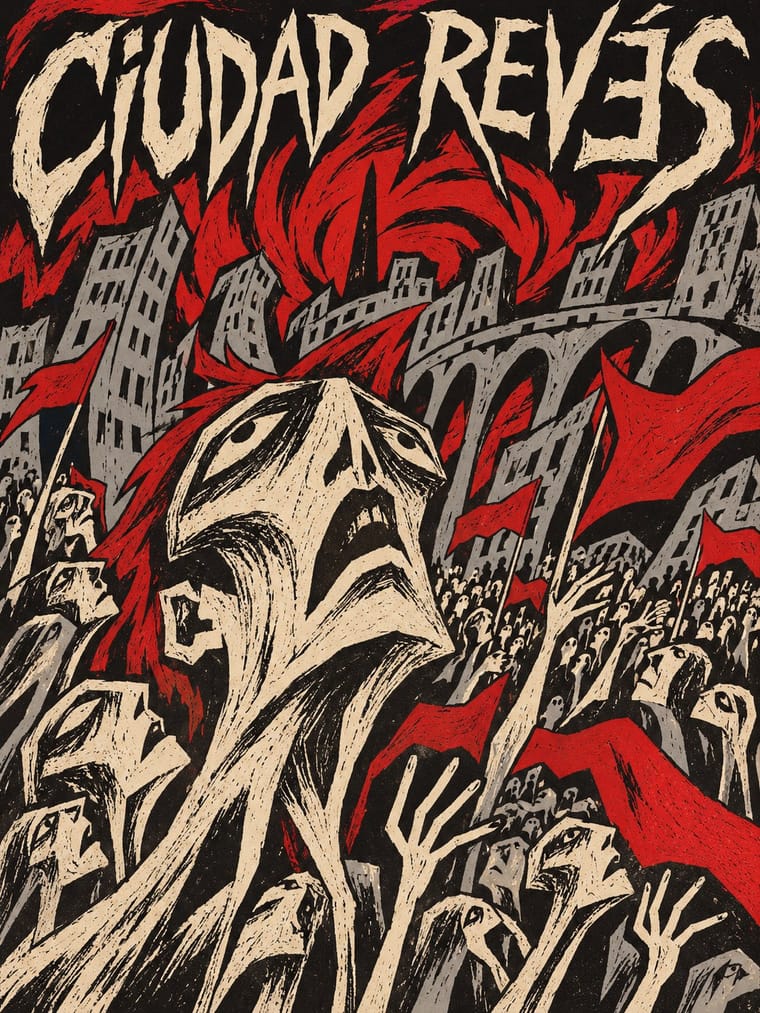
Rocambole's Ricotero Rock Graphics
Rocambole's Ricotero Rock Graphics is one of stereo-skate’s nearest styles by choices; no real work of either fits the other better.
Choices that tell Stereo Skate and Rocambole's Ricotero Rock Graphics apart Choice Stereo Skate Rocambole's Ricotero Rock Graphics Complementary clash defining — Hand-lettering occasional defining Treated photography defining — Dark ground — characteristic Misregistration & overprint defining — No shared descent in the atlas: they reached these choices separately.
-
Hauntology & Ghost Box Design
Hauntology & Ghost Box Design is one of stereo-skate’s nearest styles by choices; no real work of either fits the other better.
Choices that tell Stereo Skate and Hauntology apart Choice Stereo Skate Hauntology Complementary clash defining — Flat fields — defining Misregistration & overprint defining occasional Found & vernacular imagery — defining Distortion & exaggeration characteristic — No shared descent in the atlas: they reached these choices separately.
-
Surrealist Graphics
Surrealist Graphics is one of stereo-skate’s nearest styles by choices; no real work of either fits the other better.
Choices that tell Stereo Skate and Surrealist Graphics apart Choice Stereo Skate Surrealist Graphics Complementary clash defining — Gradients avoids characteristic Limited spot colours defining — Collage & layering — defining Misregistration & overprint defining — No shared descent in the atlas: they reached these choices separately.
— means the choice isn’t among the style’s recorded choices. Critics recorded each work’s choices with the styles’ descriptions in view, so this shows whether the descriptions hold together, not proof that they are right.