One of our own styles · made in 2026
Stamp Stroke
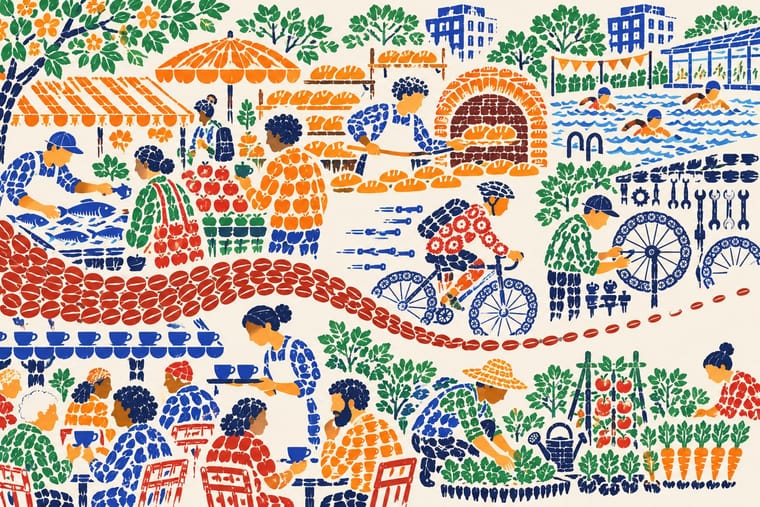
Scenes painted with a brush that stamps one small, simple object along each stroke: the sea in sweeps of little fish, a baker's apron in dabs of tiny loaves, a night sky in trails of stars. Each stamp is a flat silhouette, turned to follow the stroke, packed where the brush pressed and thinning to a tail where it lifted, in complementary inks on bare paper. From across the room it is a loose painting; close up, a heap of things. For shops, makers, markets, cafés and festivals.
Make something in this style Get advice in this style Mix it with another style
Use it with care
It paints a place in the things it holds: never stamp a scene in objects that mock the people in it, never use a person's body, food or faith as a stamp for a joke about them, and show no real shop, brand, logo or person. Its pictures are made by an image model: label them as generated and never pass one off as a hand-painted or hand-stamped original.
01
Its picture in other colours
Change a colour and every picture on this page follows. It happens in your browser, from the same pictures: nothing new is made or saved.
Choose a colour to change it
-
#f4efe4 -
#2440b8 -
#f07a24 -
#d8402f -
#2f8a57 -
#1b2346
A faded colour isn’t in these pictures, so changing it changes nothing.
Light and dark stay where they are; greys hardly move.
More colours: any style’s, or your own
The pictures show the style’s own colours.
02
Make something in this style
Say what you need, and Stylogeny’s image studio draws it from Stamp Stroke’s design choices and checks it against them. It takes about a minute, and you get a link to share.
03
How it works
Palette
-
#f4efe4ground · 45% -
#2440b8accent · 3% -
#f07a24accent · 10% -
#d8402faccent · 4% -
#2f8a57accent · 3% -
#1b2346ink · 2%
Shares measured from its 9 pictures. The ground is what the pictures sit on (of the colours covering most, the most neutral), the ink stands out from it most, the rest are accents.
Typefaces
-
Rubik
-
A rounded sans, set small in the picture's quiet patch of paper in its darkest ink, one short line
Who is in it. One place and its own people at a time: a fishmonger at her stall, a baker at his counter, a cyclist on her road, two regulars at a café table, women and men from twenty to eighty of every build, skin and background, in their own work clothes, aprons, rain jackets and trainers. They are painted as loosely as everything else, in a few dabs of stamps, absorbed in what they do, and never pose or look at us. Many pictures have no people at all, only a place or a thing.
Direction
- What it says
- Everything is painted with what it is made of or what it is for, so a picture is a painting of a place from across the room and its inventory up close.
- Performance
- People keep working and moving as if nobody were painting them: a hand mid-reach, a body leaning into the pedals, a head bent over a counter. They wear their own work clothes and are stamped in the objects of their own trade.
- Set
- One real working place of today per picture, and only that place: the stall and the harbour behind it, the bakery counter and its shelves, the pool and its edge. No other trade, street or crowd is squeezed in around it, and the stamps on every surface come from what that place holds.
- Light
- Daylight from one side, shown only by the stamps: dense strokes of the darker complementary ink cross the shadows, sparse strokes of the brighter ink lie in the light, and bare paper is left for the brightest spots, a window, a white apron, the sun on water.
- Camera
- The painter stands where a passer-by would: at eye level across a counter, on the pavement looking down a street, over a table from above. Never a dramatic low angle, never a fisheye.
- Frame
- The scene fills the sheet but its strokes stop short of the edges in loose tails, so the paper frames it. One patch of sparse, quiet strokes is left for the eye to rest, and any given line goes there.
- Moment
- The middle of the work or the day: bread coming out, a fish being weighed, a wheel spinning on a stand. Never an empty, staged place before anyone came.
- Finish
- Flat silhouette stamps in one pair of complementary inks plus navy on off-white paper, each stamp crisp-edged and in one ink, jittered a little in size, angle and shade. No gradient, no smooth paint, no outline, no texture filter laid over it.
- A set of pictures
- A set has two wides of a place, two mediums of one or two people at work, one close of a face or hands, one detail of a single stroke whose stamps can be counted, and one lone object on bare paper, each stamped in its own place's things.
- Never
- No smooth brush paint or filled area anywhere, no mosaic or wallpaper fill, no outline drawing, no photograph, no gloss or 3D shading on a stamp, no second place or panorama of a whole town, no stamp from the wrong world (no fish on a baker), and no lettering but the line given.
- Paint everything with strokes whose only mark is one small, simple object stamped over and over along the stroke, such as a bean, a button, a leaf, a little fish, a star, a key or a cup. A picture is a few dozen strokes the eye can follow one by one, each with a packed start and a thinning tail, laid in different directions with bare off-white paper showing between them; no area is ever filled edge to edge like a mosaic, a tiling or a wallpaper pattern, and there is no smooth paint, flat fill or outline anywhere.
- Each stroke behaves like a real brush loaded with one object: the stamps overlap thickly where the brush pressed down, turn to follow the curve of the stroke, and shrink and spread apart into a thin tail where it lifted, with a slight jitter in size, angle and shade from stamp to stamp. Long sweeping strokes lay in skies, water and walls, short dabs build faces and hands, and crossing strokes in a darker ink make the shadows. Shapes are found by the strokes, never drawn with a contour first.
- Each picture shows one place and nothing of anywhere else, and its objects come from that place, one kind of object per stroke and three to five kinds per picture: a fishmonger's sea is stamped in little fish, a baker's flour in tiny loaves, a cyclist's road in bolts and washers. Every stamp is a flat, solid silhouette in one ink that reads as what it is when you look close, never a detailed or shaded drawing. Each picture is built on one pair of complementary inks, ultramarine against orange or red against green, the strokes of one crossing the strokes of the other so they vibrate where they meet, with dark navy for the deepest shadows and the off-white paper for the light.
- From across the room a picture reads as a quick, loose painting of a scene; only up close does the eye find that the strokes are things. Keep the stamps small enough that the scene wins at a glance, about a fortieth of the picture's width, and let them grow only in a close-up or a detail.
- Scenes vary in distance and number: a wide market street, two people at a counter, one face close, a pair of hands at work, one object alone on the paper; seen from the pavement, across a counter, from above a table or from a seat on a tram.
- For a client, take the stamps from what the client sells or makes, so the picture is also its inventory. A crop of one corner, all trails of one object, makes a pattern for packaging, a wall, a tote or a website's background.
A studio style: made by Stylogeny, not a documented movement.
With an idea put on it
-
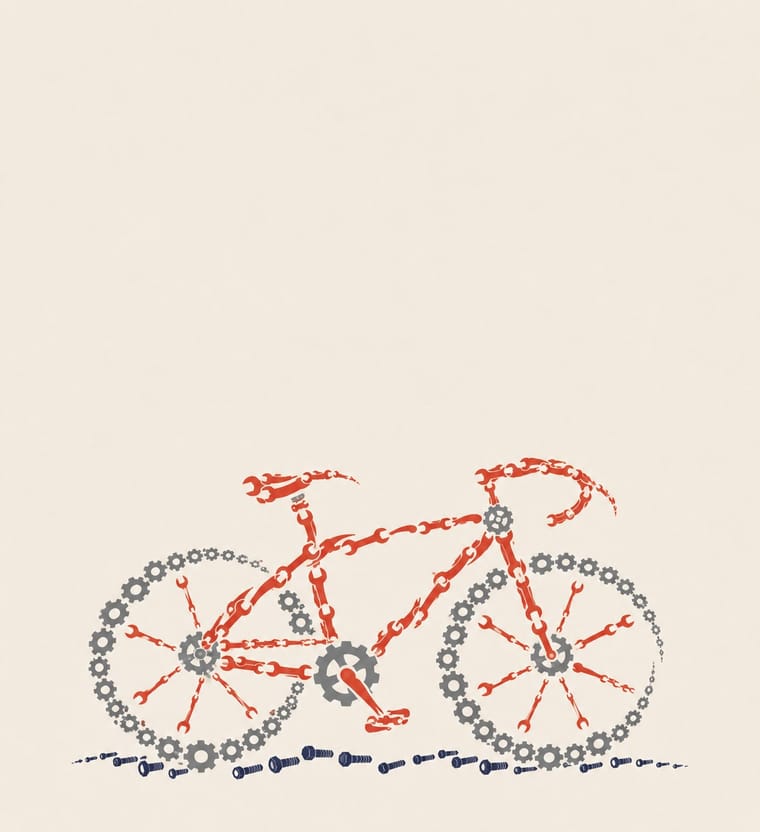
Isolation Alone on the bare paper, the bike shows it is made of the workshop's own tools, so it was built and kept by hand. -
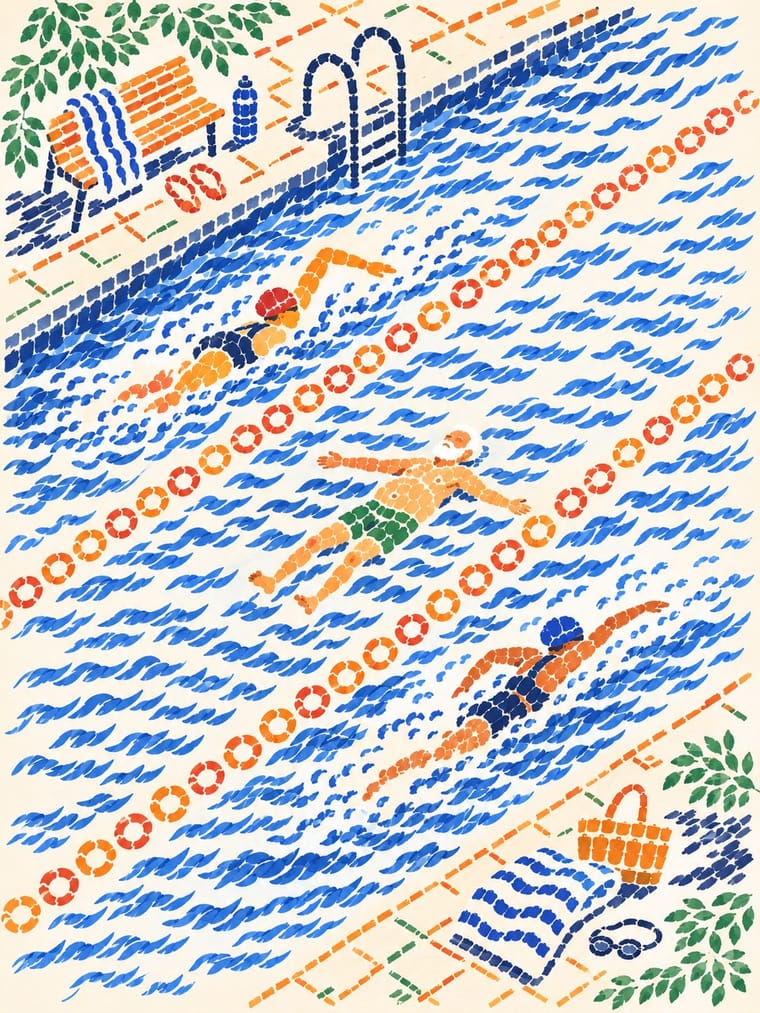
Odd one out Two swimmers race and one man floats, so the pool is for doing nothing as well. -
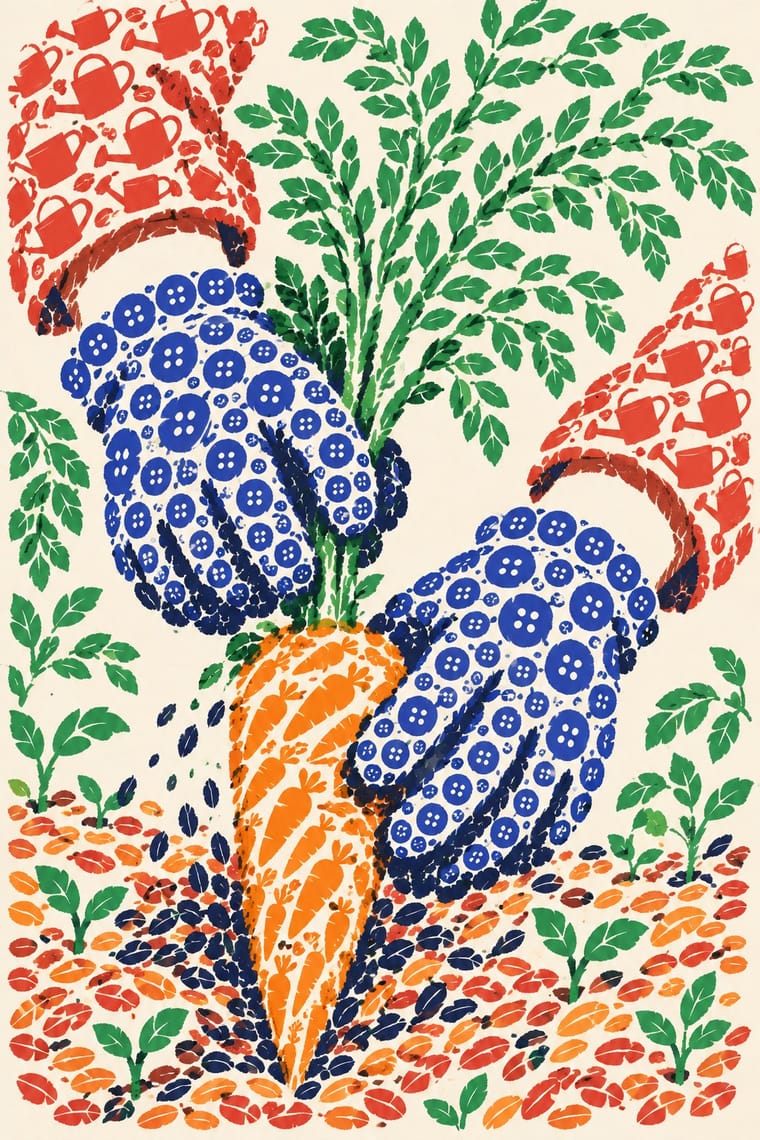
Part for the whole Two hands and one carrot stand for the whole allotment and the season it took. -
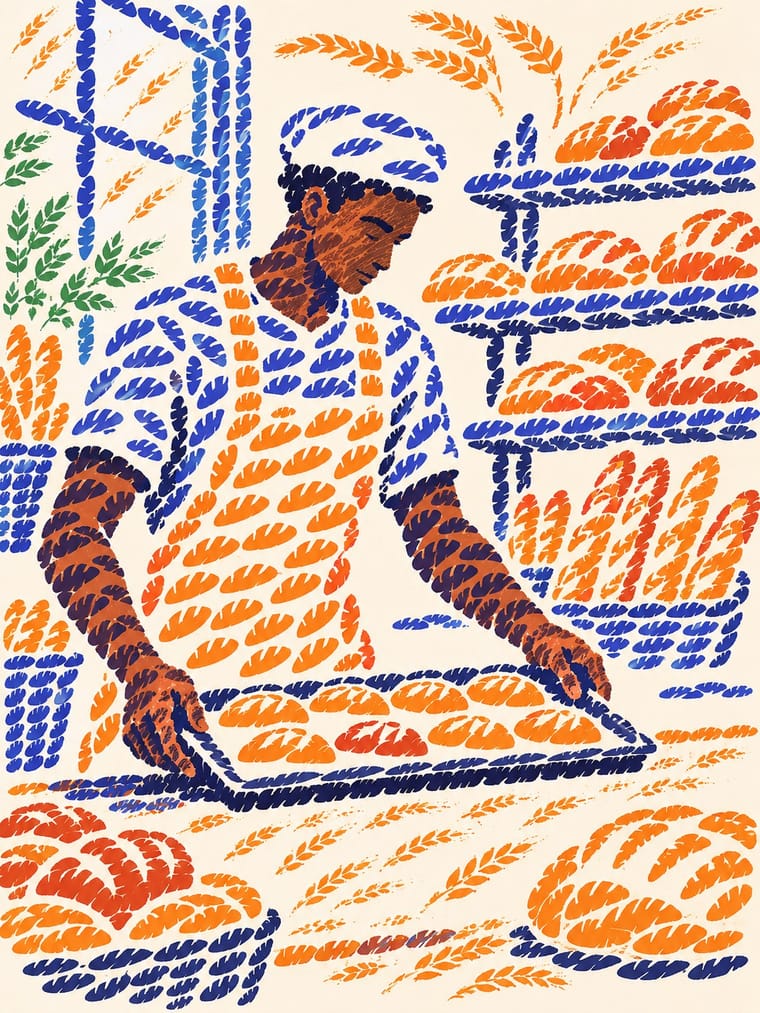
Composite figure The baker's own apron and arms are stamped in little loaves, so the person and the bread are made of the same thing. -
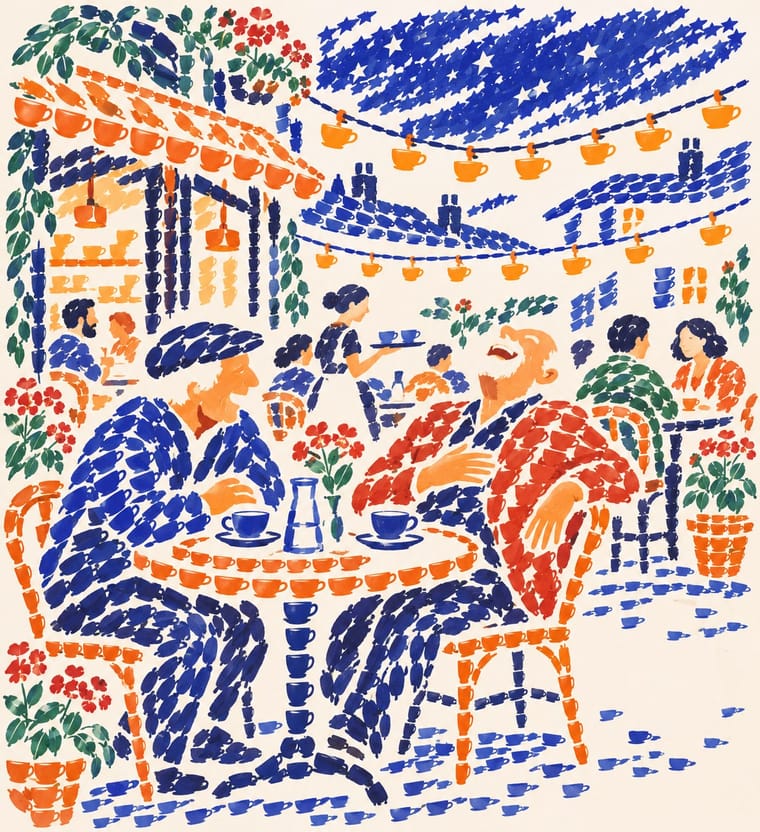
Telling gesture One friend laughs with his head thrown back, so the evening at the terrace is about the company. -
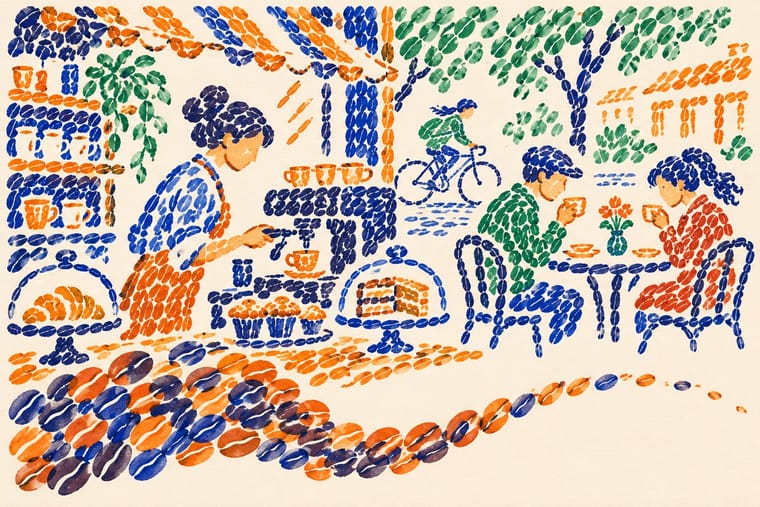
Movement in a still One stroke of beans shows the gesture that made it, so the label carries a hand, not a logo. -
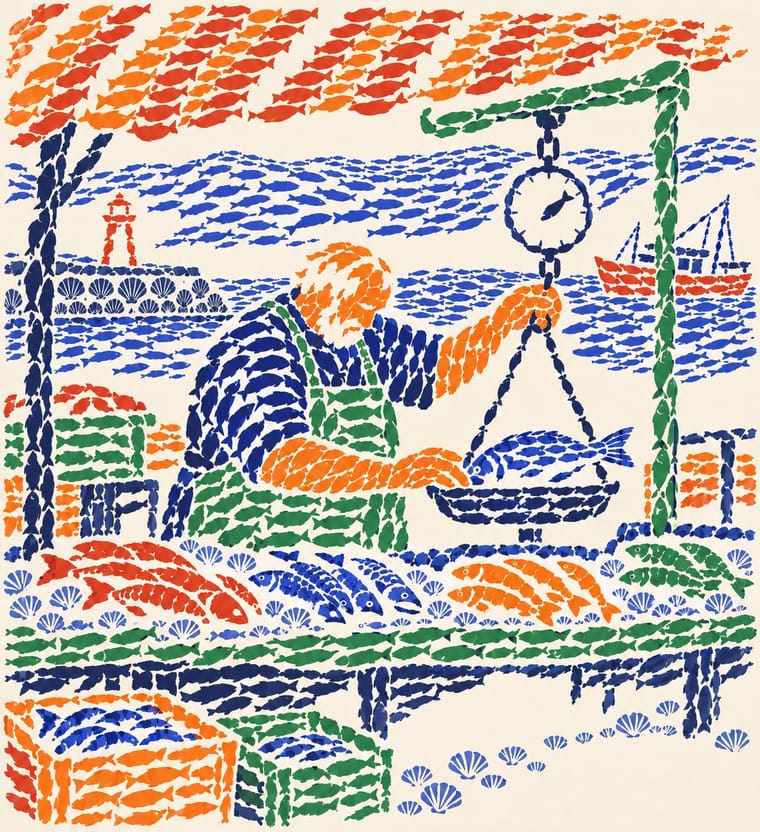
Made of something else The sea behind the stall is painted in the very fish on the ice, so the catch and where it came from are one thing. -
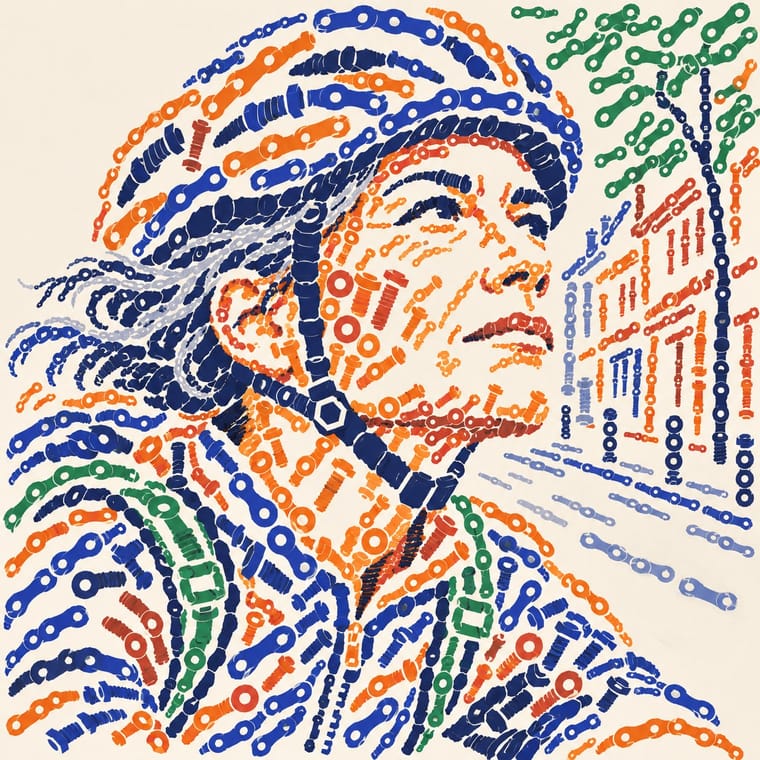
Looking ahead She looks past us to the road ahead, and the bolts she is made of say she and the bike are one machine.
AI-generated: Stamp Stroke with an idea put on it. Not a real or historical work.
Change it with an idea. Any of the 73 moves that make a design say something can go on this style.
04
Its design choices
From Stylogeny’s vocabulary of design choices: defining choices make the style, characteristic ones are usual, occasional ones turn up now and then.
- Layout & composition
- Space & hierarchy
- Typography
- Colour
- Surface & texture
- Ornament
- Imagery
- Medium & production
- Avoids
- Straight photography, 3D render, Line illustration, Gloss & highlights, Chrome & 3D render, Glitch, Gradients, Fluorescent & neon, Abundant decoration
How its pictures are made Drawn & painted, light, viewpoint, pose, made with, figures
Kind of picture: Drawn & painted How they are made, from the questions Stylogeny asks of that kind:
- Light
-
- Flat form defining
- Raking side light characteristic
- Blown highlights occasional
- Viewpoint
-
- Eye level characteristic
- Middle distance characteristic
- Overhead & flat lay occasional
- Pose
-
- Absorbed in a task defining
- Eyes lowered or closed characteristic
- Looking away occasional
- Made with
-
- Digital painting defining
- Figures
-
- Faceless & simplified features characteristic
- Naive & untrained occasional
What new pictures of it show
Subjects Stylogeny draws it with, each taken from a kind of real work the style was made for.
- poster A fish market stall by the harbour: the sea behind in long ultramarine sweeps of little fish, the ice in sparse dabs of shells, a broad fishmonger in his sixties in a rubber apron weighing a fish
- menu cover A bakery counter in the morning: the loaves stamped in tiny loaves, the flour dust in white dabs of wheat ears, a tall young baker with dark skin in a white cap sliding a tray onto the counter
- social media post A cyclist's face close, a slim woman of forty with grey-streaked hair under a helmet, her cheeks and hair stamped in tiny bolts, washers and chain links, a city street behind in loose strokes
- packaging label One long stroke of coffee beans across bare paper: packed and overlapping where the brush pressed, turning in a curve, shrinking to single beans where it lifted
- poster An outdoor pool on a hot day seen from above: the water in long blue strokes of little waves, the lanes in dabs of rubber rings, two swimmers in caps doing lengths and one older man floating
- invitation A café terrace at dusk: the sky in long navy strokes of little stars, the strung lamps in orange dabs of small cups, two old friends of seventy at a round table, one laughing with his head back
- book cover A gardener's two hands in soil, pulling up a carrot: the soil stamped in seeds, the leaves in little green leaves, the gloves in buttons
- poster One red bicycle alone on bare paper, laid in a dozen quick brushstrokes of tiny red spanners and grey cogs, each stroke thinning to a tail, a short shadow of dark blue bolts under it
05
What it’s close to
One of our own styles: Stylogeny made it from its own design choices, so no earlier style is claimed.
Stamp Stroke Made 2026
No later style in the atlas grew out of it yet.
Alike in its design choices
06
Often taken for
stamp-stroke has no real works recorded yet, so these are its nearest styles by its choices alone, with the choices that tell them apart.
-
Kerala Political Wall Writing
Kerala Political Wall Writing is one of stamp-stroke’s nearest styles by choices; no real work of either fits the other better.
Choices that tell Stamp Stroke and Kerala Political Wall Writing apart Choice Stamp Stroke Kerala Political Wall Writing Stylised figuration defining — Extreme scale contrast — defining Complementary clash characteristic — Hand-lettering — defining Painterly illustration characteristic — No shared descent in the atlas: they reached these choices separately.
-
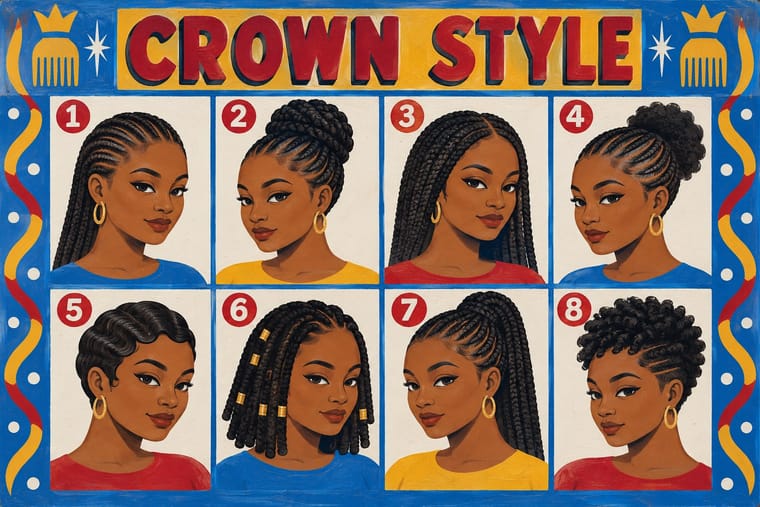
West African Barbershop & Hair Salon Signs
West African Barbershop & Hair Salon Signs is one of stamp-stroke’s nearest styles by choices; no real work of either fits the other better.
Choices that tell Stamp Stroke and West African Barbershop apart Choice Stamp Stroke West African Barbershop Light ground defining occasional Modular grid — defining Complementary clash characteristic — Hand-lettering — defining Limited spot colours characteristic — No shared descent in the atlas: they reached these choices separately.
-
Fribourg Poya Procession Painting
Fribourg Poya Procession Painting is one of stamp-stroke’s nearest styles by choices; no real work of either fits the other better.
Choices that tell Stamp Stroke and Fribourg Poya Procession Painting apart Choice Stamp Stroke Fribourg Poya Procession Painting Horror vacui occasional avoids Sequential narrative — defining Light ground defining occasional Earth & mineral — characteristic Complementary clash characteristic — No shared descent in the atlas: they reached these choices separately.
-
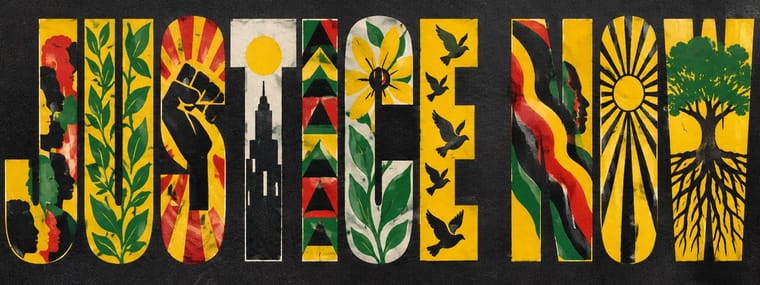
Black Lives Matter Street Murals
Black Lives Matter Street Murals is one of stamp-stroke’s nearest styles by choices; no real work of either fits the other better.
Choices that tell Stamp Stroke and Black Lives Matter Street Murals apart Choice Stamp Stroke Black Lives Matter Street Murals Light ground defining — All caps — defining Complementary clash characteristic — Type as image — defining Pictogram characteristic — No shared descent in the atlas: they reached these choices separately.
— means the choice isn’t among the style’s recorded choices. Critics recorded each work’s choices with the styles’ descriptions in view, so this shows whether the descriptions hold together, not proof that they are right.