Postmodern · 2004–present · Western Europe
Hauntology & Ghost Box Design
Also known as Hauntology, Ghost Box aesthetic, Hauntological design
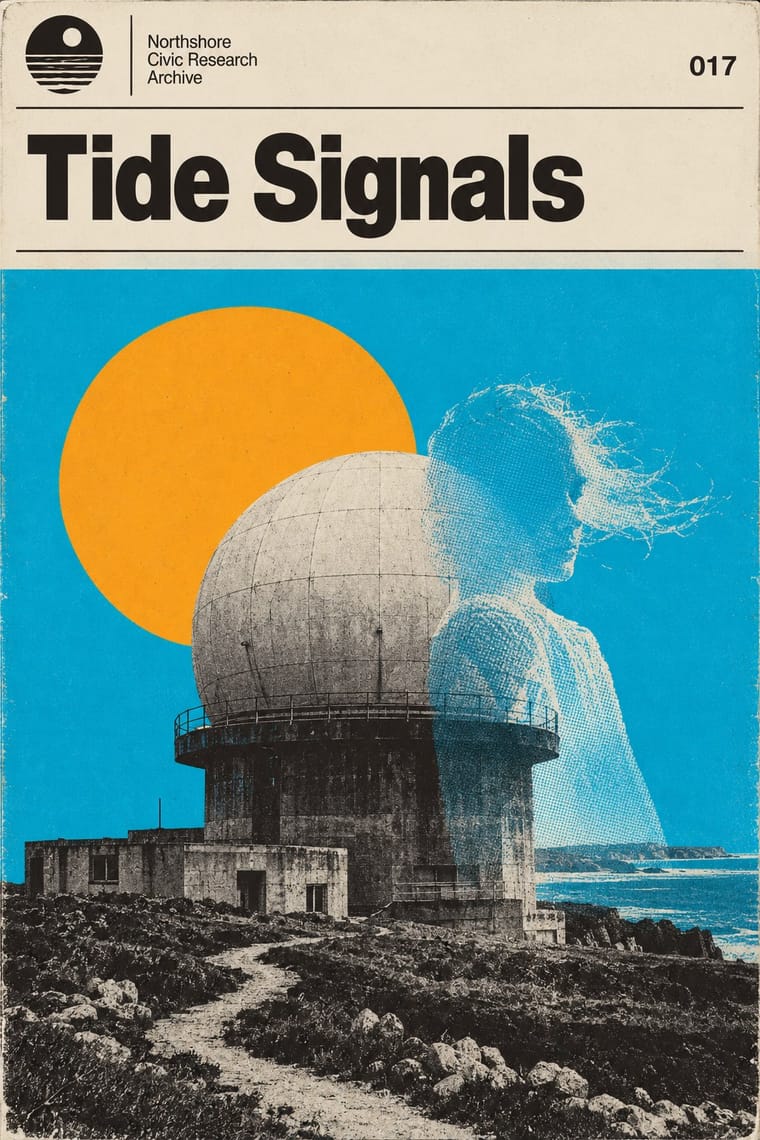
Sleeves and print that rebuild a misremembered British past from the public graphics of roughly 1958–1978. At Ghost Box, founded in London in 2004, Julian House gave every release one template after the Penguin paperback grid and library-music LPs: bold grotesque type in a ruled Penguin-style band over a single saturated colour field and an eerie collage of textbook, science and occult imagery. Reynolds and Fisher called it hauntology; Richard Littler's Scarfolk turned it into sinister public-information posters.
Make something in this styleGet advice in this styleMix it with another style
Use it with care
The Ghost Box sleeves and logo, Littler's Scarfolk images and Frances Castle's Clay Pipe sleeves are in copyright, and much of what they imitate (Penguin covers, government public information posters, textbook illustrations, archive photographs) has its own rights holders: build a new fictional institution from public-domain or licensed material rather than copying a Ghost Box sleeve or Penguin's trade dress.
01
How it works
- Invent an institution and dress every release as one volume of its series, after the front-cover grid of Penguin paperbacks, university course books and the numbered, faintly institutional sleeves of library music. Fix one cover template: a ruled strip at the top with the label roundel at left and the catalogue number at right, then a horizontal title band with the artist line, separated by thin rules. Change only the colour, the title and the picture, and let size and alignment drift a little from release to release.
- Set the title large and bold in an old, plain grotesque such as Monotype Grotesque, rather than Helvetica, inside the Penguin-like horizontal band, and set back covers and booklets in Clarendon, with track lists, catalogue numbers and a footnoted quotation.
- Build the picture as a clunky, eerie collage of found material (textbook and science diagrams, cut-out archive photographs, eyes, circles, triangles and dot grids, occult and science-fiction motifs) and either isolate it on the flat coloured field or run it full bleed beneath the title band.
- Age the picture rather than the print: on the early sleeves the offset printing and flat colour are crisp, and the age sits in the grain and halftone of the archive photographs and, on single releases, in a corroded or overexposed display face. Keep misregistered overprints and worn paper for later sleeves such as Entropicalia and for Scarfolk's distressed parodies.
- Make it familiar and slightly wrong: impersonate public-service modernism (school books, public information films and posters, television idents, library records) and let in a trace of the cosmic horror and pastoral uncanny of Arthur Machen and Algernon Blackwood, never as straight revival or as camp.
London: Ghost Box, the record label that the producer Jim Jupp and the graphic designer Julian House (a member of the design company Intro) established in 2004 and formally launched on 10 January 2005. In the mid-2000s the critics Simon Reynolds and Mark Fisher applied Jacques Derrida's term 'hauntology' (Specters of Marx, 1993) to the label and its circle.
02
Its design choices
From Stylogeny’s vocabulary of design choices: defining choices make the style, characteristic ones are usual, occasional ones turn up now and then.
- Layout & composition
- Space & hierarchy
- Typography
- Colour
- Form & shape
- Surface & texture
- Ornament
- Imagery
- Tone & intent
- Avoids
- Gloss & highlights, Chrome & 3D render, Glitch, Gradients, 3D render, Script, Abundant decoration, Horror vacui, Iridescent & holographic
Palette
#efe9d8#1e1b18#f9a61a#01b2de#d51a21#8e3419
Typefaces
Monotype Grotesque (MT Grotesque), the main face of the Ghost Box front covers, chosen over Helvetica
Clarendon (Bitstream's cut) on Ghost Box back covers and booklets
Period display faces on single releases within the template
ITC Avant Garde Gothic (Belbury Poly, From an Ancient Star), Albertus, Countdown and Eurostile
Jean Midolle's Alphabet Lapidaire Monstre, used for decorated capitals on The Transactional Dharma of Roj
Motter Tektura with Clarendon and Eurostile on The Belbury Circle's Outward Journeys
2017
Known for
Julian House, designer of the Ghost Box sleeves and recording artist as The Focus Group, Sketches and Spells
Ghost Box GBX002, 2005
Belbury Poly (Jim Jupp), Farmer's Angle (Ghost Box GBX001, a three-inch CD) and The Willows (GBX003, 2005), shown beside House's account of the 'Penguin paperback-style grid' that made the records 'feel like part of a series'
Belbury Poly, From an Ancient Star (Ghost Box GBX011, 2009), its title set in ITC Avant Garde Gothic
The Advisory Circle (Cate Brooks), From Out Here (Ghost Box GBX021, 2014), whose cover drew on 1970s computer magazines and music-education textbooks
Broadcast and The Focus Group Investigate Witch Cults of the Radio Age (Warp, October 2009), House's collaboration with Broadcast, whose artwork and packaging he had designed before
Julian House, posters, studio ephemera and the film-within-a-film credit sequence for Peter Strickland's Berberian Sound Studio
2012
Plone, Puzzlewood (Ghost Box GBX034, 2020), for which House looked at the posters of Tadanori Yokoo and Keiichi Tanaami, Push Pin Studios and Eduardo Paolozzi's Moonstrips Empire News
Frances Castle, all the sleeves for Clay Pipe Music
the label she founded in London in 2010, for themed records such as Gilroy Mere's The Green Line, a requiem for the Green Line buses, and the anonymous Tyneham House, on the requisitioned Dorset village; the label is often described as folkloric, pastoral, spectral and hauntological
03
Make something in this style
Say what you need, and Stylogeny’s image studio draws it from Hauntology & Ghost Box Design’s design choices and checks it against them. It takes about a minute, and you get a link to share.
04
Where it comes from, and what it’s close to
Before it
The style it grew out of, and the styles it borrowed from.


After it
The styles that grew out of it.
No later style in the atlas grew out of it yet.
Alike in its design choices
Styles that make many of the same choices, related or not, besides those above.


05
Sources
- Simon Reynolds, 'Spirit of Preservation' (written as 'Hauntology: the Ghost Box label'), Frieze, October 2005, reposted on Reynolds's blog: https://reynoldsretro.blogspot.com/2017/10/hauntology-ghost-box-label-frieze-2005.html
- K-Punk (Mark Fisher), 'Interview: Belbury Poly', FACT, 4 February 2009, with Jim Jupp on the 'all at once' Ghost Box world of popular culture from 1958 to 1978: http://www.factmag.com/2009/02/04/interview-belbury-poly/
- Vel Ilic, 'Ghost Box: Unearthly Realms', Electronic Sound, 14 September 2023: https://www.electronicsound.co.uk/features/long-reads/ghost-box-unearthly-realms
- Love Lagerkvist, 'Ghost Box Records #01–20 (2004–2014)', Fonts In Use, 15 January 2018: https://fontsinuse.com/uses/18461/ghost-box-records-01-20-2004-2014
- Fonts In Use, Julian House (designer page): https://fontsinuse.com/designers/7347/julian-house
- MusicBrainz, Plone, Puzzlewood (Ghost Box GBX034LP, GBX034CD, 17 April 2020): https://musicbrainz.org/search?query=Plone+Puzzlewood&type=release&method=indexed
- Wikipedia, Ghost Box Records: https://en.wikipedia.org/wiki/Ghost_Box_Records
- Wikipedia, Hauntology (music): https://en.wikipedia.org/wiki/Hauntology_(music)
- Wikipedia, Julian House: https://en.wikipedia.org/wiki/Julian_House
- Wikipedia, Scarfolk: https://en.wikipedia.org/wiki/Scarfolk
- Wikipedia: Belbury Poly; The Advisory Circle; Broadcast and the Focus Group Investigate Witch Cults of the Radio Age
- Mark Fisher, Ghosts of My Life: Writings on Depression, Hauntology and Lost Futures (Zer0 Books, 2014)
- Neil Mason, 'Clay Pipe Music', Electronic Sound, 14 November 2019: https://www.electronicsound.co.uk/?p=6927
- Bob Fischer, 'The Art of Clay Pipe Music', The Haunted Generation, 13 July 2019: https://hauntedgeneration.co.uk/2019/07/13/the-art-of-clay-pipe-music/
- Colours May Vary, 'The Art of Clay Pipe by Frances Castle', exhibition, Leeds, 5 July–1 August 2019: https://coloursmayvary.com/blogs/past-events/the-art-of-clay-pipe-by-frances-castle-july-5th-august-1st-2019
How Stylogeny researches and checks a style: where the facts come from.