One of our own styles · made in 2026
Pinned Tissue
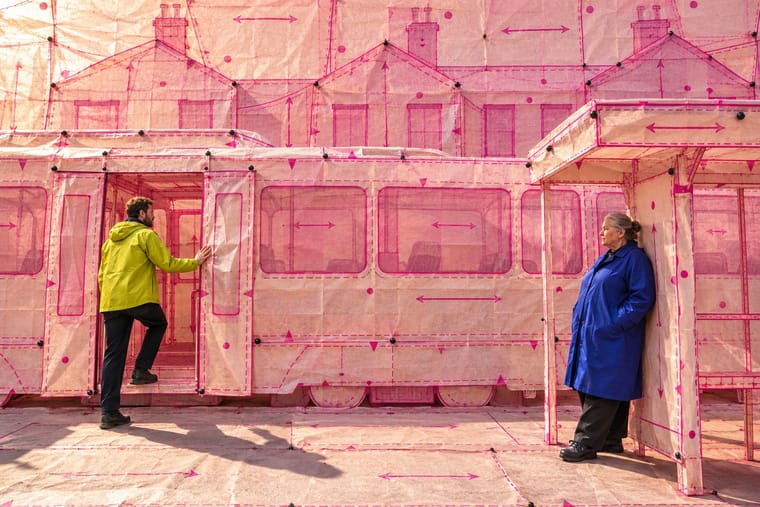
A world still at the dressmaker's pattern stage: every house, tram, tree and stall is full-size pattern tissue, thin crisp paper you can see through, printed with fuchsia cutting lines, notches and dots and held with round-headed pins. Only the people are finished: solid and in loud chartreuse or deep cobalt, they lean on, ride and smooth the paper as if it were wood and steel. For tailors, fashion and design schools, architects, builders and anything still being made to fit.
Make something in this style Get advice in this style Mix it with another style
Use it with care
It is about a world still being made to fit and is kind to everyone in it: never use it to make a person look unfinished, flimsy or fake, and show no real person, building, brand, pattern company's marks or a real pattern's printing. Its pictures are made by an image model and must be labelled as generated.
01
More pictures in this style
2 pictures, AI-generated from its design choices: none is a real or historical work.
Try other colours
Change a colour and every picture on this page follows. It happens in your browser, from the same pictures: nothing new is made or saved.
Choose a colour to change it
-
#efe2c6 -
#e5007d -
#b9e000 -
#2338c8 -
#1c1c22
A faded colour isn’t in these pictures, so changing it changes nothing.
Light and dark stay where they are; greys hardly move.
More colours: any style’s, or your own
The pictures show the style’s own colours.
02
Make something in this style
Say what you need, and Stylogeny’s image studio draws it from Pinned Tissue’s design choices and checks it against them. It takes about a minute, and you get a link to share.
03
How it works
Palette
-
#efe2c6ground · 30% -
#e5007daccent · 3% -
#b9e000accent · 1% -
#2338c8accent · 1% -
#1c1c22ink · 4%
Shares measured from its 4 pictures. The ground is what the pictures sit on (of the colours covering most, the most neutral), the ink stands out from it most, the rest are accents.
Typefaces
-
Instrument Sans
-
no lettering in the pictures
Who is in it. Grown women and men of today, from twenty-five to eighty, of every build, skin and background, real and solid in their own everyday clothes: one main garment in chartreuse or deep cobalt, the rest black or dark denim, never fuchsia, pink, cream, white, beige or tan. They do the one task the scene names, calm and capable, eyes open on the task or the way ahead, never looking at us, startled or posing. A scene has only the figures it names, and every scene names at least one.
Direction
- What it says
- The world round us is still being fitted and only the people are finished: solid and in full colour, they go about their day in a place made of pinned paper patterns.
- Performance
- Whoever the scene names does the one task it names at an everyday pace, eyes on the task or the way ahead, and handles the paper with the touch the scene names as if it were the real thing it stands for; never surprised, never looking at us, never tearing it.
- Set
- Only the place the scene names, full size, all of it pinned pattern tissue printed in fuchsia, the ground included, ending in a tall pinned-tissue backdrop that rises above every roof and fills the sky, glowing with the sun through it, so no blue sky or cloud shows; only the people are solid; nothing unnamed is added.
- Light
- A clear late-morning sun high on the left, level with the people and a little behind them: paper turned to the sun glows warm, the pieces behind show as darker layers, each crease throws a fine shadow. Faces are lit three-quarter from the left, clear, with firm shadows falling right and a little toward us.
- Camera
- A real camera with the lens and at the height the shot names, held level and as sharp from front to back as that lens allows. Never a fisheye, a tilt, a blur laid over the paper or a view from straight above.
- Frame
- The paper world runs off every edge, with no border or margin. The person or hand the scene leads with sits in the left or right third against glowing paper, never dead centre, a face is never cut by an edge, and the place where a person touches the paper sits clear of the edges.
- Moment
- Mid-task on an ordinary day, at the instant the scene names, with a hand, an elbow, a shoulder or a foot on the paper. The paper holds: nothing is torn, blowing away or falling down.
- Finish
- A straight daylight photograph in true colour, crisp to the fibre: the square fold creases, the slight wave of the paper between pins and the glint of the steel pins all sharp, with fine natural grain and no filter, glow effect or drawn outline added.
- A set of pictures
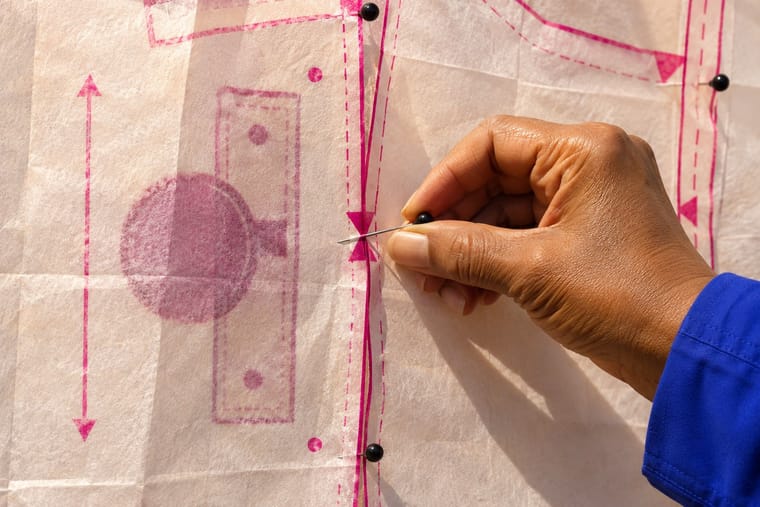
- Four places at four distances: a tram stop wide with two travellers, a stall medium with its keeper pressing out the awning, a man close pinning back his paper window shutter, a hand in detail pinning a door's notches; the spare is a gardener wide under a paper tree.
- Never
- No letters, numbers, size marks or words on any piece; no cloth, plastic, glass, wireframe or ghostly see-through overlay where the paper should be; no solid building, vehicle, tree or furniture; no person in fuchsia, pink, cream, white or beige; no torn, crumpled or burning paper; nobody posing, pointing or amazed.
- Make everything in the picture except the people full-size pattern tissue: thin, crisp, dry pale paper you can see through, like baking parchment, with sharp square fold creases across every piece. Whatever the scene names keeps its true shape and size but is built from flat paper pieces pinned edge to edge along their printed lines, so the paper sags a little between pins and the pieces behind show through it as darker layers. It is real paper standing in sunlight, never cloth, plastic, glass, a drawing or a pale overlay laid over a photograph.
- Print every paper piece in one bold fuchsia ink and nothing else: a solid cutting line round its edge, a dashed line just inside it, small solid triangle notches on the edges where it meets the next piece, a few round dots and one straight double-headed arrow along its length, with no letters, numbers or words anywhere. Steel pins with round black glass heads hold every seam and pin the pieces down into the paper ground; marks and pins grow with the piece, so on the biggest pieces a pinhead is the size of an apple and reads from across a street.
- Let the people be the only solid things and put the colour on them: true skin and hair, and each wears one main garment in loud chartreuse or deep cobalt with the rest in black or dark denim, so nobody fades into the pale paper or the fuchsia marks. Photograph them as sharp, real and heavy as anyone on a street, casting firm shadows on the paper, and in every picture let at least one of them press a hand, an elbow or a foot on the tissue so the paper dents or creases under the touch.
- Give every picture two readings. At a glance it is a bright photograph of a few people in chartreuse and cobalt in a street of glowing paper; a second later the houses turn out to be pinned, notched and creased, and the seams of a whole city are matched notch to notch.
- Vary the place, the number of people and the thing touched from picture to picture: a street seen wide with travellers, a stall at medium distance with its keeper, one face close at a window, one hand in detail at a seam.
- For a client, fit the idea to what they make or plan: a tailor's or a fashion school's poster, an architect's or a builder's site hoarding of the building that is coming, a city plan that shows the people first. The fuchsia marks can be printed as a real second ink on uncoated paper.
A studio style: made by Stylogeny, not a documented movement.
With an idea put on it
-
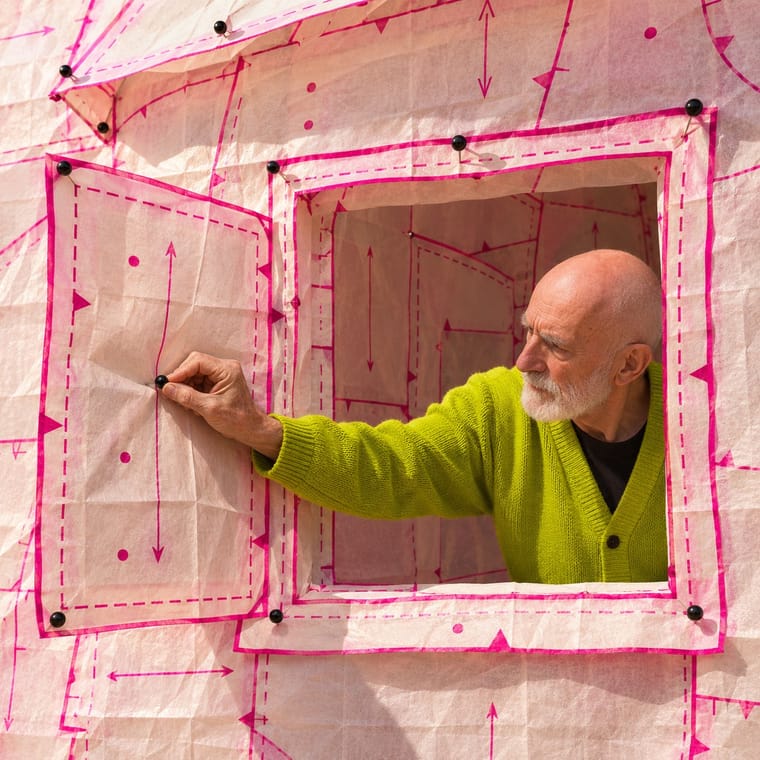
Frame within a frame The fuchsia cutting line round the paper window frames the one solid, coloured thing in the house, so the man is the part of his home already finished. -
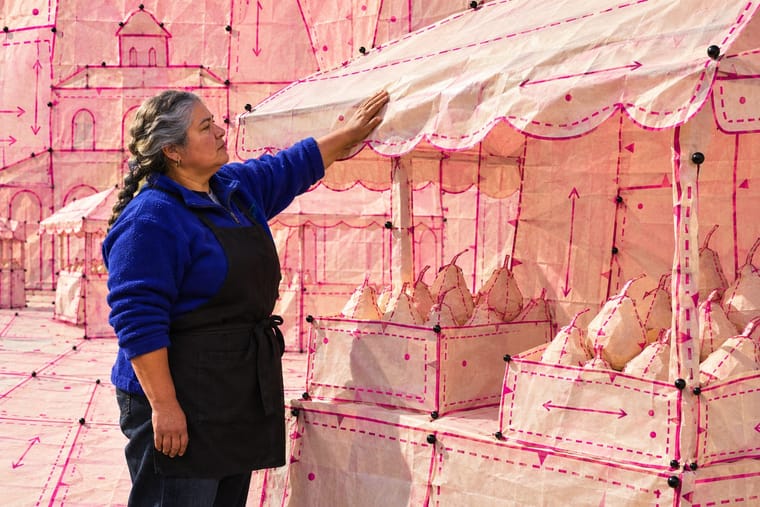
Telling gesture She smooths her paper awning flat with her palm the way you smooth a pattern before cutting, so her own stall is something she is still fitting by hand.
AI-generated: Pinned Tissue with an idea put on it. Not a real or historical work.
Change it with an idea. Any of the 73 moves that make a design say something can go on this style.
04
Its design choices
From Stylogeny’s vocabulary of design choices: defining choices make the style, characteristic ones are usual, occasional ones turn up now and then.
- Layout & composition
- Space & hierarchy
- Typography
- Form & shape
- Surface & texture
- Ornament
- Medium & production
- Tone & intent
- Avoids
- 3D render, Flat vector illustration, Comic & cartoon, Painterly illustration, Dark ground, Gradients, Glitch, Type as image
How its pictures are made Photographic, light, viewpoint, lens, pose, finish
Kind of picture: Photographic How they are made, from the questions Stylogeny asks of that kind:
- Light
-
- Backlight & rim characteristic
- Raking side light characteristic
- Cast shadows as shapes characteristic
- High-key occasional
- Viewpoint
-
- Eye level characteristic
- Layered depth characteristic
- Middle distance occasional
- Lens
-
- Deliberate stillness characteristic
- Deep focus occasional
- Pose
-
- Absorbed in a task characteristic
- Relaxed & natural occasional
- Three-quarter turn occasional
- Finish
-
- Straight print characteristic
- Visible grain occasional
What new pictures of it show
Subjects Stylogeny draws it with, each taken from a kind of real work the style was made for.
- poster A tram stop on a city street, tram, shelter and houses all pinned pattern tissue; a tall man of thirty in a chartreuse rain jacket steps aboard while a stout woman of sixty in a cobalt coat waits
- art print A market stall in a square, awning, crates and pears all pinned pattern tissue; its keeper, a broad grey-braided woman of fifty in a cobalt fleece and black apron, runs a palm along the awning's edge
- social media post A slim bald man of seventy with a white beard, in a chartreuse cardigan, leans out of his front window to pin its open shutter back, window, shutter, wall and house all pinned pattern tissue
- postcard A brown-skinned woman's hand, in her forties, a cobalt sleeve at the wrist, pushes a black-headed pin through two matched notches where a pattern-tissue front door meets its tissue frame
- poster A park lawn under a big tree of pinned pattern tissue, trunk, branches and leaves; a short gardener of sixty-five with cropped grey hair, in chartreuse overalls, lifts a low paper branch to pin a leaf
05
What it’s close to
One of our own styles: Stylogeny made it from its own design choices, so no earlier style is claimed.
Pinned Tissue Made 2026
No later style in the atlas grew out of it yet.
Alike in its design choices

06
Often taken for
pinned-tissue has no real works recorded yet, so these are its nearest styles by its choices alone, with the choices that tell them apart.
-
Digital Scrapbook Collage
Digital Scrapbook Collage is one of pinned-tissue’s nearest styles by choices; no real work of either fits the other better.
Choices that tell Pinned Tissue and Digital Scrapbook Collage apart Choice Pinned Tissue Digital Scrapbook Collage Complementary clash characteristic — Found & vernacular imagery — defining Full bleed characteristic — Dynamic asymmetry — defining Eclectic mixing — defining No shared descent in the atlas: they reached these choices separately.
-
Xiaoqingxin (Small and Fresh) Aesthetic
Xiaoqingxin Aesthetic is one of pinned-tissue’s nearest styles by choices; no real work of either fits the other better.
Choices that tell Pinned Tissue and Xiaoqingxin Aesthetic apart Choice Pinned Tissue Xiaoqingxin Aesthetic Paper & letterpress bite defining occasional Pastel — defining Complementary clash characteristic — Generous white space — defining Full bleed characteristic — No shared descent in the atlas: they reached these choices separately.
-
Corporate Stock-Photo Look (Royalty-Free Business Imagery)
Corporate Stock-Photo Look is one of pinned-tissue’s nearest styles by choices; no real work of either fits the other better.
Choices that tell Pinned Tissue and Corporate Stock-Photo Look apart Choice Pinned Tissue Corporate Stock-Photo Look Paper & letterpress bite defining — Gradients avoids occasional Collage & layering occasional avoids Single focal point occasional defining Complementary clash characteristic — No shared descent in the atlas: they reached these choices separately.
-
Light Academia
Light Academia is one of pinned-tissue’s nearest styles by choices; no real work of either fits the other better.
Choices that tell Pinned Tissue and Light Academia apart Choice Pinned Tissue Light Academia Complementary clash characteristic — Restrained accents — defining Full bleed characteristic — Analogous harmony — characteristic Illusion of depth characteristic — No shared descent in the atlas: they reached these choices separately.
— means the choice isn’t among the style’s recorded choices. Critics recorded each work’s choices with the styles’ descriptions in view, so this shows whether the descriptions hold together, not proof that they are right.