Counterculture · 1965–1973 · North America, Western Europe
Psychedelic Poster
Also known as Psychedelic Art, San Francisco Rock Poster, Fillmore Poster
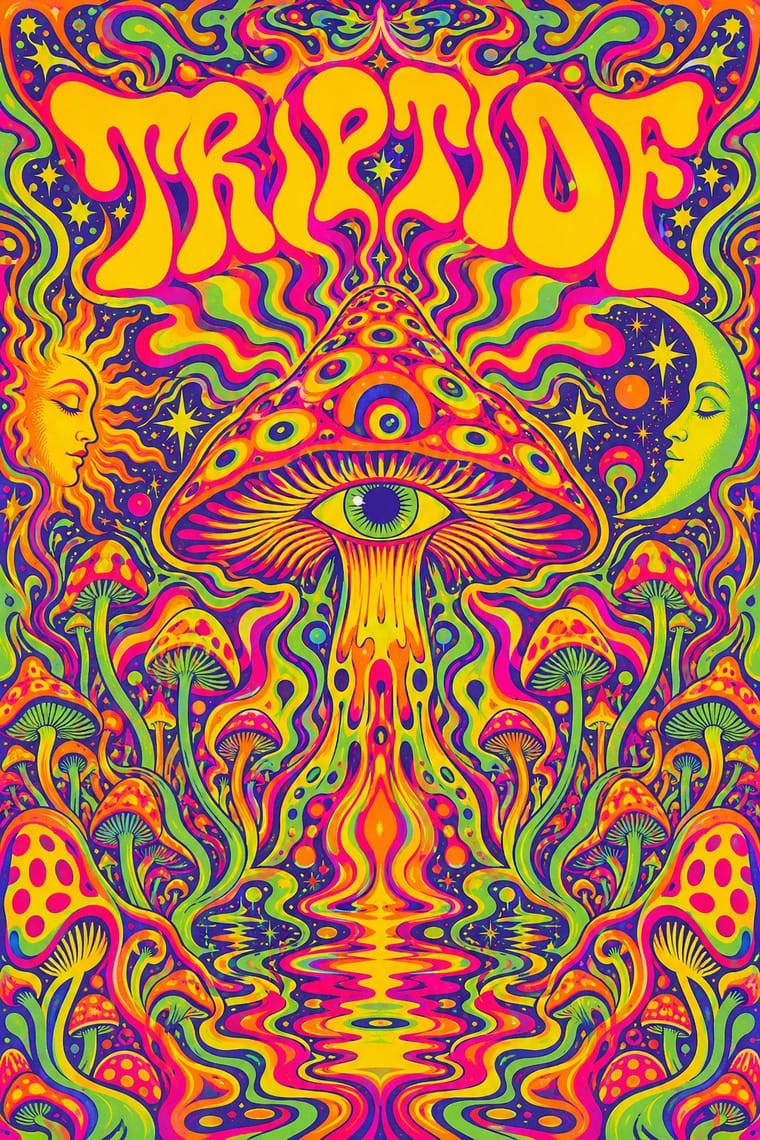
The concert-poster language of the 1960s counterculture, born in San Francisco's Fillmore and Avalon ballrooms and echoed in London's underground press. Hand-drawn letters melt and swell to fill whole shapes, Art Nouveau and Vienna Secession curves are revived at hallucinatory intensity, and vibrating complementary or fluorescent colours make reading a slow, immersive act.
Make something in this styleGet advice in this styleMix it with another style
01
How it works
- Draw the lettering by hand and warp it to fill a shape (a flame, a figure, a balloon) until the words become a texture.
- Place complementary hues of equal value edge to edge so the boundary vibrates.
- Revive Art Nouveau and Vienna Secession curves, borders and maidens at hallucinatory intensity.
- Fill every inch of the sheet and let the reader decode the poster slowly rather than at a glance.
- Collage Victorian engravings, old photographs and Eastern symbols into a timeless, mystical tableau.
- Print in fluorescent and split-fountain inks so colour glows and shifts across the sheet.
San Francisco (Fillmore and Avalon ballrooms, Haight-Ashbury) and London's underground
02
Its design choices
From Stylogeny’s vocabulary of design choices: defining choices make the style, characteristic ones are usual, occasional ones turn up now and then.
- Layout & composition
- Space & hierarchy
- Typography
- Colour
- Form & shape
- Surface & texture
- Ornament
- Imagery
- Medium & production
- Tone & intent
- Avoids
- Modular grid, Classical text block, Grotesque & neo-grotesque, Flush left, ragged right, Generous white space, Ornament-free, Rational & objective
Palette
#ff6a13#e4007c#2e3192#8cc63f#ffd200#6a2c91
Typefaces
Hand-drawn melting lettering after Alfred Roller
Wes Wilson
Victorian wood-type and Tuscan display faces
Arnold Böcklin
Davida
Known for
Wes Wilson
Fillmore Auditorium posters for Bill Graham, 1966–67
Victor Moscoso
Neon Rose series
Rick Griffin
Grateful Dead, Aoxomoxoa, 1969
Stanley Mouse & Alton Kelley
Family Dog / Avalon Ballroom posters
Bonnie MacLean
Fillmore posters
Hapshash and the Coloured Coat
Michael English & Nigel Waymouth, London
Martin Sharp
Oz magazine
03
Make something in this style
Say what you need, and Stylogeny’s image studio draws it from Psychedelic Poster’s design choices and checks it against them. It takes about a minute, and you get a link to share.
04
Where it comes from, and what it’s close to
Before it
The style it grew out of, and the styles it borrowed from.


After it
The styles that grew out of it.


Alike in its design choices
Styles that make many of the same choices, related or not, besides those above.


05
Real works
Artefacts in museums, libraries and archives that show the style, linked at their source.
- Byrds Byrds Byrds (Bill Graham presents The Byrds and other bands, Winterland and Fillmore Auditorium)Wes Wilson · 1967 (concerts 31 March–2 April 1967) · Victoria and Albert Museum, London (E.396-1968)
- The Yardbirds / The Doors, James Cotton Blues Band, Richie Havens, Fillmore (Bill Graham presents)Bonnie MacLean · 1967 (concerts 25–30 July 1967) · Victoria and Albert Museum, London (E.421-2004)
- Neon Rose #2 (The Miller Blues Band at the Matrix, 10–15 January 1967)Victor Moscoso · 1967 · Victoria and Albert Museum, London (E.624-2004)
- 'Flying Eyeball' poster (Jimi Hendrix Experience, John Mayall & the Bluesbreakers, Albert King; Fillmore and Winterland)Rick Griffin · 1968 (concerts 1–4 February 1968) · Victoria and Albert Museum, London (S.169-2021)
- The Move and Pink Floyd at UFOHapshash and the Coloured Coat (Michael English and Nigel Waymouth) · 1967 · Victoria and Albert Museum, London (E.1708-1991)
06
Sources
- Philip B. Meggs & Alston W. Purvis, Meggs' History of Graphic Design
- Paul D. Grushkin, The Art of Rock: Posters from Presley to Punk (1987)
- Delaware Art Museum, Wes Wilson, The Sound (1966): https://emuseum.delart.org/objects/8178/the-sound
How Stylogeny researches and checks a style: where the facts come from.