Counterculture · 1974–1990 · Western Europe
See Red Women's Workshop Feminist Screenprints
Also known as See Red, See Red feminist posters, See Red Women's Poster Collective
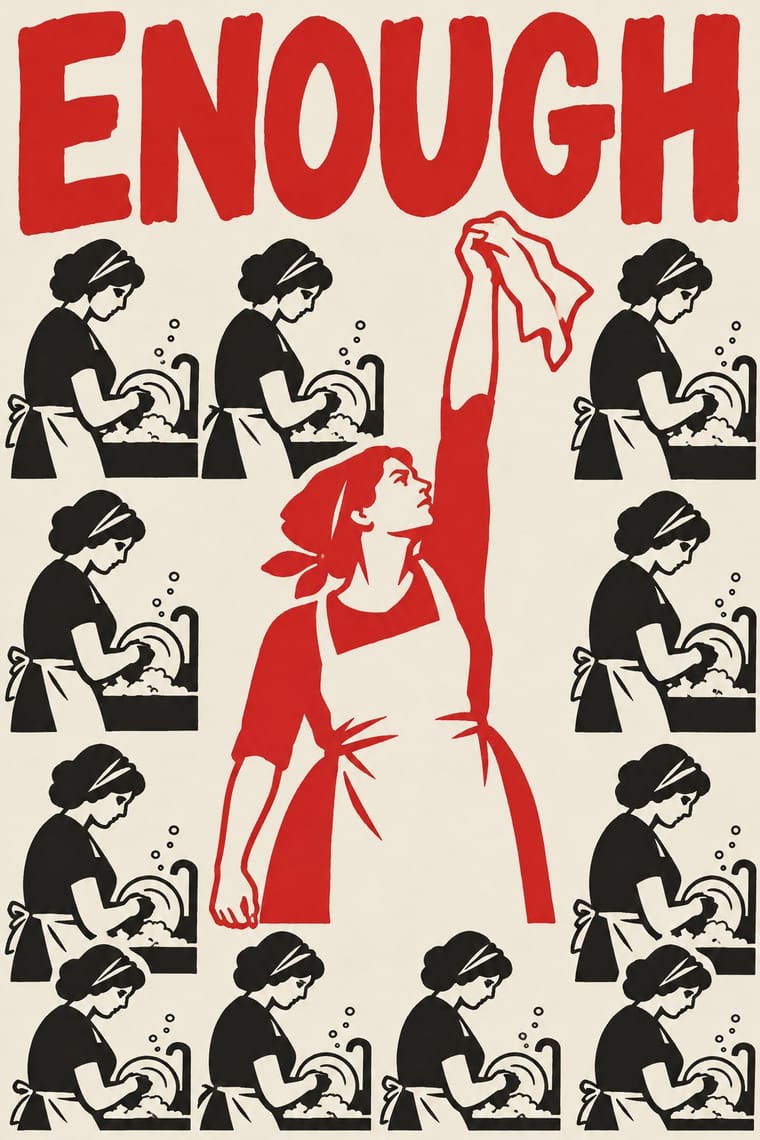
Screenprinted posters of a London feminist collective founded in 1974 to answer negative images of women in advertising and the media, designed and approved by the group and credited to no one member. In a few flat inks, drawn or photographic housewives, mothers and workers repeat across cells and strips or stand under a wry slogan, turning housework, childcare and the double shift into agitation. From the late 1970s posters also took on racism, Irish and international struggles and lesbian sexuality, some in photomontage. No new designs after 1984; closed 1990.
Make something in this style Get advice in this style Mix it with another style
01
How it works
- Print in two to four flat screen inks, often a single red or dark blue against black and the white or cream of the paper.
- Show ordinary women at the sink, the pram and the production line, drawn as plain stylised figures or, once the darkroom was built, as high-contrast photographs and montages: ordinary and capable rather than idealised.
- Repeat the same figure or chore across a grid of cells, or set one image over a slogan, until the routine itself becomes the argument.
- Turn the language of adverts and slogans back on itself, with a wry caption under the image.
- Letter the slogan by hand in plain, readable capitals and give it its own colour.
- Decide the design together and sign it with the workshop's name, not an individual's.
London, England: a women's screenprinting collective founded in 1974 in a Camden Town squat, later working off Walworth Road and in Camberwell
02
Its design choices
From Stylogeny’s vocabulary of design choices: defining choices make the style, characteristic ones are usual, occasional ones turn up now and then.
- Layout & composition
- Space & hierarchy
- Colour
- Form & shape
- Surface & texture
- Imagery
- Medium & production
- Tone & intent
- Avoids
- Photocopy & distress, Gloss & highlights, Gradients, Fluorescent & neon, Abundant decoration, Eclectic mixing, Luxurious & glamorous, Authoritative & institutional
Palette
-
#f4f0e6 -
#151515 -
#d4262a -
#1f2f6b -
#8fb4d4 -
#6b4a2e
Typefaces
-
Hand-drawn poster capitals for the slogans
for example 'ALONE WE ARE POWERLESS... TOGETHER WE ARE STRONG', 'PROTEST'
-
Comic-strip captions and speech balloons in hand-lettered capitals
My Wife Doesn't Work, 1980
Known for
-
See Red Women's Workshop, Protest (1974; the workshop's gallery dates it 1973), colour screenprint in green, red and blue, V&A
-
See Red Women's Workshop, A Woman's Work Is Never Done (gallery 1974; V&A copy dated 1976), screenprint in red ink, V&A
-
See Red Women's Workshop, Capitalism Also Depends on Domestic Labour
1975
-
See Red Women's Workshop, Alone We Are Powerless, Together We Are Strong (1976–7), screenprint, V&A
-
See Red Women's Workshop, Take a Pill Mrs Brown (1977), screenprint in black, brown and green, V&A
-
See Red Women's Workshop, Girls Are Powerful
1979
-
See Red Women's Workshop, A 'Service' a Day and He'll Work, Rest, and Play (ca. 1979–81), pale blue, black and white, reusing the 1975 Capitalism image under a play on the Mars slogan, V&A
-
See Red Women's Workshop, My Wife Doesn't Work (V&A 1980; the workshop's gallery dates it 1976), screenprint in dark blue and red, V&A
03
Make something in this style
Say what you need, and Stylogeny’s image studio draws it from See Red Women's Workshop Feminist Screenprints’s design choices and checks it against them. It takes about a minute, and you get a link to share.
04
Where it comes from, and what it’s close to
Before it
The style it grew out of, and the styles it borrowed from.
Nothing earlier is recorded: in the atlas it is a starting point.
After it
The styles that grew out of it.
No later style in the atlas grew out of it yet.
Alike in its design choices
Styles that make many of the same choices, related or not, besides those above.
- Sudanese Revolution Graphics (Digital Illustrations and Sit-in Murals) 73% alike
-
-
-
-

-

05
Sources
- See Red Women's Workshop, 'About See Red', https://seeredwomensworkshop.com/about-see-red/ (founded 1974 by three ex-art students who met through an advertisement in Red Rag; to challenge negative images of women in advertising and the media; Camden Town squat, then Walworth Road and Camberwell; screenprinting by blocking out with water-soluble filler, 'only oil-based inks were available' at first, a darkroom for photographic stencils after a year or two; designs discussed and approved by the group, no individual credit; no new See Red designs after 1984; Southwark Council and GLC grants; closed 1990)
- See Red Women's Workshop, 'Poster gallery', https://seeredwomensworkshop.com/poster-gallery/ (titles and dates; it dates Protest, Disc Jockey and Women Unite 1973, before its stated founding in 1974, and My Wife Doesn't Work 1976 against the V&A's 1980, discrepancies kept here rather than resolved; subjects beyond housework include Organise Against the National Front 1979, Support Our Sisters in Armagh Jail 1980, Participe de Nuestra Lucha! 1981, Women Hold Up Half the Sky 1978 and Lesbians Are Coming Out 1982; images CC BY-NC-SA 3.0, so specimens must be link-only)
- Victoria and Albert Museum, 'A Woman's Work Is Never Done', O102638, https://collections.vam.ac.uk/item/O102638/ (screenprint in red ink, dated 1976; 'See Red Women's Poster Collective (1974-1989)'; co-operative, non-hierarchical work; the 'split woman' and the double shift)
- Victoria and Albert Museum, 'Alone we are powerless...Together we are strong...', O106318, https://collections.vam.ac.uk/item/O106318/ (screenprint, 1976–7; women and children repeated in 4x4 cells, black bars recalling imprisonment, text in red; caption 'What did you do to-day dear?')
- Victoria and Albert Museum, 'Protest', O1225963, https://collections.vam.ac.uk/item/O1225963/ (colour screenprint, London, 1974; blue border, caption 'PROTEST')
- Victoria and Albert Museum, 'My Wife Doesn't Work', O1225959, https://collections.vam.ac.uk/item/O1225959/ (screenprint in dark blue and red, 1980; grid of twenty squares through a woman's day, red speech bubble)
- Victoria and Albert Museum, 'Take a Pill', O1225953, https://collections.vam.ac.uk/item/O1225953/ (screenprint in black, brown and green, 1977)
- Victoria and Albert Museum, 'Black Women Will Not be Intimidated', O1225958, https://collections.vam.ac.uk/item/O1225958/ (1980–1; 'screen printed montage of seven photographs in brown ink on a cream background, the text and the central photograph is in red ink')
- Victoria and Albert Museum, 'A 'Service' a day and he'll work, rest, and play', O1260352, https://collections.vam.ac.uk/item/O1260352/ (pale blue, black and white; women cooking and cleaning for queues of men from a factory, ca. 1979–81; 'uses the same image as a 1975 poster', Capitalism also depends on domestic labour)
- See Red Women's Workshop, See Red Women's Workshop: Feminist Posters 1974–1990, foreword by Sheila Rowbotham (London: Four Corners Books, 2016), https://www.fourcornersbooks.co.uk/books/see-red-womens-workshop (posters and calendars on 'sexuality, identity and oppression', with 'humour and bold graphics', and women's 'role in wider struggles for change')
- Wikipedia, 'Mars (chocolate bar)', https://en.wikipedia.org/wiki/Mars_(chocolate_bar) (UK slogan 'A Mars a day helps you work, rest and play', echoed in the 'Service' a day poster title)
How Stylogeny researches and checks a style: where the facts come from.