One of our own styles · made in 2026
Sanded Back
A place's people and goods carved into its own painted wood, a door, counter, hull, shutter or sign board, and sanded down through a cream top coat into decades of older paint. Every carved edge shows the buried coats as concentric rings of tomato red, teal and sun yellow, like the growth rings of a tree, wider where the cut went deeper, with bare wood only at the deepest points, all picked out by one low raking light. From across the room a bold, simple carving in loud colour on cream; up close a count of how often the place was repainted. For shops, cafés and stalls with a long history.
Make something in this style Get advice in this style Mix it with another style
Use it with care
It carves into a place's own surfaces and its history: show no real shop, boat name, sign, brand, logo or person, never carve a scene that mocks the people of a place or their trade, and never present a picture as a real old door or a found antique. Its pictures are made by an image model: label them as generated and never pass one off as a carved panel or a photograph of one.
01
More pictures in this style
3 pictures, AI-generated from its design choices: none is a real or historical work.
1 of 2
Try other colours
Change a colour and every picture on this page follows. It happens in your browser, from the same pictures: nothing new is made or saved.
Choose a colour to change it
-
#f2ece0 -
#e8302a -
#00a9a5 -
#ffc400 -
#d9b98c
A faded colour isn’t in these pictures, so changing it changes nothing.
Light and dark stay where they are; greys hardly move.
More colours: any style’s, or your own
The pictures show the style’s own colours.
02
Make something in this style
Say what you need, and Stylogeny’s image studio draws it from Sanded Back’s design choices and checks it against them. It takes about a minute, and you get a link to share.
03
How it works
Palette
-
#f2ece0ground · 40% -
#e8302aink · 14% -
#00a9a5accent · 6% -
#ffc400accent · 9% -
#d9b98caccent · 13%
Shares measured from its 4 pictures. The ground is what the pictures sit on (of the colours covering most, the most neutral), the ink stands out from it most, the rest are accents.
Typefaces
-
Titan One
-
Plain rounded capitals carved into the cream and sanded soft, their sides ringed in the old coats like every other cut
Who is in it. The place's own people, its workers and its regulars, carved large and simple: women and men from twenty to eighty of every build, in the clothes the scene gives them, each a few rounded masses with one clear gesture and a face of a few soft grooves, never a caricature and never looking at us. Carved from the same coats, nobody has a skin colour, so who they are shows in build, hair, clothes and bearing. A scene has only the figures it names, and a scene that names nobody has nobody in it.
Direction
- What it says
- A place's people and goods are carved out of the paint the place itself has worn for decades, so every edge counts, ring by ring, the times it was painted to stay open.
- Performance
- People are carved in the one gesture the scene names, so that it reads from across a street, mid-action and absorbed in it, side-on or three-quarter, never posing or looking at us. Their clothes are the ones the scene gives them, reduced to the few folds a gouge can cut.
- Set
- Only the one painted surface the scene names, seen whole or in part and filling the frame. Any seam, hinge or handle it has stays where it is, painted over in cream and left uncarved, and nothing of the street or room around it shows.
- Light
- One low daylight rakes across the panel from one side, the left unless the shot says the right, so every sanded slope is lit on one side and shaded on the other and each step casts a small soft shadow. No second light, no spotlight, no glow and no shine.
- Camera
- Square on, the lens centred and parallel to the panel at the height and distance the shot names, a normal lens with everything sharp from edge to edge. Never an angle onto the panel, never a view of the surface standing in its street or room, never a fisheye.
- Frame
- The carved surface runs off all four edges. The figures or things the scene names are large and sit a little off centre, cut by an edge where the shot says so, and a calm stretch of uncut cream is left on one side, where any given words are carved.
- Moment
- The carving shows the middle of the action the scene names, at its peak. The panel itself is finished, freshly sanded and wiped clean, with no tool, dust or hand of the carver in the frame.
- Finish
- Matt, chalky old paint with the sander's faint circular swirls across cream and rings alike, the rings crisp and saturated in cream, tomato red, teal and sun yellow, pale bare wood only in the deepest spots. No varnish, gloss, peeling, crazing, rust, filter or colour grade.
- A set of pictures
- Two wides of a whole surface, a boat's hull and a stage front with four dancers; three mediums, two friends on a café shutter, a mechanic on a bike shop's sign board and an ice cream alone on a kiosk counter; one close of a fruit seller in profile; one detail of a loaf on a bakery door. Each on its own surface.
- Never
- No paint laid on after carving, no outline, no painted stripe or colour on the flat cream, no sharp, chipped or splintered edge, no peeling or distressed paint, no glossy plastic or rendered sheen, no lettering but the given words, and no real shop name, boat name or brand.
- Every picture looks like a straight photograph of one wooden surface of the place the scene names, painted over and over for decades, so that under a cream top coat lie, from newest to oldest, coats of tomato red, teal and sun yellow, then tomato red, teal and sun yellow again, down to the wood. The picture is carved down into that paint with a gouge and sanded smooth, so the buried coats come up on every sloping side of every cut as thin concentric rings in that same order, cream, tomato, teal, yellow and round again, following each outline exactly like the growth rings of a sawn tree. The deeper a cut goes, the more rings it shows and the wider their band, and pale bare wood appears only as small spots at the bottom of the deepest cuts.
- Colour comes only from how deep each part was cut: nothing is painted on after carving, and there is no outline, no painted shading and no stripe on a flat surface. The uncut cream top coat stays the ground and covers about half the panel; each figure or thing the scene names is cut as a few large, simple, rounded masses, each mass with a flat floor in the colour of the one coat its depth reaches, and the rings of every coat above it stepping up its sloping sides to the cream, while faces and hands stay mostly in the cream, shaped by the cuts around them. Sanding has rounded every edge soft, never sharp, chipped or splintered; the floors keep the faint shallow scoops of the gouge, and a few deeper grooves give eyes, mouths, fingers and folds.
- Shoot the panel square on, the lens parallel to it and the carved surface filling the frame and running off every edge, lit by one low daylight raking across it from one side, so each sanded slope is bright on one side and softly shaded on the other and every step and dome casts a small soft shadow on its far side. The paint is matt and chalky with faint circular swirls of the sander, the rings crisp and saturated, and the only colours are cream, tomato red, teal, sun yellow, pale bare wood and their own soft shadows, with no black or grey paint, no gloss or varnish and no peeling, cracking or weathering. Any words the picture is given are carved into the cream in plain rounded letters, cased and spelled exactly as given, and show their rings like everything else.
- From across the room a picture reads as one bold, simple carving of a person or a thing in loud colour on cream; up close every edge turns out to be a record of the place, rings that count how often it was repainted, and the colours say how deep each part was cut.
- Scenes vary in surface, trade, number and distance: a whole fishing boat's hull with its planks, the front boards of a festival stage with a line of dancers, two regulars on a café's shutter, a mechanic on a bike shop's sign board, a fruit seller close in profile, one loaf on a bakery door seen close enough to count its rings, an ice cream alone on a kiosk counter. The light comes from the left in most pictures and from the right now and then.
- For a client, carve into a surface the client really has, its door, counter or sign, and where its own old colours are known, carve through those: the picture is then its history too, for an anniversary poster, a reopening, a label or a menu cover. A woodworker can make the panel for real, with dust protection since old paint may hold lead, and have it photographed for print.
A studio style: made by Stylogeny, not a documented movement.
With an idea put on it
-
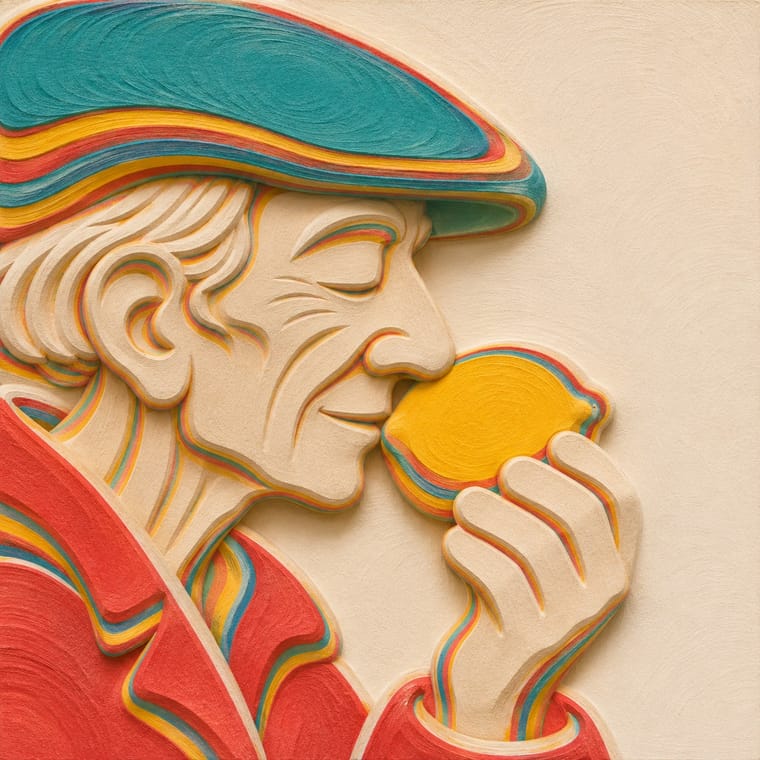
Intimate close-up Up close the rings round his cap, his nose and the lemon count every coat the stall has worn, so the man and his stall have grown old together.
AI-generated: Sanded Back with an idea put on it. Not a real or historical work.
Change it with an idea. Any of the 73 moves that make a design say something can go on this style.
04
Its design choices
From Stylogeny’s vocabulary of design choices: defining choices make the style, characteristic ones are usual, occasional ones turn up now and then.
- Layout & composition
- Space & hierarchy
- Typography
- Colour
- Form & shape
- Surface & texture
- Ornament
- Medium & production
- Tone & intent
- Avoids
- Painterly illustration, Flat vector illustration, Line illustration, Comic & cartoon, Gloss & highlights, Dark ground
How its pictures are made Photographic, light, viewpoint, lens, pose, finish
Kind of picture: Photographic How they are made, from the questions Stylogeny asks of that kind:
- Light
-
- Raking side light defining
- Soft-edged shadows characteristic
- Rounded, modelled form characteristic
- Viewpoint
-
- Flattened planes defining
- Eye level characteristic
- Close & intimate occasional
- Lens
-
- Corrected perspective defining
- Normal lens characteristic
- Deep focus characteristic
- Pose
-
- Absorbed in a task defining
- Side-on profile characteristic
- Looking away occasional
- Finish
-
- Straight print characteristic
- Hyper-detailed characteristic
What new pictures of it show
Subjects Stylogeny draws it with, each taken from a kind of real work the style was made for.
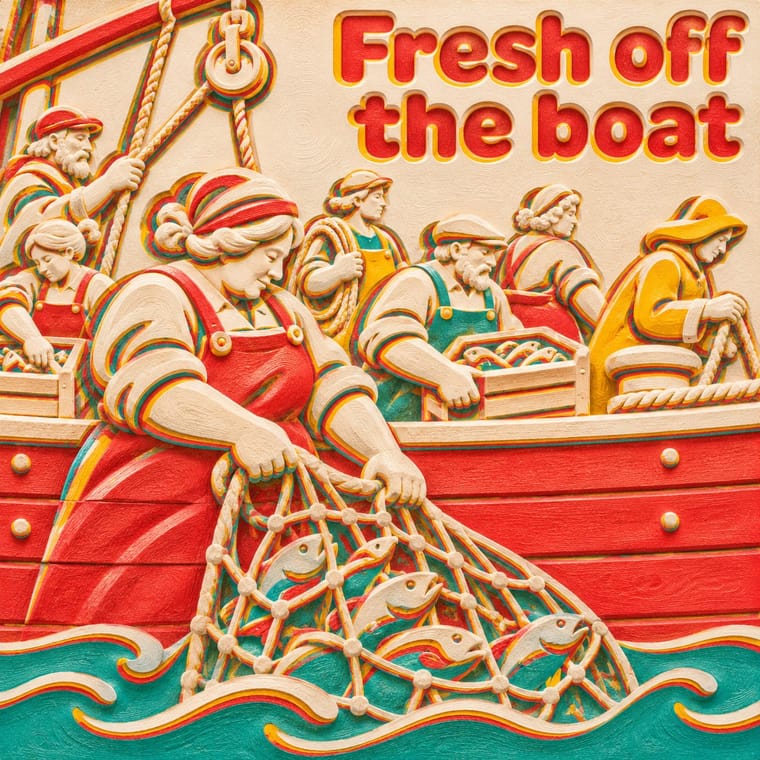
- postcard A fishing boat's wooden hull, its planks running across: carved in it, a broad fishmonger in her sixties in an oilskin apron hauls a net of fish up out of the sea below the waterline
- poster An old festival stage's plank front: carved across it, four dancers in a row kicking in one step, a lean man of 25, a broad woman of 45, a tall grey man of 60 and a small woman of 75 with a bun
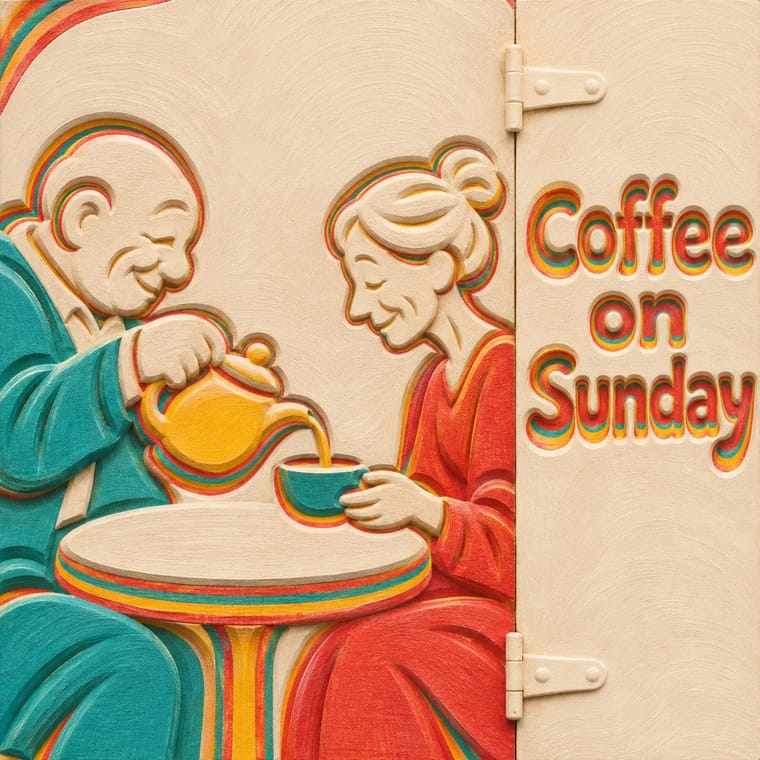
- invitation A café's folding wooden shutter, its hinges painted over in cream: carved on it, two friends in their seventies at a small round table, one pouring from a pot into the other's cup
- flyer A bike shop's long sign board: carved in it, a stocky mechanic in her fifties with cropped hair, in teal overalls, truing a wheel on a stand, its spokes cut as deep straight grooves
- social media post A fruit stall's painted front board: carved close, a thin fruit seller in his seventies in a teal flat cap and a tomato-red jacket, in profile, holding a lemon up to his nose
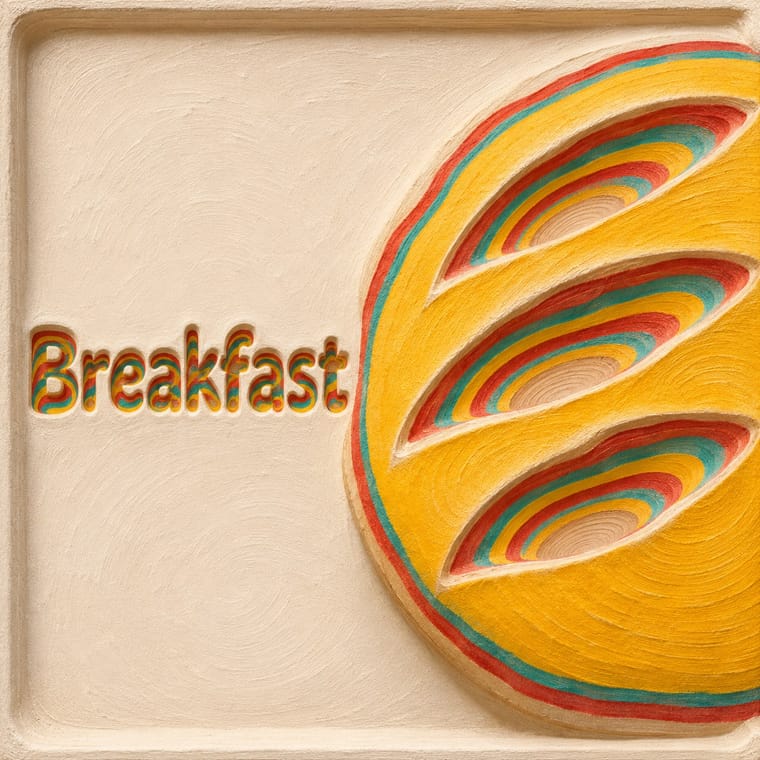
- menu cover An old bakery's panelled door: one round loaf carved in a panel, its crust cut down to the sun-yellow coat, its three deep slashes down to bare wood, close enough to count the rings in each slash
- packaging label The counter front of an old ice-cream kiosk: one cone carved alone in the cream, its three scoops cut down to the tomato-red, teal and sun-yellow coats, each ringed by the coats above it
05
What it’s close to
One of our own styles: Stylogeny made it from its own design choices, so no earlier style is claimed.
Sanded Back Made 2026
No later style in the atlas grew out of it yet.
Alike in its design choices

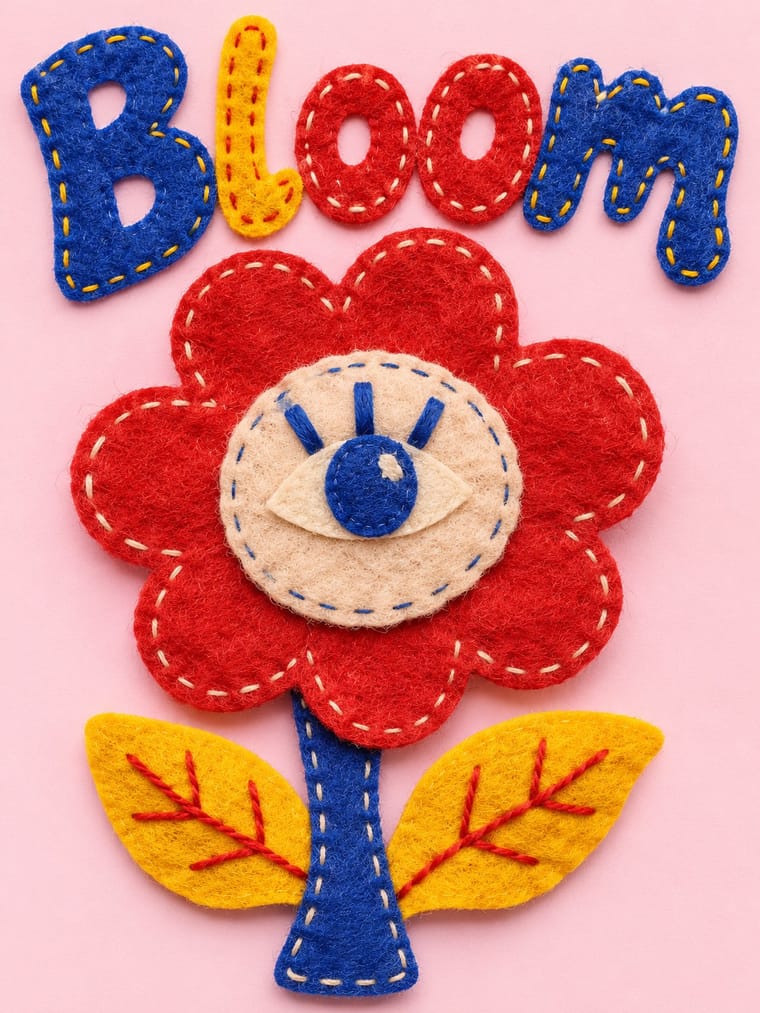

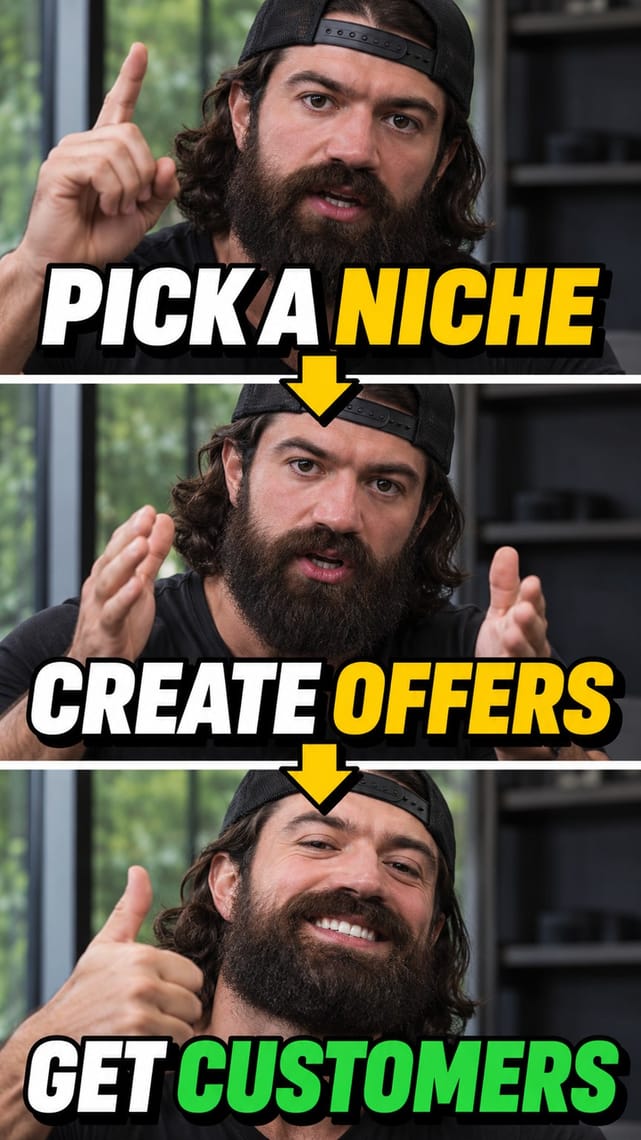
06
Often taken for
sanded-back has no real works recorded yet, so these are its nearest styles by its choices alone, with the choices that tell them apart.
-
Contemporary Papercraft Illustration (Layered Cut-Paper)
Contemporary Papercraft Illustration is one of sanded-back’s nearest styles by choices; no real work of either fits the other better.
Choices that tell Sanded Back and Contemporary Papercraft Illustration apart Choice Sanded Back Contemporary Papercraft Illustration Full bleed defining — Collage & layering — defining Carved line defining — Paper & letterpress bite — defining Ornament-free occasional avoids No shared descent in the atlas: they reached these choices separately.
-
Photographed Tactile Craft & Lettering
Photographed Tactile Craft & Lettering is one of sanded-back’s nearest styles by choices; no real work of either fits the other better.
Choices that tell Sanded Back and Photographed Tactile Craft apart Choice Sanded Back Photographed Tactile Craft Full bleed defining — Isolated object — defining Carved line defining — Hand-lettering — defining Complementary clash characteristic — No shared descent in the atlas: they reached these choices separately.
-
Gezi Park Protest Graphics (Turkey, 2013)
Gezi Park Protest Graphics is one of sanded-back’s nearest styles by choices; no real work of either fits the other better.
Choices that tell Sanded Back and Gezi Park Protest Graphics apart Choice Sanded Back Gezi Park Protest Graphics Light ground defining — Comic & cartoon avoids characteristic Illusion of depth defining — Found & vernacular imagery — defining Carved line defining — No shared descent in the atlas: they reached these choices separately.
-
Short-Form Creator Captions (Hormozi-Style Subtitles)
Short-Form Creator Captions is one of sanded-back’s nearest styles by choices; no real work of either fits the other better.
Choices that tell Sanded Back and Short-Form Creator Captions apart Choice Sanded Back Short-Form Creator Captions Skeuomorphic material characteristic avoids Sequential narrative — defining Light ground defining — Hard offset shadow — defining Stylised figuration defining — No shared descent in the atlas: they reached these choices separately.
— means the choice isn’t among the style’s recorded choices. Critics recorded each work’s choices with the styles’ descriptions in view, so this shows whether the descriptions hold together, not proof that they are right.