One of our own styles · made in 2026
Rain Ink
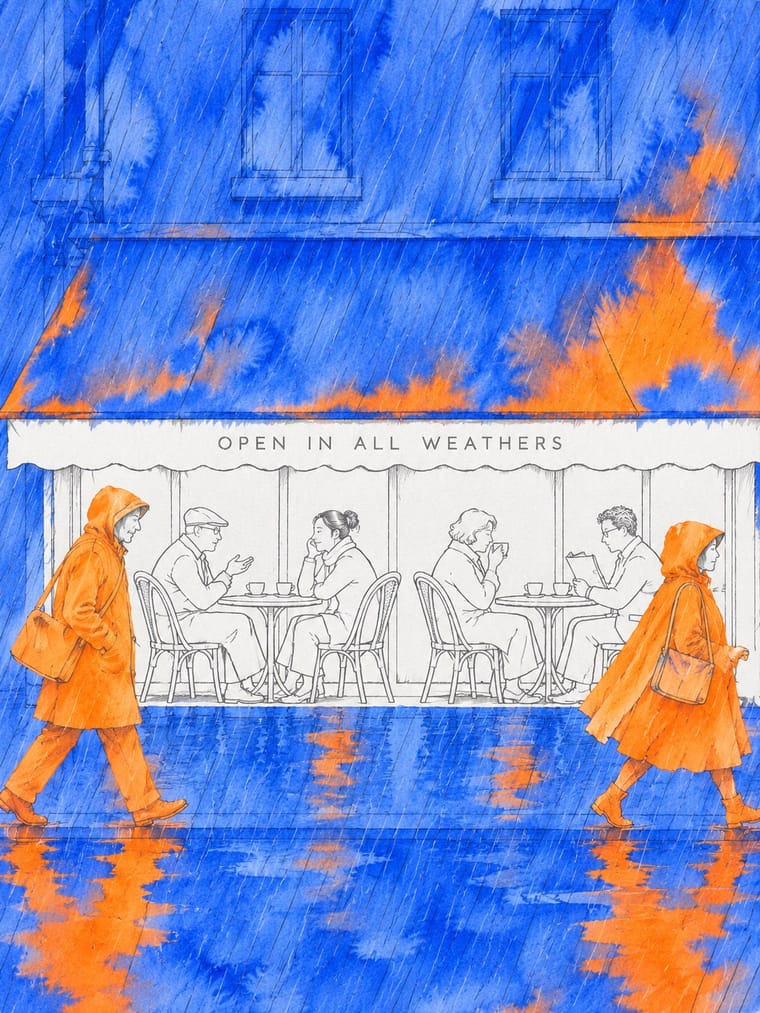
Street scenes coloured by the rain: everything under the open sky is soaked in electric blue and tangerine watercolour that blooms past its fine grey lines, and everything under an awning, an umbrella, a canopy, a poncho or a doorway stays bare white paper in line alone. Every shelter leaves a crisp white shape cut out of the colour, and the rain falls as fine slanting grey lines that stop at its edge. From across a room it is a loud wet painting; up close, a map of who is keeping dry. For terrace cafés, markets, bike and rain-gear shops and festivals in a rainy port city.
Make something in this style Get advice in this style Mix it with another style
Use it with care
It shows rain as what makes a city bright and a shelter as a kindness: keep it to everyday weather, never a flood, a storm that harms, people with nowhere to shelter or a person sleeping rough made into a picture of the rain, and show no real shop, brand, logo, venue or person. Its pictures are made by an image model: label them as generated and never pass one off as a hand-painted watercolour or an original drawing.
01
Its picture in other colours
Change a colour and every picture on this page follows. It happens in your browser, from the same pictures: nothing new is made or saved.
Choose a colour to change it
-
#f7f6f2 -
#8e9196 -
#2463ff -
#173bd1 -
#ff8a1a
A faded colour isn’t in these pictures, so changing it changes nothing.
Light and dark stay where they are; greys hardly move.
More colours: any style’s, or your own
The pictures show the style’s own colours.
02
Make something in this style
Say what you need, and Stylogeny’s image studio draws it from Rain Ink’s design choices and checks it against them. It takes about a minute, and you get a link to share.
03
How it works
Palette
-
#f7f6f2ink · 23% -
#8e9196accent · 6% -
#2463ffground · 30% -
#173bd1accent · 17% -
#ff8a1aaccent · 15%
Shares measured from its 4 pictures. The ground is what the pictures sit on (of the colours covering most, the most neutral), the ink stands out from it most, the rest are accents.
Typefaces
-
Josefin Sans
-
small fine grey pen capitals
Who is in it. City people going about a wet day, women and men from their twenties to their eighties of every build, skin and background, in the clothes the scene gives them. A scene has only the figures it names, and a scene that names nobody has nobody in it. They are drawn from life in fine grey line, faces in a few calm lines, never cartoons, and they never pose or look at us. Colour never lands on skin: faces and hands stay white, and anyone out in the rain takes the colour on what they wear.
Direction
- What it says
- Rain is the only paint: whatever the sky can reach is soaked in colour and whatever is sheltered stays white, so every picture is a map of who and what is keeping dry.
- Performance
- People do the action the scene names as they would on any wet day, at ease under whatever covers them; nobody runs from the rain, shakes off water or acts out being wet.
- Set
- Only the place and the shelter the scene names, drawn whole in fine grey line and plain enough to read at a glance: the shelter's rain side soaked in colour, its dry white shape lying sharp beneath it, and nothing added around them.
- Light
- The flat, even daylight of steady rain. Any sky in view is a wet sky, painted the same electric blue as the place and crossed by rain lines, never grey and never clear. No sun, no lamp, no glow and no cast shadow anywhere. The only light and dark in the picture are the wet colour and the dry white paper.
- Camera
- Level, with a normal lens, at the height and distance the shot names (standing eye level from across the street when it names none), so the underside of every shelter and the dry shape beneath it can be seen; never from straight above, never a low, tilted or fisheye view.
- Frame
- Wet colour fills most of the sheet and runs off at least two of its edges; the dry white shapes sit off centre and are the only bare paper. Any words given sit small in fine grey capitals inside the largest dry white shape, sheltered like the people.
- Moment
- During the rain, never before or after it: rain is coming down hard at that instant, slanting one way across the whole sheet, and everyone in the scene has stayed out in it or found cover.
- Finish
- Fine, even grey pen line on bright white cold-pressed watercolour paper under saturated electric blue and tangerine watercolour laid wet, running past the lines, pooling into darker edges and blooming as it dried, the paper's grain showing through. No brown, no grey wash, no black, no third colour.
- A set of pictures
- Two wides of many shelters (a market's canopies, a festival's umbrellas), four mediums (a café awning, a bus shelter, a rider's clear poncho, a couple in a shop doorway) and one detail of hands at a quay kiosk's roof edge; no two share a kind of shelter.
- Never
- No colour on anything sheltered and no white left on anything the rain can reach; no rain line inside a dry white shape; no sunshine, clear sky, night or lamplight; no brown or muddy grey where the two inks meet; no third colour, no black or thick outline, no photograph, and no lettering but the words given.
- Paint the rain's rule: everything under the open sky, where rain falls on it, is soaked in loose watercolour of two loud inks, electric blue and tangerine, that bloom and run past its fine grey lines; everything under the shelter the scene names stays bare white paper drawn only in fine grey line. So every shelter leaves a crisp white shape cut out of the colour beneath it, sharp exactly where the rain stops, and anything half out from under one is coloured precisely up to its edge.
- The two inks carry the whole picture, saturated and never washed pale: electric blue for the wet place itself and every roof or canopy over it; tangerine for whatever wet thing people wear, carry or ride, umbrella tops included. Where blue meets tangerine they bleed into each other in feathered blooms and stay two pure colours, never stirred into brown. Wet colour fills most of the sheet, so the dry white shapes are few, sharp and easy to find.
- Draw the rain as fine, straight grey lines slanting one way across the whole wet part of the sheet, many and thin like hatching, stopping at the edge of every shelter so that no rain line ever crosses a dry white shape. Draw the place and its people first in one fine, even grey pen line, loosely and from life, then let the colour come down on it like the rain: running over the lines and out of register with them, pooling into darker edges and spreading in blooms, with the white of the paper left only where something kept it dry.
- From across a room a picture reads as a loud blue and tangerine painting with a few crisp white shapes cut out of it; up close the white shapes turn out to be dry places, and the eye finds who is under the awning, the white oranges on a covered stall, the one shoulder sticking out into the rain.
- Scenes vary in shelter, crowd and distance: a market under its canopies, a café terrace under its awning, a cyclist under a clear poncho, a queue in a bus shelter, a festival crowd under umbrellas, a fish kiosk on a harbour quay, a couple in a doorway; seen wide across a market or a field, medium across a street, close in a doorway and in detail at a kiosk's edge.
- For a client, the dry white shape is the client's own: the café's awning, the stall's canopy, the poncho the shop sells, so a poster, a menu cover or a label shows the client as the place where the city comes in out of the rain.
A studio style: made by Stylogeny, not a documented movement.
With an idea put on it
-
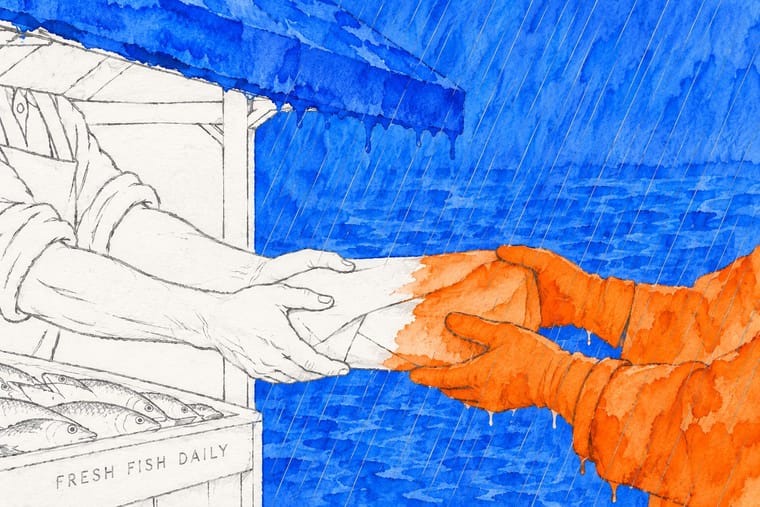
Part for the whole One parcel crosses the roof's drip line between two pairs of hands, white on the seller's side and tangerine on the customer's, so a single sale stands for the kiosk: it serves right where the rain begins. -
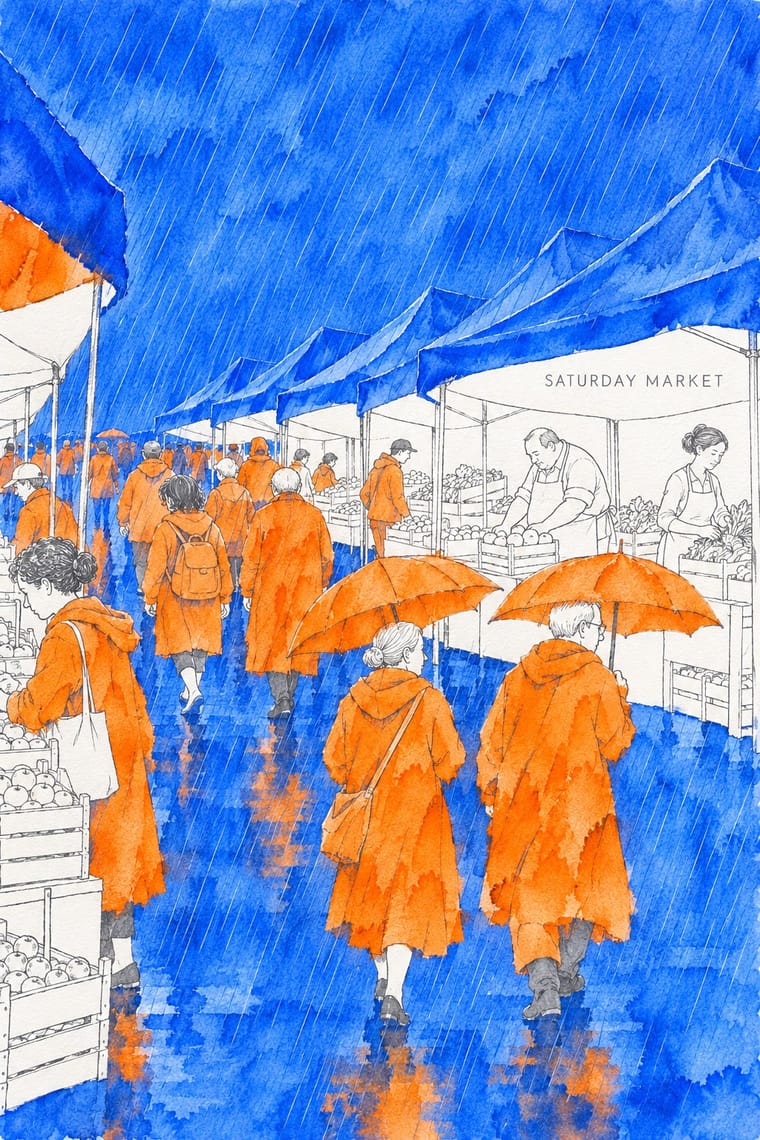
Accumulation Canopy after canopy leaves its own white dry island in the blue, so the row of them shows a market that stays open whatever the rain does. -
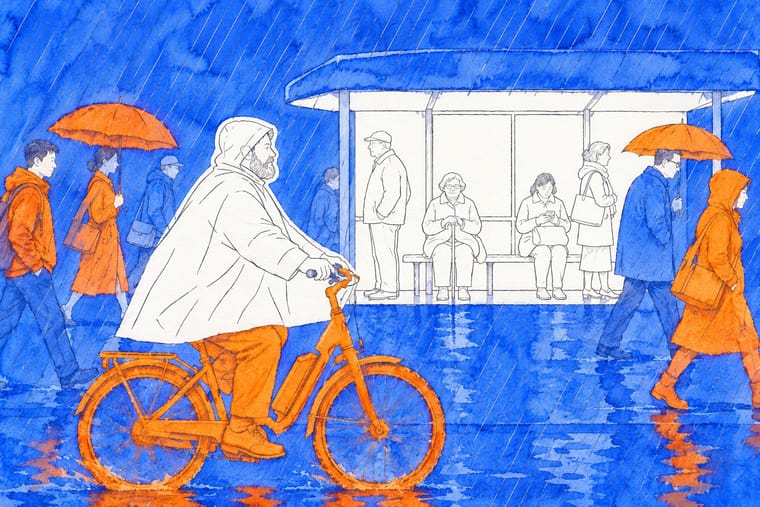
Demonstration Everything inside the clear poncho's outline is dry white and everything outside it is soaked, so the poncho shows exactly how much of him it keeps dry.
AI-generated: Rain Ink with an idea put on it. Not a real or historical work.
Change it with an idea. Any of the 73 moves that make a design say something can go on this style.
04
Its design choices
From Stylogeny’s vocabulary of design choices: defining choices make the style, characteristic ones are usual, occasional ones turn up now and then.
- Layout & composition
- Space & hierarchy
- Typography
- Colour
- Surface & texture
- Ornament
- Medium & production
- Tone & intent
- Avoids
- Straight photography, 3D render, Dark ground, Earth & mineral, Pastel, Full polychrome, Gloss & highlights
How its pictures are made Drawn & painted, light, viewpoint, pose, made with, figures
Kind of picture: Drawn & painted How they are made, from the questions Stylogeny asks of that kind:
- Light
-
- Rain & wet surfaces defining
- Overcast & flat daylight characteristic
- Shadowless characteristic
- Viewpoint
-
- Eye level defining
- Middle distance characteristic
- Frame within a frame characteristic
- Far & detached occasional
- Pose
-
- Relaxed & natural characteristic
- Looking away characteristic
- Walking & mid-stride occasional
- Made with
-
- Watercolour & wash defining
- Pen & ink line characteristic
- Figures
-
- Lifelike proportions characteristic
What new pictures of it show
Subjects Stylogeny draws it with, each taken from a kind of real work the style was made for.
- menu cover A café terrace in a downpour: four regulars at small tables under its long awning stay white in grey line, while the awning's top, the street and two passers-by in raincoats bloom blue and tangerine
- flyer A market in the rain: eight canopied stalls with crates, two aproned sellers (a stout man of 50, a lean woman of 40), a grey-haired woman and man in long tangerine raincoats under tangerine umbrellas
- postcard A cyclist in the rain, a broad bearded man in his fifties under a clear hooded poncho drawn only as an outline: inside it he stays white; his trousered shins and his bike below it are tangerine
- social media post A bus shelter in pouring rain: an old man in a flat cap, a young woman with a ponytail and a man of forty stay white under its roof; a tall woman of thirty stands half out, one shoulder tangerine
- poster A festival field in a downpour: dozens of tangerine umbrella domes, no faces seen, face a small stage where three young musicians play white under a blue roof; nearest us, a young woman with a bun
- packaging label A fish kiosk on a harbour quay in the rain: under its short roof a sturdy fishmonger's bare forearms, white sleeves rolled up, hold out a paper parcel to a customer's hands in tangerine rubber gloves
- invitation A couple in their seventies chat in the deep doorway of a plain shopfront: a short woman in a knee-length coat with a walking stick and a tall bald man in a long coat, both white in grey line
05
What it’s close to
One of our own styles: Stylogeny made it from its own design choices, so no earlier style is claimed.
Rain Ink Made 2026
No later style in the atlas grew out of it yet.
Alike in its design choices
06
Often taken for
rain-ink has no real works recorded yet, so these are its nearest styles by its choices alone, with the choices that tell them apart.
-
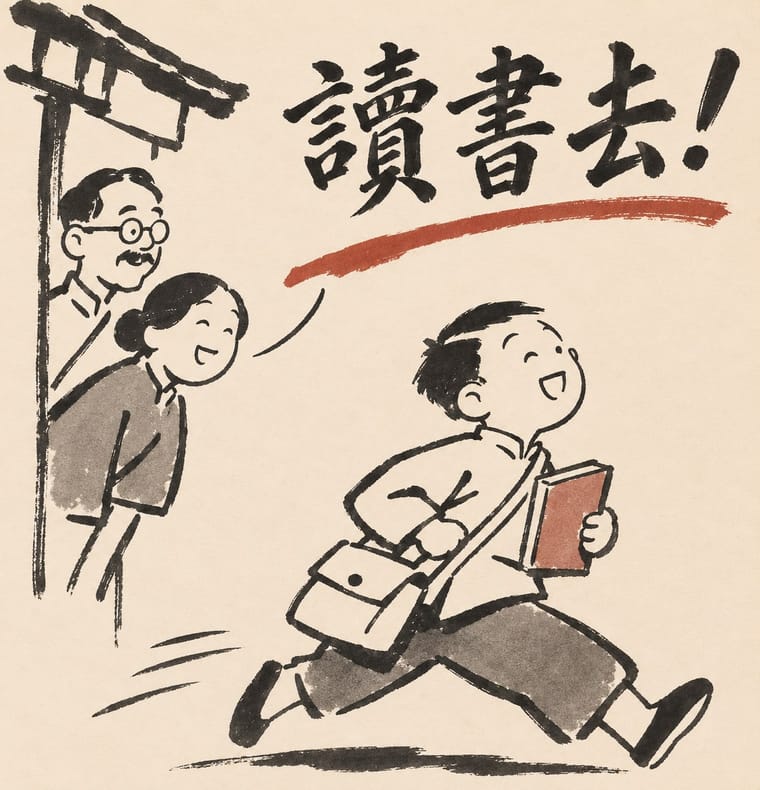
Republican-Era Manhua (Shanghai Cartoon Magazines)
Republican-Era Manhua is one of rain-ink’s nearest styles by choices; no real work of either fits the other better.
Choices that tell Rain Ink and Republican-Era Manhua apart Choice Rain Ink Republican-Era Manhua Complementary clash defining — Monochrome — defining Painterly illustration defining — Comic & cartoon — defining Full bleed characteristic — No shared descent in the atlas: they reached these choices separately.
-
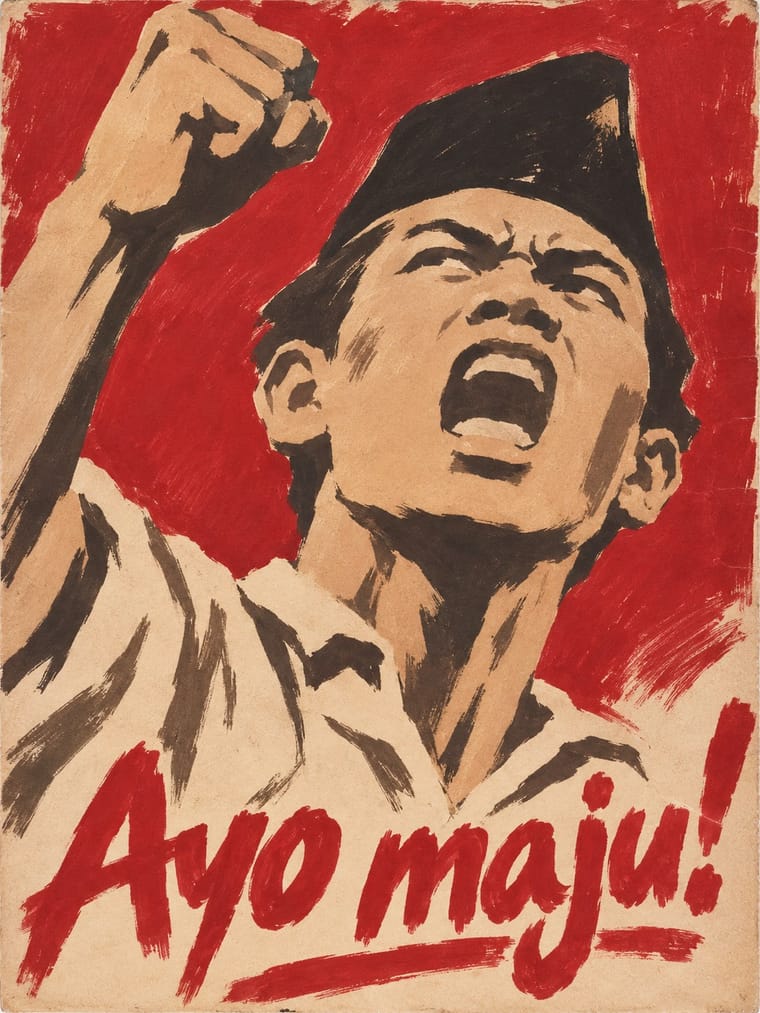
Indonesian Revolution Poster (Poster Perjuangan)
Indonesian Revolution Poster is one of rain-ink’s nearest styles by choices; no real work of either fits the other better.
Choices that tell Rain Ink and Indonesian Revolution Poster apart Choice Rain Ink Indonesian Revolution Poster Complementary clash defining — Single focal point — defining Line illustration defining — Stylised figuration occasional defining Light ground characteristic — No shared descent in the atlas: they reached these choices separately.
-
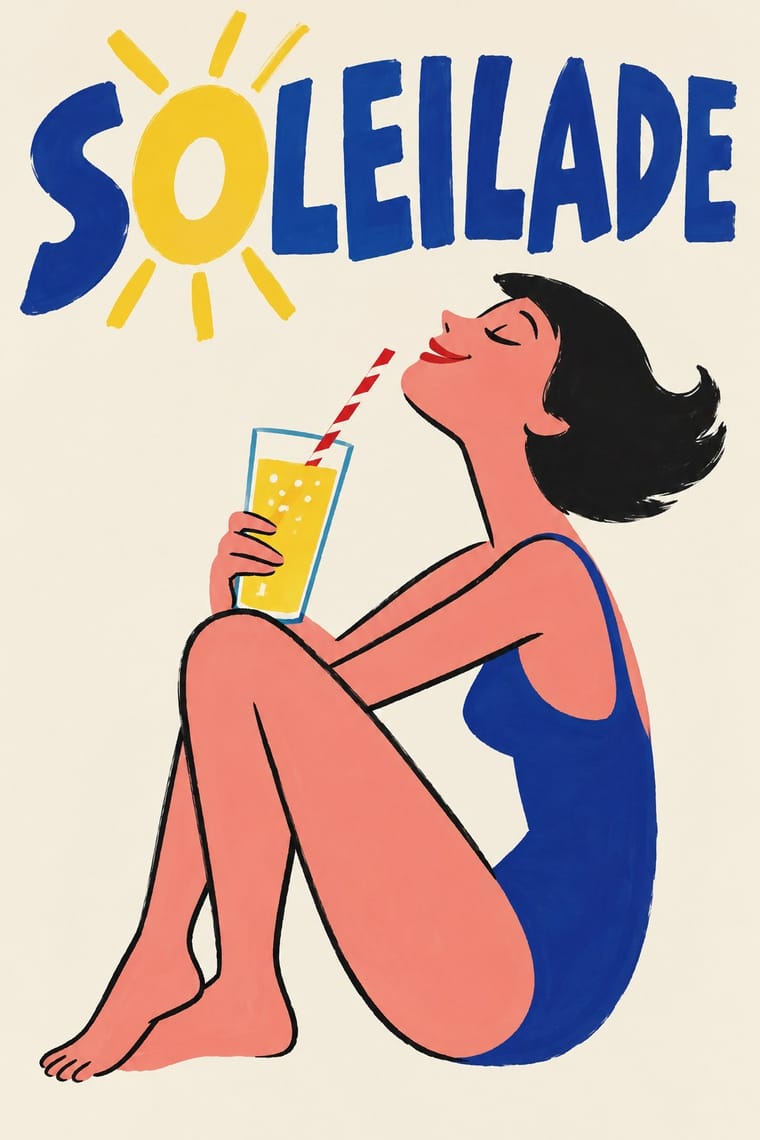
French Post-War Visual-Gag Poster (Savignac, Villemot, Morvan)
French Post-War Visual-Gag Poster is one of rain-ink’s nearest styles by choices; no real work of either fits the other better.
Choices that tell Rain Ink and French Post-War Visual-Gag Poster apart Choice Rain Ink French Post-War Visual-Gag Poster Complementary clash defining — Flat fields — defining Dynamic asymmetry characteristic — Isolated object — defining Misregistration & overprint characteristic — No shared descent in the atlas: they reached these choices separately.
-
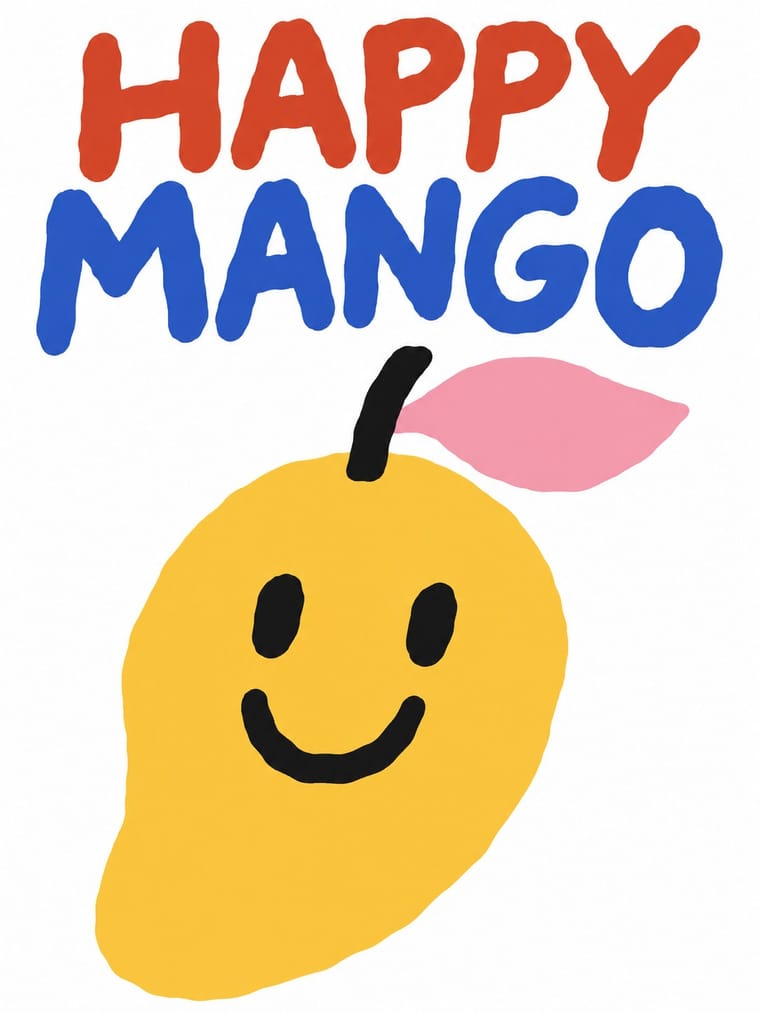
Naive Scribble Branding
Naive Scribble Branding is one of rain-ink’s nearest styles by choices; no real work of either fits the other better.
Choices that tell Rain Ink and Naive Scribble Branding apart Choice Rain Ink Naive Scribble Branding Complementary clash defining — Flat fields — defining Painterly illustration defining — Isolated object — defining Full bleed characteristic — No shared descent in the atlas: they reached these choices separately.
— means the choice isn’t among the style’s recorded choices. Critics recorded each work’s choices with the styles’ descriptions in view, so this shows whether the descriptions hold together, not proof that they are right.