Avant-garde · 1915–1925 · Eastern Europe
Suprematism
Also known as Suprematizm, UNOVIS, Non-objective art
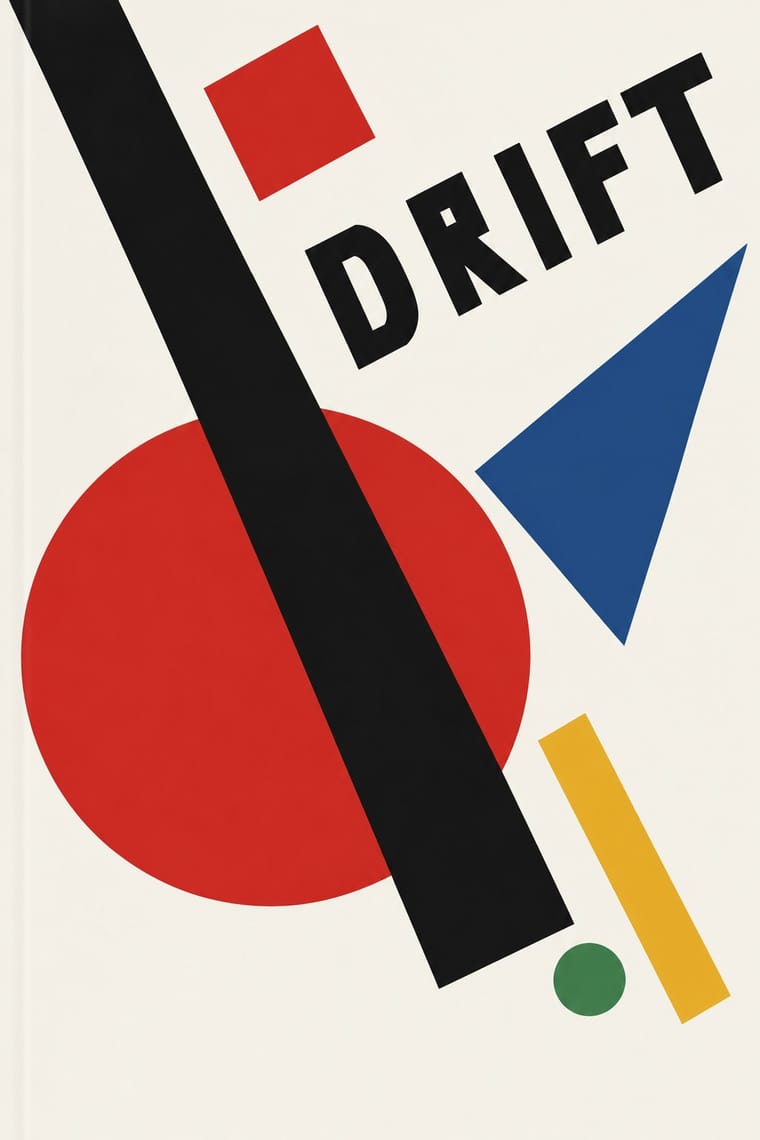
Kazimir Malevich's non-objective art, unveiled with the Black Square at the 0.10 exhibition in Petrograd in 1915, reduced painting to pure geometric planes floating in white, infinite space. Through the UNOVIS collective in Vitebsk and El Lissitzky's books it became a graphic language of squares, bars and circles tilted on dynamic diagonals, the seedbed of Constructivist layout.
Make something in this styleGet advice in this styleMix it with another style
01
How it works
- Reduce every image to pure geometric planes: square, rectangle, circle, cross and bar.
- Float the forms on an open white field that reads as infinite space rather than as a background.
- Tilt the composition on diagonals so planes seem to drift, fly or collide.
- Represent nothing: let scale, overlap and the intervals between forms carry the feeling.
- Keep colour flat and sparse: black and red first, with occasional yellow, blue or green.
- Suggest depth through the relative size and overlap of planes, never through perspective.
Petrograd and Moscow, then Vitebsk (UNOVIS), Russia
02
Its design choices
From Stylogeny’s vocabulary of design choices: defining choices make the style, characteristic ones are usual, occasional ones turn up now and then.
- Layout & composition
- Space & hierarchy
- Typography
- Colour
- Surface & texture
- Ornament
- Imagery
- Medium & production
- Tone & intent
- Avoids
- Naturalistic depiction, Stylised figuration, Straight photography, Abundant decoration, Horror vacui, Gradients
Palette
#f4f1e8#121212#cf2a27#e9b824#2a4d8f#3f7d4e
Typefaces
Russian grotesques (rubleny shrift) as set by Lissitzky
Hand-drawn lithographic lettering of UNOVIS publications
Known for
Kazimir Malevich
Black Square, 1915; Suprematist Composition: White on White, 1918
El Lissitzky
About Two Squares, designed 1920, published 1922
UNOVIS collective, Vitebsk
1920–22
Ilya Chashnik
Nikolai Suetin
Suprematist porcelain for the State Porcelain Factory
Olga Rozanova
03
Make something in this style
Say what you need, and Stylogeny’s image studio draws it from Suprematism’s design choices and checks it against them. It takes about a minute, and you get a link to share.
04
Where it comes from, and what it’s close to
Before it
The style it grew out of, and the styles it borrowed from.


Alike in its design choices
Styles that make many of the same choices, related or not, besides those above.


05
Real works
Artefacts in museums, libraries and archives that show the style, linked at their source.
- About Two Squares: A Suprematist Tale in Six Constructions (Suprematicheskii skaz pro dva kvadrata), construction 'They fly to Earth from afar'El Lissitzky · designed 1920 (Vitebsk), published 1922 · Copy of the 1922 Skythen edition inscribed by Jan Tschichold, sold at Swann Auction Galleries, sale 2568, lot 244 (scan via Wikimedia Commons)
- Front and back cover for the programme of the Congress of Committees of Rural Poverty of the Northern Region (S"ezd komitetov derevenskoi bednoty)Kazimir Malevich · autumn 1918 · Stedelijk Museum Amsterdam, 4.2001(082), on loan from the Khardzhiev Foundation (museum photograph via Wikimedia Commons)
- Flight ('Aeroplane Flying'), plate from Suprematism: 34 Drawings (Suprematizm. 34 risunka)Kazimir Malevich · 1920 · Ohara Museum of Art, Kurashiki (scan from the 2017 exhibition catalogue 'Ohara Museum of Art II', Hokkaido Museum of Modern Art; via Wikimedia Commons)


06
Sources
- Aleksandra Shatskikh, Black Square: Malevich and the Origin of Suprematism (Yale University Press, 2012)
- Christina Lodder, Russian Constructivism (Yale University Press, 1983)
- Philip B. Meggs & Alston W. Purvis, Meggs' History of Graphic Design
How Stylogeny researches and checks a style: where the facts come from.