Postmodern · 1984–1998 · North America
Emigre & Early Digital Type
Also known as Emigre magazine, Early Macintosh typography, Bitmap type
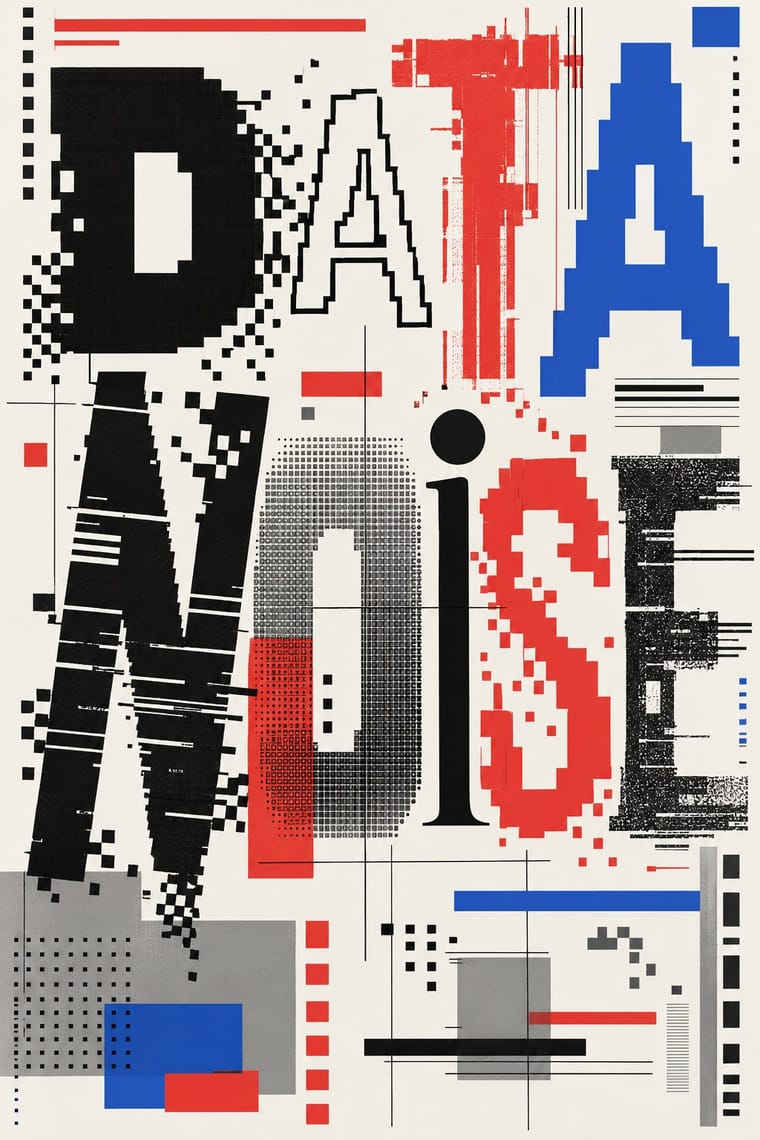
Rudy VanderLans and Zuzana Licko's magazine and type foundry, launched in 1984 alongside the first Macintosh, turned the computer's low-resolution constraints into a new typographic idiom. Licko's bitmap and modular faces, VanderLans's shifting, layered layouts and the magazine's showcase of Cranbrook and CalArts work made Emigre the laboratory and mouthpiece of digital postmodern typography.
Make something in this styleGet advice in this styleMix it with another style
01
How it works
- Design typefaces for the technology at hand, building letters from the pixel grid of screen and printer.
- Treat each issue or spread as a new layout experiment rather than a fixed template.
- Mix many new digital faces at different sizes on one page.
- Layer, overlap and run text at varied widths to make long-form writing visually expressive.
- Work in black and white or one spot colour and let typography carry the expression.
Berkeley and Sacramento, California
02
Its design choices
From Stylogeny’s vocabulary of design choices: defining choices make the style, characteristic ones are usual, occasional ones turn up now and then.
- Layout & composition
- Space & hierarchy
- Typography
- Surface & texture
- Ornament
- Imagery
- Medium & production
- Tone & intent
- Avoids
- Central symmetry, Floral & vegetal, Skeuomorphic material, Gloss & highlights, Painterly illustration, Luxurious & glamorous
Palette
#f4f2ec#111111#8c8c8c#e03c31#2b59c3
Typefaces
Oakland
Zuzana Licko, 1985
Emperor
Zuzana Licko, 1985
Matrix
Zuzana Licko, 1986
Lunatix
Zuzana Licko, 1988
Template Gothic
Barry Deck, 1990
Known for
Rudy VanderLans
Emigre magazine, 1984–2005
Zuzana Licko
Oakland, Emperor, Matrix, Lunatix
Emigre Fonts
foundry, from 1985
Barry Deck
Template Gothic, 1990
Jeffery Keedy
Keedy Sans
03
Make something in this style
Say what you need, and Stylogeny’s image studio draws it from Emigre & Early Digital Type’s design choices and checks it against them. It takes about a minute, and you get a link to share.
04
Where it comes from, and what it’s close to
Before it
The style it grew out of, and the styles it borrowed from.


After it
The styles that grew out of it.
No later style in the atlas grew out of it yet.
Alike in its design choices
Styles that make many of the same choices, related or not, besides those above.


05
Real works
Artefacts in museums, libraries and archives that show the style, linked at their source.
- Emigre no. 10 (Cranbrook issue), coverGlenn A. Suokko and Emigre Graphics (Rudy VanderLans, publisher) · 1988 · Letterform Archive, digitised on the Internet Archive (LFAEmigre0010)
- Emigre no. 5, coverRudy VanderLans (publisher and art director) and Zuzana Licko (digital type); cover photograph by Mark Farbin · 1986 · Letterform Archive, digitised on the Internet Archive (LFAEmigre0005)
- Bitmap Fonts, Pictograms, PostScript Fonts (Zuzana Licko Design font catalogue and order sheet)Zuzana Licko (Zuzana Licko Design) · c. 1986 (fonts copyrighted 1986) · Letterform Archive, 'Lo-Res Process Work' folder, digitised on the Internet Archive (lfaemigre0096)
- Emigre no. 14 ('Heritage'), coverRudy VanderLans (design and production); Zuzana Licko (typeface designs) · 1990 · Letterform Archive, digitised on the Internet Archive (LFAEmigre0014)
06
Sources
- Rudy VanderLans & Zuzana Licko, Emigre: Graphic Design into the Digital Realm (1993)
- https://www.emigre.com
- Philip B. Meggs & Alston W. Purvis, Meggs' History of Graphic Design
How Stylogeny researches and checks a style: where the facts come from.