Pictorial & machine age · 1930–1945 · North America
Streamline Moderne
Also known as Streamline, Streamlining, American Art Deco
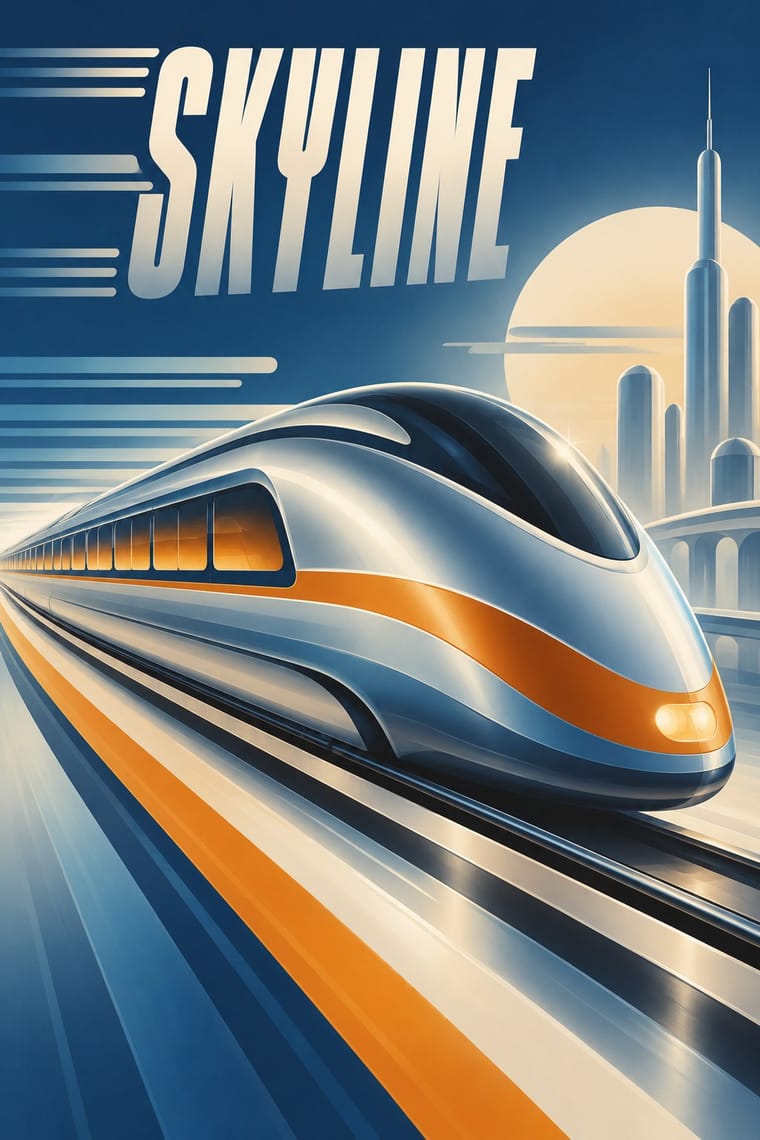
The late, chiefly American phase of Art Deco, in which aerodynamic science became a visual language for a Depression-era culture hungry for progress. Industrial designers and illustrators wrapped trains, radios, diners and posters in teardrop curves, horizontal speed lines, rounded corners and airbrushed chrome, selling the 'World of Tomorrow' at the 1939 New York World's Fair.
Make something in this styleGet advice in this styleMix it with another style
01
How it works
- Express speed with parallel horizontal speed lines trailing behind forms and lettering.
- Round every corner: teardrops, bullets and wraparound curves replace Deco's stepped angles.
- Airbrush smooth gradients and metallic highlights so surfaces look polished and aerodynamic.
- Run compositions on low, sweeping horizontals or dramatic perspective toward the horizon.
- Present machines and transport (locomotives, airliners, ocean liners) as heroic, monumental icons.
- Set display type in condensed or extended sans capitals, often striped with inline speed bars.
United States (New York, Detroit, Los Angeles), showcased at the 1933 Chicago and 1939 New York World's Fairs
02
Its design choices
From Stylogeny’s vocabulary of design choices: defining choices make the style, characteristic ones are usual, occasional ones turn up now and then.
- Layout & composition
- Space & hierarchy
- Typography
- Colour
- Form & shape
- Surface & texture
- Imagery
- Medium & production
- Tone & intent
- Avoids
- Angular & zigzag, Floral & vegetal, Abundant decoration, Carved line, Collage & layering, Rebellious & subversive
Palette
#1f3a5f#c0c6cc#e8dcc2#d9822b#2b2b2b#7fa7b8
Typefaces
Huxley Vertical
Walter Huxley, ATF, 1935
Agency Gothic
Morris Fuller Benton, ATF, 1932
Futura
Airbrushed custom lettering with speed stripes
Known for
Raymond Loewy
Pennsylvania Railroad locomotives
Henry Dreyfuss
20th Century Limited, 1938
Norman Bel Geddes
Horizons, 1932; General Motors Futurama, 1939
Leslie Ragan
New York Central System posters
Joseph Binder
official New York World's Fair poster, 1939
Walter Dorwin Teague
03
Make something in this style
Say what you need, and Stylogeny’s image studio draws it from Streamline Moderne’s design choices and checks it against them. It takes about a minute, and you get a link to share.
04
Where it comes from, and what it’s close to
Before it
The style it grew out of, and the styles it borrowed from.


Alike in its design choices
Styles that make many of the same choices, related or not, besides those above.


05
Real works
Artefacts in museums, libraries and archives that show the style, linked at their source.
- New York World's Fair 1939 / The World of TomorrowJoseph Binder · 1938 (for the 1939 fair; Commons gives 20 July 1938) · Wikimedia Commons (scan of a copy sold at Christie's)
- The Zephyr: Burlington's Streamline Motor Train (brochure front)Chicago, Burlington & Quincy Railroad; printed by Gusdorf-Warren Printing Co., Chicago · 1934 · Wikimedia Commons (copy sold on eBay; no holding institution)
- Union Pacific M-10000 brochure, 'Tomorrow's Train… Today!' (both sides)Union Pacific Railroad · 1934 (undated; train delivered February 1934) · Wikimedia Commons (copy sold on eBay; no holding institution)


06
Sources
- Jeffrey L. Meikle, Twentieth Century Limited: Industrial Design in America, 1925–1939 (1979)
- Steven Heller & Louise Fili, Streamline: American Art Deco Graphic Design (Chronicle Books, 1995)
How Stylogeny researches and checks a style: where the facts come from.