Pictorial & machine age · 1974–1987 · Western Europe, North America
Métal hurlant Science-Fiction Comics (Mœbius, Druillet & Les Humanoïdes Associés)
Also known as Métal hurlant style, Heavy Metal style, Mœbius style, Humanoïdes Associés
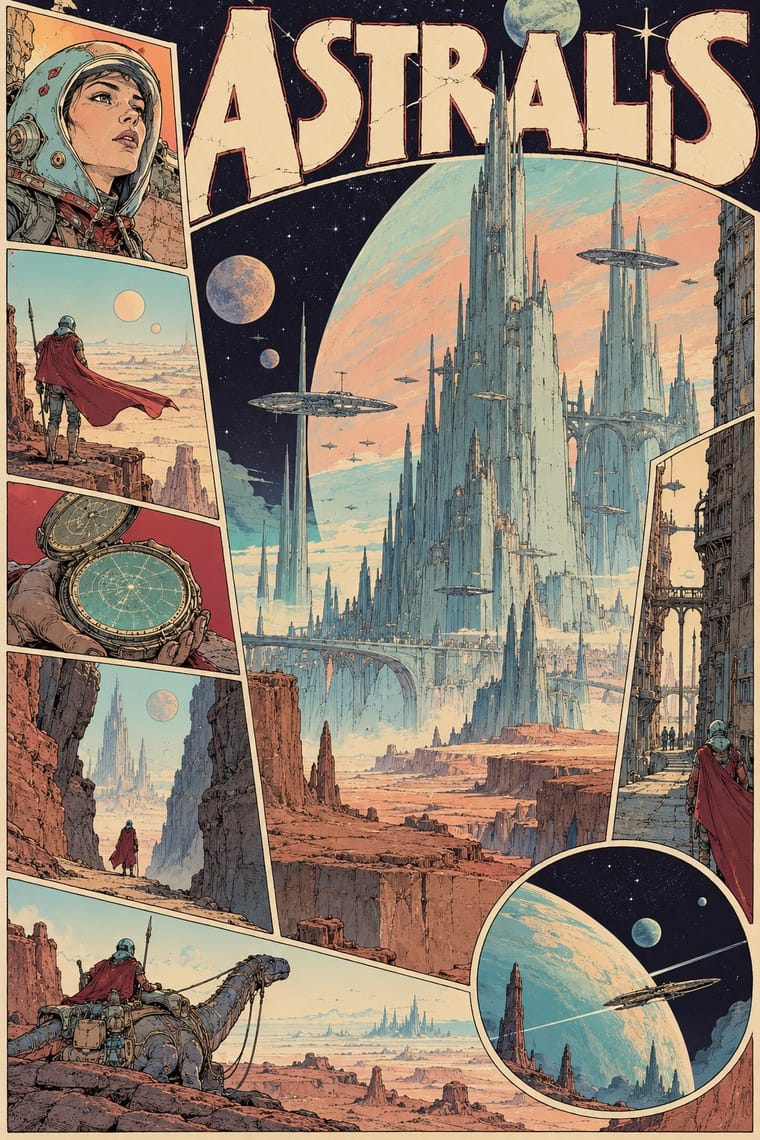
The adult science-fiction comics of Métal hurlant, the Paris magazine founded in 1974 by Mœbius, Philippe Druillet, Jean-Pierre Dionnet and Bernard Farkas. Mœbius's fine pen line and luminous colour set tiny figures in vast, silent deserts; Druillet exploded the page into baroque architecture and painterly double spreads. Sometimes wholly wordless, as in Arzach, and often dreamlike and erotic, it was carried abroad by Heavy Metal from 1977 and shaped film design from Alien to Blade Runner.
Make something in this styleGet advice in this styleMix it with another style
Use it with care
The stories, characters and drawings of Mœbius, Druillet, Bilal and the other contributors remain in copyright with their authors, estates and publishers: build your own worlds, creatures and title lettering in the shared idiom, do not ask an image model to imitate a named artist, and never present a generated picture as a page from the magazine. The magazine's adult register also ran to sexualised depictions of women; keep that choice deliberate and give women the same agency and drawing care as the heroes.
01
How it works
- Draw with a fine pen and spend the detail where it builds a world: costume, machinery, rock and alien flesh rendered closely in line, hatching and stipple, then left to stand in open, quiet ground.
- Make scale the drama: set a lone rider or explorer against an empty desert, a cliff of stone or a city-sized ship, low on the page and dwarfed by sky.
- Break the panel grid when the vision demands it: explode the page into a single full-page or double-page tableau, let colossal architecture run through the borders, and use circular or radiating frames instead of the regular rows of the weekly comic.
- Colour for atmosphere, not for code: pale, luminous tints and modulated skies laid on by hand, deepening into black space and saturated jewel tones for the cosmic scenes; never the flat primaries of the four-colour newsstand comic.
- Let the pictures carry the story through long silent sequences and, at the extreme, whole stories without a word (as in Arzach), and follow a dream logic: improvised, non-linear episodes, metamorphosing creatures, mysticism, sex and violence told for adult readers.
Paris: the comics magazine Métal hurlant, created in December 1974 by two cartoonists, a writer and a financial director (Jean Giraud, or Mœbius; Philippe Druillet; Jean-Pierre Dionnet; Bernard Farkas), who called themselves Les Humanoïdes Associés (also the publisher's name). The first issue appeared in January 1975 as a 68-page quarterly with only 16 pages in colour; it became bimonthly with no. 7 and monthly with no. 9, and its writer-founder edited it until 1985 (Dionnet). The original run ended with no. 133 in July 1987. Heavy Metal, an American edition launched in April 1977 as a glossy full-colour monthly (founded by Leonard Mogel and published by HM Communications, a subsidiary of Twenty First Century Communications, the publisher of National Lampoon), carried the look to North America, and a German edition, Schwermetall, followed
02
Its design choices
From Stylogeny’s vocabulary of design choices: defining choices make the style, characteristic ones are usual, occasional ones turn up now and then.
- Layout & composition
- Space & hierarchy
- Typography
- Colour
- Form & shape
- Surface & texture
- Medium & production
- Tone & intent
- Avoids
- Modular grid, Primary triad, Flat, Straight photography, Halftone & Ben-Day dots, Pictogram, Rational & objective, Authoritative & institutional
Palette
#ecdcb9#e7a487#9fd0c9#1d1b3a#a3243f#151312
Typefaces
Pen-lettered balloon capitals
drawn by the artists themselves on the page
Monumental drawn title lettering
ornamented display titles drawn into the picture, sharing the page architecture of the story they open
Hand-drawn masthead lettering
the Métal hurlant logo on the covers and the Heavy Metal logo of the American edition
Silent pages without lettering
Arzach, with nothing written but the story title
Known for
Mœbius, Arzach (Métal hurlant from no. 1, 1975; book 1976)
four short stories with no balloons, captions or written sound effects, executed directly in colour, the hero's name spelled differently in each (Arzach, Harzach, Arzak, Harzakc)
Mœbius, The Airtight Garage (Le Garage hermétique, Métal hurlant nos. 6–41, 1976–1979, in two-to-four-page episodes), improvised 'in a deliberately whimsical or capricious manner' and first collected in black and white as Major Fatal (1979)
Dan O'Bannon and Mœbius, The Long Tomorrow (Métal hurlant nos. 7–8, 1976), the science-fiction noir that Ridley Scott cited as an influence on Blade Runner (1982)
Alejandro Jodorowsky and Mœbius, The Incal
Métal hurlant from no. 58, December 1980; six books from Les Humanoïdes Associés, 1981–1988
Jean-Pierre Dionnet and Enki Bilal, Exterminateur 17 (Métal hurlant nos. 11–19, 1976–1977; album March 1979), coloured by Patricia Bilal
Philippe Druillet, Gaïl (a Lone Sloane story serialised in Métal hurlant; album 1978) and Salammbô (Les Humanoïdes Associés, 1980; continued as Carthage, 1982, and Matho, 1986), with painterly double-page battle scenes
Mœbius's concept designs for Ridley Scott's Alien (1979), whose Nostromo crew clothing and spacesuits were adopted almost as drawn, and his storyboards and production design for Tron (1982)
Heavy Metal no. 1 (April 1977), the American edition, mostly reprinting Métal hurlant material
03
Make something in this style
Say what you need, and Stylogeny’s image studio draws it from Métal hurlant Science-Fiction Comics (Mœbius, Druillet & Les Humanoïdes Associés)’s design choices and checks it against them. It takes about a minute, and you get a link to share.
04
Where it comes from, and what it’s close to
Before it
The style it grew out of, and the styles it borrowed from.


After it
The styles that grew out of it.
No later style in the atlas grew out of it yet.
Alike in its design choices
Styles that make many of the same choices, related or not, besides those above.


05
Sources
- Wikipedia: 'Métal hurlant' (https://en.wikipedia.org/wiki/Métal_hurlant: created in December 1974 by Jean Giraud, Philippe Druillet, Jean-Pierre Dionnet and Bernard Farkas as Les Humanoïdes Associés; originally quarterly, 68 pages with only 16 in colour, bimonthly from no. 7 and monthly from no. 9; December 1974 to July 1987, 133 issues; 'complex graphics, cinematic imagery and surreal storylines'; one of the first mature expressions of adult comics; German edition Schwermetall)
- Wikipédia: 'Métal hurlant' (https://fr.wikipedia.org/wiki/Métal_hurlant: first issue January 1975; Arzach and Druillet's Gaïl in the first issue; Dionnet editor 1975–1985; contributors including Richard Corben, Yves Chaland, Serge Clerc, Frank Margerin and François Schuiten; Heavy Metal from April 1977; last original issue no. 133, July 1987; tone 'contre-culturel, déjanté et érotique'; inspired the look of Alien, Blade Runner and Le Cinquième Élément)
- Wikipedia: 'Mœbius' (https://en.wikipedia.org/wiki/Mœbius: born 8 May 1938, died 10 March 2012; co-founded Les Humanoïdes Associés in December 1974; Métal hurlant from January 1975, Heavy Metal from April 1977; Arzach 'entirely devoid of captions, speech balloons and written sound effects' and 'executed directly in color'; The Airtight Garage from no. 6, 1976; The Long Tomorrow in nos. 7–8, 1976; The Incal from no. 58, 1980; a pen for work signed Mœbius, a brush for Gir; Alien crew attire and spacesuits; Tron storyboards and production design; Ridley Scott cited The Long Tomorrow for Blade Runner; Miyazaki on directing Nausicaä under Mœbius's influence)
- Lambiek Comiclopedia, 'Jean Giraud (Moebius)' (https://www.lambiek.net/artists/g/giraud.htm: Arzach in Métal hurlant, collected in 1976, with no balloons, captions or onomatopoeia; Le Garage Hermétique from 1 March 1976 to 1 June 1979, black-and-white book Major Fatal, 1979; The Incal from December 1980, six books 1981–1988; his switch from brush to pen gave more open drawings influenced by the clear line; the Moebius work's themes 'highly influenced by philosophical writings and hallucinogenic drugs'; Arzach 'a surreal and psychedelic reading experience'; influences including Robert Crumb)
- Wikipedia: 'Arzach' (https://en.wikipedia.org/wiki/Arzach: four wordless short stories, the title respelled in each: Arzach, Harzach, Arzak, Harzakc; a strange, desolate landscape)
- Wikipedia: 'The Airtight Garage' (https://en.wikipedia.org/wiki/The_Airtight_Garage: Métal hurlant nos. 6–41, 1976–1979, in two-to-four-page episodes; the French book with the original black-and-white art; improvised 'in a deliberately whimsical or capricious manner'; styles 'from exquisite illustrative rendering to big-foot cartooning')
- La Revue des livres pour enfants no. 264 (Centre national de la littérature pour la jeunesse, BnF, April 2012), 'Jean Giraud-Moebius, le bout de la piste' (https://cnlj.bnf.fr/sites/default/files/revues_document_joint/PUBLICATION_8522.pdf: founder of Métal Hurlant (1975) and the Humanoïdes associés with Dionnet and Druillet; an adult comic 'affranchie de la censure, abordant le sexe, la drogue, la psychanalyse et les jeux littéraires'; where Gir saturates the panels, Moebius's drawing is pared down to an expressive economy of means; costumes for Alien, storyboards for Tron)
- Encyclopædia Universalis, 'Druillet Philippe (1944- )' (https://www.universalis.fr/encyclopedie/philippe-druillet/: born in Toulouse on 28 June 1944; Lone Sloane from 1966, continued in Pilote from 1970, with a baroque graphic style, grandiose architecture and a 'mise en page éclatée' that broke the regular order of panels; co-founder of Les Humanoïdes associés and Métal hurlant in 1975; Salammbô, 1980–1986)
- Wikipedia: 'Philippe Druillet' (https://en.wikipedia.org/wiki/Philippe_Druillet: bold page designs; backdrops of huge structures drawn from Art Nouveau, indigenous architecture and Gothic cathedrals, earning the nickname 'space architect') and Lambiek Comiclopedia, 'Philippe Druillet' (https://www.lambiek.net/artists/d/druillet.htm: 'innovative page-setting and contrasted colors'; Gail in Métal hurlant)
- Wikipédia: 'Lone Sloane' (https://fr.wikipedia.org/wiki/Lone_Sloane: albums Gaïl, 1978; Salammbô, Les Humanoïdes Associés, 1980; Carthage, 1982; Matho, 1986) and 'Philippe Druillet' (https://fr.wikipedia.org/wiki/Philippe_Druillet: Salammbô in a style close to painting, with double-page battle scenes)
- Wikipédia: 'Exterminateur 17' (https://fr.wikipedia.org/wiki/Exterminateur_17: script by Jean-Pierre Dionnet, art by Enki Bilal, colours by Patricia Bilal; serialised in Métal hurlant nos. 11–19, 1976–1977; album Les Humanoïdes Associés, March 1979) and Lambiek Comiclopedia, 'Jean-Pierre Dionnet' (https://www.lambiek.net/artists/d/dionnet_jean-pierre.htm: born 25 November 1947; editor-in-chief until 1985)
- Wikipedia: 'Heavy Metal (magazine)' (https://en.wikipedia.org/wiki/Heavy_Metal_(magazine): first issue April 1977 from HM Communications, Inc., 'a subsidiary of Matty Simmons' Twenty First Century Communications, Inc.', with the cover line 'From the people who bring you the National Lampoon'; the parent company renamed National Lampoon Inc. in late 1979; Mogel called the magazine's founder; founded by Leonard Mogel after a September 1976 trip to France; the first issue mostly reprinted Métal hurlant; a glossy, full-colour monthly whose format allowed sex and violence not seen in American comic books; introduced Mœbius, Druillet, Caza, Bilal and Manara to Anglophone readers)
- Gran Enciclopèdia Catalana, 'Moebius' (https://www.enciclopedia.cat/gran-enciclopedia-catalana/moebius: co-founder of Métal hurlant in 1975; Arzach told without text, entirely through images; a hyperrealistic drawing of great virtuosity)
- Wikipedia: 'National Lampoon (magazine)' (https://en.wikipedia.org/wiki/National_Lampoon_(magazine): owned and published by Twenty First Century Communications, Inc., whose president was Leonard Mogel; Heavy Metal published from April 1977 by its subsidiary HM Communications, Inc.)
- Tom Lennon, 'Philippe Druillet Comics in English' (https://tomlennon.com/?p=9665: in 1980 Druillet moved Flaubert's Salammbô from ancient Carthage into 'his own psychedelic sci-fi playground', with Lone Sloane as its hero)
- Wikipedia: 'Solarpunk' (https://en.wikipedia.org/wiki/Solarpunk: examples of the aesthetic include 'some Studio Ghibli movies, particularly Castle in the Sky and Nausicaä of the Valley of the Wind')
How Stylogeny researches and checks a style: where the facts come from.