Counterculture · 1968–1983 · Western Europe
Hipgnosis Photographic Concept Sleeve
Also known as Hipgnosis style, Storm Thorgerson style, Hipgnosis album cover
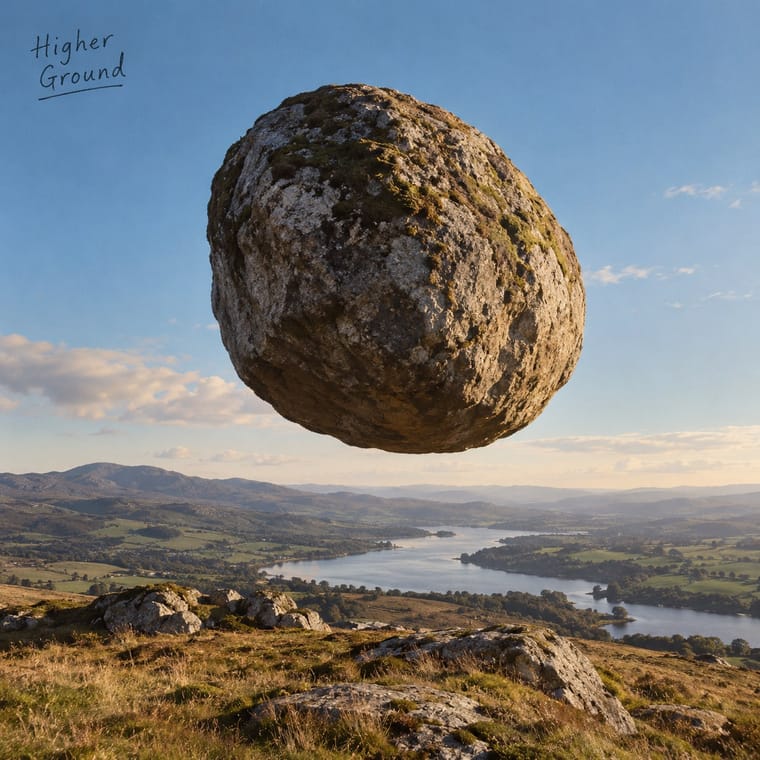
The sleeves the London studio Hipgnosis made for Pink Floyd, Led Zeppelin, Genesis, Peter Gabriel, 10cc and others from 1968 to 1983. The front is rarely a band portrait or a title: it is a staged photograph of an impossible or deadpan event in a real place, often a pun on the title or a lyric, finished by hand in the darkroom with multiple printing, tinting and cut-and-paste long before Photoshop. George Hardie's crisp pen-and-ink graphics, stickers and inner sleeves carry what lettering there is. Thorgerson carried the idiom on after 1983, as on The Division Bell (1994).
Make something in this styleGet advice in this styleMix it with another style
Use it with care
The sleeves, their photographs and the Dark Side of the Moon prism are in copyright and the archive is held privately by Aubrey Powell: stage and photograph your own pun rather than recreating a Hipgnosis image, and never present a design as a Hipgnosis, Pink Floyd or Led Zeppelin cover. Some sleeves rest on nudity, including two young children on Houses of the Holy, or on jokes Thorgerson himself later called 'not exactly the most politically correct' (Lovedrive) and 'quite sexist' (Technical Ecstasy): borrow the staging and the wit, not those subjects.
01
How it works
- Turn the album title or a lyric into a visual pun or an absurd incident and stage it for real in front of the camera (on the sleeves: a businessman on fire, a cow in a pasture, a black obelisk at a marina, a pig floating over a power station).
- Shoot on location in a wide, real setting (a desert, a basalt causeway, a gorge, a studio lot) and let one deadpan event sit in that quiet space, the photograph running edge to edge on the 12-inch square.
- Finish the picture by hand in the darkroom: multiply, superimpose, cut and paste, hand-tint and retouch until the impossible looks plausible, without letting the seams read as collage.
- Keep the band's faces and name off the front wherever the client allows, and move the lettering to a sticker, a paper wrap-around band, a rubber stamp on a brown bag, the spine or the inner sleeve (XTC's Go 2, 1978, whose front is only an essay on how album covers are used to attract buyers, is the joke that proves the rule).
- Carry the concept across the whole package (back cover, gatefold, inner sleeve, labels, posters and stickers), each panel a further variation, with crisp, technical pen-and-ink graphics as a counterpoint to the photographs.
London: the album-cover design studio Hipgnosis. Storm Thorgerson and Aubrey 'Po' Powell founded it in 1968 when Pink Floyd asked them for the cover of A Saucerful of Secrets. They worked from a darkroom at the Royal College of Art, then from a studio at 6 Denmark Street from early 1970; Peter Christopherson joined in 1974 as an assistant and became the third partner, and George Hardie, Richard Evans and Richard Manning drew, designed and retouched for them. The group dissolved in 1983, when Thorgerson and Powell formed Greenback Films; Thorgerson went on designing sleeves until his death in 2013
02
Its design choices
From Stylogeny’s vocabulary of design choices: defining choices make the style, characteristic ones are usual, occasional ones turn up now and then.
- Layout & composition
- Space & hierarchy
- Typography
- Colour
- Form & shape
- Surface & texture
- Imagery
- Medium & production
- Tone & intent
- Avoids
- Type as image, Experimental & distorted, Typography only, Horror vacui, Abundant decoration, Halftone & Ben-Day dots, Photocopy & distress, Complementary clash
Palette
#141414#7fa6c8#6d8c4a#c9a46b#d8642c#eee8dc
Typefaces
Technical pen-and-ink logo
George Hardie's mechanical-handshake sticker for Wish You Were Here, 1975
Rubber-stamped title on brown paper
Led Zeppelin, In Through the Out Door, 1979, in the manner of bootleg sleeves
Handwritten lettering
Nick Mason's hand used as the typeface throughout the Animals packaging, 1977
Existing band logotype on the photo
Roger Dean's Yes logo on Going for the One, 1977
Known for
Pink Floyd, A Saucerful of Secrets (1968)
the first Hipgnosis cover, designed by Storm Thorgerson around Marie Severin's drawing of Doctor Strange from Strange Tales #158
Hipgnosis, poster for Pink Floyd's The Massed Gadgets of Auximenies, Royal Festival Hall, 14 April 1969
a black-and-white photolithographic collage of one large ear beside clockwork machinery and two smaller ears floating to its right, under a night sky (V&A S.295-1980)
Pink Floyd, Ummagumma (Harvest, 1969)
the band photographed in a Droste-effect recursion of pictures within the picture, an 'exploded' layout of their equipment on an airfield taxiway on the back
Pink Floyd, Atom Heart Mother (Harvest, 1970)
a Holstein-Friesian cow in a pasture photographed by Thorgerson near Potters Bar, with no band name or title on the original front
Wishbone Ash, Argus (1972)
a costumed warrior looking out over the Gorges du Verdon in Provence, design Storm Thorgerson and Aubrey Powell
Pink Floyd, The Dark Side of the Moon (Harvest, 1973)
Hipgnosis and George Hardie's prism splitting white light on a black ground, after a prism photograph Thorgerson found in a physics textbook; the spectrum runs on across the gatefold, and two posters and two stickers came inside
Led Zeppelin, Houses of the Holy (Atlantic, 1973)
Aubrey Powell's photographs of two children at the Giant's Causeway, multi-printed into eleven figures across front and back and given an accidental tint in post-production, with neither name nor title on the sleeve (Grammy nomination for Best Album Package, 1974)
Pink Floyd, A Nice Pair (1973)
grids of small photographs that act out sayings as visual puns, such as 'a fork in the road' and 'a fine kettle of fish'
03
Make something in this style
Say what you need, and Stylogeny’s image studio draws it from Hipgnosis Photographic Concept Sleeve’s design choices and checks it against them. It takes about a minute, and you get a link to share.
04
Where it comes from, and what it’s close to
Before it
The style it grew out of, and the styles it borrowed from.
After it
The styles that grew out of it.
No later style in the atlas grew out of it yet.
Alike in its design choices
Styles that make many of the same choices, related or not, besides those above.
- AIZ Political Photomontage (Heartfield)66% alike
- Post-Punk Record Sleeve (Stiff, Factory, 4AD)61% alike
- Grapus (French Militant Graphic Collective)55% alike
05
Sources
- V&A, Hipgnosis, poster for Pink Floyd, The Massed Gadgets of Auximenies, Royal Festival Hall, 14 April 1969, S.295-1980 ('surreal, elaborately manipulated photography and collage, a form of what today would be classed as photoshopping'): https://collections.vam.ac.uk/item/O154581/
- V&A, Hipgnosis, sleeve for Peter Gabriel (Charisma, 1977), colour offset lithograph on cardboard, hand-tinted photograph, E.1186-1988: https://collections.vam.ac.uk/item/O174808/
- V&A, Hipgnosis (Richard Evans with Alwyn Claydon), Yesshows World Tour 1977 programme, E.1306-1990: https://collections.vam.ac.uk/item/O189738/
- Tate, 'Storm Thorgerson on Magritte', 21 July 2011 (took from Magritte 'a sort of love of oddity, or oddness, or rather, juxtaposition or contrariness'; 'We often stage these things for real and don't do them in a computer because the reality has its own attributes'): https://www.tate.org.uk/art/artists/rene-magritte-1553/storm-thorgerson-on-magritte
- Groninger Museum, The Art of Hipgnosis: Pink Floyd, Led Zeppelin, Genesis, Paul McCartney, Peter Gabriel & 10cc, 19 January – 14 May 2023, curated by Andreas Blühm with Aubrey Powell ('Many featured surrealist images, produced long before the invention of digital photography and Photoshop'; Powell: 'Everything had to be shot on film and done by hand'; 'All the photographs and objects in The Art of Hipgnosis come from Powell's private archive'), archived: https://web.archive.org/web/20260305103016/https://www.groningermuseum.nl/en/art/exhibitions/hipgnosis
- Groninger Museum, press release 'Groninger Museum unveils a world first with exhibition The Art of Hipgnosis', 12 October 2022 (the Animals pig over Battersea Power Station, 1977), archived: https://web.archive.org/web/20240523022354/https://www.groningermuseum.nl/en/press/groninger-museum-heeft-wereldprimeur-met-overzichtstentoonstelling-the-art-of-hipgnosis
- Aubrey Powell, Vinyl . Album . Cover . Art: The Complete Hipgnosis Catalogue (Thames & Hudson, 2017), Open Library record: https://openlibrary.org/books/OL27403177M
- Wikipedia, Hipgnosis (founded 1968; Christopherson from 1974; Evans, Hardie and Manning; Hasselblad medium format, multiple exposures, airbrushing and cut-and-paste; Hardie's pen-and-ink logos; dissolved 1983): https://en.wikipedia.org/wiki/Hipgnosis
- Wikipedia, Storm Thorgerson (objects out of context in vast spaces; 'I like to mess with reality'; Greenback Films after 1983): https://en.wikipedia.org/wiki/Storm_Thorgerson
- Wikipedia, George Hardie (artist) (NTA Studios; artwork for The Dark Side of the Moon and Wish You Were Here): https://en.wikipedia.org/wiki/George_Hardie_(artist)
- Wikipedia, Peter Christopherson (third partner in Hipgnosis): https://en.wikipedia.org/wiki/Peter_Christopherson
- Wikipedia, Squaring the Circle (The Story of Hipgnosis), documentary by Anton Corbijn, 2022: https://en.wikipedia.org/wiki/Squaring_the_Circle_(The_Story_of_Hipgnosis)
- Wikipedia album articles on the sleeves: A Saucerful of Secrets; Ummagumma; Atom Heart Mother; Argus (album); The Dark Side of the Moon; Houses of the Holy; A Nice Pair; Wish You Were Here (Pink Floyd album); Presence (album); Technical Ecstasy; Peter Gabriel (1977 album); Animals (Pink Floyd album); I Robot (album); Going for the One; Lovedrive; In Through the Out Door; Peter Gabriel (1980 album); Go 2; The Division Bell
How Stylogeny researches and checks a style: where the facts come from.