Traditions & vernacular · 1967–present · Latin America & Caribbean
Picó Sound-System Painting (Colombian Caribbean)
Also known as Pintura picotera, Arte picotero, Gráfica picotera, Picó art, Painted picó fronts
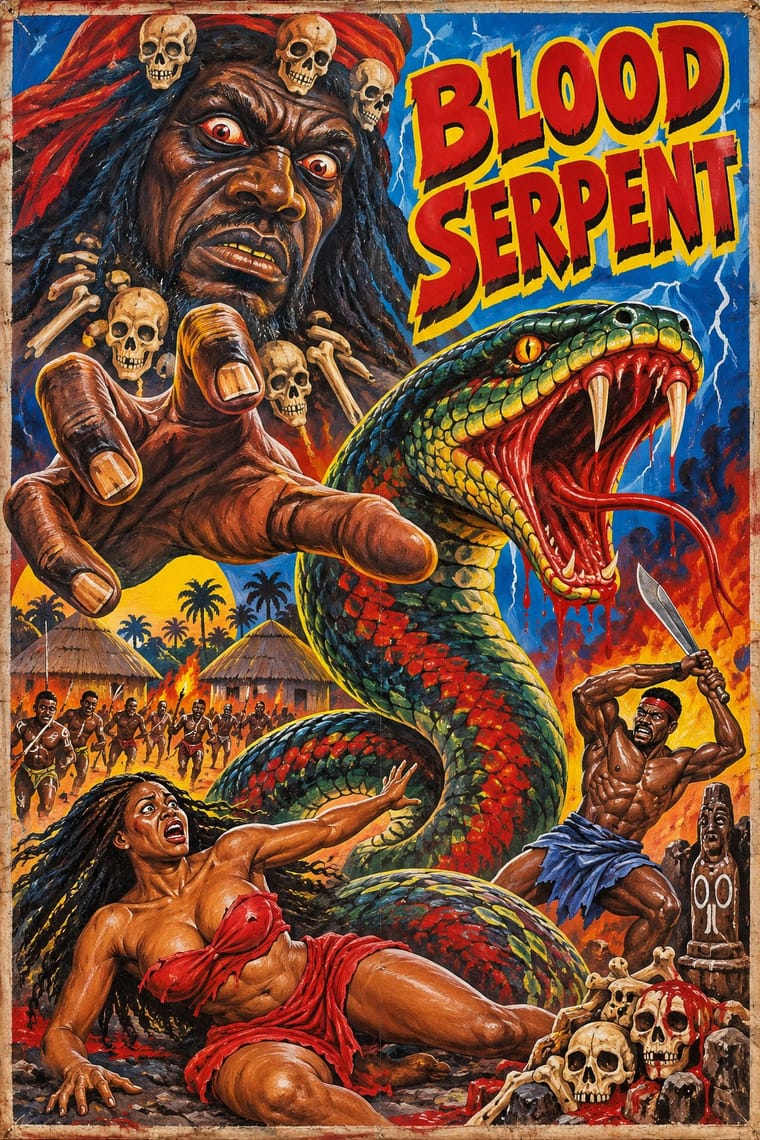
The hand-painted fronts of the picós, the giant sound systems that play dances in the barrios of Barranquilla and Cartagena. On the cotton canvas over the speaker cabinet a picó painter brushes and airbrushes one central, totemic figure (a cobra, lion or eagle, an armed warrior or superhero, a salsa singer, a scene in outer space) in fluorescent vinyls, lacquers and enamels, today usually on a black ground, with the picó's name and its combat slogan in block capitals. The painting is the machine's identity in its rivalry with other picós.
Use it with care
Picó painting is the living trade of named barrio painters in Barranquilla and Cartagena and part of an Afro-Caribbean dance culture, so commission and credit picó painters rather than imitating their hand, and never lift a real picó's name, slogan or painting, which are its owner's identity in a rivalry. The figures often quote film heroes, superheroes and real singers, so do not reproduce a likeness or a character in commercial work without rights. Picó and champeta culture has long been looked down on along race and class lines, as Afro-Colombian, poor-barrio culture tied to marginality and crime, so do not present the painting as naive or 'kitsch' curiosity, and do not use the style as shorthand for noise, fights or a generic tropical party: picó dances have been criticised on exactly those grounds.
01
How it works
- Give the machine one picture: paint a single central, totemic figure square in the middle of the canvas that covers the speakers, so the composition is symmetric and reads across a dance floor (Néstor Martínez Celis notes that the central figure 'habitualmente condiciona a trabajar una composición simétrica'); set it alone or at the centre of a scene with landscape and perspective around it, and give only the main figure full detail, simplifying the background into colour zones because the open weave of the speaker canvas cannot hold fine lines.
- Make the figure personify the picó's name and its boast, and repaint it when the identity changes (a red cobra for El Rojo, 'la cobra de Barranquilla'; a lion for El Isleño, 'el león de la salsa'), with themes of power, ferocity, luxury and success throughout; crush frogs and snakes under it (slang for gossips and enemies), or let it bite or chase a rival picó's mascot.
- Always pair the picture with the picó's name and a combat slogan (such as 'El tanque de guerra', 'Nunca afloja' or 'El rey de la galaxia') in crushing block capitals, and make the lettering work as the machine's logotype (on the picture itself in the first manner; from Belimastth on, on the secondary speakers and the canvas margins, so text and image are separate); on contemporary split stacks built for bigger crowds, paint the logotype alone on the metal grille instead of a full picture.
- Paint for the night: lay primaries in vinyl, then spray fluorescent, contrasting lacquers and enamels over them on a black ground, never a flat or white one, which does not shine; model the volumes with smooth airbrushed gradients, set golden bodies against the block letters in acid contrasts, add glitter or LEDs if the owner asks, and let the front glow under the neon lights in the cabinet frame at the dance.
- Borrow heroes and power from film posters, record covers and comics (Rambo-like gunmen, superheroes, Stallone's Cobra), from salsa idols, gods and history, or set the scene in outer space with spaceships and science-fiction machines, or in a Caribbean landscape with palms.
- Work to the owner's brief: take the picó's name, theme and reference images from the owner, round out the composition and add the complementary elements yourself, sign it, and leave the rest of the cabinet in coloured formica or in the picó's own identity colour.
The popular barrios of Barranquilla (Carrizal and the south of the city) and Cartagena on Colombia's Caribbean coast, with Soledad, Malambo, Galapa and Santa Marta nearby. Picós (from the English pick-up) date from the late 1930s and boomed in the 1960s and 1970s. The painting of picó speakers is traced to 1967, when Máximo Forero painted the boxes of El Perro in Cartagena (Barriosnuevo, via Sonic Street Technologies). In Barranquilla, Gerson (given as Gerson Acosta and as Gerson Costa) started the trend with a first manner of figures and lettering together on flat grounds in restrained colours. His apprentice Belisario de la Mata ('Belimastth') formed a second, scenic manner in the early 1970s that moved the lettering off the picture, while William Gutiérrez, born in the late 1950s, painted his first speaker at 13 and became the champion of a third manner of dense, psychedelic colour on black grounds. Early picós were painted in sober colours, and Gutiérrez remembers Belimastth's 'El Gran Picasso' as the first neon front he saw. The picós also spread champeta criolla, sung from about 1981; Cartagena's El Rey de Rocha led its spread and, with its label Rocha Discs, recorded its first song in 1993.
02
Its design choices
From Stylogeny’s vocabulary of design choices: defining choices make the style, characteristic ones are usual, occasional ones turn up now and then.
- Layout & composition
- Space & hierarchy
- Typography
- Colour
- Surface & texture
- Imagery
- Medium & production
- Tone & intent
- Avoids
- Dynamic asymmetry, Collage & layering, Generous white space, Ornament-free, Pastel, Earth & mineral, Light ground, Straight photography, Rational & objective, Calm & contemplative
Palette
#0b0b1e#ff2a1a#ff8a00#f6ff1f#2bff4a#1f6bff
Typefaces
Crushing painted block capitals
Fluorescent painted slogan capitals
Name lettering on the side speakers
Painted logotype on a metal grille
Known for
El Rojo, 'La cobra de Barranquilla'
a front by Belimastth that first showed a devil in flames with a trident, became a three-headed dragon after complaints from evangelical groups, and then a cobra taken from Sylvester Stallone's film Cobra (Cartel Urbano, 2016); mocked on El Príncipe Turbo, whose tiger bites a red cobra (SST, 2024)
El Coreano, 'El tanque de guerra', Barranquilla, painted by Belimastth
a photograph of it was the cover of the LP 'Salsa picotera Vol. 2' (1980), and Gutiérrez recalls a time when every owner wanted a war tank like El Coreano's (SST, 2024); named by the owner in honour of a relative who served in the Korean War (Cartel Urbano, 2016; slogan in Martínez Celis, 2015)
El Isleño, 'El león de la salsa', Barranquilla
a lion that replaced an earlier canvas of a man fishing on an island (Cartel Urbano, 2016; i-D, 2020); SST lists it among the picós of the first manner, with figure and lettering together
El Conde, Cartagena
a front based on the Puerto Rican salsa singer Pete 'El Conde' Rodríguez (Cartel Urbano, 2016)
El Perro, Cartagena, whose speaker boxes Máximo Forero ('Max Forero') painted in 1967, which Sonic Street Technologies, after Barriosnuevo (2015), takes as the foundation of the art (SST, 2024)
Belisario de la Mata ('Belimastth'), Barranquilla, Gerson's apprentice, who worked mostly in barrio Carrizal
a voracious, menacing eagle with enormous wings, diving with its claws out ('exhibiendo sus garras en picada'), 'cielos rumberos' and dripped and splashed paint on walls and high surfaces (El Heraldo, 2015); scenes with landscape and perspective around a central figure, with the name and slogan moved to the side speakers (SST, 2024); Gutiérrez remembers his 'El Gran Picasso', in neon tones, as the first more colourful front he saw (El Heraldo, 2020)
José Alexander Lugo Caballero ('Alsanders', who signed 'Alsander'), Belimastth's rival and William Gutiérrez's teacher, whose first picó was El Palladium and who says he painted more than three hundred (El Heraldo, 2015; Martínez Celis, 2015)
William Gutiérrez, called a 'maestro de la gráfica picotera'
(Bacánika), born in Calamar, Bolívar, a shop-sign painter who studied at university: the champion of a third manner of dense, psychedelic colour over black grounds (SST, 2024), with El Solista, El Gran Pijuán and El Rojo among his commissions, and the exhibition 'El artista: el maravilloso mundo picotero de William Gutiérrez' at Galería La Escuela in 2023 (El Heraldo, 2020; Bacánika, 2023)
03
Where it comes from, and what it’s close to
Before it
The style it grew out of, and the styles it borrowed from.
After it
The styles that grew out of it.
No later style in the atlas grew out of it yet.
Alike in its design choices
Styles that make many of the same choices, related or not, besides those above.

04
Sources
- https://es.wikipedia.org/wiki/Pic%C3%B3 (origins in Barranquilla from 1938–1939; boom in the 1960s and peak in the 1970s; the speaker membrane of canvas or cañamazo; pine cabinets clad in coloured formica in red, yellow, green and black; airbrush and mixed technique in vinyl, acrylic, lacquer and enamel; 'kitsch estrafalarios, de colores vivos, fosforescentes y psicodélicos'; beasts, gods, warriors, superheroes, weapons, war machines, futuristic spaceships, Caribbean landscapes, salsa singers; paintings that sometimes satirise rival picós; table of picós, slogans and cities; single-colour identities; El Rey de Rocha of Cartagena, Rocha Discs and champeta criolla, 1993; picós long a culture of the clases populares 'asociados a la marginalidad y la delincuencia'; criticism over noise, fights and violence)
- https://es.wikipedia.org/wiki/Champeta (champeta's origins in the marginal barrios of Cartagena and Afro-descendant areas; the name given by the economic elite to belittle the culture and associated with 'vulgaridad, pobreza y negritud')
- Néstor Martínez Celis, 'La pintura picotera: arte singular desde el Caribe colombiano', Arte Actual, 25 January 2015, https://arte-actual.blogspot.com/2015/01/la-pintura-picotera-arte-singular-desde.html (Gerson started the trend in Barranquilla; Belimastth's style from the early 1970s; Alsander as William Gutiérrez's teacher; brush and ordinary vinyl, later the airbrush for 'los degradados de los volúmenes'; a layer of primary vinyls under fluorescent, contrasting colours; glitter and LEDs; Celia Cruz, Héctor Lavoe, Cheo Feliciano; 'guerreros, rambos y superhéroes fuertemente armados'; lions, tigers and cobras; palm landscapes; 'título y un slogan o frase de combate' (El Coreano, El Rojo); a central totemic figure and symmetric composition; owner and painter as collaborators, the painter rounding out the composition)
- Redacción El Heraldo, 'La gráfica picotera reclama su lugar', 14 December 2015, https://www.elheraldo.co/tendencias/la-grafica-picotera-reclama-su-lugar-233442 (Belimastth in Carrizal, an eagle 'de alas grandísimas, voraz y amenazante exhibiendo sus garras en picada', 'cielos rumberos', dripping; José Alexander Lugo Caballero 'Alsanders', El Palladium, more than 300 picós; William Gutiérrez learned from Alsanders; enamel, lacquer sprayed by airbrush, fluorescent enamels; Dairo Barriosnuevo's research from 1993)
- Amanda Parra, 'Arte picoteril: explosión colorida que viste el sonido', El Heraldo, 20 September 2020, https://www.elheraldo.co/entretenimiento/arte-picoteril-explosion-colorida-que-viste-el-sonido-759855 (early picós in sober colours; Belimastth's 'El Gran Picasso', with neon tones, the first more colourful work Gutiérrez remembers seeing; red, orange, yellow and green became customary; William Gutiérrez painting since the age of 13, El Solista, El Gran Pijuán, El Rojo; Pablo Hernández, airbrush and stencils, El Yanqui; most requested themes are strong, famous characters and portraits)
- Ignacio Mayorga Alzate, 'William Gutiérrez: maestro de la gráfica picotera', Bacánika, 27 June 2023, https://bacanika.com/articulo/william-gutierrez-maestro-de-la-grafica-picotera (born in Calamar, Bolívar, in the late 1950s; painted shop, billiard and bakery signs; studied and taught painting at university; 'contrastes ácidos entre cuerpos áureos y letras en bloque aplastantes'; 'virilidad hiperbólica'; outer space and science fiction; images taken from record covers and film posters; a neon layer to make the colours stand out at night; owners supply the name and reference images; exhibition at Galería La Escuela)
- Nicolás Rodríguez Sanabria, 'El Picó, manifestación del folclor de la región Caribe', Cartel Urbano, 13 October 2016, https://cartelurbano.com/historias/el-pico-manifestacion-del-folclor-de-la-region-caribe (El Rojo by Belimastth: devil, three-headed dragon, cobra from Stallone's Cobra; El Conde after Pete 'El Conde' Rodríguez; El Coreano; El Isleño; decoration as marketing and a statement of power, luxury, ferocity and success)
- Brian D'Aquino, 'SST Colombia Fieldnotes pt.1', Sonic Street Technologies (Goldsmiths, University of London, ERC grant 866239), 23 May 2023, https://sonic-street-technologies.com/?p=2810 (the pintura hand-painted in fluorescent colours and lit during dances, representing the picó's name and identity; cañamazo cotton canvas over the turbo front, rarely over 1.5 x 2 m; the fraccionado, a more contemporary stack adopted to cater for bigger audiences, with a metal grille often painted with a logotype rather than a full artwork)
- Manuel Nieves, 'Colombian Picó Graphics Vol. 1', Sonic Street Technologies, 13 September 2024, https://sonic-street-technologies.com/colombian-pico-graphics-vol-1/ (poster lettering by self-taught painters who also work for restaurants, bars and other businesses, versus picó painting by specialists in sound-system decoration; identities as animals, heroes or fictional characters; Cartagena posters on yellow grounds, symmetric on a vertical axis, by Los Loros del Cartel and José Corredor 'El Runner'; Barranquilla posters on black card with gradients, outlines and shadows by painters such as Oscar Peña 'Añepracso'; luminous paint advertisements on black credited to Algesan at the beginning of the 1990s, after Barriosnuevo 2012; El Skorpion's posters in two shades of green)
- Manuel Nieves, 'Colombian Picó Graphics Vol. 2', Sonic Street Technologies, 11 October 2024, https://sonic-street-technologies.com/colombian-pico-graphics-vol-2/ (Máximo Forero and El Perro of Cartagena, 1967, after Barriosnuevo 2015; three trends not tied to particular times: Gerson Costa's figures and lettering on flat grounds in restrained palettes, Belimastth's scenes with landscape and perspective and the name and slogan moved to the secondary speakers and margins, and William Gutiérrez's dense, psychedelic colours over black grounds, 'flat or white backgrounds are not used'; the canvas as a low-resolution medium, with backgrounds simplified to colour zones; neon lights in the box frames; El Coreano by Belimastth on the cover of the LP 'Salsa picotera Vol. 2', 1980; yellow, red, orange, green, fuchsia and blue, blue brightening most under neon; boasting with frogs and snakes, and mockery such as El Príncipe Turbo's tiger biting El Rojo's red cobra)
- 'Now reading: A new exhibition traces the history of Colombian street parties', i-D, 2020, https://i-d.co/?p=50610 ('PICO: Un Parlante de África en América', Invernomuto and Jim C. Nedd, Auto Italia, London; El Rojo as a red snake, El Isleño as a lion; paintings by local painters)
How Stylogeny researches and checks a style: where the facts come from.