Postmodern · 1986–2002 · Western Europe, East Asia
Techno-Futurist Graphics
Also known as Techno graphics, Cyber-corporate, Designers Republic style
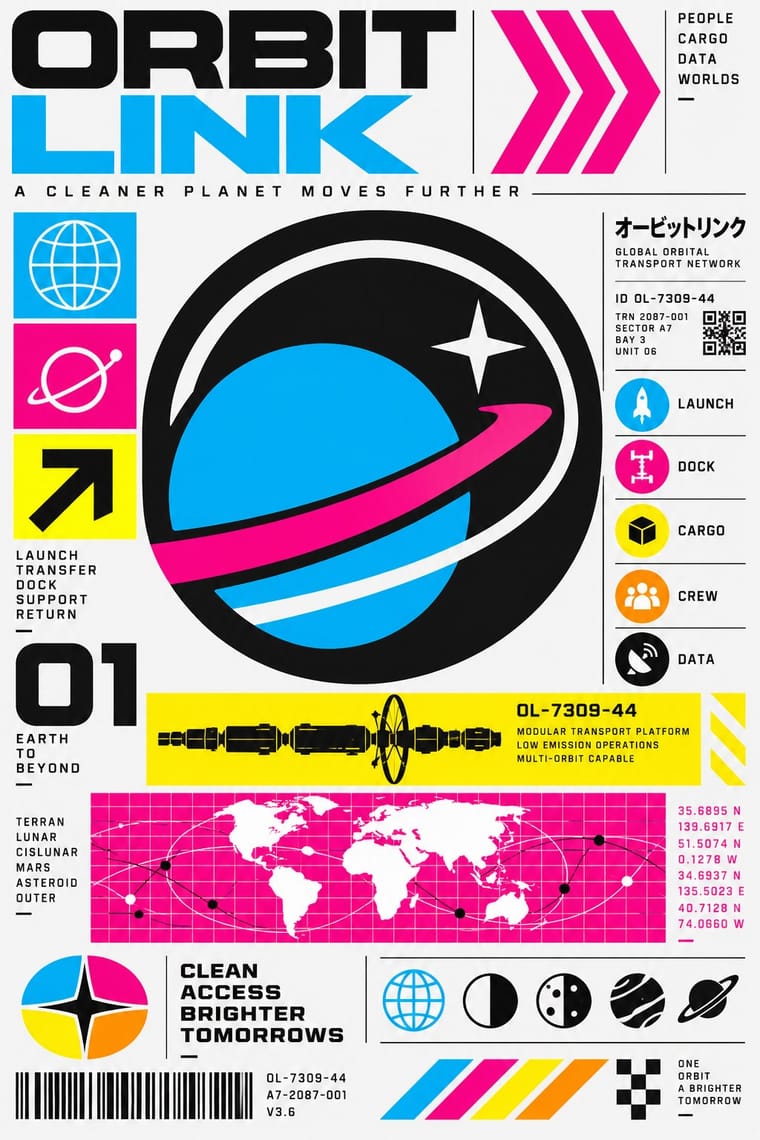
Electronic-music and video-game graphics of the late 1980s and 1990s that turned corporate modernism into a sci-fi consumer fantasy. Grids, Helvetica, pictograms, barcodes, warning labels and invented corporate logos were recombined with katakana, manga cuteness and early 3D, producing slick, flat, information-saturated surfaces that both celebrated and satirised technology and branding.
Make something in this styleGet advice in this styleMix it with another style
01
How it works
- Borrow the grammar of corporate identity (logos, pictograms, product codes, warning labels) and invent fictional brands with it.
- Surround a bold central mark with dense micro-typography of serial numbers, katakana and slogans.
- Keep surfaces flat and vector-clean, with candy brights and fluorescents on white or silver.
- Mix Swiss grids and grotesques with techno display faces and cute characters for ironic overload.
- Design across sleeves and screens alike, using interface frames, HUD elements and title sequences.
Sheffield and London, UK; Kyoto and Tokyo, Japan
02
Its design choices
From Stylogeny’s vocabulary of design choices: defining choices make the style, characteristic ones are usual, occasional ones turn up now and then.
- Layout & composition
- Space & hierarchy
- Typography
- Colour
- Imagery
- Medium & production
- Tone & intent
- Avoids
- Script, Earth & mineral, Carved line, Photocopy & distress, Floral & vegetal, Painterly illustration, Hand-painted, Nostalgic & retro
Palette
#f5f5f5#111111#00aeef#ec008c#fff200#f7941d
Typefaces
Helvetica
Eurostile / Microgramma
OCR-B
Katakana gothic
e.g. Morisawa Shin Go
Custom techno logotypes
The Designers Republic, Wipeout
Known for
The Designers Republic
Ian Anderson; Warp Records sleeves; Wipeout, 1995
Tomato
London; Underworld
Me Company
Paul White; Björk sleeves
Groovisions
Kyoto, 1993; Chappie; Pizzicato Five stage visuals
Tycoon Graphics
Tokyo
Build
Michael C. Place, 2001
03
Make something in this style
Say what you need, and Stylogeny’s image studio draws it from Techno-Futurist Graphics’s design choices and checks it against them. It takes about a minute, and you get a link to share.
04
Where it comes from, and what it’s close to
Before it
The style it grew out of, and the styles it borrowed from.


Alike in its design choices
Styles that make many of the same choices, related or not, besides those above.


05
Real works
Artefacts in museums, libraries and archives that show the style, linked at their source.
- Work Buy Consume Die (Pho-Ku Corporation poster)The Designers Republic (Ian Anderson) · 1994 · Victoria and Albert Museum, London
- Very Metal Noise Pollution (Pop Will Eat Itself), 7-inch gatefold record sleeveThe Designers Republic, for Pop Will Eat Itself (RCA/BMG Records) · 1989 · Victoria and Albert Museum, London
- Blech club night entry ticket ('Discoclub Pass')The Designers Republic, for Warp Records' Blech club night · 1996–7 · Victoria and Albert Museum, London
- Build website holding page ('The Build™ website is currently under construction')Build (Michael C. Place) · 2002 (header 'Build™/2002'; archived 7 February 2003) · Internet Archive Wayback Machine
06
Sources
- Rick Poynor, No More Rules: Graphic Design and Postmodernism (2003)
- https://www.thedesignersrepublic.com
- Kyoto ddd gallery, groovisions exhibition notes: https://www.dnpfcp.jp/gallery/ddd/eng/00000814
How Stylogeny researches and checks a style: where the facts come from.