Digital native · 2007–present · Global / networked, Western Europe, North America
Generative & Dynamic Identities
Also known as Dynamic identities, Flexible visual systems, Programmatic branding, Responsive logos
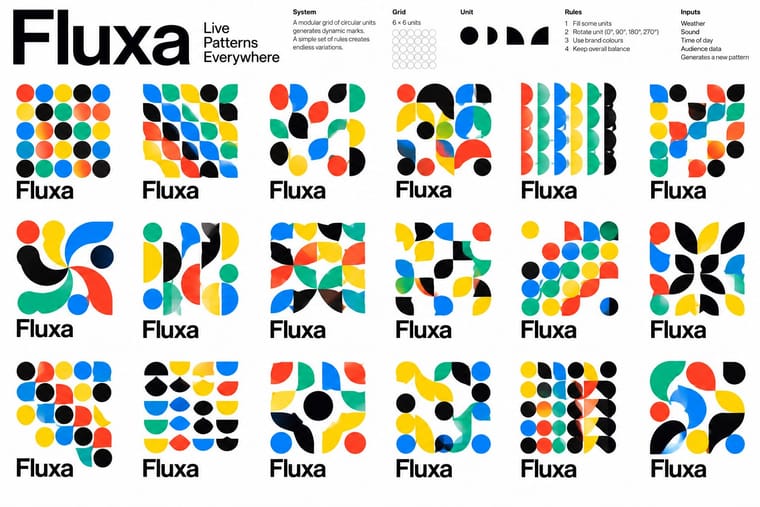
Identity systems designed as rules rather than fixed marks: logos and graphics generated by code, data or parameters so that they vary endlessly while staying recognisable. Anticipated by Karl Gerstner's Designing Programmes (1964) and launched by projects such as Sagmeister's Casa da Música (2007) and TheGreenEyl's MIT Media Lab identity (2011), the approach now spans responsive, data-driven and AI-assisted brands.
Make something in this styleGet advice in this styleMix it with another style
01
How it works
- Design the rules, not a single logo: define a grid, algorithm or parameter set that generates endless valid variants.
- Hold a few elements constant (a wordmark, a typeface, a colour logic or a grid) so variation still reads as one brand.
- Drive variation with meaningful inputs such as weather, sound, content or audience data rather than randomness alone.
- Build marks from abstract primitives that can be recombined, recoloured and animated.
- Deliver the identity as software and motion so it lives in real time across screens, signage and print.
Design studios in Europe and North America (Porto, Cambridge MA, Toronto, New York, Oslo)
02
Its design choices
From Stylogeny’s vocabulary of design choices: defining choices make the style, characteristic ones are usual, occasional ones turn up now and then.
- Layout & composition
- Space & hierarchy
- Typography
- Colour
- Form & shape
- Surface & texture
- Ornament
- Medium & production
- Tone & intent
- Avoids
- Skeuomorphic material, Floral & vegetal, Borders & frames, Naturalistic depiction, Painterly illustration, Ornamented display, Nostalgic & retro
Palette
#ffffff#111111#ff3b30#0091ff#ffd400#00c389
Typefaces
Neue Haas Grotesk
Whitney Museum, Experimental Jetset
Variable fonts
OpenType Font Variations, 2016
Custom parametric and algorithmic letterforms
Known for
Sagmeister Inc., Casa da Música identity, Porto
2007
TheGreenEyl with E Roon Kang, MIT Media Lab identity
2011
Bruce Mau Design, OCAD University identity
2011
Experimental Jetset, Whitney Museum 'Responsive W'
2013
Neue Design Studio, Visit Nordkyn weather-driven identity
Karl Gerstner, Designing Programmes
1964
03
Make something in this style
Say what you need, and Stylogeny’s image studio draws it from Generative & Dynamic Identities’s design choices and checks it against them. It takes about a minute, and you get a link to share.
04
Where it comes from, and what it’s close to
Before it
The style it grew out of, and the styles it borrowed from.


After it
The styles that grew out of it.


Alike in its design choices
Styles that make many of the same choices, related or not, besides those above.


05
Real works
Artefacts in museums, libraries and archives that show the style, linked at their source.
- MIT Media Lab identity: algorithmic logo system, variants and business cardsTheGreenEyl (Richard The) with E Roon Kang; programming Willy Sengewald · January 2011 (case study archived 7 March 2011) · Internet Archive Wayback Machine (TheGreenEyl website)
- Casa da Música identity: logo variants and colour 'logo generator'Sagmeister Inc. (Stefan Sagmeister; design Matthias Ernstberger, Ralph Ammer, Quentin Walesch) · 2007 (case study archived 28 May 2016) · Internet Archive Wayback Machine (Sagmeister & Walsh website)
- Visit Nordkyn: weather-driven dynamic identityNeue Design Studio · c. 2010–12 (undated case study archived 21 November 2014; generator screenshot dated 27 October 2012) · Internet Archive Wayback Machine (Neue website)
- Whitney Museum of American Art graphic identity ('Responsive W'): sketches and applicationsExperimental Jetset (Marieke Stolk, Danny van den Dungen, Erwin Brinkers) · May 2013 (archive page captured 8 June 2013) · Internet Archive Wayback Machine (Experimental Jetset website)
06
Sources
- Karl Gerstner, Designing Programmes (1964)
- Irene van Nes, Dynamic Identities: How to Create a Living Brand (BIS Publishers, 2012)
- CreativeApplications.Net, 'MIT Media Lab Identity' (creativeapplications.net)
How Stylogeny researches and checks a style: where the facts come from.