Digital native · 2012–present · Global / networked
Low Poly Illustration
Also known as Low poly art, Low-poly style, Polygon art, Polygonal illustration
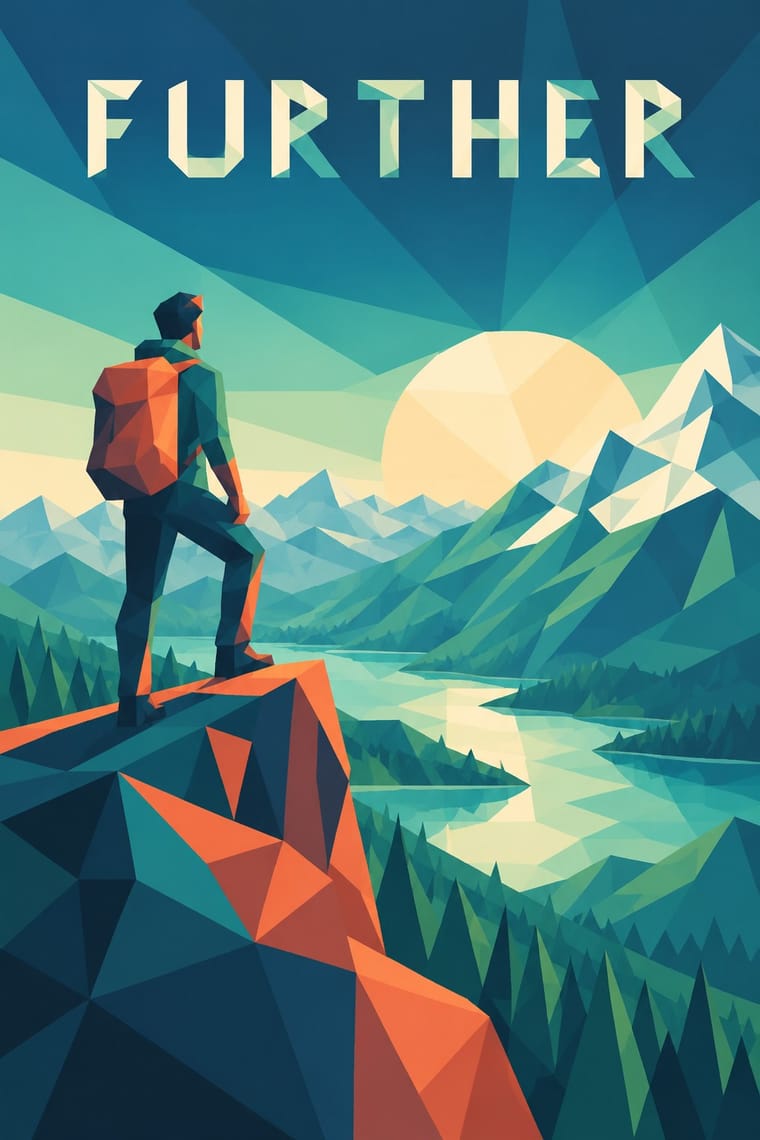
A digital illustration and game look in which subjects are built from a visible mesh of a few flat-shaded polygons, so that animals, faces, vehicles and landscapes read as hard-edged facets with no outline or texture. Around 2012 the polygon budgets of early real-time 3D became a chosen style, in Timothy J. Reynolds's Cinema 4D illustrations and then in indie games such as MirrorMoon EP (2013). Triangulation tools such as Trianglify then carried it into 2D vector art, posters and web backgrounds.
Make something in this styleGet advice in this styleMix it with another style
01
How it works
- Rebuild every subject (animal, face, vehicle, mountain, island) from a mesh of relatively few connected points, and replace every curve with a run of straight edges, so that form reads as a set of hard, angular facets.
- Fill each facet with a single flat tone and let the step from one facet to the next do all the modelling: a key light in 3D, or neighbouring colours sampled from a photograph or a colour ramp in 2D. Use no outlines, texture maps or brushwork.
- Spend polygons where the form needs them (eyes, joints, silhouettes, the ridge of a mountain) and keep the rest coarse, so the reduction looks designed and lit rather than produced by decimating a detailed mesh.
- Isolate one subject, island or small diorama, often in an isometric or axonometric view, on a plain or softly graded ground, or fill a whole background evenly with a triangle mesh in one colour ramp.
- The style has no typographic canon of its own: set titles in a clean geometric sans beside the faceted picture, or choose a display face whose straight segments echo the polygons.
Networked digital illustration and independent game culture (Dribbble, Behance, Steam). Real-time 3D was mostly built from polygon meshes, from early polygonal console games such as Star Fox (Nintendo EAD and Argonaut Software, 1993) to the fifth- and sixth-generation consoles; that 1990s polygonal 3D has no entry of its own in the atlas, so the parent here is bitmap-pixel, the nearest game-graphics ancestor. By 2012 creators were treating a low polygon count as a choice rather than a limit: Eran Hilleli's graduation film Between Bears (Bezalel, 2010), praised at the time for its 'low-poly models', was an early example, and the Milwaukee 3D illustrator Timothy J. Reynolds was building a low poly series in Cinema 4D, including his 'Low-Poly, Isometric Worlds' (Dribbble interview, October 2012; GIGAZINE, December 2012), while bloggers noted low-polygon art 'making the rounds' (November 2012). Indie games followed, among them Santa Ragione's MirrorMoon EP (4 September 2013), whose Steam page promises 'astonishing low-poly sceneries' and which Wikipedia (uncited) calls the oldest Steam game tagged 'low poly'. Triangle-mesh generators such as Quinn Rohlf's Trianglify (April 2014) and image-stylisation algorithms carried the look into 2D vector illustration, posters and web backgrounds
02
Its design choices
From Stylogeny’s vocabulary of design choices: defining choices make the style, characteristic ones are usual, occasional ones turn up now and then.
- Layout & composition
- Space & hierarchy
- Colour
- Form & shape
- Surface & texture
- Ornament
- Imagery
- Medium & production
- Tone & intent
- Avoids
- Biomorphic curves, Rounded & pill, Whiplash line, Painterly brushwork, Paper & letterpress bite, Skeuomorphic material, Gloss & highlights, Straight photography, Script, Abundant decoration, Horror vacui, Line illustration, Chrome & 3D render
Palette
#163a4f#1f6f78#3fa58a#9fd3a8#f1e8d0#e8704f
Typefaces
Faceted display faces that replace every curve with straight segments, such as Ray Larabie's Alphii (Typodermic, 2006), which in the foundry's words 'does not imitate a mesh or toolpath; it shares their economy'
A clean geometric sans set flat beside the faceted picture, so the letters stay legible while the mesh carries the image
a working recommendation: the style has no settled typographic canon
Known for
Timothy J. Reynolds (Milwaukee)
low poly illustrations modelled, lit and rendered in Cinema 4D and finished in Photoshop, for clients including MakerBot, Facebook, Greenpeace, Fast Company and Wired ('It's the Polygons You Don't See', Lesterbanks, 5 March 2014), and a low-poly pattern design for The North Face's 'Homestead' collection (Spring 2016)
Timothy J. Reynolds, 'Low-Poly, Isometric Worlds' (2012)
a rocky mountain, a factory interior, a racing car and an aerial road among other small isometric dioramas (GIGAZINE, 30 December 2012), part of the low poly series he said he would keep building (Dribbble interview, 24 October 2012)
Eran Hilleli, Between Bears (graduation film, Bezalel Academy of Art and Design, Jerusalem, 2010), made in Maya and After Effects, whose 'low-poly models' Art-Spire singled out in August 2010
MirrorMoon EP (Santa Ragione, released on Steam 4 September 2013), a space-exploration game whose Steam page promises 'astonishing low-poly sceneries'; Wikipedia, without a citation, names it the oldest Steam title tagged 'low poly'
Superhot (Superhot Team, 2016), Necropolis
(Harebrained Schemes, 2016), Grow Up (Ubisoft Reflections, 2016), Ravenfield (early access 2017) and Totally Accurate Battle Simulator (Landfall, 2021), which Wikipedia's 'Low poly' article lists, without citations, among 'notable low poly games released since the late-2010s'; Superhot's own article never calls it low poly, only 'minimalistic by design' (art director Marcin Surma), with white for the environment, black for usable objects and red for enemies. Wikipedia counts 244 Steam titles tagged 'low poly' from 2014 to 2018
Trianglify (Quinn Rohlf, GitHub repository opened 12 April 2014, GPL-3.0), a JavaScript library that turns a jittered grid of points into coloured triangle meshes with ColorBrewer gradients for SVG images and CSS backgrounds
Works collected by Sessions College in 'What's the Deal with Low Poly Art?'
Paul Douard's portrait of Jack Nicholson with a cigar in 2,520 polygons, Hesham Adel's 'low low poly' film posters (Interstellar, Maleficent, Captain America: The Winter Soldier), Calder Moore's landscapes and his 'Isometric Swamp', and CAZAPAPELES's cardboard installation The Red Cape Project
03
Make something in this style
Say what you need, and Stylogeny’s image studio draws it from Low Poly Illustration’s design choices and checks it against them. It takes about a minute, and you get a link to share.
04
Where it comes from, and what it’s close to
Before it
The style it grew out of, and the styles it borrowed from.


After it
The styles that grew out of it.
No later style in the atlas grew out of it yet.
Alike in its design choices
Styles that make many of the same choices, related or not, besides those above.


05
Sources
- Wikipedia, 'Low poly' (https://en.wikipedia.org/wiki/Low_poly), an article flagged 'More citations needed': low poly as a deliberate aesthetic rather than an optimisation (cited to Sessions College); a specific style from late 2013, crediting Timothy J. Reynolds; MirrorMoon EP (September 2013) as the oldest Steam title tagged 'low poly'; Into this Wylde Abyss (2014); 244 tagged Steam titles 2014–2018; Superhot, Necropolis, Grow Up, Totally Accurate Battle Simulator and Ravenfield listed as notable games 'since the late-2010s'. Much of it is unsourced: the pixel-art analogy and the Cézanne comparison are tagged citation needed; the console nostalgia, the MirrorMoon, Steam-tag and games-list claims carry no reference; and the late-2013 date and the credit to Reynolds rest only on the Lesterbanks article of March 2014, which gives September 2013 as the start of his freelance career, not of the style, and says he had been making low poly art 'for the last few years'
- Lesterbanks, 'It's the Polygons You Don't See, The Low Poly Art of Timothy J. Reynolds' (5 March 2014), https://lesterbanks.com/2014/03/polygons-dont-see-low-poly-art-timothy-j-reynolds/ (Milwaukee freelance 3D illustrator since September 2013; Cinema 4D and Photoshop process; clients MakerBot, Facebook, Greenpeace, Fast Company, Wired; 'I just like hard edges'; low poly is hard to do well beyond decimating a mesh; 'creating and refining his low poly art for the last few years')
- Timothy J. Reynolds, portfolio, https://www.turnislefthome.com/ (The North Face 'Homestead' collection, Spring 2016: low-poly pattern design; Twitch, Red Robin and other clients)
- Sessions College, 'What's the Deal with Low Poly Art?', https://www.sessions.edu/notes-on-design/whats-the-deal-with-low-poly-art/ (dated 15 January 2016 on the page; Wikipedia cites it as 15 January 2015): simple geometric shapes placed side by side in angular, often minimalist compositions; low polygon counts first used to cut render times; Paul Douard, Hesham Adel, Calder Moore, Amjad Ahdab, Jona Dinges, CAZAPAPELES; Photoshop, Illustrator and Cinema 4D
- Steam store, MirrorMoon EP (app 231310), https://store.steampowered.com/app/231310/ (developer and publisher Santa Ragione; released 4 September 2013)
- Wikipedia, 'Superhot' (https://en.wikipedia.org/wiki/Superhot): 7 Day FPS Challenge, August 2013; release 25 February 2016; art director Marcin Surma, 'minimalistic by design'; white environment, black interactive objects, red enemies; the article never calls the game low poly
- Quinn Rohlf, Trianglify, https://github.com/qrohlf/trianglify ('Algorithmically generated triangle art'; ColorBrewer palettes; GPL-3.0; repository created 12 April 2014) and the npm package https://www.npmjs.com/package/trianglify (first published 15 April 2014)
- Thitiwudh Uasmith, Tantikorn Pukkaman and Peeraya Sripian, 'Low-Poly Image Stylization', Journal for Geometry and Graphics 21(1), 2017, 131–139, https://www.heldermann.de/JGG/JGG21/JGG211/jgg21012.htm ('A low-poly image is a minimalist style of art that is currently widely used'; raster to low-poly vector conversion with K-means segmentation and Delaunay triangulation)
- Meng Gai and Guoping Wang, 'Artistic Low Poly rendering for images', The Visual Computer 32(4), 2016, 491–500 (published online 9 April 2015), doi:10.1007/s00371-015-1082-2
- Wikipedia, 'Star Fox (1993 video game)' (https://en.wikipedia.org/wiki/Star_Fox_(1993_video_game)): Nintendo EAD and Argonaut Software; released in Japan on 21 February 1993 and North America on 23 March 1993; the first Nintendo game to use polygonal graphics, through the Super FX chip
- MyFonts, Alphii by Ray Larabie (Typodermic), https://www.myfonts.com/fonts/typodermic/alphii (MyFonts debut 22 June 2006; curves replaced by straight segments)
- Dribbble, 'Timeout: Timothy J. Reynolds', 24 October 2012, https://dribbble.com/stories/2012/10/24/timeout-with-timothy-j-reynolds (he continues 'to build on my low poly series', linked to his isometric work; 'for the last year or so' focused on personal work)
- GIGAZINE, 'A small world with a fantastic atmosphere drawn with 3DCG polygon "Low-Poly, Isometric Worlds"', 30 December 2012, https://gigazine.net/gsc_news/en/20121230-low-poly-world (Reynolds's series: rocky mountain, inside the factory, racing car, aerial road and other scenes)
- yewknee.com, 'The Rise of Low-Polygon Art', 2 November 2012, https://yewknee.com/blog/the-rise-of-low-polygon-art ('Lately I've been seeing more and more "low-polygon" art making the rounds'; Geo A Day and works by Tim Reynolds)
- Art-Spire, 'Short Animation Film #29: Between Bears', 14 August 2010, https://www.art-spire.com/en/3d/short-animation-film-29-between-bears/ (graduation project at Bezalel Academy of Art and Design, Jerusalem; 'The low-poly models, the fantastic framing and the astonishing soundtrack totally immerse us')
- Amid Amidi, 'Between Bears by Eran Hilleli', Cartoon Brew, 3 August 2010, https://cartoonbrew.com/cgi/between-bears-by-eran-hilleli-26237.html (style crafted in Maya and After Effects; graduation short made at Bezalel Academy in Jerusalem)
How Stylogeny researches and checks a style: where the facts come from.