Pictorial & machine age · 1932–1989 · Eastern Europe, Central Europe, East Asia, Southeast Asia
Socialist Realist Propaganda Poster
Also known as Socialist Realism, Stalinist poster, Chinese propaganda poster
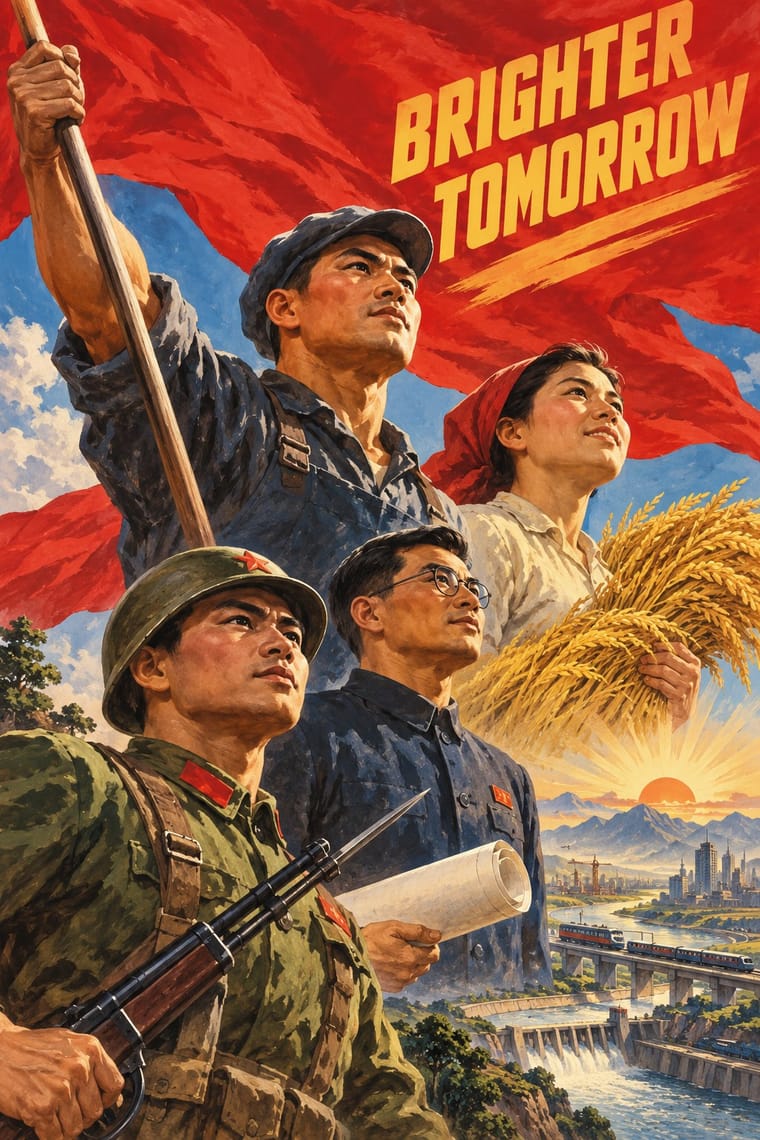
The official art doctrine of the Soviet Union from 1932, later exported across the socialist world, which replaced avant-garde experiment with legible, heroic realism 'national in form, socialist in content'. Its posters show idealised workers, soldiers and leaders on rising diagonals and low horizons, bathed in red, with bold slogans promising a radiant future; in China they merged with New Year print and calendar-poster conventions.
Make something in this styleGet advice in this styleMix it with another style
01
How it works
- Depict idealised, robust workers, farmers, soldiers and leaders in heroic, instantly readable realism.
- Shoot figures from below on rising diagonals, gazing toward a future beyond the frame.
- Drench the image in red (banners, flags, sunrise) against blue skies and golden fields.
- Set a short slogan in bold, hand-drawn capitals across a top or bottom band.
- Mass people into rhythmic crowds or marching columns to express collective will.
- Keep the message unambiguous: no irony, abstraction or formal experiment.
Soviet Union, later the Eastern Bloc, China, North Korea and Vietnam
02
Its design choices
From Stylogeny’s vocabulary of design choices: defining choices make the style, characteristic ones are usual, occasional ones turn up now and then.
- Layout & composition
- Space & hierarchy
- Typography
- Colour
- Surface & texture
- Ornament
- Medium & production
- Tone & intent
- Avoids
- Non-representational, Ironic & self-aware, Rebellious & subversive, Experimental & distorted, Broken grid, Flat hierarchy
Palette
#c8102e#f2c230#1d1d1b#f3e8d2#2f5f8a#b5651d
Typefaces
Hand-drawn Cyrillic poster capitals in condensed grotesque and slab forms
Songti and Heiti display characters
Chinese posters
Brush-written slogan calligraphy
Known for
Gustav Klutsis
photomontage posters of the early 1930s
Viktor Koretsky
Irakli Toidze
The Motherland Calls!, 1941
Nina Vatolina
Don't Chatter!, 1941
Kukryniksy
Shanghai People's Fine Arts Publishing House
Chinese posters
Liu Chunhua
Chairman Mao Goes to Anyuan, 1967
03
Make something in this style
Say what you need, and Stylogeny’s image studio draws it from Socialist Realist Propaganda Poster’s design choices and checks it against them. It takes about a minute, and you get a link to share.
04
Where it comes from, and what it’s close to
Before it
The style it grew out of, and the styles it borrowed from.


Alike in its design choices
Styles that make many of the same choices, related or not, besides those above.

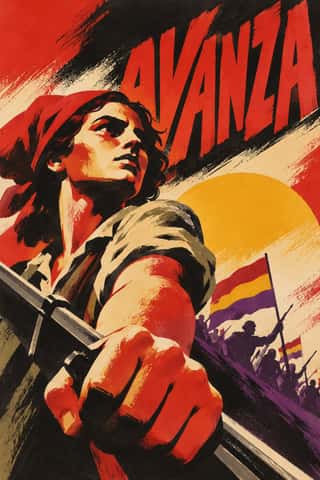

- Italian Fascist Graphics (Romanità & Exhibition Photomontage)69% alike
- Nippon Kōbō & Tōhōsha Photo-Propaganda Magazines (NIPPON & FRONT)67% alike


05
Real works
Artefacts in museums, libraries and archives that show the style, linked at their source.
- 胸怀革命壮志 勇攀世界高峰 (Cherish great revolutionary ideals, bravely climb the world's highest peaks)Song Huimin · July 1975 · Victoria and Albert Museum, London (FE.12-2008)
- Коммунистическая партия Советского Союза (Communist Party of the Soviet Union; catalogued by the V&A as 'Communism is the start of the Soviet Union')Nina Vatolina · 1965 · Victoria and Albert Museum, London (E.508-2021)
- 毛主席去安源 (Chairman Mao Goes to Anyuan)Liu Chunhua · 1968 · Victoria and Albert Museum, London (FE.7-2008)
06
Sources
- Victoria E. Bonnell, Iconography of Power: Soviet Political Posters under Lenin and Stalin (University of California Press, 1997)
- Stefan R. Landsberger, chineseposters.net (Chinese propaganda poster archive)
- Philip B. Meggs & Alston W. Purvis, Meggs' History of Graphic Design
How Stylogeny researches and checks a style: where the facts come from.