Pictorial & machine age · 1934–1974 · Middle East & North Africa
Hebrew Poster Lettering & Early Israeli State Design
Also known as Early Israeli graphic design, Hebrew commercial art of Mandate Palestine, Israeli state modernism
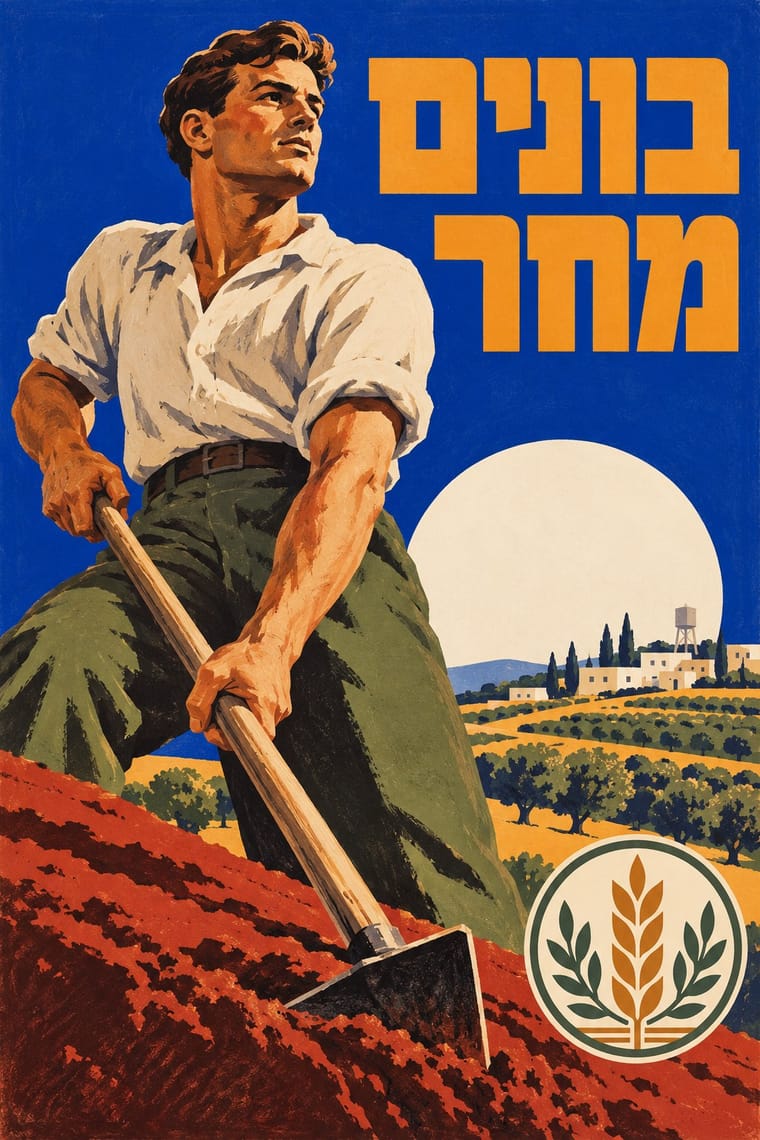
The commercial and state graphics of the Jewish community in Mandate Palestine and early Israel, made in Tel Aviv from 1934 by designers who had trained in Berlin and Vienna: Franz Krausz, Otte Wallish and the Shamir brothers. Posters for juice, cigarettes, tourism and national campaigns centre one heroic figure, product or word, painted in gouache or airbrush under hand-drawn Hebrew block letters. After 1948 the same studios drew the state emblem, stamps, banknotes and medals, joining modernist reduction to the menorah, the olive branch and ancient coins.
Make something in this styleGet advice in this styleMix it with another style
Use it with care
This is the graphic language of the Zionist movement and the new Israeli state in a land shared with Palestinian Arabs: its pioneer, settlement and tourism imagery, 'Visit Palestine' (1936) among it, served the project of Jewish immigration and statehood in the years that led to the displacement of Palestinians in 1948, the Nakba, so present it as political history rather than a neutral regional or 'Holy Land' look, and think twice before reusing it to brand places whose ownership is contested. 'Visit Palestine' is built around the Dome of the Rock, a Muslim shrine, and since David Tartakover reissued it with Krausz's permission in 1995 it has hung in Palestinian homes, shops and Palestinian Authority offices and been reworked by Palestinian artists such as Amer Shomali (2009): it now belongs to two conflicting national memories, so do not use it, or pastiches of it, as a neutral Israeli or Palestinian brand image. Its state symbols are still in force: Israel's Flag and Emblem Law of 1949 (since 2004 the Flag, Emblem and National Anthem Law) requires a permit from the Interior Ministry to produce or use the emblem, so do not adapt it or pass new work off as official. The menorah, the Shema and Torah-scroll calligraphy are also Jewish sacred forms: have any Hebrew checked by a fluent reader, and do not distort scripture or use the names of God as decoration.
01
How it works
- Draw the Hebrew lettering by hand for each job: heavy, square block letters for slogans and brand names, a brush or cursive line when the message needs a voice, and let the word itself become the picture when it can, stacked, extruded or poster-high.
- Centre one hero, such as a pioneer, a soldier, a worker, a product or a landmark, and model it in gouache or airbrush against a dark or flat ground, often on a diagonal.
- Speak for the nation in a few symbols: the menorah, the olive branch, the Star of David and motifs from ancient Jewish coins and seals, set symmetrically and simply on emblems, stamps, banknotes and medals.
- Hold colour to a few inks: white on blue for the national emblem, and red, black, orange, olive and blue on white or dark grounds for the posters.
- Address several readers at once and say little: set Hebrew beside English, and on state paper beside Arabic, and cut each message to a slogan, a name, a price or a date.
Tel Aviv studios of designers who had trained and worked in Berlin, Vienna and Prague and settled in Mandate Palestine in 1934-1935 (Franz Krausz and Otte Wallish in 1934, Gabriel and Maxim Shamir around 1935); after 1948 the same studios designed the State of Israel's emblem, stamps, banknotes and medals, until the Shamir studio closed in 1974
02
Its design choices
From Stylogeny’s vocabulary of design choices: defining choices make the style, characteristic ones are usual, occasional ones turn up now and then.
- Layout & composition
- Space & hierarchy
- Typography
- Colour
- Surface & texture
- Ornament
- Imagery
- Medium & production
- Tone & intent
- Avoids
- Abundant decoration, Horror vacui, Experimental & distorted, Broken grid, Whiplash line, Geometric tessellation, Ironic & self-aware, Rebellious & subversive
Palette
#f1ebdd#0038b8#161616#c8322b#e0952e#5d6b3c
Typefaces
Hand-drawn Hebrew block letters, heavy and square, drawn for each poster and label; Franz Krausz kept one consistent letter style, while the Shamir brothers fitted the lettering to each subject
Brush-written and cursive Hebrew lettering for slogans
'Shma Yisrael!', attributed to Shamir, its letters brushed on a slight diagonal below a hand rising from flames; the looping script line of the 'Adam' cigarette poster
Otte Wallish's calligraphy for the scroll of the Declaration of Independence (1948), modelled on a 16th-century Torah scroll
Hadassah (Henri Friedlaender, begun 1930, completed 1958) and Koren Bible Type (Eliyahu Koren, 1962), new Hebrew text faces of the state's first decades
Franzisca Baruch's Hebrew lettering and emblems, including the Haaretz masthead
Bold sans-serif Latin capitals and Latin script beside the Hebrew on tourism and export posters
'VISIT PALESTINE', 1936; 'Dafne Cigarettes'
Known for
Franz Krausz, 'Visit Palestine' (1936), 'issued by the Tourist Development Ass'n of Palestine' according to its imprint
the walls of Jerusalem's Old City, the Dome of the Rock and a row of cypresses above a terracotta hillside, framed by a dark tree trunk and drawn in flat colour, with 'VISIT' in white on a dark band and 'PALESTINE' in dark blue bold sans-serif capitals
Gabriel and Maxim Shamir, enlistment poster 'Here is the order on everyone's lips: From ten thousand to twenty thousand!'
(United States Holocaust Memorial Museum, 2011.270.3, dated 1941 and catalogued as for the Jewish Brigade, which was formed only in 1944): four helmeted soldiers in profile, modelled by overprinting green and orange inks into brown, against an orange sky above two lines of bold black Hebrew lettering
Shamir, poster for Asis fruit juice (Yeshiva University Museum, New York; catalogued as "ca. 1930s?"; litho-offset by A. Levin-Epstein, Tel Aviv): the Hebrew word עסיס built as giant white letters extruded in blue, heaped with airbrushed fruit and pouring juice, on a black ground
'Adam' cigarette poster (Yeshiva University Museum, catalogued as 'Shamir (?)' and signed with the studio's mark; colour lithograph)
the brand name אדם stacked three times in giant red and grey Hebrew letters on black, crossed by a looping cursive line of Hebrew script, 'in every mouth'
Shamir, 'Yom Seret le-ma'an Asireinu' (Film Day for Our Prisoners), 13-14 December 1947 (Yeshiva University Museum; colour lithograph)
heavy square Hebrew block letters in blue on white beneath a small vignette of a prisoner in a cell
Shamir, 'Dafne Cigarettes' (Yeshiva University Museum; lithograph printed by Levin-Epstein)
an airbrushed cigarette box inside a white laurel wreath on a red ground, with Hebrew block letters, a Latin script 'Dafne' and the price
Gabriel and Maxim Shamir, Emblem of the State of Israel
(adopted 10 February 1949, from their competition entry with changes requested by the committee): the menorah of the Arch of Titus between two olive branches above the word ישראל, white on light blue; the committee chose the olive branches over overtly religious symbols and preferred the Arch of Titus menorah to the brothers' modern one
Otte Wallish, Israel's first postage stamps, 'Doar Ivri' (Hebrew Post, 1948), with designs based on ancient Judean coins, and the calligraphy and layout of the scroll of the Declaration of Independence (1948)
03
Make something in this style
Say what you need, and Stylogeny’s image studio draws it from Hebrew Poster Lettering & Early Israeli State Design’s design choices and checks it against them. It takes about a minute, and you get a link to share.
04
Where it comes from, and what it’s close to
Before it
The style it grew out of, and the styles it borrowed from.


After it
The styles that grew out of it.
No later style in the atlas grew out of it yet.
Alike in its design choices
Styles that make many of the same choices, related or not, besides those above.


05
Sources
- United States Holocaust Memorial Museum, 'Poster promoting enlistment for the Jewish Brigade designed by the Shamir brothers', 1941, 2011.270.3, with a biographical note on Gabriel and Maxim Shamir (Berlin-Charlottenburg school 1926-1933, Tel Aviv c. 1935, State Emblem 1949, Bank of Israel banknote competition 1958, studio closed 1974): https://collections.ushmm.org/search/catalog/irn44060
- Yeshiva University Museum (Center for Jewish History), Shamir posters: 'asis' (https://www.europeana.eu/item/465/412732), 'Cigarette ad' ('Adam', https://www.europeana.eu/item/465/412704), 'Yom Seret l'ma'an lasireinu' (1947, https://www.europeana.eu/item/465/412726), 'Dafne Cigarettes' (https://www.europeana.eu/item/465/412712), 'Shma Yisrael!' (https://www.europeana.eu/item/465/412640); images at https://linkresolver.cjh.org/412732 and the same pattern for each record number
- Wikipedia, 'Gabriel and Maxim Shamir' (https://en.wikipedia.org/wiki/Gabriel_and_Maxim_Shamir) and Hebrew Wikipedia, 'האחים שמיר' (https://he.wikipedia.org/wiki/האחים_שמיר), on the 1958 banknotes and Jacob Zim's reverses
- Wikipedia, 'Franz Krausz' (https://en.wikipedia.org/wiki/Franz_Krausz): Berlin 1926-1933, Jaffa October 1934, Dubek and Elite, gouache, 'Visit Palestine' (1936)
- Wikipedia, 'Otte Wallish' (https://en.wikipedia.org/wiki/Otte_Wallish): Vienna Academy, Palestine 1934, Doar Ivri stamps and the Declaration of Independence scroll
- Tel Aviv Museum of Art, 'Otte Wallish: The Face of Land and Nation' (curator Emanuela Calò, 2015): https://tamuseum.org.il/en/exhibition/otte-wallish-the-face-of-land-and-nation
- Brown University Library, Galkin collection, 'Israel, 1948' (Wallish's Doar Ivri stamps based on ancient Judean coins): https://library.brown.edu/create/stamps/?p=183
- Wikipedia, 'Emblem of Israel' (https://en.wikipedia.org/wiki/Emblem_of_Israel) and Hebrew Wikipedia, 'סמל מדינת ישראל' (https://he.wikipedia.org/wiki/סמל_מדינת_ישראל), on the 1948-1949 competitions, the committee's changes, and the Flag and Emblem Law (1949; since 2004 the Flag, Emblem and National Anthem Law)
- Wikipedia, 'Eliyahu Koren' (https://en.wikipedia.org/wiki/Eliyahu_Koren) and 'Henri Friedlaender' (https://en.wikipedia.org/wiki/Henri_Friedlaender)
- Jüdische Allgemeine (epd), 'Pioniere des hebräischen Grafikdesigns', 19 June 2017, on the exhibition 'New Types: Three Pioneers of Hebrew Graphic Design' (Israel Museum 2015-2016, curator Ada Wardi): https://www.juedische-allgemeine.de/kultur/pioniere-des-hebraeischen-grafikdesigns/
- Wikimedia Commons, Category:Shamir Brothers (1958 banknotes and stamps by Gabriel and Maxim Shamir): https://commons.wikimedia.org/wiki/Category:Shamir_Brothers
- Wikimedia Commons, photograph of a reprint of Franz Krausz's 'Visit Palestine' showing the issuer's imprint, by Adam Yahav (2016, CC BY-SA 4.0): https://commons.wikimedia.org/wiki/File:%D7%9C%D7%91%D7%A7%D7%A8_%D7%91%D7%A4%D7%9C%D7%A9%D7%AA%D7%99%D7%A0%D7%94.jpg
- Wikimedia Commons, Category:Stamps by Gabriel and Maxim Shamir (Independence Day 1962 stamps, also filed under Yom Hazikaron stamps, with the IDF Memorial Day on the tab) and Category:1969 stamps of Israel - Town emblems series (files credited to 'Gabriel and Maxim Shamir for Israel Post'): https://commons.wikimedia.org/wiki/Category:Stamps_by_Gabriel_and_Maxim_Shamir and https://commons.wikimedia.org/wiki/Category:1969_stamps_of_Israel_-_Town_emblems_series
- Rochelle Davis and Dan Walsh, '"Visit Palestine": A Brief Study of Palestine Posters', Jerusalem Quarterly 61 (2015): the Tourist Development Association commission, the 1995 Tartakover reprint, its Palestinian adoption and the Dome of the Rock: https://www.palestine-studies.org/en/node/190753
- Jewish Museum of Belgium, Amer Shomali / Zan Studio, 'Visit Palestine' (after Krausz 1936): https://www.col.mjb-jmb.org/Detail/objects/13442
- Wikipedia, 'Jewish Brigade' (https://en.wikipedia.org/wiki/Jewish_Brigade): formed in late 1944
- Wikipedia, 'Hatikvah' (https://en.wikipedia.org/wiki/Hatikvah): the anthem made official in November 2004 by amending and renaming the flag and emblem law
- Wikipedia, 'Nakba' (https://en.wikipedia.org/wiki/Nakba): the displacement and dispossession of Palestinians in 1948
- Wikimedia Commons: Category:1965 stamps of Israel - Town emblems series (https://commons.wikimedia.org/wiki/Category:1965_stamps_of_Israel_-_Town_emblems_series)

How Stylogeny researches and checks a style: where the facts come from.