Pictorial & machine age · 1974–1991 · Sub-Saharan Africa
Ethiopian Revolutionary Poster (Derg Era)
Also known as Derg-era posters, Socialist Ethiopian poster
The poster and mural art of the Derg military government and its successor, Mengistu's People's Democratic Republic of Ethiopia (1974–1991), made mostly by teachers and students of the Addis Ababa School of Fine Arts. The first posters were hurried pen-and-ink cartoons in black and white: hand-drawn Amharic slogans over crowds crushing caricatured Feudalism, Imperialism and Bureaucratic Capitalism. Red-ground hammer workers ran alongside them from 1974; from the late 1970s, Soviet-advised designs settled on red stars, painted crowds under sunbursts, photomontage panels and multicolour offset.
Use it with care
These are the posters of a military dictatorship whose Red Terror campaign of 1976–78 killed, tortured and imprisoned large numbers of Ethiopians, and slogans such as 'Intensify the Red Terror!' called for that violence; survivors and victims' families are still living, so present the posters as historical sources with context, never as retro decor. Some motifs, such as the vigilant eye and the profile-for-evil convention, come from Orthodox church painting and healing scrolls that are still in use, and any Amharic text should be read by a fluent reader before reuse. Posters also cast real groups as enemies: the Eritrean fronts and Somali insurgents, sometimes named in Arabic as well, and an outline map that claimed what is now independent Eritrea during a war that killed many people. Haile Selassie is caricatured with the devil's claws and snake tongue, though some Ethiopians now remember him fondly and many Rastafari regard him as God incarnate. The lion-maned Amhara warrior of Adwa used as a national icon is contested in present-day Ethiopia, where Adwa and Menelik II's conquests divide opinion, especially among Oromo. Do not reuse these figures, maps or caricatures as neutral decoration.
01
How it works
- Put the Amharic slogan in fidel across the top or bottom: small, hasty handwriting on the first sketch posters, huge white letters on red in the Red Terror typographic posters, and from the late 1970s Ministry of Information typesetting over the artists' drawings. Keep English for international captions and verbatim Marxist quotations.
- Draw the image in quick pen and ink with cross-hatching and print it in black and white or one added colour; let it look hurried rather than polished.
- Personify the enemies as labelled caricatures (a feudal lord, a top-hatted Uncle Sam, the deposed emperor in one-eyed profile) being struck down by the broad masses: student, soldier, peasant woman and worker.
- Anchor imported communist signs in Ethiopian ones: the outline map of Ethiopia, an Amhara warrior of Adwa in a lion-mane headdress, meskel daisies beneath the red star.
- In the later state style, set one worker, star or emblem on a flat red, yellow or blue ground; paint crowds of workers, peasants and soldiers under red flags beneath a red-star emblem in a sunburst; or tell a development story in two columns of photographs read from top left to bottom right, like the scenes of a popular Solomon and Sheba narrative painting.
- Draw so the design works at any size: shrunk beside a magazine article or onto a cover, blown up to a 2 × 3 m street poster, or worked up into a mural or large painting for a rally or anniversary.
Addis Ababa after the 1974 revolution: teachers and students of the School of Fine Arts, whose first graphic-art class graduated in 1978, drew posters on approved slogans for the Ministry of Culture and the Yekatit '66 Political School, and the Ministry of Information typeset and reused the drawings; COPWE's newspaper Serto Ader issued photomontage posters in the early 1980s, and North Korean consultants helped stage the 1984 tenth-anniversary decorations. Tadesse Mesfin and Eshetu Tiruneh, who drew some of the first posters, left in 1978 for the Soviet academies in Moscow and Leningrad and returned to teach at the School in the mid-1980s as polished academic painters
02
Its design choices
From Stylogeny’s vocabulary of design choices: defining choices make the style, characteristic ones are usual, occasional ones turn up now and then.
- Layout & composition
- Space & hierarchy
- Typography
- Colour
- Form & shape
- Surface & texture
- Ornament
- Imagery
- Medium & production
- Tone & intent
- Avoids
- Ironic & self-aware, Luxurious & glamorous, Non-representational, Gloss & highlights, Pastel, Fluorescent & neon, Generous white space
Palette
#cf2f26#f2c418#1f8a3c#2f7fb5#1c1a17#f1ebdc
Typefaces
Hand-drawn heavy Ethiopic (fidel) display lettering for Amharic slogans
Typeset Amharic text added by Ministry of Information designers
Hand-drawn condensed Latin capitals for English and French captions
Arabic lettering on some posters aimed at Arabic-speaking audiences
Known for
Tadesse Mesfin, The Broad Masses Crushing the Triple Enemy (c. 1975), black-and-white offset poster
Tadesse Mesfin, Revolutionary Motherland or Death! (c. 1976–77), pen-and-ink poster design reprinted in the Ministry of Culture magazine Kinat La-Abyot
Bisrat Bekele, Let's Campaign, Let's Awaken, Let's Organize (1975, 1968 E.C.), pen-and-ink Zemecha poster, National Library of Ethiopia, Addis Ababa
Eshetu Tiruneh, hammer-wielding worker smashing stones labelled Feudalism, Imperialism and Bureaucratic Capitalism (cover of Abyotawit Ityopya, September 1974), enlarged to 2 × 3 m posters after winning the Yekatit '66 Political School competition for the revolution's second anniversary
'Ethiopia Tikdem' poster board (c. 1974)
an empty outline map of Ethiopia with a single radiating eye, carried on a tank-brigade vehicle
Unknown artist, 'The Illiterate person is outside of politics' (c. 1978), multicolour mixed-media poster design with Lenin, rays and chequers in pink, orange and yellow, School of Fine Arts, Addis Ababa
'ቀይ ሽብር ይፋፋም!' (Ḳäy Shəbbər Yəfafam!, 'Intensify the Red Terror!'; Cowcher's 'Kāy Ṡaber Yefāfām!'), typographic poster of 1977–78 in white fidel on red, Library of Congress
Ending the Feudal Bondage (c. 1983), two-colour photomontage offset poster, National Library of Ethiopia
03
Where it comes from, and what it’s close to
Before it
The style it grew out of, and the styles it borrowed from.

After it
The styles that grew out of it.
No later style in the atlas grew out of it yet.
Alike in its design choices
Styles that make many of the same choices, related or not, besides those above.
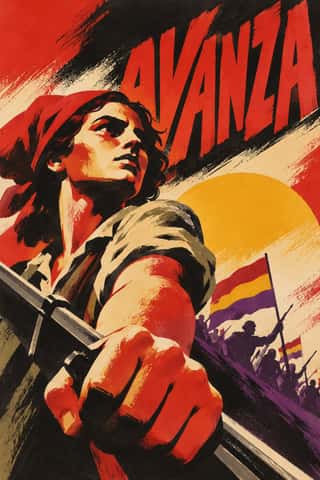
- Vietnamese Propaganda Poster (Tranh cổ động)77% alike
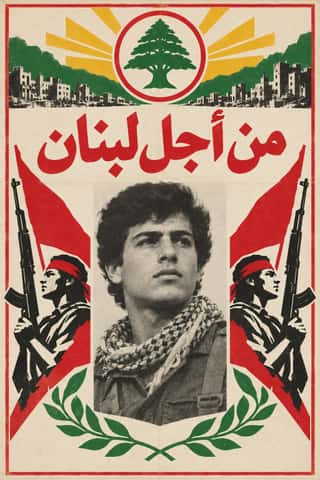
- Iranian Revolutionary & Sacred Defence Poster74% alike
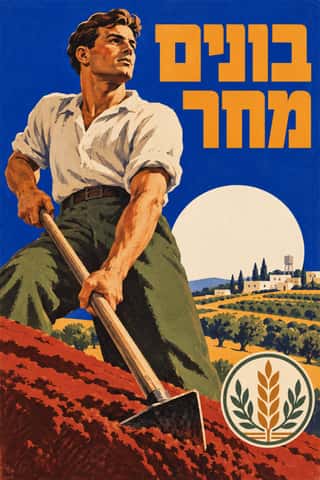
- Italian Fascist Graphics (Romanità & Exhibition Photomontage)72% alike


04
Sources
- Kate Ellen Cowcher, Between Revolutionary Motherland and Death: Art and Visual Culture in Socialist Ethiopia (PhD, Stanford University, 2017), ch. 2 'This is Lenin! Graphic Art, Communication and Demystification', https://purl.stanford.edu/fs146wj2023; full text https://stacks.stanford.edu/file/druid:fs146wj2023/Cowcher-DissFinal-text-augmented.pdf
- Berit Sahlström, Political Posters in Ethiopia and Mozambique: Visual Imagery in a Revolutionary Context (Almqvist & Wiksell, 1990)
- Seyoum Wolde, 'Some Aspects of Post-Revolution Visual Arts in Ethiopia', Proceedings of the Ninth International Conference of Ethiopian Studies, Moscow, 26–29 August 1986, vol. 4 (Moscow: Nauka, 1988), pp. 7–25; Smithsonian Libraries African Art Index record, https://si.edu/object/siris_sil_793211
- UCLA Library Special Collections, Ethiopian Poster Collection 1965–2010 (LSC.1922), https://oac.cdlib.org/findaid/ark:/13030/c81r6xrq
- Wikipedia, 'Meskel Square' (Revolution Square and its portraits of Marx, Engels and Lenin), https://en.wikipedia.org/wiki/Meskel_Square
- UCL History of Art, Confrontations blog, 'Expanding Socialist Realism' (2022), on Eshetu Tiruneh and Tadesse Mesfin's Moscow training and return as 'masters of polished academic style', https://blogs.ucl.ac.uk/confrontations/2022/08/28/expanding-socialist-realism
- Wikipedia, 'Derg' (dissolved in 1987 into the People's Democratic Republic of Ethiopia under Mengistu; fell in May 1991), https://en.wikipedia.org/wiki/Derg
- Awol Allo, 'How a major anti-colonial victory divided Ethiopia', Al Jazeera, 1 March 2019 (Adwa, Menelik II and Oromo ambivalence), https://www.aljazeera.com/opinions/2019/3/1/how-a-major-anti-colonial-victory-divided-ethiopia
- Wikipedia, 'Rastafari' (many Rastas see Haile Selassie as Jah incarnate), https://en.wikipedia.org/wiki/Rastafari
How Stylogeny researches and checks a style: where the facts come from.