Postmodern · 2005–present · East Asia
Itasha (Anime Character Car Graphics)
Also known as 痛車 (itasha, 'painful car'), Itansha (痛単車, motorcycles), Itachari (痛チャリ, bicycles), Moesha (萌車)
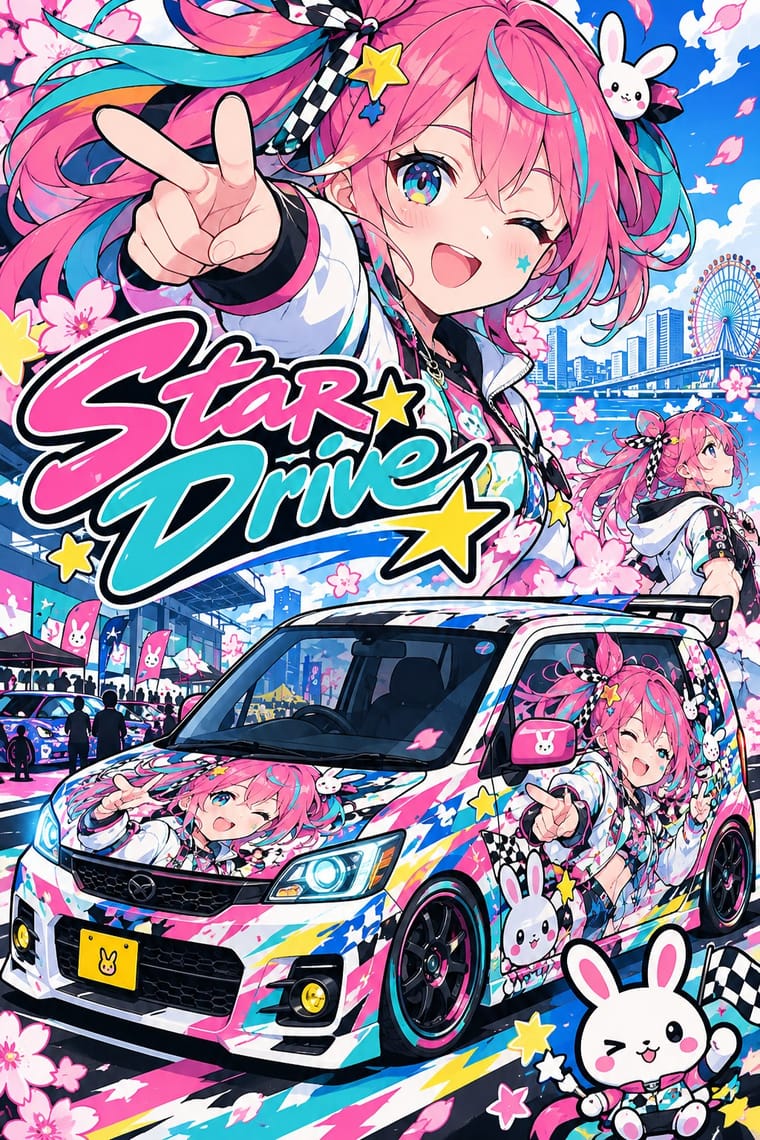
Private cars, motorbikes and bicycles that Japanese fans of anime, manga and games cover with their favourite characters, named by the mid-2000s with the self-mocking word itasha, 'painful car'. Printed or cut vinyl, designed panel by panel, puts a large character on the bonnet and each flank, against the car's own paint or in a full wrap, with the series logo and parody racing decals. Owners show them at Comic Market car parks, in Akihabara and at meets of up to about 1,000 cars.
Make something in this styleGet advice in this styleMix it with another style
Use it with care
Itasha is a living fan community, and its own self-mocking name is not an invitation to sneer at owners, whose cars have been vandalised (the Japanese Wikipedia records 'itasha-gari', itasha hunting) and who have courted goodwill with tidy meets and even traffic-safety prayers at Kawasaki Daishi (Web Japan, 2019). The characters belong to publishers and studios: the Japanese Wikipedia notes that most itasha are made without licences and tolerated rather than approved, and AUTOCAR Japan (2020) reports that very few makers hold official permission, while a specialist shop reports more than 150 officially licensed works and calls licensing standard practice for reputable makers (Kuruma News, 2018), so design original characters or secure the rights rather than copying key art. Some itasha carry characters from adult (eroge) games (English Wikipedia), and the Japanese Wikipedia notes that such wraps may breach youth-protection ordinances, while local outdoor-advertising and landscape ordinances can apply to any vehicle wrap; stickers on the windscreen can break road traffic law and fail inspection (Kuruma News, 2019).
01
How it works
- Give the bonnet and both flanks to the character, the commonest order at the itasha shop Jiokurieito, and lay the design out panel by panel across the body so the figure spans seams while the face stays clear and readable from the street.
- Decide how much of the car to give up: one cut-vinyl silhouette or a single sticker, a half wrap that lets the base paint show around the figures, or a full wrap that hides the paint entirely.
- Carry the source's own signs beside the figure: the series title logo and the character's name beside licensed key art or an original character drawn in the series' manner, so other fans can name the work at a glance.
- Borrow the language of motorsport: race numbers, rows of sponsor decals and team names, tuning brands' logotypes turned into otaku puns (MAID SPEED for MAZDASPEED, 2ZIGEN for 5ZIGEN), or a replica of a racing livery or of a car from an anime.
- Extend the display into the cabin, with plush toys and life-size character figures riding inside and character body pillows or life-size printed sheets used as seat covers, and show the car parked in rows with other itasha where fans gather, owning the 'painful' label rather than hiding from it.
Japan, out of Tokyo's otaku car culture. By 2008 some owners had been driving character-decorated cars to Comic Market for about ten years (J-CAST, April 2008). The Japanese Wikipedia dates wider visibility to the late 1990s and large character designs to the 2000s, when cheap stretchable adhesive sheets, large colour printers and online image sharing made them easy, and Kuruma News (2019) says the practice is held to have begun with truck drivers painting enka singers and hannya masks on their trucks. Its characters come mostly from TV anime, video games and light novels (Kuruma News 2018) and from Vocaloid illustration such as Hatsune Miku's, printed in full colour: it borrows story manga's character idiom but not its black-and-white page, and the Japanese Wikipedia keeps dekotora truck art distinct from itasha while recording cars that cross over with it. By 2005 itasha made up nearly half the reader cars posted on the Moero Downhill Night 2 website (Japanese Wikipedia); ASCII.jp photographed at least 18 itasha around Tokyo Big Sight on the last day of Comic Market 71, 31 December 2006. The name joins itai ('painful', cringe-worthy to look at) with sha ('car') and puns on ita-sha, slang for Italian cars (J-CAST 2008; Web Japan 2019). The scene grew around the Comiket car parks in Ariake and the Akihabara UDX car park (Kuruma News 2018), the magazines Itasha Graphics (Geibunsha, from 26 March 2008) and Itasha Tengoku (Yaesu Publishing), and shows from Autosalone, held beside Comiket from summer 2007, and Ita G Festa in Odaiba (2008) to Odaiba Itasha Tengoku, which drew about 1,000 itasha in 2018 (Web Japan 2019). Good Smile Company took it into Super GT from 2008, and by 2019 a specialist shop named kei cars as the commonest base and idol and VTuber fans as growing clients (Kuruma News 2019).
02
Its design choices
From Stylogeny’s vocabulary of design choices: defining choices make the style, characteristic ones are usual, occasional ones turn up now and then.
- Layout & composition
- Space & hierarchy
- Typography
- Colour
- Surface & texture
- Imagery
- Medium & production
- Tone & intent
- Avoids
- Non-representational, Typography only, Ornament-free, Sequential narrative, Photocopy & distress, Modular grid, Rational & objective, Authoritative & institutional
Palette
#f4f5f7#39c5bb#ff5fa2#2f6fde#ffd84a#16161d
Typefaces
Series title logos reproduced as decals from the anime's or game's own artwork, such as the 'HARUHI ISM' logo of The Melancholy of Haruhi Suzumiya, the most common design among the itasha at Comic Market 71 (ASCII.jp, 3 January 2007)
Parody tuning and sponsor logotypes that keep a real brand's letterforms but change its words
'MAID SPEED' for MAZDASPEED on a Nanoha StrikerS car at Comic Market 73 (ASCII.jp, 1 January 2008), '2ZIGEN' ('two dimensions') for the parts maker 5ZIGEN (Japanese Wikipedia)
Motorsport lettering
racing numbers on the doors, team names and rows of sponsor-style decals, as on show cars at Autosalone (GIGAZINE, 2008) and on the Super GT cars of Goodsmile Racing
Japanese mottos in kanji on the bonnet, such as the one GIGAZINE rendered as 'Love Chihaya or Die' at Machi★Asobi, Tokushima, 2009
Known for
Itasha around Tokyo Big Sight on the third day of Comic Market 71 (31 December 2006), photographed by Tetsuto Fujiyama for ASCII.jp
a Nissan Skyline with the 'HARUHI ISM' logo of The Melancholy of Haruhi Suzumiya, the most common design there, several Touhou Project cars, a Toyota Corolla in cut vinyl and a Nissan AD van decorated for women fans (ASCII.jp, 3 January 2007)
'MAID SPEED's Nanoha StrikerS-go', an RX-8-based car with Magical Girl Lyrical Nanoha StrikerS characters in cut vinyl on both doors and 'MAID SPEED' in place of MAZDASPEED, in the North Standby car park of Comic Market 73, Ariake, 31 December 2007 (ASCII.jp, 1 January 2008)
Autosalone beside Comic Market 74 (August 2008), with cars of Tsukihime's Ciel, Nanoha's Fate Testarossa, Touhou Project's Sakuya Izayoi and Hatsune Miku, one decorated down to the fuel cap and one with a racing number on its side (GIGAZINE, 18 August 2008)
Ita G Festa in Odaiba, organised by Geibunsha, publisher of Itasha Graphics, 9 November 2008
390 itasha, 48 itansha and 26 itachari before about 12,000 visitors (Response, 28 November 2008)
Studie GLAD Racing's Hatsune Miku BMW Z4M Coupé in the GT300 class of Super GT
with Good Smile Company as title sponsor from summer 2008, the series' first itasha (DailySportscar, 2021): a design chosen from submissions on the Piapro site, with a silver Miku silhouette on the bonnet, was replaced for the planned Suzuka round of 23–24 August 2008 by a full-colour waist-up Miku across the bonnet and bust-up Miku art on the sides (ITmedia, 20 August 2008); Goodsmile Racing's Miku cars took the GT300 drivers' title in 2011, 2014 and 2017 (DailySportscar, 2021)
Moe Fes in Washimiya 2009
('anata ga itai kara'), 18 July 2009, in the Washimiya Town Office car park, the pilgrimage town of the anime Lucky Star: 36 itasha, itansha and itachari, run by an executive committee of about 60 staff with the local youth and women's associations and volunteer itasha fans, with official Lucky Star itasha stickers on sale (ASCII.jp, 23 July 2009)
Itasha show at Tokushima's Machi★Asobi festival on Mt. Bizan
2009, including a Toyota Crown with Megurine Luka and Hatsune Miku on the bonnet and a Mitsubishi Mirage covered in The Idolm@ster characters with, apparently, a kanji motto rendered by GIGAZINE as 'Love Chihaya or Die' on the bonnet (GIGAZINE, 11 October 2009)
Odaiba Itasha Tengoku 2018, Tokyo
about 1,000 itasha from across Japan with stage shows, visitors' awards, more than 20 company booths and cosplayers from Russia and elsewhere (Web Japan, Ministry of Foreign Affairs of Japan, 2019)
03
Make something in this style
Say what you need, and Stylogeny’s image studio draws it from Itasha (Anime Character Car Graphics)’s design choices and checks it against them. It takes about a minute, and you get a link to share.
04
Where it comes from, and what it’s close to
Before it
The style it grew out of, and the styles it borrowed from.


After it
The styles that grew out of it.
No later style in the atlas grew out of it yet.
Alike in its design choices
Styles that make many of the same choices, related or not, besides those above.


05
Sources
- Tetsuto Fujiyama, '【年始特別企画】国民よ! 辞書を修正せよ! “イタ車”ならぬ“痛車”大集合!(2006大晦日 PART1)', ASCII.jp (3 January 2007), itasha at Comic Market 71: https://ascii.jp/elem/000/000/357/357222/
- Tetsuto Fujiyama, '愛があれば乗れる! 愛があれば貼れる! 究極の痛車 in コミケ73【1痛目】', ASCII.jp (1 January 2008), including 'MAID SPEED's Nanoha StrikerS-go': https://ascii.jp/elem/000/000/097/97241/
- Daisuke Sueoka (末岡大祐) and ASCII.jp editors, '痛車で街興し! 萌フェスで鷲宮が萌えた!', ASCII.jp (23 July 2009), on Moe Fes in Washimiya 2009: https://ascii.jp/elem/000/000/438/438562/
- '美少女キャラ車体に描く 「痛車」が20代前半に大うけ', J-CAST News (April 2008), on the name, cutting sheets, airbrushing and magnets, owners in their early 20s, Comiket visits for about ten years, and Itasha Graphics (Geibunsha, launched 26 March 2008): https://www.j-cast.com/2008/04/06018429.html?p=all
- '痛車写真蔵…痛Gふぇすた in お台場 詳報', Response (28 November 2008), on Ita G Festa in Odaiba: 390 itasha, 48 itansha, 26 itachari, about 12,000 visitors: https://response.jp/article/2008/11/28/117091.html
- '初音ミク痛車、もっと“痛く”なって「SUPER GT」へ', ITmedia NEWS (20 August 2008), on the Studie GLAD Racing Hatsune Miku car's redesign for Suzuka: https://www.itmedia.co.jp/news/articles/0808/20/news107.html
- 'Goodsmile Racing, 100 Races & Counting', DailySportscar (16 July 2021), on the BMW Z4M Coupé of 2008 as Super GT's first itasha and the GT300 titles of 2011, 2014 and 2017: https://www.dailysportscar.com/2021/07/16/goodsmile-racing-100-races-and-counting.html
- '「Fate」「プロメア」「初音ミク」デザインのマシンが「スパ24時間」を走る', Car Watch, Impress (22 July 2019): https://car.watch.impress.co.jp/docs/news/1197462.html
- GIGAZINE, 'The exhibition of "Itasha" held at Comiket place' (18 August 2008), on Autosalone at Comic Market 74: http://gigazine.net/gsc_news/en/20080818_comike_itasya
- GIGAZINE, 'Ita-Sha Exhibition held at Tokushima Machi★Asobi festival Vol.1' (11 October 2009): https://gigazine.net/gsc_news/en/20091011_itasya_01/
- 'Itasha - Showing off Individuality', Trends in Japan, Web Japan (Ministry of Foreign Affairs of Japan, 2019), on the name, whole-car and part designs, printed and cut decals, itansha, itachari and ita-taxis, Odaiba Itasha Tengoku 2018 and the Kawasaki Daishi gathering (single source for the 2018 figures and the Kawasaki Daishi gathering; the page could not be re-fetched in October 2026, and Response 2024 corroborates about 1,000 cars per edition): https://web-japan.org/trends/11_culture/pop201901.html
- Kumiko Kato, '海外も注目! 日本独自のクルマ文化「痛車」 SNS普及で低年齢化も進む「乗りたいから免許も取得」', Kuruma News (22 December 2018), pp. 1–3, on a definition that includes real idols as well as two-dimensional characters, the Akihabara UDX car park, popular series and their origins in light novels, video games and TV anime, replica liveries, designs laid out panel by panel across seams with the face kept clear, bonnet-and-sides orders, and the shop Jiokurieito's 150+ licensed works: https://kuruma-news.jp/post/121061
- Peacock Blue K.K., '誰もが二度見する? 軽自動車からスーパーカーまで広がる「痛車」とは', Kuruma News (1 September 2019), pp. 1–2, on truck-painting origins, partial, half and full wraps and their costs, kei cars, idol and VTuber fans, and windscreen stickers: https://kuruma-news.jp/post/172102
- Kumiko Kato, '【痛車の世界】クルマのボディにアニメや漫画、ゲームなどのキャラクター 著作権や版権は大丈夫?', AUTOCAR JAPAN (29 December 2020), on copyright, a section headed 'very few makers hold official permission' (公式許諾をとっている業者ごくわずか), replica liveries and larger vehicles chosen for more surface: https://www.autocar.jp/post/614784
- '痛車', Japanese Wikipedia (consulted October 2026), for the late-1990s visibility, large designs in the 2000s, the 2005 Moero Downhill Night 2 reader-car posts, Autosalone from summer 2007, cutting-sheet silhouettes used by many itasha, parody logos such as '2ZIGEN', plush toys, life-size figures and body-pillow seat covers inside, dekotora as distinct but sometimes crossed over, itasha-gari, licensing, and youth-protection, outdoor-advertising and landscape ordinances: https://ja.wikipedia.org/wiki/痛車
- 'Itasha', English Wikipedia (consulted October 2026), for a definition naming bishōjo games and eroge among the sources of itasha characters, and for its earliest known convention report, Comiket 68 (August 2005), not confirmed in a primary source here: https://en.wikipedia.org/wiki/Itasha
- '【お台場痛車天国2024】約1000台の痛車が大集結、今年は『ホロライブ』などのVtuberが人気', Response (3 April 2024), on about 1,000 itasha, itansha and itachari at Odaiba Itasha Tengoku on 31 March 2024, with more VTuber designs than in earlier years and hololive's especially numerous: https://response.jp/article/2024/04/03/380906.html
How Stylogeny researches and checks a style: where the facts come from.