Counterculture · 1965–1985 · East Asia
Angura Theatre Poster
Also known as Underground theatre poster, Angura (アングラ) poster, Japan Avant-Garde posters
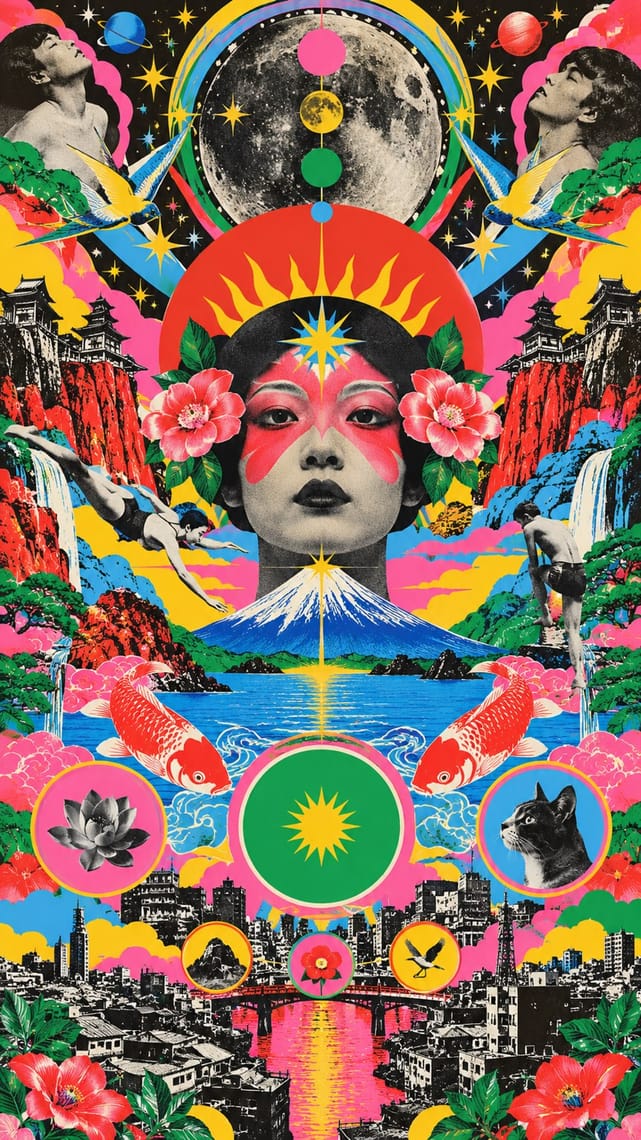
The posters of Japan's underground (angura) theatre from the mid-1960s to the mid-1980s, made for troupes such as Kara Jūrō's Jōkyō Gekijō and Terayama Shūji's Tenjō Sajiki. Tadanori Yokoo, Akira Uno, Kiyoshi Awazu and others crammed silkscreen sheets with Meiji and Shōwa photographs, rising-sun rays, Mount Fuji, ukiyo-e waves and comic-strip figures in flat, often fluorescent colour, mocking prewar kitsch and the restraint of Japanese corporate modernism at once.
Make something in this styleGet advice in this styleMix it with another style
Use it with care
Rising-sun rays quote the ensign of the Imperial Japanese Army and Navy, which many people in Korea, China and across Asia read as a symbol of wartime aggression; Yokoo's ironic use belonged to a 1960s Japanese argument with its own past and does not travel safely as a decorative sunburst. The ero-guro imagery includes sexualised and violent bodies, and the posters remain in copyright, so quote or license them with context rather than tracing them.
01
How it works
- Fill the sheet edge to edge with appropriated Japanese vernacular imagery: old photographs, ukiyo-e waves, Mount Fuji, rising-sun rays and printed ephemera.
- Organise the collage around a central axis or a radiating sunburst rather than a modernist grid.
- Print in flat, saturated and often fluorescent silkscreen inks: pink, red, yellow, green and sky blue.
- Combine photographs with flat, outlined comic-style figures, including erotic and morbid ero-guro motifs.
- Cram vertical Japanese titles, credits and hand lettering into the picture instead of a separate text zone.
- Quote prewar national imagery with ironic nostalgia, turning it against both the state and modernist good taste.
Tokyo, Japan: posters for Kara Jūrō's Jōkyō Gekijō, Terayama Shūji's Tenjō Sajiki, the Black Tent, the Free Theatre and Ankoku Butoh performances
02
Its design choices
From Stylogeny’s vocabulary of design choices: defining choices make the style, characteristic ones are usual, occasional ones turn up now and then.
- Layout & composition
- Space & hierarchy
- Typography
- Colour
- Form & shape
- Surface & texture
- Ornament
- Medium & production
- Tone & intent
- Avoids
- Generous white space, Modular grid, Ornament-free, Flush left, ragged right, Rational & objective, Calm & contemplative
Palette
#ff4f9a#e8352a#ffd400#1fa65a#3fa9f5#1a1a1a
Typefaces
Hand-drawn and brush-written Japanese titles set vertically
Retro Meiji–Shōwa display lettering lifted from found print
Mincho and gothic phototype for credits
Known for
Tadanori Yokoo, Koshimaki-Osen, poster for Kara Jūrō's Jōkyō Gekijō
1966; MoMA collection
Tadanori Yokoo, 'Having Reached a Climax at the Age of 29, I Was Dead'
1965
Tenjō Sajiki (founded 1967 by Shūji Terayama with Yokoo and Higashi Yutaka) and its posters
Akira Uno and Kiyoshi Awazu, posters for angura troupes
Genpei Akasegawa and Kuniyoshi Kaneko, angura theatre posters
Poster Hari's Company archive (Hiroyuki Sasame) and its 'Japan Avant-Garde' angura poster exhibitions
03
Make something in this style
Say what you need, and Stylogeny’s image studio draws it from Angura Theatre Poster’s design choices and checks it against them. It takes about a minute, and you get a link to share.
04
Where it comes from, and what it’s close to
Before it
The style it grew out of, and the styles it borrowed from.


After it
The styles that grew out of it.
No later style in the atlas grew out of it yet.
Alike in its design choices
Styles that make many of the same choices, related or not, besides those above.


05
Real works
Artefacts in museums, libraries and archives that show the style, linked at their source.
- Koshimaki-Osen (腰巻お仙), poster for Kara Jūrō's Jōkyō GekijōTadanori Yokoo · 1966 · The Museum of Modern Art, New York (698.1966)
- Made in Japan, Tadanori Yokoo, Having Reached a Climax at the Age of 29, I Was DeadTadanori Yokoo · 1965 · The Museum of Modern Art, New York (696.1966)
- À la Maison de M. Civeçawa (Rose-Coloured Dance), poster for Tatsumi Hijikata's Ankoku Butoh-haTadanori Yokoo · 1965 (MoMA dates its copy 1966) · Victoria and Albert Museum, London (E.43-2011)
- The Hunchback of Aomori Prefecture (青森県のせむし男), poster for Tenjō SajikiTadanori Yokoo · 1967 · The National Museum of Art, Osaka (81248)
- Crimes Committed by Dr. Garigari (ガリガリ博士の犯罪), poster for Tenjō SajikiMasamichi Oikawa · 1969 · The National Museum of Art, Osaka (80329)
06
Sources
- https://performingarts.jpf.go.jp/en/article/person/hiroyuki-sasame (Japan Foundation)
- https://en.wikipedia.org/wiki/Tadanori_Yokoo
- https://www.moma.org/collection/works/7957 (Tadanori Yokoo, Koshimaki-Osen, 1966)
- https://niewmedia.com/en/news/055962/ (Japan Avant-Garde underground theatre poster exhibition, Osaka 2025)
How Stylogeny researches and checks a style: where the facts come from.