Craft & organic · 1897–1918 · Central Europe
Vienna Secession
Also known as Wiener Secession, Secessionstil, Wiener Werkstätte style
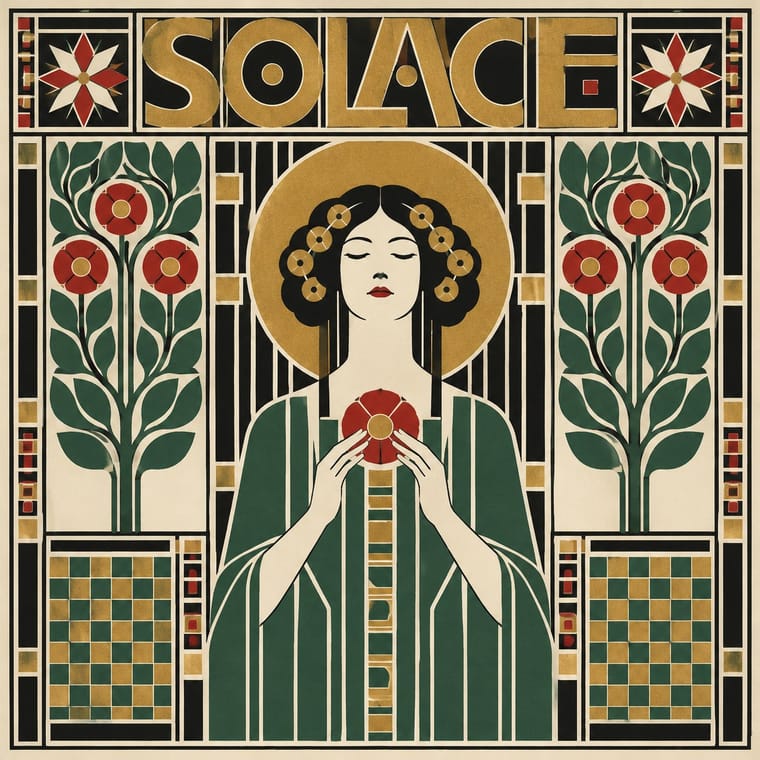
The Viennese break with academic art led by Gustav Klimt, Koloman Moser, Josef Hoffmann and Alfred Roller, which pulled Art Nouveau toward the square, the grid and the flat plane. Its exhibition posters, the journal Ver Sacrum and Wiener Werkstätte graphics enclose stylised figures and dense geometric lettering in rectangular frames, in black, white and gold, with severe symmetrical clarity.
Make something in this styleGet advice in this styleMix it with another style
01
How it works
- Compose within a square or strongly rectangular frame and lock elements into blocks, bands and panels.
- Draw custom capitals that interlock and stretch to fill their rectangle, even at some cost to legibility.
- Replace Art Nouveau's tendrils with squares, chequers, dots and stylised flowers in strict repetition.
- Use black, white and gold as the core palette, adding one or two flat accent colours.
- Leave generous white margins around a centred, symmetrical arrangement of image and text.
- Design lettering, ornament, objects and architecture as one Gesamtkunstwerk.
Vienna, Austria-Hungary
02
Its design choices
From Stylogeny’s vocabulary of design choices: defining choices make the style, characteristic ones are usual, occasional ones turn up now and then.
- Layout & composition
- Space & hierarchy
- Typography
- Colour
- Form & shape
- Surface & texture
- Ornament
- Medium & production
- Tone & intent
- Avoids
- Whiplash line, Diagonal axis, Collage & layering, Eclectic mixing, Straight photography, Illusion of depth
Palette
#f4f1e8#141414#b8913a#a3282a#3b5e4a
Typefaces
Alfred Roller's elongated, interlocking block capitals
Koloman Moser's geometric display lettering
Rudolf von Larisch's ornamental lettering
Unterricht in ornamentaler Schrift, 1905
Known for
Gustav Klimt
poster for the 1st Secession exhibition, 1898
Koloman Moser
Alfred Roller
poster for the 14th Secession exhibition, 1902
Josef Hoffmann and the Wiener Werkstätte
1903–1932
Joseph Maria Olbrich
Secession Building, 1897–98
Ver Sacrum
1898–1903
03
Make something in this style
Say what you need, and Stylogeny’s image studio draws it from Vienna Secession’s design choices and checks it against them. It takes about a minute, and you get a link to share.
04
Where it comes from, and what it’s close to
Before it
The style it grew out of, and the styles it borrowed from.


Alike in its design choices
Styles that make many of the same choices, related or not, besides those above.


05
Real works
Artefacts in museums, libraries and archives that show the style, linked at their source.
- Ver Sacrum V. Jahr: XIII. Ausstellung der Vereinigung bildender Künstler Österreichs SecessionKoloman Moser; printed by A. Berger, Vienna · 1902 · Bibliothèque nationale de France, Gallica btv1b52506931h (via Wikimedia Commons)
- Gustav Klimt: Secession XVIII. Ausstellung (Klimt retrospective poster)Gustav Klimt; printed by A. Berger, Vienna · 1903 · Bibliothèque nationale de France, Gallica btv1b52506932z (via Wikimedia Commons)
- Ver Sacrum: Theseus und Minotaurus, I. Kunstausstellung Secession (first exhibition poster, uncensored state)Gustav Klimt; printed by A. Berger, Vienna · 1898 · Bibliothèque nationale de France, Gallica btv1b525069302 (via Wikimedia Commons)
- Ver Sacrum, 1. Jahrgang, Heft 1 (January 1898), coverAlfred Roller; published by Gerlach & Schenk, Vienna · January 1898 · Heidelberg University Library (via Wikimedia Commons)


06
Sources
- Philip B. Meggs & Alston W. Purvis, Meggs' History of Graphic Design
- Jane Kallir, Viennese Design and the Wiener Werkstätte (1986)
- Vienna Secession, history of the association (secession.at)
How Stylogeny researches and checks a style: where the facts come from.