Style combination · Contrasts
Hanafuda Card Design × Lotería Card Imagery
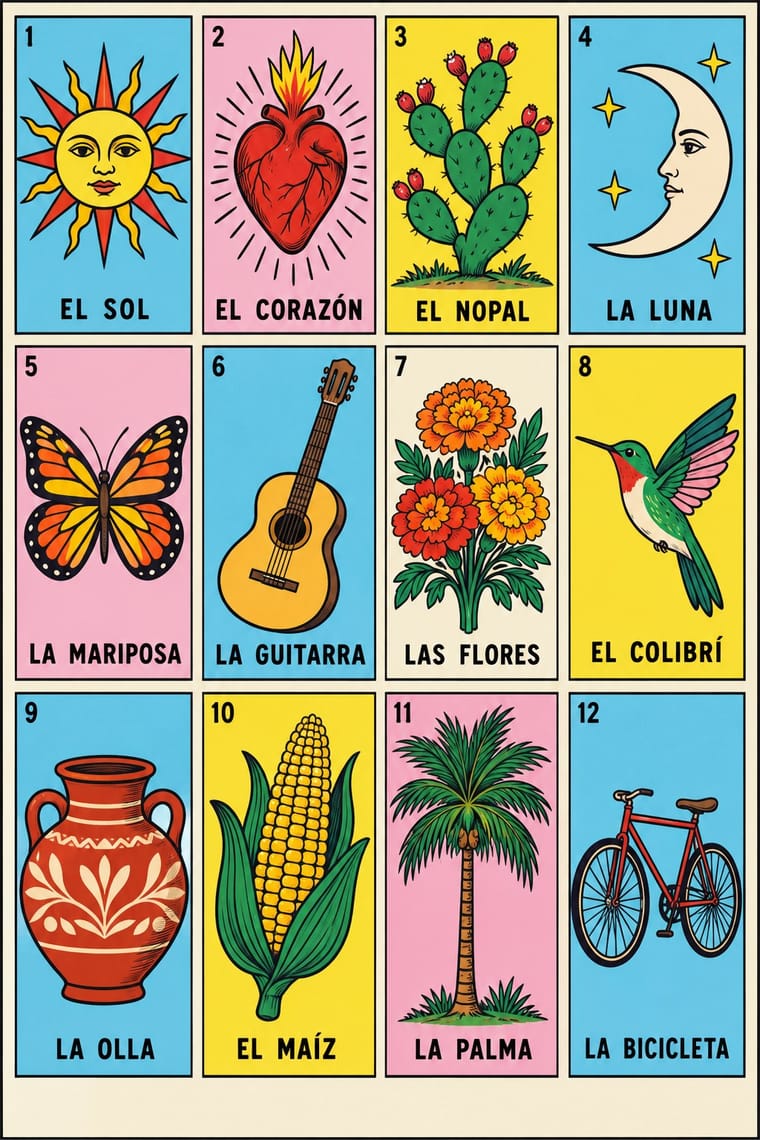
Lotería gives each card a number and a printed name; hanafuda uses pictures only.
Mix them and make something Hanafuda Card Design Lotería Card Imagery
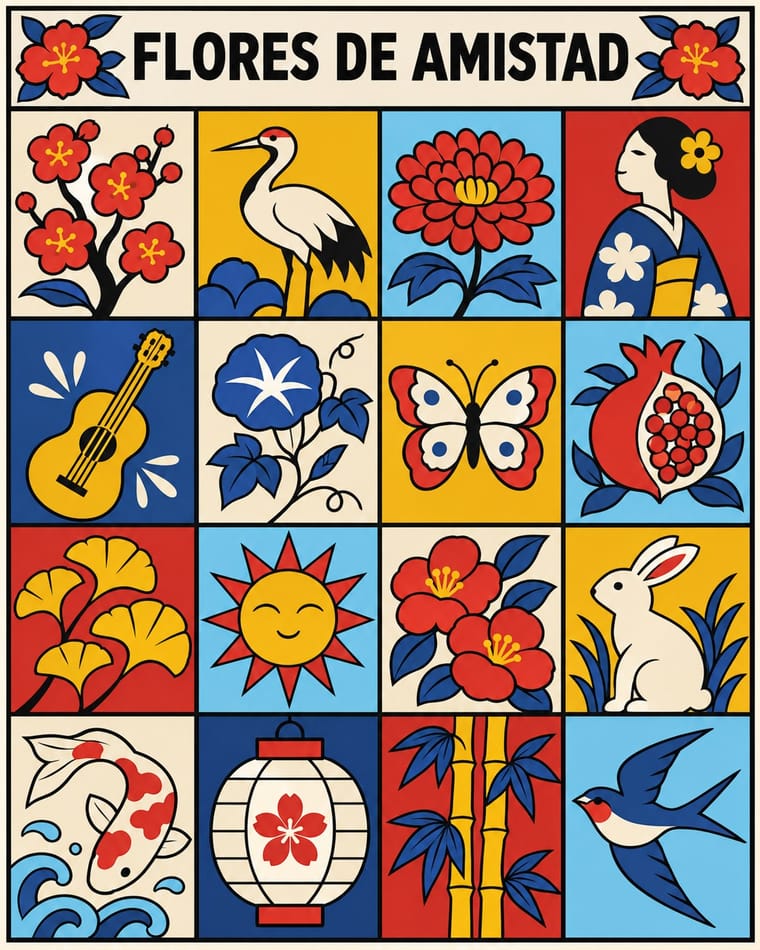
01
What each style brings
Each part of the design comes from the style with the stronger say in it, and each style gives at least two.
Hanafuda Card Design (Japanese Flower Cards) Lotería Card Imagery (Mexican Lotería)
- Type from Lotería Card Imagery
- Colour from Hanafuda Card Design
- Form from Hanafuda Card Design
- Composition from Lotería Card Imagery
- Surface from Hanafuda Card Design
02
The type
Open fonts standing in for each style’s own type, which is often hand-drawn or commercial.
Display · Lotería Card Imagery
Hello
Londrina Solid, standing in for Hand-drawn capitals on homemade tablas and artists' redrawn decks
Text · Hanafuda Card Design
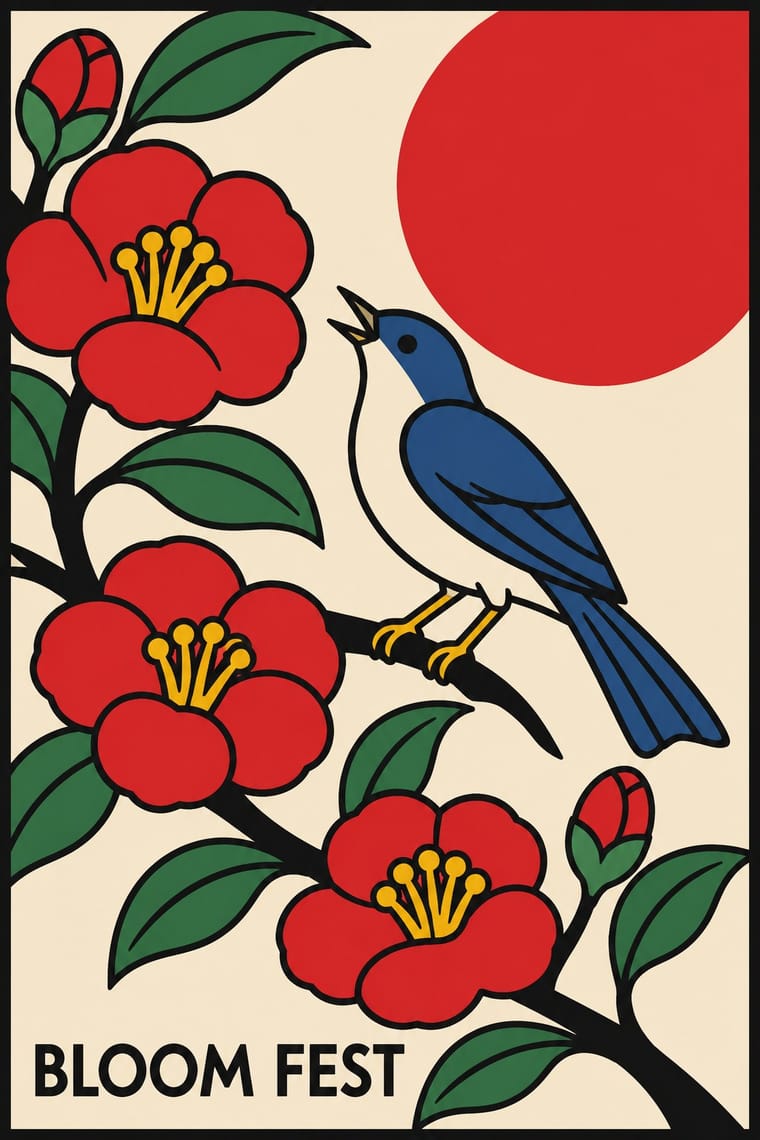
A 48-card Japanese deck of twelve suits, one per month, each tied to a plant such as pine, plum, cherry, peony, maple or willow. Japanese cards carry no numbers or letters (Korean hwatu mark Bright cards with the character 光): flat, outlined flora, animals, ribbons and objects tell bright, animal, ribbon and chaff cards apart by picture alone, on a plain red or black back.
Shippori Mincho; Hanafuda Card Design used Calligraphic poem strips (tanzaku) in kana and kanji and Maker marks and brand names in Japanese brush lettering
03
The colours
The ground and leading colours come from Hanafuda Card Design, with a counter-accent from Lotería Card Imagery. The ink reads on the ground at 4.5:1 or more.
Hanafuda Card Design (Japanese Flower Cards) Lotería Card Imagery (Mexican Lotería)
-
#f2e8cfground · 36% -
#111111ink · 14% -
#e8b923accent · 18% -
#c62f2aaccent · 14% -
#86c8e6accent · 10% -
#2b4c8caccent · 8%
As CSS
:root {
  --ground: #f2e8cf;
  --ink: #111111;
  --accent-1: #e8b923;
  --accent-2: #c62f2a;
  --accent-3: #86c8e6;
  --accent-4: #2b4c8c;
  --font-display: "Londrina Solid", cursive;
  --font-text: "Shippori Mincho", serif;
}
Use it with care
Lotería Card Imagery (Mexican Lotería): Lotería is a living family game, played across Mexico and much of the United States and in parts of Central America, and a marker of Mexican and Mexican-American identity, so do not use it as generic 'Mexican' party decoration for products with no tie to those communities, and commission and credit Mexican, Central American and Chicanx artists when you redraw it. The standard deck's nine human figures are all stereotypes of Indigenous people, upper-class white people and Afro-Latinos (TIME, citing Gloria Arjona), most plainly El Negrito (No. 26) and El Apache (No. 38), stock figures of a Black man and a Native American, and other decks carry the same kind of figure (the feathered Indio with bow and arrow on Lomas Garza's 1972 tablas): do not reproduce them as period charm; replace them, as new decks freely do. The owners of Don Clemente Gallo (Pasatiempos Gallo) hold the registered trademark of the original images, so draw new emblems rather than tracing them, and write card names in correct Spanish instead of mock-Spanish.
04
The two styles
05
More combinations
With Hanafuda Card Design
- Ukiyo-e Woodblock Prints Pairs well · Both use flat colour and outline; hanafuda turns the print's flower-and-bird subjects into a repeatable game system.
- Tarot de Marseille Woodcut Cards Contrasts · A card deck built on allegory and numbered arcana, against hanafuda's seasonal plant logic with no numerals.
- Kamon (Japanese Family Crests) Pairs well · Plant motifs reduced to compact, emblem-like shapes that read at small size.
- Mamluk Playing-Card Design (Mulūk wa-Nuwwāb) Pairs well · Another non-European card system where emblem, rank and seasonal or suit identity are carried by flat painted signs.
With Lotería Card Imagery
- Kanga (Swahili Message Cloth) Contrasts · Both centre one motif in a frame above a line of capitals, but a kanga is a cloth whose printed Swahili saying is its message, while a lotería card prints only the emblem's name and leaves the verse to the caller's voice.
- West African Barbershop & Hair Salon Signs Contrasts · Both lay out named, numbered pictures in rows and columns, but a barbershop sign is one hand-painted menu of heads that differ only in their hairstyle, under the shop's boast, while a lotería tabla is a printed board of unrelated emblems, one of a set of boards that each hold a different selection from the same deck.
- Chicano Screenprint Poster Pairs well · Chicano artists from Carmen Lomas Garza's 1972 tablas onward redraw the lotería card as a sign of Mexican-American home life; frame a screenprinted slogan or portrait as a numbered, named card to borrow that recognition.
- Isotype Pictorial Statistics Contrasts · Both set picture signs on a grid, but Isotype's pictograms are reduced, uniform and repeated to count quantities, while every lotería emblem is a different, fully drawn picture with its own name, matched by chance and read aloud.
- Imagerie d'Épinal & European Bilderbogen Contrasts · Both are cheap coloured popular prints of stock figures in ruled frames under capital captions, but an Épinal sheet tells a story or musters a row of soldiers across many cases, while a lotería card holds one emblem and the tabla's cells have no order: the caller draws them by chance.
- Mexican Popular Graphics (Posada) Pairs well · Posada himself printed a Juego de lotería; pair the lotería card's single framed emblem and name with his black relief calaveras and shouting broadside type for a Mexican popular-print voice that is both orderly and satirical.
- Tarot de Marseille Woodcut Cards Contrasts · Lotería also gives each card one figure with its name at the foot, but in letterspaced sans capitals and soft offset colour; borrow the tarot's carved roman title band, ruled frame and stencil drift to make a lotería-type card set look older and graver.
- Mexican Calendar Chromo (Cromos calendáricos) Contrasts · Both are popular Mexican colour prints for everyday use, but the lotería sets one flat, outlined emblem figure per numbered card in a ruled frame, named in capitals at the foot, for a game, while the chromo paints one modelled scene in deep landscape to hang for a year.