Style combination · Contrasts
Lotería Card Imagery × Tarot de Marseille Woodcut Cards
Lotería also gives each card one figure with its name at the foot, but in letterspaced sans capitals and soft offset colour; borrow the tarot's carved roman title band, ruled frame and stencil drift to make a lotería-type card set look older and graver.
Mix them and make something Lotería Card Imagery Tarot de Marseille Woodcut Cards
01
What each style brings
Each part of the design comes from the style with the stronger say in it, and each style gives at least two.
Lotería Card Imagery (Mexican Lotería) Tarot de Marseille Woodcut Cards
- Type from Tarot de Marseille Woodcut Cards
- Colour from Lotería Card Imagery
- Form from Lotería Card Imagery
-
Tarot de Marseille Woodcut Cards avoids naturalistic depiction: this is where the two pull against each other, which is the point of the contrast.
- Composition from Lotería Card Imagery
- Surface from Tarot de Marseille Woodcut Cards
02
The type
Open fonts standing in for each style’s own type, which is often hand-drawn or commercial.
Display · Tarot de Marseille Woodcut Cards
Pop
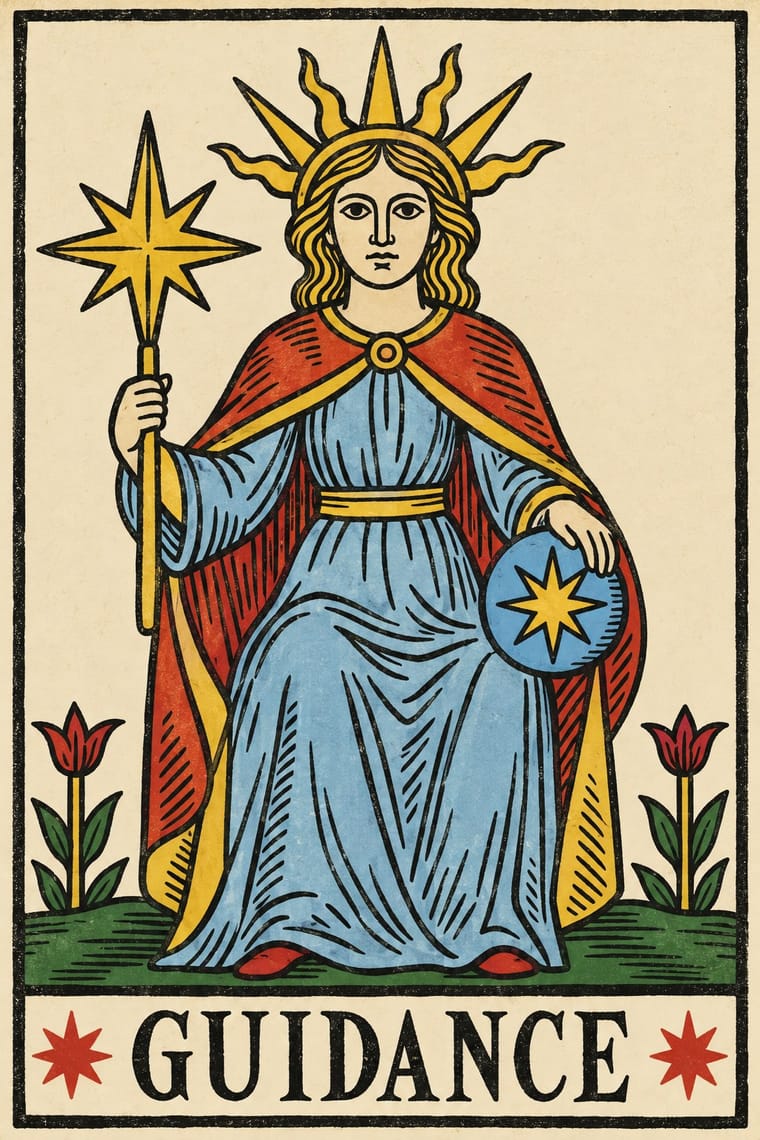
Cinzel, standing in for Roman capitals cut into the woodblock with the picture, in a band at the foot of each trump and court card, often with interpuncts and the copyists' spellings ('LE CHARIOR' and 'LA PANCES' on Dodal's cards, 'LE BATELEVR' with V for U)
Text · Lotería Card Imagery
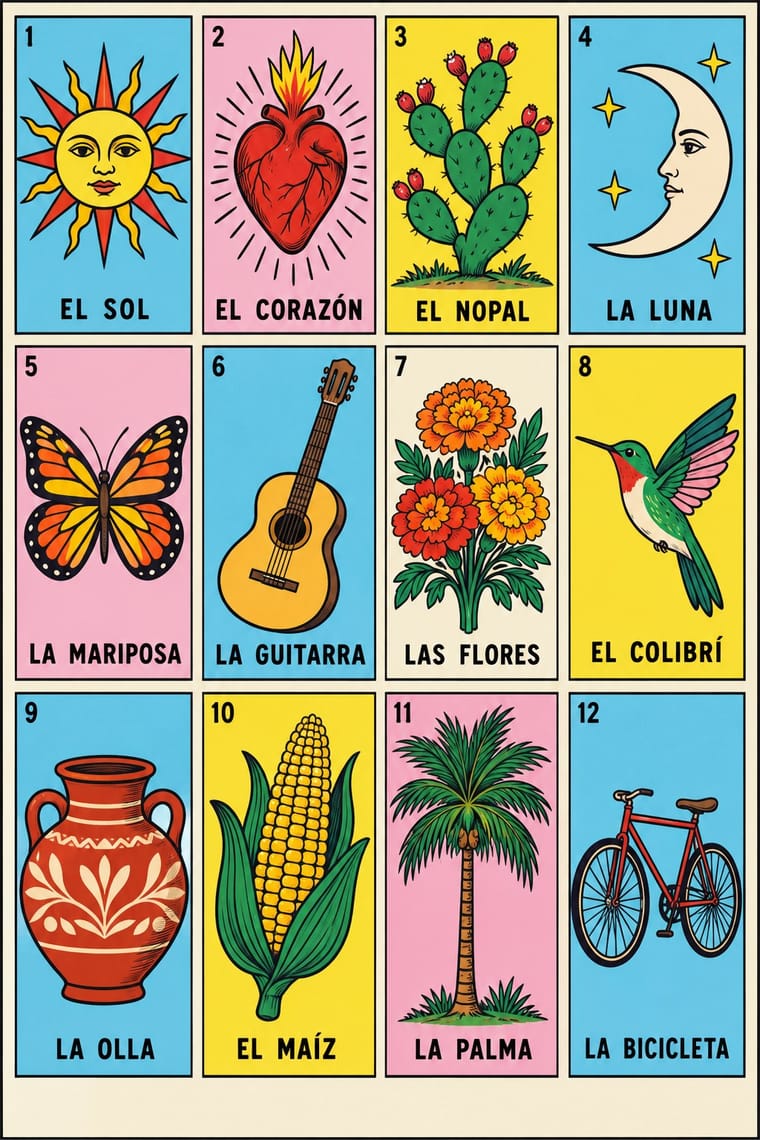
The picture deck of Mexico's lotería, a bingo-like game of chance. Clemente Jacques's 54-card deck, published from 1887 and known in today's version since the early 1920s, set the canon: one figure or object per card (El Gallo, La Sirena, La Muerte), usually on a pale tinted ground in a ruled frame, a small number at the top and its name in capitals at the foot. A standard tabla sets 16 of them in a 4 × 4 grid, marked with beans as the caller draws cards and sings verses. Chicano artists, designers and parody decks keep redrawing the set.
Newsreader; Lotería Card Imagery used Plain, letterspaced sans-serif capitals with the article for the card names at the foot of each Don Clemente card and Small numerals at the top left of each card
03
The colours
The ground and leading colours come from Lotería Card Imagery, with a counter-accent from Tarot de Marseille Woodcut Cards. The ink reads on the ground at 4.5:1 or more.
Lotería Card Imagery (Mexican Lotería) Tarot de Marseille Woodcut Cards
-
#f4efe2ground · 36% -
#1d1d1bink · 14% -
#c62f2aaccent · 18% -
#e6c13faccent · 14% -
#86c8e6accent · 10% -
#f2bfd3accent · 8%
As CSS
:root {
  --ground: #f4efe2;
  --ink: #1d1d1b;
  --accent-1: #c62f2a;
  --accent-2: #e6c13f;
  --accent-3: #86c8e6;
  --accent-4: #f2bfd3;
  --font-display: "Cinzel", serif;
  --font-text: "Newsreader", serif;
}
Use it with care
Lotería Card Imagery (Mexican Lotería): Lotería is a living family game, played across Mexico and much of the United States and in parts of Central America, and a marker of Mexican and Mexican-American identity, so do not use it as generic 'Mexican' party decoration for products with no tie to those communities, and commission and credit Mexican, Central American and Chicanx artists when you redraw it. The standard deck's nine human figures are all stereotypes of Indigenous people, upper-class white people and Afro-Latinos (TIME, citing Gloria Arjona), most plainly El Negrito (No. 26) and El Apache (No. 38), stock figures of a Black man and a Native American, and other decks carry the same kind of figure (the feathered Indio with bow and arrow on Lomas Garza's 1972 tablas): do not reproduce them as period charm; replace them, as new decks freely do. The owners of Don Clemente Gallo (Pasatiempos Gallo) hold the registered trademark of the original images, so draw new emblems rather than tracing them, and write card names in correct Spanish instead of mock-Spanish.
Tarot de Marseille Woodcut Cards: Trace decks cut before 1800 (Noblet, Dodal and Conver in the BnF; Dodal cards and early 19th-century Conver printings at the Met) rather than recent redrawings such as Grimaud's 1930 'Ancien Tarot de Marseille' or the 1998 Camoin–Jodorowsky restoration, which are modern works; and do not present the occultists' story of an Egyptian origin, launched by Court de Gébelin in 1781, as history: the pattern descends from Milanese tarot and was made for the card game of tarot, which French and Swiss players used it for until the early 20th century.
04
The two styles
05
More combinations
With Lotería Card Imagery
- Kanga (Swahili Message Cloth) Contrasts · Both centre one motif in a frame above a line of capitals, but a kanga is a cloth whose printed Swahili saying is its message, while a lotería card prints only the emblem's name and leaves the verse to the caller's voice.
- West African Barbershop & Hair Salon Signs Contrasts · Both lay out named, numbered pictures in rows and columns, but a barbershop sign is one hand-painted menu of heads that differ only in their hairstyle, under the shop's boast, while a lotería tabla is a printed board of unrelated emblems, one of a set of boards that each hold a different selection from the same deck.
- Chicano Screenprint Poster Pairs well · Chicano artists from Carmen Lomas Garza's 1972 tablas onward redraw the lotería card as a sign of Mexican-American home life; frame a screenprinted slogan or portrait as a numbered, named card to borrow that recognition.
- Isotype Pictorial Statistics Contrasts · Both set picture signs on a grid, but Isotype's pictograms are reduced, uniform and repeated to count quantities, while every lotería emblem is a different, fully drawn picture with its own name, matched by chance and read aloud.
- Imagerie d'Épinal & European Bilderbogen Contrasts · Both are cheap coloured popular prints of stock figures in ruled frames under capital captions, but an Épinal sheet tells a story or musters a row of soldiers across many cases, while a lotería card holds one emblem and the tabla's cells have no order: the caller draws them by chance.
- Mexican Popular Graphics (Posada) Pairs well · Posada himself printed a Juego de lotería; pair the lotería card's single framed emblem and name with his black relief calaveras and shouting broadside type for a Mexican popular-print voice that is both orderly and satirical.
- Mexican Calendar Chromo (Cromos calendáricos) Contrasts · Both are popular Mexican colour prints for everyday use, but the lotería sets one flat, outlined emblem figure per numbered card in a ruled frame, named in capitals at the foot, for a game, while the chromo paints one modelled scene in deep landscape to hang for a year.
With Tarot de Marseille Woodcut Cards
- Literatura de Cordel Woodcut Contrasts · Both cut stiff figures in wood with no perspective or modelling, but the cordel cover is printed in black only, with solid blacks and gouged white lines, above a plain letterpress title, while the tarot card colours an outline key through stencils and cuts its numeral and title into the same block; choose cordel for a stark one-colour cover, tarot for a coloured emblem in a numbered set.
- European Heraldry Pairs well · The Emperor's and Empress's eagle shields and the maker's escutcheon on the 2 of Coupes come from armory; pair heraldic tinctures and charges with a tarot figure for a crest-like card or label.
- Nianhua & Chinese Folk Print Pairs well · Door gods and many tarot trumps are single frontal figures cut in wood and brightly coloured by hand; set them side by side for a cross-cultural series of guardian or allegorical figures.
- Imagerie d'Épinal & European Bilderbogen Contrasts · Both stencil-colour a black woodcut key in a few drifting colours, but the Épinal sheet tells a story in grids of captioned cases and marches rows of soldiers, while the tarot card isolates one emblematic subject under a numeral and a title; choose tarot for a single symbol, Épinal for a sequence.
- Risograph & Indie Print Culture Pairs well · Riso's few flat inks and loose registration reproduce the stencil drift of an old tarot; print a black woodcut-style key with red, yellow and pale blue for a contemporary deck or poster.
- Emblem Book (Motto, Picture & Epigram) Contrasts · The emblem book explains its picture with a printed motto and epigram on the page, while the tarot gives only a carved title and a numeral and leaves the meaning to play or reading; choose the emblem book when the text must carry the argument.