Rational modernism · 1954–1995 · North America
Saul and Elaine Bass Conceptual Film Graphics
Also known as Bass film-title style, Saul Bass film posters and titles, Saul Bass title sequences
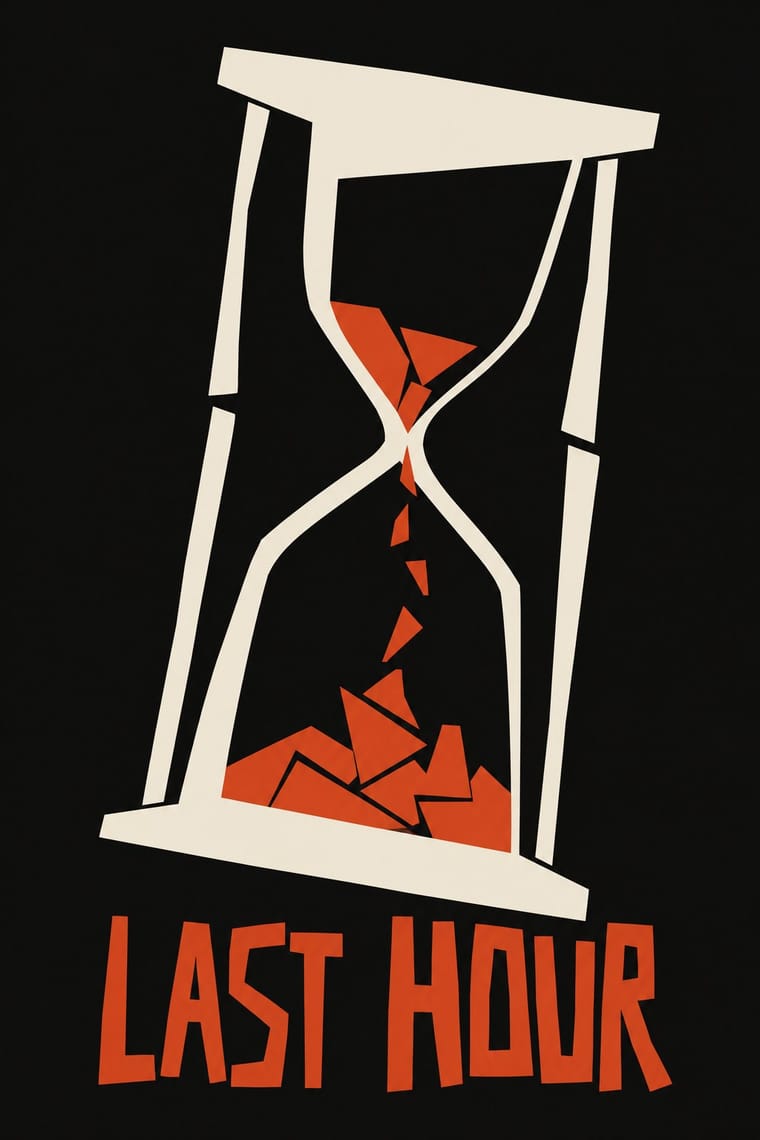
The film-title and poster language Saul Bass built in Los Angeles from Preminger's Carmen Jones (1954), later made with Elaine Bass. Instead of star portraits, a film gets one symbol (a jagged arm, a body cut into pieces, a spiral) that runs through the poster and an opening sequence in which bars, cut-paper shapes and ragged hand-cut letters move and assemble to the score and set the mood. Their Scorsese titles, up to Casino (1995), carried the same single metaphor into filmed water, flowers and neon. Kuntzel + Deygas's Catch Me If You Can titles (2002) later transposed its handmade look.
Make something in this styleGet advice in this styleMix it with another style
Use it with care
The posters, title sequences, film scores and corporate marks are in copyright, and several logos are still registered trademarks: borrow the method (one cut symbol, a flat ground, bars that assemble in time), never a specific arm, spiral, dissected body or logo, and do not present new work as a Bass design. Credit Elaine Bass and the letterers where the record names them rather than attributing everything to Saul.
01
How it works
- Reduce the film to one symbol of its psychological core rather than its stars or plot, and carry that symbol through the poster, the press advertising, the record sleeve and the opening titles alike (The Man with the Golden Arm's jagged arm; Anatomy of a Murder's dissected body).
- Make the title happen in time: let a strict, small vocabulary of bars, lines or cut shapes come on and go off the screen, cut to the score, and either assemble into the symbol only at the end (white bars on black forming a distorted, disjointed arm to Elmer Bernstein's jazz in The Man with the Golden Arm, 1955) or simply carry the titles in and out ('On, off, left, right, up, down, black, white' for Psycho, 1960).
- Set the symbol on a plain, flat ground of black, grey, white or one strong colour and leave the rest of the frame or sheet empty, so the single image carries the whole film.
- Cut rather than draw: build figures and letters as paper cut-outs with a slightly jagged imprecision, keeping the scissor edge visible, and let a plain sans carry the credits when the motion is the point.
- Unsettle by breaking the body or the space: dismember a figure across the credits, pull figures into a spiral, tilt the credits along the grid of a glass facade, so the opening proposes the film's anxiety before the first scene.
- When the title is filmed, keep the one metaphor and let it run continuously: a timid line-drawn rose over red-tinted fire (Carmen Jones), phantom reflections in water (Cape Fear), a man falling through a neon hell (Casino).
Los Angeles, United States: the office of Saul Bass (1920–1996), who had studied with György Kepes at Brooklyn College and designed Otto Preminger's poster for Carmen Jones (1954) and was then asked to make its title sequence. Elaine Makatura (Elaine Bass) joined the office in 1955, married Saul in 1961 and co-directed titles with him from Spartacus (1960), uncredited as a title designer until 1989. Lettering was executed by studio and freelance letterers, among them Harold Adler.
02
Its design choices
From Stylogeny’s vocabulary of design choices: defining choices make the style, characteristic ones are usual, occasional ones turn up now and then.
- Layout & composition
- Space & hierarchy
- Typography
- Colour
- Form & shape
- Surface & texture
- Imagery
- Medium & production
- Avoids
- Abundant decoration, Borders & frames, Horror vacui, Ornamented display, Eclectic mixing, Gloss & highlights, Chrome & 3D render
Palette
#111111#efe9dc#e0461f#9a9894#2d4f8e#e8a92c
Typefaces
Ragged, paper-cut display lettering with a 'subtly jagged imprecision', drawn and cut in the studio and by freelance letterers
Harold Adler for Carmen Jones and The Man with the Golden Arm; Art Goodman supervising and Dave Nagata lettering, according to Letterform Archive
Plain sans-serif credits moved as graphic elements
Psycho, 1960; North by Northwest, 1959, whose credits slide along the lines of a grid
Known for
Saul Bass, Carmen Jones (Otto Preminger, 1954)
Bass's poster, then his title sequence, a drawn rose laid over red-tinted filmed fire for the whole sequence, to Bizet's overture; lettering and title cards by Harold Adler (Art of the Title)
Saul Bass, The Man with the Golden Arm (Preminger, 1955)
white bars on a black ground appear, vanish and form patterns until they become 'a distorted, disjointed arm', to Elmer Bernstein's jazz score; lettering by Harold Adler; the jagged arm also heads the poster (Letterform Archive holds original one-sheets)
Saul Bass with John Whitney, Vertigo (Alfred Hitchcock, 1958)
Whitney's spirographic Lissajous figures over close-ups of Kim Novak; Bass's poster pulls stylised figures into the centre of a spiral vortex
Saul Bass, North by Northwest (Hitchcock, 1959)
intersecting lines over a forest-green ground carry the sans-serif credits up and down, then dissolve into the glass facade of the C.I.T. Building, an early case of kinetic type
Saul Bass, Anatomy of a Murder (Preminger, 1959)
paper cut-outs of a body broken into pieces on a uniform grey ground beside each credit, to Duke Ellington's score; the poster shows a corpse silhouette dissected into seven pieces (lithograph, 1959; People's Graphic Design Archive)
Saul Bass, Psycho (Hitchcock, 1960)
white bars that usher sans-serif titles in and out on black and never intersect, to Bernard Herrmann's score
Saul and Elaine Bass, Spartacus (Stanley Kubrick, 1960)
opening titles co-directed and produced by Elaine Bass, uncredited
Saul and Elaine Bass, titles for Martin Scorsese
Goodfellas (1990), 'the simple, speeding graphic' timed to passing cars; Cape Fear (1991), 'ominous, wavering reflections in water'; The Age of Innocence (1993), 'endlessly blooming flowers' under lace; and Casino (1995), 'a man falling through a neon hell', their last title sequence
03
Make something in this style
Say what you need, and Stylogeny’s image studio draws it from Saul and Elaine Bass Conceptual Film Graphics’s design choices and checks it against them. It takes about a minute, and you get a link to share.
04
Where it comes from, and what it’s close to
Before it
The style it grew out of, and the styles it borrowed from.
After it
The styles that grew out of it.
No later style in the atlas grew out of it yet.
Alike in its design choices
Styles that make many of the same choices, related or not, besides those above.


05
Sources
- Art of the Title, Saul Bass designer page (born 8 May 1920, died 25 April 1996; breakthrough with The Man with the Golden Arm, 1955; Elaine Makatura joined in 1955 and co-directed and produced the Spartacus opening; Vertigo with John Whitney; later Scorsese titles, Casino their last; AT&T bell 1969, Continental 1968, United 1974), https://www.artofthetitle.com/designer/saul-bass/
- Art of the Title, Carmen Jones (1954): title designer Saul Bass; lettering by Harold Adler, who also set the title cards; a rose drawn as a 'timid line drawing' over a 'perpetual fire' of red-tinted live action, https://www.artofthetitle.com/title/carmen-jones/
- Art of the Title, The Man with the Golden Arm (1955): white bars on black forming 'a distorted, disjointed arm'; Elmer Bernstein's 'driving jazz-like score'; lettering Harold Adler, https://www.artofthetitle.com/title/the-man-with-the-golden-arm/
- Art of the Title, Vertigo (1958): 'spirographic imagery', Lissajous waves by John Whitney, Kim Novak close-ups, https://www.artofthetitle.com/title/vertigo/
- Art of the Title, North by Northwest (1959): forest-green ground, intersecting lines, dissolve into the C.I.T. Building facade, 'type in motion', https://www.artofthetitle.com/title/north-by-northwest/
- Art of the Title, Anatomy of a Murder (1959): 'cutouts of paper on a uniform grey background', the body broken up 'like it is part of a puzzle', https://www.artofthetitle.com/title/anatomy-of-a-murder/
- Art of the Title, Psycho (1960): 'a series of simple white bars' ushering sans-serif titles; 'On, off, left, right, up, down, black, white', https://www.artofthetitle.com/title/psycho/
- Art of the Title, Casino (1995): by Saul and Elaine Bass, their last sequence together; a figure in 'a fiery Las Vegas purgatory' giving way to neon, https://www.artofthetitle.com/title/casino/
- Art of the Title, Catch Me If You Can (2002): titles by Kuntzel + Deygas, who 'stylistically transpose the handmade design of Saul Bass using decidedly modern means', https://www.artofthetitle.com/title/catch-me-if-you-can/
- Saul Bass, Wikipedia (Carmen Jones poster, then titles at Preminger's request; Vertigo poster's spiral vortex; Anatomy of a Murder poster's corpse dissected into seven pieces; studied with György Kepes at Brooklyn College; married Elaine Makatura 1961; logos), https://en.wikipedia.org/wiki/Saul_Bass
- Elaine Bass, Wikipedia (joined 1955; uncredited as a title designer until 1989; Scorsese's descriptions of the Goodfellas, Cape Fear, Age of Innocence and Casino titles), https://en.wikipedia.org/wiki/Elaine_Bass
- Letterform Archive, 'Saul Bass' (original one-sheets of The Man with the Golden Arm, Vertigo and Anatomy of a Murder; 'paper-cut lettering styles' with a 'subtly jagged imprecision'; letterers Art Goodman, Dave Nagata, Harold Adler, Maury Nemoy; West Side Story poster by Joseph Caroff, not Bass), https://letterformarchive.org/news/saul-bass
- People's Graphic Design Archive, Anatomy of a Murder film poster (1959, lithograph), https://peoplesgdarchive.org/item/17134/anatomy-of-a-murder-film-poster
- Los Angeles County Museum of Art, Saul Bass, album cover for the Anatomy of a Murder soundtrack, offset lithography, M.2012.110, https://collections.lacma.org/object/165689
How Stylogeny researches and checks a style: where the facts come from.