Traditions & vernacular · c. 1204–present · East Asia
Mongol Bichig Calligraphy & Ugalz Ornament
Also known as Mongolian calligraphy, Classical Mongolian script (Mongol bichig), Uyghur-Mongolian script, Khee ugalz (Mongolian ornament), Ugalz (horn scroll), Ölzii (endless knot), Soyombo
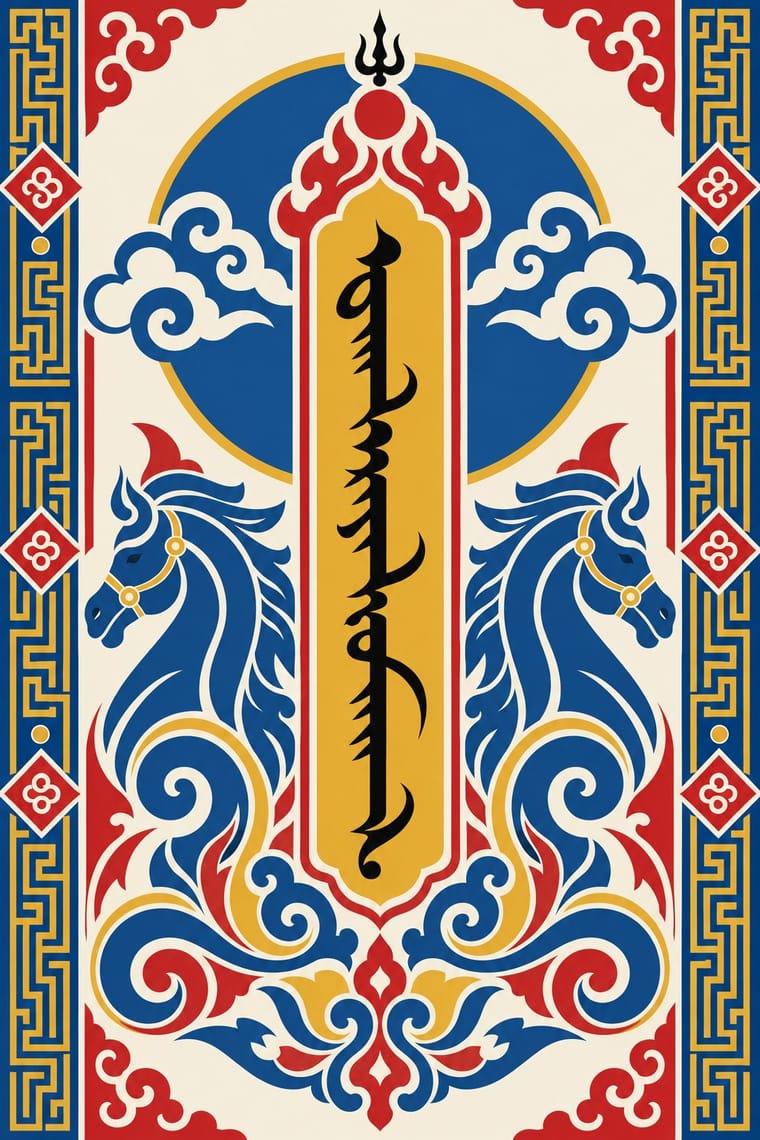
Mongolia's classical script and the auspicious ornament that frames it on state, Buddhist and household objects. Mongol bichig is an alphabet written in vertical columns that advance left to right, its letters joined down one continuous spine, and condensed into 'folded' forms for seals, emblems, coins and stamps. Around it curl ugalz, horn scrolls mirrored on a central axis, with auspicious signs (five-eyes roundel, endless knot, wishing jewel, lotus) and the Soyombo, in symmetric roundels and borders of flat blue, red, yellow, white and black.
Make something in this styleGet advice in this styleMix it with another style
Use it with care
Mongol bichig is the living script of Mongols in Mongolia and in Inner Mongolia, where in 2020 China moved three school subjects in Mongolian-medium schools into Mandarin, met by protests and school boycotts; UNESCO lists Mongolian calligraphy as heritage in need of urgent safeguarding, and at inscription in 2013 only three scholars were training just over twenty young calligraphers. Have every word written or checked by a fluent reader or calligrapher: letters change shape by position, so pseudo-script, mirrored text, text rotated the wrong way and letters broken up as texture read as nonsense. The Soyombo is a state symbol on the flag and emblem, and Mongolia regulates the use of its state symbols by law (Constitution, Article 12(7)): the Law on State Symbols (1994) forbids disparaging them and imitating the State Seal. The endless knot, wishing jewel and lotus are Buddhist auspicious signs; keep them and the state symbols out of trivial or demeaning uses. The khas (swastika) is an old Mongolian sign of good fortune but reads as the Nazi swastika to many audiences, so avoid it outside a context that explains it, and commission or credit Mongolian calligraphers and craftspeople rather than tracing their work.
01
How it works
- Write in vertical columns from top to bottom, advancing from left to right, and hang every letter from one continuous spine so that each word reads as a single unbroken stroke.
- Build letters from the script's six strokes (head, tooth, stem, stomach, bow and tail), and fold them into a compact, symmetric block when a word has to fill a seal, emblem, coin or stamp.
- Centre the composition on one axis: put the main sign (the five-eyes roundel, tavan nüden hee; an emblem; the Soyombo) in the middle and mirror the ornament on either side of it, above all the ugalz, horn scrolls curled into spirals and built from identical halves fitted together.
- Frame the field with the tumen nasan ('thousands of ages') pattern or knotwork, and set auspicious signs at fixed places: a lotus at the top centre, endless knots or wishing jewels in the corners. Borders of linked khas (swastika) frets are traditional, but use them only where the context explains them (see caution).
- Colour in flat, unshaded fields drawn from the five colours (blue, red, yellow, white and black), and write the script in black or cinnabar-red ink.
- Choose each sign for what it wishes on the object and its owner (good fortune, long life, well-being, rank), not as filler: on the gown flaps of the nobility the five-eyes pattern marked the first rank and the wishing jewel the fourth.
Mongolia and Inner Mongolia (China). Chinese sources date the Mongols' adoption of the Uyghur alphabet to 1204, and the Stele of Yisüngge (c. 1224–25) is the earliest surviving inscription in it. Cyrillic replaced it in everyday use in Mongolia in the 1940s, while it stayed in common use in Inner Mongolia; Article 7.2 of Mongolia's 2015 language law, in force from 1 January 2025, brings it back beside Cyrillic in official affairs, step by step
02
Its design choices
From Stylogeny’s vocabulary of design choices: defining choices make the style, characteristic ones are usual, occasional ones turn up now and then.
- Layout & composition
- Space & hierarchy
- Typography
- Colour
- Form & shape
- Surface & texture
- Ornament
- Medium & production
- Tone & intent
- Avoids
- Diagonal axis, Illusion of depth, Naturalistic depiction, Gradients, Fluorescent & neon, Straight photography, Ornament-free, Gloss & highlights
Palette
#1d4f91#c4272f#e0a526#f4efe3#16130f
Typefaces
Classical Mongolian (Uyghur-Mongolian) script, ninety letter forms joined vertically by continuous strokes, written with a reed pen until the 18th century and with the brush after it
'Folded' condensed forms of the script, drawn to fill emblems, logos, coins and stamps, as in the 'Mongol Uls' of the State Seal
Mongolian Baiti (Beijing Founder Electronics for Microsoft; in Windows since Vista), a digital face for the vertical script
Noto Sans Mongolian
Google Noto
Known for
Stele of Yisüngge ('Stone of Chinggis'), c. 1224–25, the earliest surviving inscription in the Uyghur-Mongolian script
State Hermitage Museum, St Petersburg
Zanabazar (1635–1723), Soyombo script (1686)
a separate script written horizontally, left to right, not a form of bichig, included here for the sign it shares. Its letters hang from a frame of a filled triangle and a vertical bar, and its head mark, the Soyombo sign, is now an official symbol on the flag and coat of arms of Mongolia
Baga Bolzoot treasury notes
(Bogd Khan government, 1921), printed from wood blocks, the first cut by the monk-craftsman Luvsangombo, called 'Black Hands': ornament borders in blue, red or yellow-green, a lotus at the top centre, swastikas and endless knots in the corners, a central 'five eyes' roundel, and Mongolian script beneath a Soyombo on the reverse
Danzan dollar banknotes (1921), designed by the painter Balduu 'Marzan' Sharav and printed in Moscow, in bright colours with traditional Mongolian patterns and the 'five eyes' sign combined with the swastika
State Emblem of Mongolia (Constitution of Mongolia, Article 12)
a circle on a white lotus base, its blue ground filled with the never-ending tumen nasan ('thousands of ages') ornamental pattern, the flying steed with the golden Soyombo at the centre, a wish-granting jewel above and a wheel of the law below
State Seal of Mongolia (Constitution, Article 12(6); Law on State Symbols, 1994, Articles 16–17)
a square of solid silver, 10 × 10 cm, made by hand as a single piece with a lion-shaped handle, the State Emblem at its centre and 'Mongol Uls' written on both sides in folded Mongolian letters; the President holds it
Square silk cloth, 21 × 21 cm, early 20th century, embroidered with the wishing jewel (chandmani erdene) in each of its four corners and a much larger five-eyes pattern (tavan nüden hee) in the middle (Pop 2018, fig. 1)
State ceremonial gown of the Bogd Khan (Bogd Khan Palace Museum, Ulaanbaatar), its flap carrying a circular emblem embroidered around the centre with four wishing jewels, the khan's bracelet, the queen's earrings, the five-eyes pattern, an elephant tusk and a fish, with mountains and waters
03
Make something in this style
Say what you need, and Stylogeny’s image studio draws it from Mongol Bichig Calligraphy & Ugalz Ornament’s design choices and checks it against them. It takes about a minute, and you get a link to share.
04
Where it comes from, and what it’s close to
Before it
The style it grew out of, and the styles it borrowed from.
Nothing earlier is recorded: in the atlas it is a starting point.
After it
The styles that grew out of it.
No later style in the atlas grew out of it yet.
Alike in its design choices
Styles that make many of the same choices, related or not, besides those above.
05
Sources
- UNESCO Intangible Cultural Heritage, 'Mongolian calligraphy', inscribed 2013 (8.COM) on the List of Intangible Cultural Heritage in Need of Urgent Safeguarding: ninety letters connected vertically, six strokes, 'folded' forms for emblems, logos, coins and stamps, three masters and some twenty young calligraphers (https://ich.unesco.org/en/USL/mongolian-calligraphy-00873)
- Igor de Rachewiltz, 'Sino-Mongolica Remota', East Asian History 42, Australian National University: adoption of the Uighur alphabet in 1204 (Chinese sources) and the Yisüngge stele, 1224 or 1225, now in the Hermitage (https://eah.anu.edu.au/42/rachewiltz-sino-mongolica-remota/index.html)
- Anshuman Pandey, 'Proposal to Encode the Soyombo Script', Unicode L2/15-004R (2015): designed in 1686 by Zanabazar (1635–1723); frame of a filled triangle and a vertical bar; 'All the available sources show Soyombo text represented horizontally, left-to-right'; the head mark with triple flame is the Soyombo symbol on the flag and coat of arms (https://www.unicode.org/L2/L2015/15004r-soyombo.pdf)
- Rodica Pop, 'The "five eyes pattern" tavan nüden hee', in Á. B. Apatóczky (ed.), Ideas behind symbols – languages behind scripts, Studia uralo-altaica 52 (Szeged, 2018), pp. 91–105: endless knot (ölzii utas), swastika (has) and linked swastikas (has hee), the five colours, the silk cloth of fig. 1, the Bogd Khan's ceremonial gown in the Bogd Khan Palace Museum, the rank of nobles marked by the sign on the gown flap (after Nyambuu 2002), the 1921 Baga Bolzoot and Danzan notes (https://ebook.ek.szte.hu/index.php/btk-magyarnyelviirodalmi-intezet/catalog/download/143/445/1146?inline=1)
- Kh. Nyambuu, 'Khalkhyn zarim nutgiin khee ugalzny züilees' [On some ornaments of the Khalkha regions] (1967 edition), e-nom.mn digital library: a pattern of rounded, spiral shape is called ugalz, the twisted horn pattern seems to be what is meant by ugalz, and an ugalz is formed from identical parts or identical sides fitted together (https://e-nom.mn/book?bid=MTE0Ng%3D%3DenomMTE0Ng%3D%3D)
- Mongolian National Art Gallery, 'Hypnotising Mongolian Patterns', Google Arts & Culture: in silk and textile patterns, animal-themed patterns such as horn and nose patterns dominated in ancient times; from the Middle Ages, regulations on ceremonial dress made patterns markers of social rank (https://artsandculture.google.com/story/yAVR8x3tUw0Rqw)
- B. Tögsöö (Inner Mongolia Normal University), 'XIII–XIV zuuny mongolchuudyn khuvtsasny khee ugalzny tukhai asuudald' [On the ornament (khee ugalz) of 13th–14th-century Mongol dress], Erdem shinjilgeenii bichig 18 (2017): khee ugalz as the Mongolian term for ornament and pattern (https://lavai.msue.edu.mn/ppapers/18-LAV-024.pdf)
- Constitution of Mongolia, Article 12 (State Emblem, Flag and Seal): the never-ending, ever-flowering tumen nasan pattern on a blue ground, the flying steed with the golden Soyombo; golden Soyombo on the red-blue-red flag; the square State Seal with the coat of arms in the middle, 'Mongol Ulus' on both sides and a lion-shaped handle, held by the President (12(6)); the revered use of the state symbols prescribed by law (12(7)) (Constitute Project, https://www.constituteproject.org/constitution/Mongolia_2001)
- Law of Mongolia on State Symbols (Töriin belge temdgiin tukhai khuul'), 20 May 1994, Articles 16–17 (State Seal: square, solid silver, made by hand as a single piece, 10 × 10 × 2 cm, lion-shaped handle 8 cm high, 'Mongol Uls' written folded in Mongolian letters), 17.4 (imitating the State Seal prohibited) and 26 (disparaging the state symbols prohibited) (https://legalinfo.mn/mn/detail/496)
- Law of Mongolia on Mongolian Language, 12 February 2015, unofficial English translation, Articles 4, 7, 17.1.2 (names and addresses of organisations, streets and squares written in Cyrillic and the national script) and 24.2 (https://legalinfo.mn/en/edtl/16760272253581)
- Erzhen V. Khilkhanova, 'Nation-building and Writing System: Mongol Bichig in Linguistic Landscape of Ulaanbaatar', Polylinguality and Transcultural Practices 22 (4), 2025, pp. 882–900: Mongol bichig on the signboards of the Prosecutor General's Office and the National Art Gallery of Mongolia (photographs 2024), found only on official signs in the street studied; government letterheads in both scripts approved; the script used on souvenirs and premium packaging for its ornamental look (https://doi.org/10.22363/2618-897X-2025-22-4-882-900)
- Jinke Du and Paolo Coluzzi, 'Linguistic landscape in the Inner Mongolia autonomous region: the case of a multilingual and multi-ethnic region in China', Journal of Multilingual and Multicultural Development 47 (1), pp. 127–145 (online 2024): 1046 signs in three major cities; Mongolian highly visible on both official and private signs (https://doi.org/10.1080/01434632.2024.2376738)
- Human Rights Watch, 'China: Mongolian Mother-Tongue Classes Curtailed', 4 September 2020 (https://www.hrw.org/news/2020/09/04/china-mongolian-mother-tongue-classes-curtailed)
- Microsoft Typography, 'Mongolian Baiti' (https://learn.microsoft.com/en-us/typography/font-list/mongolian-baiti)
- Wikipedia, 'Mongolian script': writing direction, reed pen and brush, black or cinnabar ink, Cyrillic in the 1940s, common use in Inner Mongolia (https://en.wikipedia.org/wiki/Mongolian_script)
How Stylogeny researches and checks a style: where the facts come from.