Counterculture · 1977–1988 · Southern Europe
La Movida Madrileña Graphics
Also known as Movida graphics, Madrid new-wave graphics, Movida fanzine and comic art
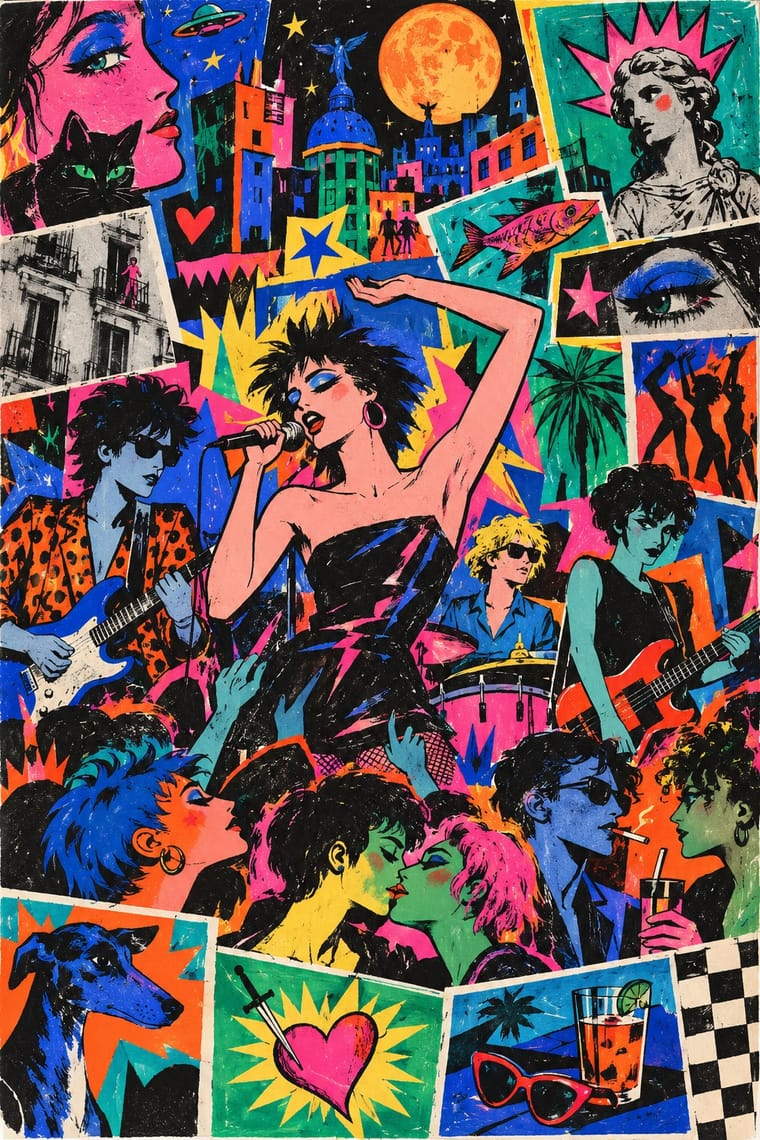
The graphics of Madrid's Movida, the post-Franco scene of new-wave bands, fanzines and night life usually dated from the Canito concert of 9 February 1980 and later backed by the city council. Punk's cut-and-paste fanzine met underground comics and Pop: drawn figures in loud colour, hand lettering over cut-out photographs of the scene's own people, the castizo tebeo mixed with cosmopolitan Pop, in Madriz, La Luna de Madrid, Madrid Me Mata and the posters for Almodóvar's first films; its painters and photographers added hand-coloured prints and saints re-staged with camp.
Make something in this styleGet advice in this styleMix it with another style
Use it with care
The Movida's makers are recent and partly living (Mariné and García-Alix still work; Ceesepe died in 2018, Ouka Leele in 2022), and their works and the Madrid Me Mata, Madriz and La Luna mastheads are under copyright: draw your own figures, titles and mastheads in the shared idiom, do not ask an image model for Ceesepe's, Costus's, Ouka Leele's or Mariné's hand, and do not present a generated piece as a period work. Its Virgins and saints, at once camp and devotional, were painted by insiders who grew up under Franco's National Catholicism; turning Catholic images into a joke or a sales gimmick from outside is a different act. The Valle de los Caídos that Costus quoted, renamed Valle de Cuelgamuros under the 2022 Democratic Memory Law, was built largely by Republican political prisoners and holds over 33,000 Civil War dead of both sides, Republicans among them: its imagery is not neutral decoration. The camp idiom came from a queer scene: Costus were a couple, and both died in 1989.
01
How it works
- Put drawn people at the centre: stylised figures from comics, painted friends of the scene and the band itself fill covers, posters and pages, and stories are told in comic panels rather than in slogans.
- Turn the colour up: use many saturated hues at once and clashing complements, and hand-colour black-and-white photographs with watercolour, as Ouka Leele did in Peluquería (1979), instead of punk's black plus one or two fluorescent spot inks; the painters Costus went as far as fluorescent acrylic made for black light.
- Letter by hand: draw mastheads, titles and balloons as free lettering laid over cut-out pictures, mix it with a plain sans, and let a word become an image, like the zigzag 'MMM' of Madrid Me Mata.
- Make a magazine a collage: cut out photographs of the scene's own people and drawings, overlap them with lettering on loosely ordered pages, and choose a format that stands out at the kiosk (Madrid Me Mata ran landscape and stapled).
- Reclaim the imagery of Catholic and Francoist Spain with camp and open sensuality, re-staging the Virgin and the saints with the scene's own people rather than mocking them, as the painters Costus did; mix the castizo tebeo with cosmopolitan Pop, and celebrate the city, the night and sexual freedom.
- Print cheaply and widely: fanzines and comics sold on the Rastro, offset magazines and posters, sleeves for independent labels, badges and screenprinted T-shirts.
Madrid in the years after Franco's death (1975), around the city's punk and new-wave bands from 1977 to 1978; the scene is usually dated from the concert in memory of the drummer José Enrique Cano Leal, 'Canito', at the Escuela de Caminos on 9 February 1980, and lasted until the mid-1980s. Its graphics ran through fanzines such as 96 Lágrimas (1980–1982), the comic stall Cascorro Factory, founded in 1977 by Ceesepe and Alberto García-Alix with El Hortelano, Montxo Algora, Agust and Pejo, La Luna de Madrid (1983–1988), Óscar Mariné's Madrid Me Mata (16 issues from 1984), and the comic monthly Madriz (January 1984 to February 1987), subsidised by the youth department of Enrique Tierno Galván's city council, and through the posters of Pedro Almodóvar's first films
02
Its design choices
From Stylogeny’s vocabulary of design choices: defining choices make the style, characteristic ones are usual, occasional ones turn up now and then.
- Layout & composition
- Space & hierarchy
- Typography
- Colour
- Form & shape
- Imagery
- Medium & production
- Tone & intent
- Avoids
- Generous white space, Ornament-free, Rational & objective, Authoritative & institutional, Calm & contemplative, Agitational & persuasive
Palette
#ff2e88#14b8b0#ff5a1f#1f4fd6#16a85a#141414
Typefaces
Free hand lettering over cut-out images ('collage de rotulación libre') in Madrid Me Mata, whose masthead moves from a special display lettering to a plain sans ('de una tipografía especial a otra funcional de palo') and whose 'MMM' works as a zigzag of lightning
Comic-strip hand lettering for balloons, captions and titles in Madriz, La Luna de Madrid and the Cascorro Factory comics
Prominent drawn titles in Iván Zulueta's Pop-influenced film posters, from Arrebato (1979) to Almodóvar's films of 1982–1984
Known for
Óscar Mariné (b. Madrid, 1951), Madrid Me Mata (16 issues from 1984), which he created, designed and directed
a landscape-format, stapled magazine laid out as 'un collage de rotulación libre' with cut-out images and overlapping lettering, 'entre el tebeo castizo y la modernidad cosmopolita'; copies were acquired by the Museo Reina Sofía. Mariné received the Premio Nacional de Diseño in 2010
Madriz (33 issues, January 1984 to February 1987)
the comic monthly subsidised by the Concejalía de Juventud of the Ayuntamiento de Madrid and edited in practice by Felipe Hernández Cava, with Ceesepe, Ana Juan, Federico del Barrio, Javier de Juan, Keko, Fernando Vicente, Sento, Carlos Giménez and others; in April 1984 Alianza Popular asked for issue 4 to be withdrawn over a Ceesepe strip
La Luna de Madrid (first regular issue November 1983, closed 1988), directed first by Borja Casani, with sections for comics, photography and design; Javier de Juan painted the cover of no. 22 (November 1985)
Ceesepe (Carlos Sánchez Pérez, 1958–2018)
comics in Star, El Víbora, Madriz and La Luna de Madrid, drawings and collages after British Pop, and the posters for Almodóvar's Pepi, Luci, Bom y otras chicas del montón (1980) and La ley del deseo (1987)
Iván Zulueta's Pop-influenced posters for Almodóvar's Laberinto de pasiones (1982), Entre tinieblas (1983) and ¿Qué he hecho yo para merecer esto!! (1984)
Ouka Leele (Bárbara Allende Gil de Biedma, 1957–2022), the scene's photography rather than its print graphics
Peluquería (1979), black-and-white photographs hand-coloured with watercolour; and Rapelle-toi, Barbara (1987), staged at the Cibeles fountain
Costus (Enrique Naya and Juan Carrero), the scene's painting rather than its print graphics
Valle de los Caídos (1980–1987), twenty-five larger-than-life paintings in fluorescent acrylic on plywood, made to be seen under black light, which portray friends from music and fashion as the Virgin and the saints of Franco's monument, a lo divino in the manner of Baroque devotional portraits (now at the ECCO, Cádiz); their flat at calle de la Palma 14 was a meeting place of the Movida and a set for Pepi, Luci, Bom
Óscar Mariné's sleeve and poster for Siniestro Total's ¿Cuándo se come aquí? (DRO, November 1982), a pastiche of Morris's Daltons from Lucky Luke, and El Hortelano's cover for Gabinete Caligari's Al calor del amor en un bar (1986)
03
Make something in this style
Say what you need, and Stylogeny’s image studio draws it from La Movida Madrileña Graphics’s design choices and checks it against them. It takes about a minute, and you get a link to share.
04
Where it comes from, and what it’s close to
Before it
The style it grew out of, and the styles it borrowed from.


After it
The styles that grew out of it.
No later style in the atlas grew out of it yet.
Alike in its design choices
Styles that make many of the same choices, related or not, besides those above.


05
Sources
- Wikipedia (es): 'Movida madrileña' (https://es.wikipedia.org/wiki/Movida_madrile%C3%B1a: beginnings around Madrid's new-wave and punk bands in 1977–1978, end in the mid-1980s; the Canito concert at the Escuela de Caminos on 9 February 1980 as its start; fanzines 96 Lágrimas (1980–1982), La Pluma Eléctrica (1982), Licantropía (1982), Grátix (1983) and Du-Duá (1983); Cascorro Factory, founded by Ceesepe, El Hortelano, Montxo Algora, Agust, Pejo and Alberto García-Alix to sell their comics on the Rastro; painters Ceesepe, El Hortelano and Costus; photographers Ouka Leele, Alberto García-Alix and Pablo Pérez-Mínguez; council funding of publications under Enrique Tierno Galván)
- Wikipedia (en): 'La Movida Madrileña' (https://en.wikipedia.org/wiki/La_Movida_Madrile%C3%B1a: the 9 February 1980 tribute concert; influences of punk, synth-pop, dada and futurism; 'bright colours'; openness about sex and drugs; 'Queer people were prominent in the Movida'; Ouka Leele's hand-painted colour over black-and-white photographs; Almodóvar's films; Madrid Me Mata and La Luna de Madrid; described as 'not a political movement')
- José Miguel Arce Martínez, 'Óscar Mariné: retrospectiva profesional, análisis y caracterización de su obra gráfica y plástica', I+Diseño 17 (2022), pp. 175–202 (https://dialnet.unirioja.es/servlet/articulo?codigo=8750222: screenprinted T-shirts and badges as Mariné's first business; Madrid Me Mata created in 1984 while Mariné lived with the journalist Moncho Alpuente, 16 issues (1984–1985 in Arce), modelled on Warhol's Interview, carrying 'reportajes y fotografías del panorama cultural y musical' by photographers including Jordi Socias, Pepo Fuentes and Antonio Moreno, with figures such as Alaska and Pedro Almodóvar, 'un collage de rotulación libre con un rupturista formato apaisado', stapled spine, 'imagen recortada tipo collage y rotulación superpuesta', lettering 'de una tipografía especial a otra funcional de palo', the 'MMM' as 'potenciadores visuales' and 'un zigzag relampagueante', 'entre el tebeo castizo y la modernidad cosmopolita' (quoting Ortiz-Echagüe 2017); copies acquired by the Museo Reina Sofía; the Siniestro Total ¿Cuándo se come aquí? design after Morris's Lucky Luke Daltons; the 1982 Glutamato Ye-Yé poster)
- Wikipedia (es): 'Óscar Mariné' (https://es.wikipedia.org/wiki/%C3%93scar_Marin%C3%A9: born Madrid 1951; founder and art director of Madrid Me Mata; OMB Design founded 1983; Premio Nacional de Diseño 2010) and 'Madrid me mata' (https://es.wikipedia.org/wiki/Madrid_me_mata: 'creada, diseñada y dirigida por Oscar Mariné', monthly, sixteen issues between 1984 and 1986)
- Wikipedia (es): 'Madriz (revista)' (https://es.wikipedia.org/wiki/Madriz_(revista): January 1984 to February 1987, 33 issues, subsidised by the Concejalía de Juventud of the Ayuntamiento de Madrid; Felipe Hernández Cava its real director; contributors; 'el vehículo de los más novísimos dibujantes de la movida madrileña'; Alianza Popular's April 1984 complaint over a Ceesepe strip in issue 4; one of three aesthetic schools of 1980s Spanish comics with the línea chunga and the línea clara)
- Wikipedia (es): 'La Luna de Madrid' (https://es.wikipedia.org/wiki/La_Luna_de_Madrid: published 1983–1988, first regular issue November 1983 according to the Biblioteca Nacional; Borja Casani first director; sections for comics, photography and design; Javier de Juan's cover for no. 22, November 1985)
- Wikipedia (es): 'Ceesepe' (https://es.wikipedia.org/wiki/Ceesepe: Carlos Sánchez Pérez, Madrid 1958–2018; comics in Star, El Víbora, Madriz and La Luna de Madrid; British Pop as influence; drawings and collages; posters for Pepi, Luci, Bom (1980) and La ley del deseo (1987); his work 'el «logotipo» de la ciudad de Madrid en los 80')
- Wikipedia (es): 'Alberto García-Alix' (https://es.wikipedia.org/wiki/Alberto_Garc%C3%ADa-Alix: founded La Cascorro Factory with Ceesepe in 1977, inspired by American comic books) and 'El Hortelano' (https://es.wikipedia.org/wiki/El_Hortelano: José Alfonso Morera Ortiz, 1954–2016; Cascorro Factory as an underground comics stall on the Rastro; cover for Gabinete Caligari's Al calor del amor en un bar, 1986)
- Wikipedia (es): 'Iván Zulueta' (https://es.wikipedia.org/wiki/Iv%C3%A1n_Zulueta: posters for Almodóvar's Laberinto de pasiones (1982), Entre tinieblas (1983) and ¿Qué he hecho yo para merecer esto!! (1984); 'Sus carteles están claramente influenciados por el Pop Art')
- Wikipedia (es): 'Ouka Leele' (https://es.wikipedia.org/wiki/Ouka_Leele: black-and-white photographs hand-coloured with watercolour; Peluquería (1979); Rapelle-toi, Barbara (1987); Premio Nacional de Fotografía 2005; works in the Museo Reina Sofía and the Prado)
- Esperanza de los Ríos Martínez, 'La figuración española en la década de 1980: el equipo «Costus». Una lectura simbólica de su serie «Valle de los Caídos» (1980–1987): la iconografía de la Virgen', Laboratorio de Arte 18 (2005), pp. 541–551 (https://doi.org/10.12795/LA.2005.i18.45; PDF https://dialnet.unirioja.es/descarga/articulo/2205642.pdf: twenty-five paintings in fluorescent acrylic on plywood for black light, larger than life; Pop-Art and 'Comix' among their influences; friends 'procedentes del mundo de la canción, la moda, la vida urbana' portrayed 'a lo divino' in clothes by Spanish designers, after the Baroque devotional portrait and Naya's admiration for Murillo; the sitters assume 'con toda dignidad el símbolo al que encarnan' and are not made sexual objects as in Pop, with an 'ambigua sensualidad'; a Spain eager 'de darle color a un presente que se manifestaba eufórico y alocado')
- Wikipedia (es): 'Costus (pintores)' (https://es.wikipedia.org/wiki/Costus_(pintores): Enrique Naya (1953–1989) and Juan Carrero (1955–1989), 'pareja sentimental y artística', Naya dying of AIDS-related causes in May 1989 and Carrero a month later; the Casa Costus at calle de la Palma 14 from 1977 as a meeting place of the Movida and set for Pepi, Luci, Bom; the Valle de los Caídos series at the ECCO, Cádiz)
- Comunidad de Madrid, exhibition 'Mitologías modernas: Ouka Leele & Co', Sala Alcalá 31, 2 July to 18 October 2026, curated by Julio Pérez Manzanares (https://comunidad.madrid/actividades/2026/exposicion-mitologias-modernas-ouka-leele-co: Ceesepe's work drawing on underground comics and fanzine culture; Ouka Leele combining photography, design, pop languages, painting and myth; a 'nueva mitología de la ciudad de Madrid')
- Julio Pérez Manzanares, 'Costus: You are a Star. Pintura de corte en el Madrid de la Movida' (Servicio de Publicaciones, Universidad de Cádiz, 2018, ISBN 978-84-9828-727-1; https://portalinvestigacion.nebrija.com/documentos/64553ffcafcfab4856b4af9e: Costus as 'the real embodiment of pop, kitsch and camp in the Spain of the Transition')
- Ley 20/2022, de 19 de octubre, de Memoria Democrática, BOE-A-2022-17099 (https://www.boe.es/buscar/act.php?id=BOE-A-2022-17099: article 54 renames the 'Valle de los Caídos' the Valle de Cuelgamuros, where only the remains of people who died as a result of the war may lie)
- Wikipedia (es): 'Valle de los Caídos' (https://es.wikipedia.org/wiki/Valle_de_los_Ca%C3%ADdos: officially Valle de Cuelgamuros since 2022; built 1940–1958 'principalmente con mano de obra de presos políticos republicanos'; 33,833 combatants of both sides buried there, unseparated, with Republican soldiers' remains brought there shortly before the 1959 inauguration)
How Stylogeny researches and checks a style: where the facts come from.