Style combination · Pairs well
Nianhua × Taiwan Floral Cloth
Both use saturated red, pink and green and the same auspicious peony, phoenix and treasure vocabulary; set a nianhua-style figure or couplet on a plain panel over a floral-cloth ground for festive New Year packaging.
01
What each style brings
Each part of the design comes from the style with the stronger say in it, and each style gives at least two.
Nianhua & Chinese Folk Print Taiwan Floral Cloth (Huabu)
- Type from Nianhua
- Colour from Taiwan Floral Cloth
- Form from Taiwan Floral Cloth
- Composition from Nianhua
- Surface from Nianhua
02
The type
Open fonts standing in for each style’s own type, which is often hand-drawn or commercial.
Text · Nianhua
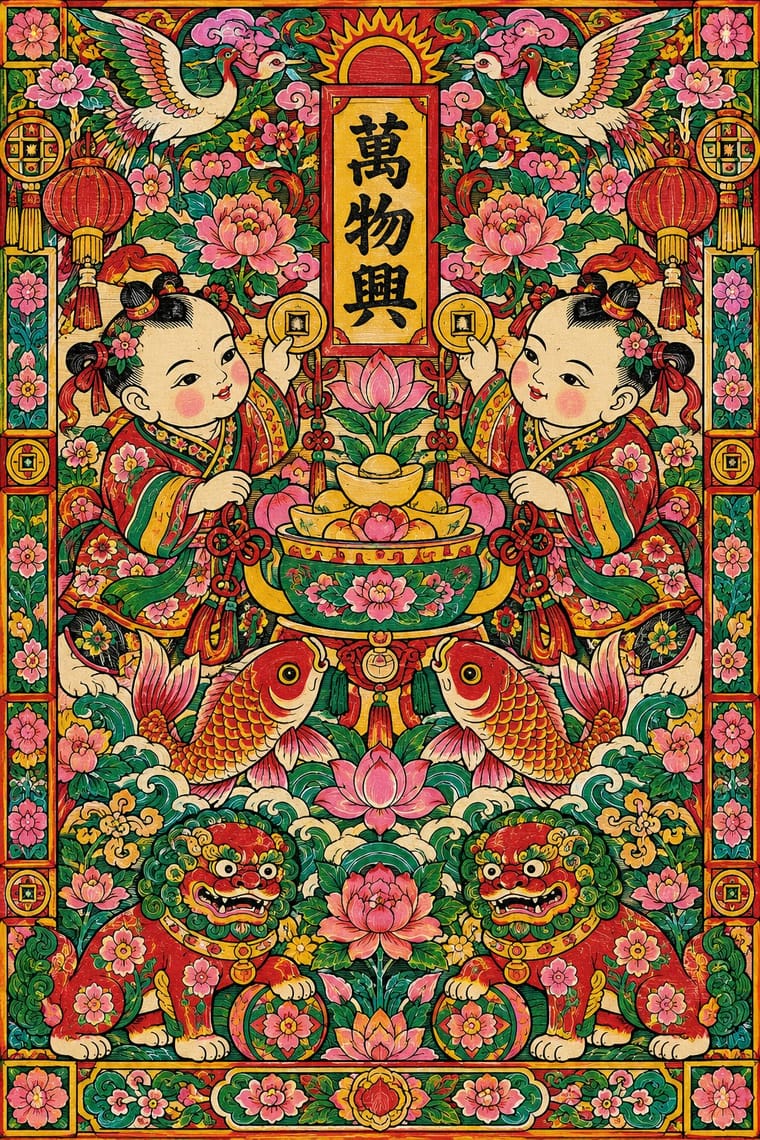
Woodblock pictures bought each New Year and pasted on doors, walls and kitchen shrines to invite luck and ward off harm: paired door gods, plump babies with carp, the Kitchen God, opera scenes and auspicious rebuses. A black keyline block is overprinted or hand-coloured in saturated red, green, yellow and pink, and compositions are dense, frontal and often mirrored in pairs.
Shippori Mincho; Nianhua used Kaishu and Lishu (clerical script) for auspicious couplets
03
The colours
The ground and leading colours come from Taiwan Floral Cloth, with a counter-accent from Nianhua. The ink reads on the ground at 4.5:1 or more.
Nianhua & Chinese Folk Print Taiwan Floral Cloth (Huabu)
-
#f7f2e8ground · 36% -
#8e1b3aink · 14% -
#d42a20accent · 18% -
#f2c230accent · 14% -
#e8468caccent · 10% -
#7bbfe6accent · 8%
As CSS
:root {
  --ground: #f7f2e8;
  --ink: #8e1b3a;
  --accent-1: #d42a20;
  --accent-2: #f2c230;
  --accent-3: #e8468c;
  --accent-4: #7bbfe6;
  --font-display: "Shippori Mincho", serif;
  --font-text: "Shippori Mincho", serif;
}
Use it with care
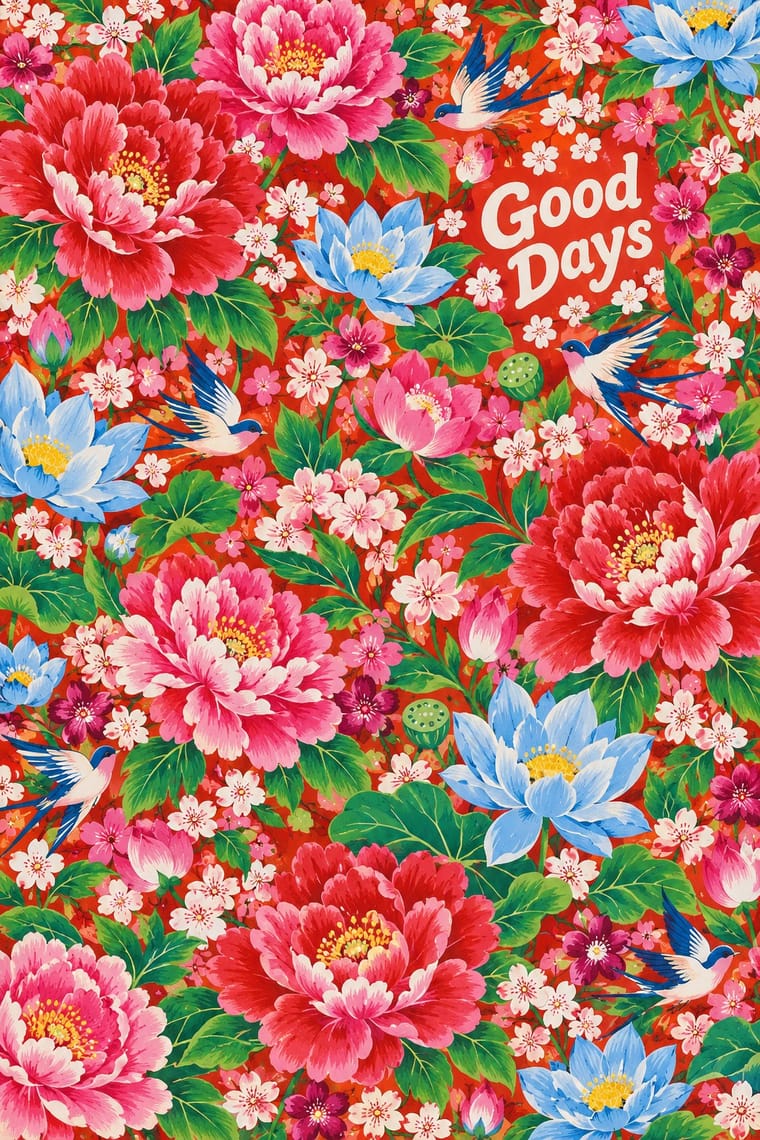
Taiwan Floral Cloth (Huabu): The cloth is shared Taiwanese popular culture, but its names and meanings are contested: 'Hakka floral cloth' is the most common label in Taiwan though Minnan, Indigenous and mainlander households all used it, so do not present it as exclusively Hakka, nor as generic 'Chinese' pattern. Northeast China has a red-and-green peony quilt cotton of its own (东北大花), revived in Harbin's 2023–24 tourist boom; describe the Taiwanese cloth by its own Japanese-era roots, Taiwanese mills and markets rather than treating the two as one. Recent prints also borrow motifs from Taiwan's Indigenous peoples, which belong to those communities and should not be reused without their involvement. Many current patterns are the protected designs of mills and designers, and Michael Lin's paintings are authored works, so work in the manner rather than copying a specific print.
04
The two styles
05
More combinations
With Nianhua
- Shanghai Modern & Yuefenpai Pairs well · Yuefenpai calendar posters grew from nianhua; mix its auspicious symbols with Shanghai's airbrushed modern figures.
- Indian Calendar & Bazaar Art Pairs well · Both are devotional bazaar prints; share frontal deities, saturated colour and decorative frames across a festive campaign.
- Socialist Realist Propaganda Poster Pairs well · The 1950s 'new New Year pictures' show how nianhua symmetry and colour can carry a contemporary message without losing folk warmth.
- Lubok Popular Print Pairs well · Russia's lubok is nianhua's closest counterpart, a hand-coloured market woodblock with captions and satire; share flat folk figures and rhymed text across a festive print series.
- Minimalist Graphic Design Contrasts · Isolate a single nianhua motif, such as a carp, on a blank minimalist ground to turn abundance into an emblem.
- Guochao (China-Chic National Trend) Pairs well · Redraw door gods, carp and auspicious babies as clean vector characters for limited-edition packaging, keeping each rebus's meaning intact.
- Tibetan Woodblock Print Culture (Pecha & Prayer Flags) Contrasts · Both are popular devotional woodblock prints pasted or hung for good fortune. Nianhua floods the paper with saturated figure scenes, whereas the Tibetan print keeps to one ink and lets the dyed cloth or the lines of script carry the effect.
- Tarot de Marseille Woodcut Cards Pairs well · Door gods and many tarot trumps are single frontal figures cut in wood and brightly coloured by hand; set them side by side for a cross-cultural series of guardian or allegorical figures.
With Taiwan Floral Cloth
- African Wax & Fancy Print Contrasts · Both are cheap industrial cotton that became a people's emblem, but wax print enlarges named emblems in an indigo key with offset colour, while Taiwan floral cloth crowds lush, nearly real peonies on a vermilion or sky-blue ground and carries nostalgia rather than proverbs.
- Newtro (Korean New-Retro) Pairs well · Both turn a postwar household look into nostalgia for young buyers; pair a reissued retro label or mascot with a floral-cloth band for packaging that recalls a grandmother's home.
- Finnish Bold Print (Marimekko Modernism) Contrasts · Marimekko's Unikko enlarges one flat poppy on open white in a few inks; Taiwan floral cloth packs many shaded peonies onto a saturated ground. Choose between modernist reduction and abundant, auspicious excess.
- Batik Pattern Tradition Contrasts · Both fill cotton edge to edge with an all-over repeat, but batik is drawn or stamped wax-resist, in court work kept to indigo, soga brown and cream on diagonal parang and kawung repeats, while Taiwan floral cloth is mass-printed with lush peonies on vermilion, pink or sky blue; choose batik for a calm, earthy field and floral cloth for loud, festive nostalgia.
- Minimalist Graphic Design Contrasts · Wrap one object, a box, a chair or a single wall, in floral cloth inside an otherwise empty white layout, as Michael Lin did when he slip-covered two Le Corbusier chairs, so that ornament and modernism confront each other.
- Josef Frank and Svenskt Tenn Botanical Prints Pairs well · Another dense, many-coloured floral cloth; Taiwan huabu is bolder, flatter and more nostalgic, Frank finer in line and more botanical.