Style combination · Contrasts
Taiwan Floral Cloth × African Wax
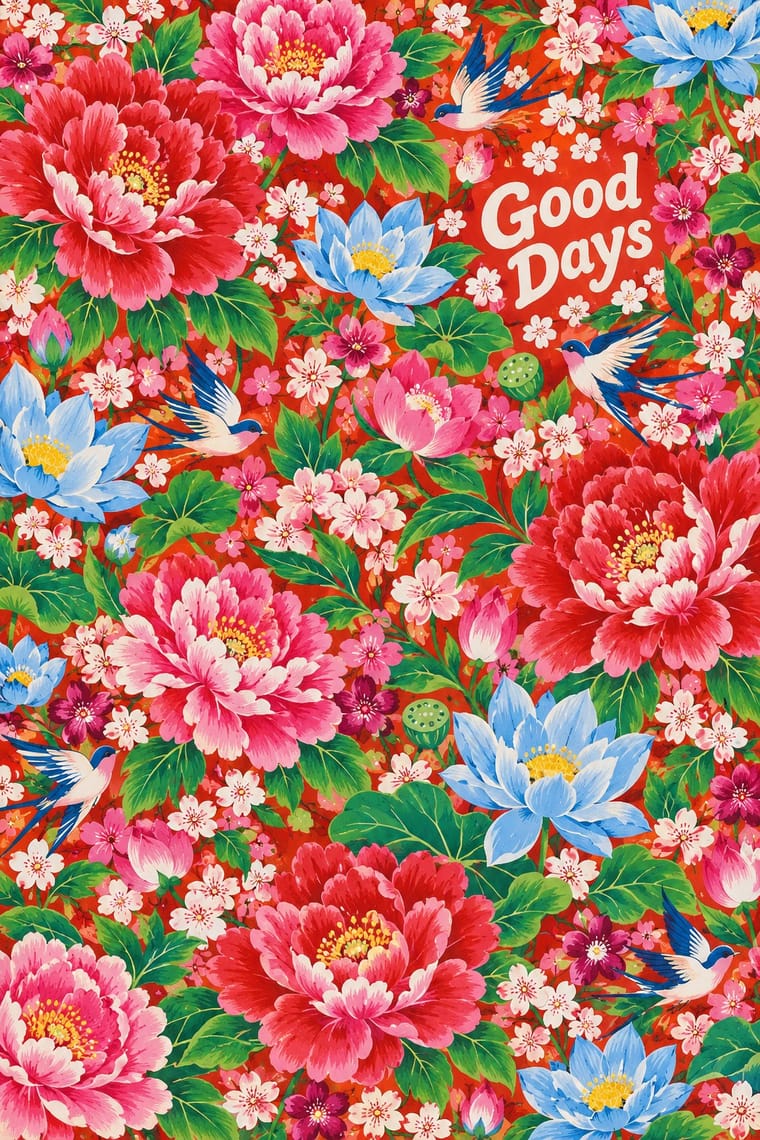
Both are cheap industrial cotton that became a people's emblem, but wax print enlarges named emblems in an indigo key with offset colour, while Taiwan floral cloth crowds lush, nearly real peonies on a vermilion or sky-blue ground and carries nostalgia rather than proverbs.
01
What each style brings
Each part of the design comes from the style with the stronger say in it, and each style gives at least two.
Taiwan Floral Cloth (Huabu) African Wax & Fancy Print
- Type from African Wax
-
- Colour from Taiwan Floral Cloth
- Form from Taiwan Floral Cloth
- Composition from Taiwan Floral Cloth
- Surface from African Wax
02
The type
Open fonts standing in for each style’s own type, which is often hand-drawn or commercial.
Display · African Wax
Square
Agbalumo; African Wax used Selvedge captions and Bold capitals in ribbon banners for slogans and dates on commemorative fancy cloth
Text · Taiwan Floral Cloth
Cheap printed cotton covered edge to edge in large, full-blown peonies with lotuses, phoenixes, dragons, mandarin ducks, small florets and auspicious emblems on saturated vermilion, bright pink or sky-blue grounds. Mass-produced from the 1950s–60s, by Far Eastern Textile among others, for quilts, curtains, wrapping cloths and clothing, it was dismissed as gaudy after the 1970s, taken up by designers and artists such as Michael Lin in the 1980s and 1990s, and revived from the 2000s as a Hakka and Taiwanese emblem on interiors, festivals and cultural-creative goods.
Shippori Mincho; Taiwan Floral Cloth used None on the cloth itself; when words accompany it, kaishu (regular brush script) for auspicious words and titles on a plain panel beside the pattern and Traditional Chinese Songti / Mingti (Ming-style) text type for labels, tags and book covers set against the cloth
03
The colours
The ground and leading colours come from Taiwan Floral Cloth, with a counter-accent from African Wax. The ink reads on the ground at 4.5:1 or more.
Taiwan Floral Cloth (Huabu) African Wax & Fancy Print
-
#f7f2e8ground · 36% -
#8e1b3aink · 14% -
#d42a20accent · 18% -
#f2b705accent · 14% -
#e8468caccent · 10% -
#7bbfe6accent · 8%
As CSS
:root {
  --ground: #f7f2e8;
  --ink: #8e1b3a;
  --accent-1: #d42a20;
  --accent-2: #f2b705;
  --accent-3: #e8468c;
  --accent-4: #7bbfe6;
  --font-display: "Agbalumo", cursive;
  --font-text: "Shippori Mincho", serif;
}
Use it with care
Taiwan Floral Cloth (Huabu): The cloth is shared Taiwanese popular culture, but its names and meanings are contested: 'Hakka floral cloth' is the most common label in Taiwan though Minnan, Indigenous and mainlander households all used it, so do not present it as exclusively Hakka, nor as generic 'Chinese' pattern. Northeast China has a red-and-green peony quilt cotton of its own (东北大花), revived in Harbin's 2023–24 tourist boom; describe the Taiwanese cloth by its own Japanese-era roots, Taiwanese mills and markets rather than treating the two as one. Recent prints also borrow motifs from Taiwan's Indigenous peoples, which belong to those communities and should not be reused without their involvement. Many current patterns are the protected designs of mills and designers, and Michael Lin's paintings are authored works, so work in the manner rather than copying a specific print.
African Wax & Fancy Print: Wax print is shared popular culture, but its designs carry names and messages given by African traders and wearers, and commemorative cloths carry political and religious portraits. Learn a design's name and meaning before reusing it, do not use commemorative portraits or party emblems out of context, and credit African designers, mills and traders rather than presenting a European brand or a generic 'African print' as the source.
04
The two styles
05
More combinations
With Taiwan Floral Cloth
- Nianhua & Chinese Folk Print Pairs well · Both use saturated red, pink and green and the same auspicious peony, phoenix and treasure vocabulary; set a nianhua-style figure or couplet on a plain panel over a floral-cloth ground for festive New Year packaging.
- Newtro (Korean New-Retro) Pairs well · Both turn a postwar household look into nostalgia for young buyers; pair a reissued retro label or mascot with a floral-cloth band for packaging that recalls a grandmother's home.
- Finnish Bold Print (Marimekko Modernism) Contrasts · Marimekko's Unikko enlarges one flat poppy on open white in a few inks; Taiwan floral cloth packs many shaded peonies onto a saturated ground. Choose between modernist reduction and abundant, auspicious excess.
- Batik Pattern Tradition Contrasts · Both fill cotton edge to edge with an all-over repeat, but batik is drawn or stamped wax-resist, in court work kept to indigo, soga brown and cream on diagonal parang and kawung repeats, while Taiwan floral cloth is mass-printed with lush peonies on vermilion, pink or sky blue; choose batik for a calm, earthy field and floral cloth for loud, festive nostalgia.
- Minimalist Graphic Design Contrasts · Wrap one object, a box, a chair or a single wall, in floral cloth inside an otherwise empty white layout, as Michael Lin did when he slip-covered two Le Corbusier chairs, so that ornament and modernism confront each other.
- Josef Frank and Svenskt Tenn Botanical Prints Pairs well · Another dense, many-coloured floral cloth; Taiwan huabu is bolder, flatter and more nostalgic, Frank finer in line and more botanical.
With African Wax
- Adinkra & Kente Symbol Systems Pairs well · Ghanaian wax and fancy prints already carry adinkra signs; pair the two to combine factory repeat with named Akan symbols, used for what they mean.
- Minimalist Graphic Design Contrasts · A single giant wax motif against a minimal white layout gives maximum impact; the full repeat is the opposite of minimal restraint.
- Batik Pattern Tradition Pairs well · Set hand-drawn Javanese batik beside its industrial descendant to show resist turning into mass repeat, crackle and giant scale.
- Pop Art Graphics Pairs well · Commemorative portrait medallions and off-register colour meet pop's serial portraits; combine them for celebratory, mass-produced portraiture.
- Finnish Bold Print (Marimekko Modernism) Contrasts · Both are industrially printed cotton that dresses bodies and rooms, but wax print crowds the cloth with misregistered emblems that traders and wearers name after proverbs and events, while Marimekko enlarges one shape on open white under a title its designer gives; compare them when a pattern must speak or simply be bold.
- Kanga (Swahili Message Cloth) Contrasts · Both are factory-printed cotton wrappers, and the atlas's wax and fancy print already includes commemorative fancy cloth with portrait medallions, flags and ribbon slogans. But wax and fancy print is yardage repeated along the bolt and named by traders by word of mouth, carrying a slogan only on commemorative designs, while every kanga, commemorative or not, is one bordered, symmetrical piece sold in pairs that prints its own sentence in a box at the foot.
- Ghanaian Funeral Poster & Banner Pairs well · Bredenbröker lists commemorative T-shirts, mugs and handkerchiefs beside the posters and banners as popular items that commemorate the dead in public, and wax print's one-sided fancy prints already serve as commemorative cloth with portraits; pair a funeral poster's photograph, name and age badge with a fancy-print repeat for a commemorative textile, keeping real people's faces and names out of new work.