Style combination · Pairs well
Nianhua × Tarot de Marseille Woodcut Cards
Door gods and many tarot trumps are single frontal figures cut in wood and brightly coloured by hand; set them side by side for a cross-cultural series of guardian or allegorical figures.
Mix them and make something Nianhua Tarot de Marseille Woodcut Cards
01
What each style brings
Each part of the design comes from the style with the stronger say in it, and each style gives at least two.
Nianhua & Chinese Folk Print Tarot de Marseille Woodcut Cards
- Type from Tarot de Marseille Woodcut Cards
- Colour from Nianhua
- Form from Nianhua
- Composition from Nianhua
-
Tarot de Marseille Woodcut Cards avoids horror vacui: this is where the two pull against each other.
- Surface from Tarot de Marseille Woodcut Cards
02
The type
Open fonts standing in for each style’s own type, which is often hand-drawn or commercial.
Display · Tarot de Marseille Woodcut Cards
Fiesta
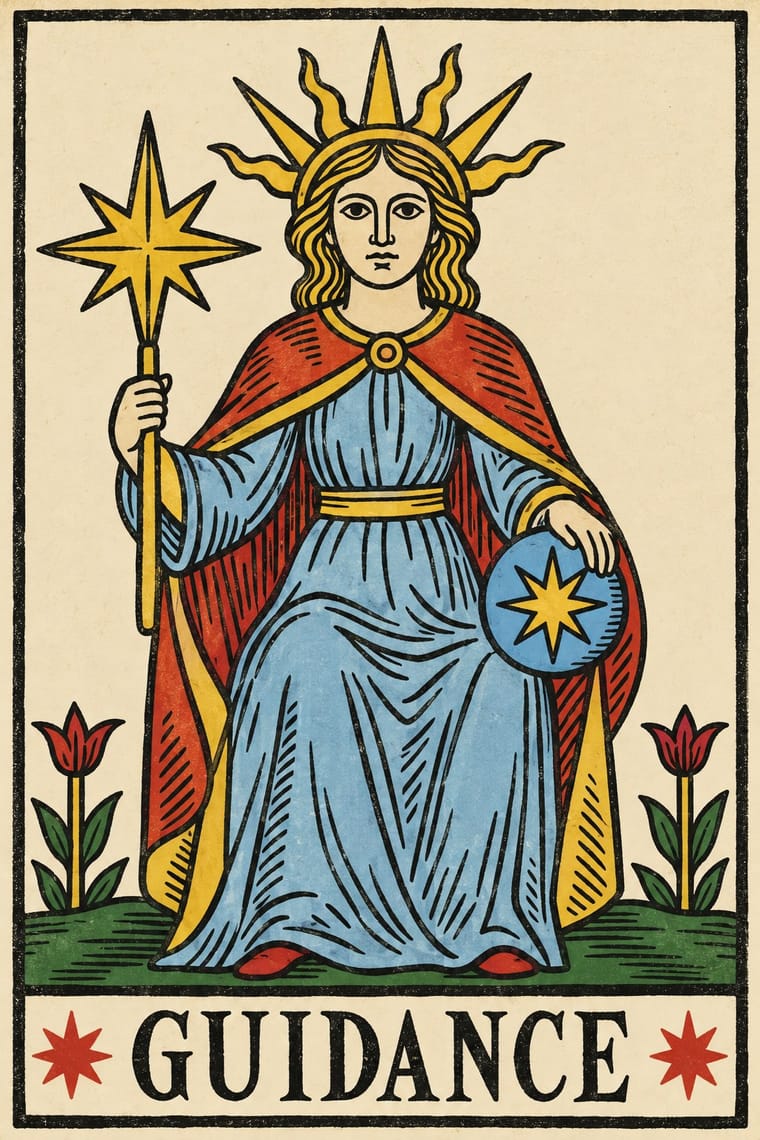
Cinzel, standing in for Roman capitals cut into the woodblock with the picture, in a band at the foot of each trump and court card, often with interpuncts and the copyists' spellings ('LE CHARIOR' and 'LA PANCES' on Dodal's cards, 'LE BATELEVR' with V for U)
Text · Nianhua
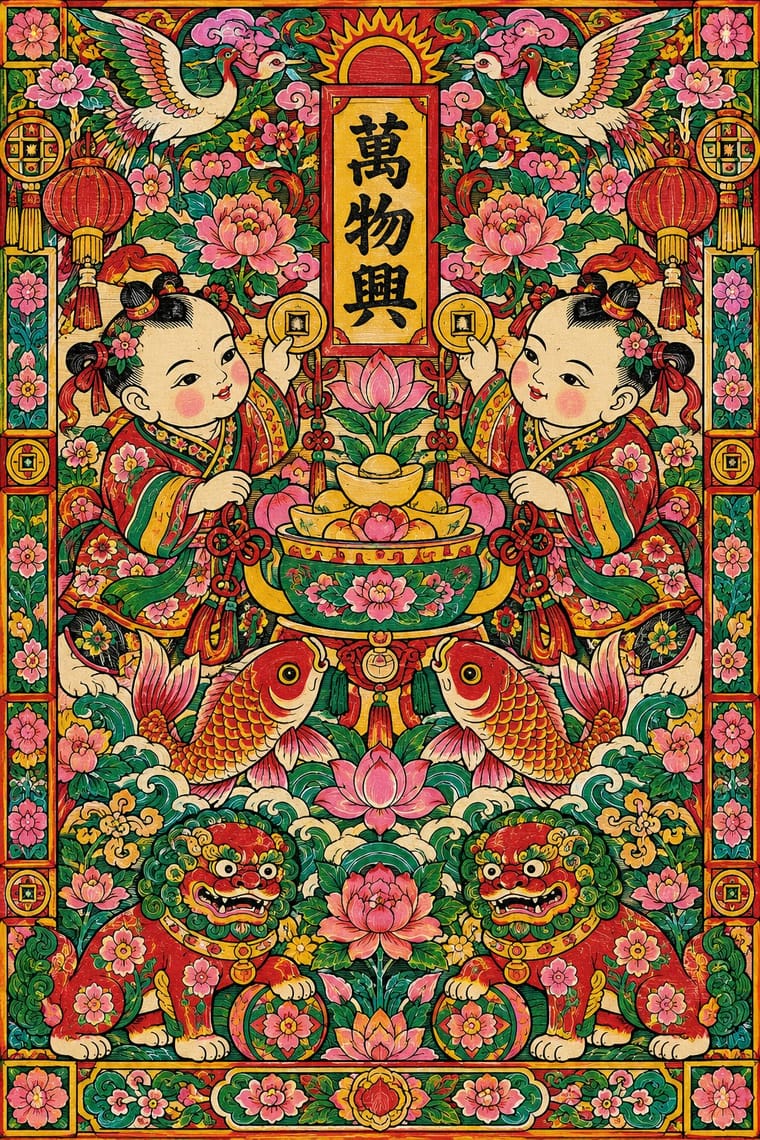
Woodblock pictures bought each New Year and pasted on doors, walls and kitchen shrines to invite luck and ward off harm: paired door gods, plump babies with carp, the Kitchen God, opera scenes and auspicious rebuses. A black keyline block is overprinted or hand-coloured in saturated red, green, yellow and pink, and compositions are dense, frontal and often mirrored in pairs.
Shippori Mincho; Nianhua used Kaishu and Lishu (clerical script) for auspicious couplets
03
The colours
The ground and leading colours come from Nianhua, with a counter-accent from Tarot de Marseille Woodcut Cards. The ink reads on the ground at 4.5:1 or more.
Nianhua & Chinese Folk Print Tarot de Marseille Woodcut Cards
-
#f1e6cfground · 36% -
#1a1a1aink · 14% -
#f2c230accent · 18% -
#c8252caccent · 14% -
#e5739aaccent · 10% -
#2f8a4eaccent · 8%
As CSS
:root {
  --ground: #f1e6cf;
  --ink: #1a1a1a;
  --accent-1: #f2c230;
  --accent-2: #c8252c;
  --accent-3: #e5739a;
  --accent-4: #2f8a4e;
  --font-display: "Cinzel", serif;
  --font-text: "Shippori Mincho", serif;
}
Use it with care
Tarot de Marseille Woodcut Cards: Trace decks cut before 1800 (Noblet, Dodal and Conver in the BnF; Dodal cards and early 19th-century Conver printings at the Met) rather than recent redrawings such as Grimaud's 1930 'Ancien Tarot de Marseille' or the 1998 Camoin–Jodorowsky restoration, which are modern works; and do not present the occultists' story of an Egyptian origin, launched by Court de Gébelin in 1781, as history: the pattern descends from Milanese tarot and was made for the card game of tarot, which French and Swiss players used it for until the early 20th century.
04
The two styles
05
More combinations
With Nianhua
- Shanghai Modern & Yuefenpai Pairs well · Yuefenpai calendar posters grew from nianhua; mix its auspicious symbols with Shanghai's airbrushed modern figures.
- Indian Calendar & Bazaar Art Pairs well · Both are devotional bazaar prints; share frontal deities, saturated colour and decorative frames across a festive campaign.
- Socialist Realist Propaganda Poster Pairs well · The 1950s 'new New Year pictures' show how nianhua symmetry and colour can carry a contemporary message without losing folk warmth.
- Lubok Popular Print Pairs well · Russia's lubok is nianhua's closest counterpart, a hand-coloured market woodblock with captions and satire; share flat folk figures and rhymed text across a festive print series.
- Minimalist Graphic Design Contrasts · Isolate a single nianhua motif, such as a carp, on a blank minimalist ground to turn abundance into an emblem.
- Guochao (China-Chic National Trend) Pairs well · Redraw door gods, carp and auspicious babies as clean vector characters for limited-edition packaging, keeping each rebus's meaning intact.
- Tibetan Woodblock Print Culture (Pecha & Prayer Flags) Contrasts · Both are popular devotional woodblock prints pasted or hung for good fortune. Nianhua floods the paper with saturated figure scenes, whereas the Tibetan print keeps to one ink and lets the dyed cloth or the lines of script carry the effect.
- Taiwan Floral Cloth (Huabu) Pairs well · Both use saturated red, pink and green and the same auspicious peony, phoenix and treasure vocabulary; set a nianhua-style figure or couplet on a plain panel over a floral-cloth ground for festive New Year packaging.
With Tarot de Marseille Woodcut Cards
- Literatura de Cordel Woodcut Contrasts · Both cut stiff figures in wood with no perspective or modelling, but the cordel cover is printed in black only, with solid blacks and gouged white lines, above a plain letterpress title, while the tarot card colours an outline key through stencils and cuts its numeral and title into the same block; choose cordel for a stark one-colour cover, tarot for a coloured emblem in a numbered set.
- European Heraldry Pairs well · The Emperor's and Empress's eagle shields and the maker's escutcheon on the 2 of Coupes come from armory; pair heraldic tinctures and charges with a tarot figure for a crest-like card or label.
- Lotería Card Imagery (Mexican Lotería) Contrasts · Lotería also gives each card one figure with its name at the foot, but in letterspaced sans capitals and soft offset colour; borrow the tarot's carved roman title band, ruled frame and stencil drift to make a lotería-type card set look older and graver.
- Imagerie d'Épinal & European Bilderbogen Contrasts · Both stencil-colour a black woodcut key in a few drifting colours, but the Épinal sheet tells a story in grids of captioned cases and marches rows of soldiers, while the tarot card isolates one emblematic subject under a numeral and a title; choose tarot for a single symbol, Épinal for a sequence.
- Risograph & Indie Print Culture Pairs well · Riso's few flat inks and loose registration reproduce the stencil drift of an old tarot; print a black woodcut-style key with red, yellow and pale blue for a contemporary deck or poster.
- Emblem Book (Motto, Picture & Epigram) Contrasts · The emblem book explains its picture with a printed motto and epigram on the page, while the tarot gives only a carved title and a numeral and leaves the meaning to play or reading; choose the emblem book when the text must carry the argument.