Style combination · Pairs well
Icelandic Magical Staves × Thai Yantra Diagrams
Both are protective diagrams copied by hand for a named use; a yantra packs script into closed shapes, while a stave is one open line, so set them side by side to see how each encodes purpose.
Mix them and make something Icelandic Magical Staves Thai Yantra Diagrams
01
What each style brings
Each part of the design comes from the style with the stronger say in it, and each style gives at least two.
Icelandic Magical Staves (Galdrastafir) Thai Yantra (Yant) Diagrams
- Type from Thai Yantra Diagrams
- Colour from Thai Yantra Diagrams
- Form from Icelandic Magical Staves
- Composition from Icelandic Magical Staves
- Surface from Thai Yantra Diagrams
02
The type
Open fonts standing in for each style’s own type, which is often hand-drawn or commercial.
Display · Thai Yantra Diagrams
Light
Yatra One; Thai Yantra Diagrams used Khom Thai (akson khom), the Khmer-derived script used for Pali formulae and heart syllables and Mul (round) Khmer script in Cambodian-lineage yantras, distinguishable from Khom only by small variants
Text · Icelandic Magical Staves
Single-line sigils drawn in ink in Icelandic grimoires, each with a named purpose: the Ægishjálmur (helm of awe) for fear and victory, the Vegvísir for finding the way, the Lukkustafir for luck. Built from crossed and branching arms ending in forks, crosses and rune-like bars, often inside a circle, they were copied and varied by hand. Today they circulate as tattoos, t-shirts and pendants, often wrongly sold as Viking.
VT323; Icelandic Magical Staves used Icelandic hand-written manuscript scripts (post-medieval cursive) of the grimoires and Runic letters and rune-like bars used as terminals and in the instructions
03
The colours
The ground and leading colours come from Thai Yantra Diagrams, with a counter-accent from Icelandic Magical Staves. The ink reads on the ground at 4.5:1 or more.
Icelandic Magical Staves (Galdrastafir) Thai Yantra (Yant) Diagrams
-
#f2ede1ground · 36% -
#1d1b18ink · 14% -
#d9b44aaccent · 18% -
#8a2f26accent · 14% -
#5b3a29accent · 10% -
#2f4f8faccent · 8%
As CSS
:root {
  --ground: #f2ede1;
  --ink: #1d1b18;
  --accent-1: #d9b44a;
  --accent-2: #8a2f26;
  --accent-3: #5b3a29;
  --accent-4: #2f4f8f;
  --font-display: "Yatra One", cursive;
  --font-text: "VT323", monospace;
}
Use it with care
Icelandic Magical Staves (Galdrastafir): Icelandic magical staves are historically real occult practice, recorded in grimoires, and are now a living part of Icelandic heritage and of Nordic neo-pagan practice. The Vegvísir has no known attestation before 1860 and is often falsely sold as a Viking compass, and the Ægishjálmur has been taken up by some extremist groups, including in the logo of a Swedish party. Do not present them as Viking Age symbols, do not use them as neutral decoration for brands tied to hate or far-right politics, credit the manuscripts and Icelandic sources, and do not invent new staves and claim they work. Date it honestly: these are a post-Reformation Icelandic book tradition, not a Viking Age emblem.
Thai Yantra (Yant) Diagrams: Yantras are consecrated Buddhist and Brahmanic protective diagrams in living use: their Khom formulae are incantations, sak yant are given by monks and ajarn within master–disciple lineages under precepts the wearer must keep, and pha yant are blessed objects hung high over doors. Do not use real or imitation yantras, Khom letters or Buddha images as texture, logos, fashion prints or tattoos without a master, do not place them low (on floors, footwear, seats) or crop and mirror them, do not invent pseudo-Khom, and work with Thai practitioners and readers of Khom rather than tracing designs from temples or tattoo photographs. Image models cannot write Khom and will invent letters: in generated images leave the cells blank or set legible secular Thai, and never present the result as a real or working yantra.
04
The two styles
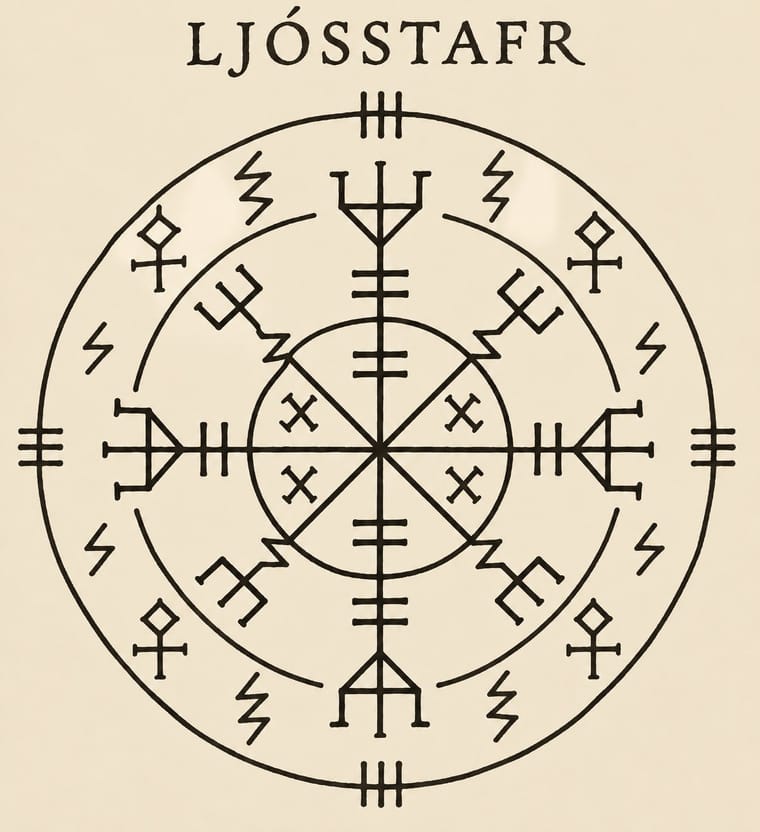
05
More combinations
With Icelandic Magical Staves
- European Heraldry Contrasts · Heraldry fixes an emblem by blazon and fills it with colour on a shield; a stave has no fixed form, no colour and no blazon.
- Viking Age Animal Styles (Borre, Jellinge, Mammen, Ringerike, Urnes) Contrasts · Animal styles are medieval carved interlace; staves are later, written, linear and have no animals, so do not blend them to make a Viking look.
With Thai Yantra Diagrams
- Ethiopian Ge'ez Manuscript & Haräg Illumination Pairs well · Ethiopian talismanic scrolls are the closest counterpart: protective scripts, frames and guardian figures made by clergy for a named owner; compare how each turns a sacred script into a frame.
- Adinkra & Kente Symbol Systems Pairs well · Both are symbol systems printed on cloth whose meaning is read through convention; set them side by side to study how coded signs travel between cloth, body and building.
- Islamic Geometric & Calligraphic Tradition Contrasts · Both make sacred script structural, but Islamic pattern repeats edge to edge without end while a yantra closes in on one centre, often inside nested text borders.
- Isotype Pictorial Statistics Contrasts · Both are diagrams built from rules: Isotype makes meaning legible to everyone, a yantra encodes it for initiates; the opposition is useful for thinking about who a diagram is for.
- Kamon (Japanese Family Crests) Contrasts · Both are one-colour, symmetrical signs on cloth governed by inherited rules, but a mon is a wordless emblem of a family, varied in small codified ways and read at a glance, while a yantra is built from sacred script and read by initiates.
- Roman-like Thai Typography (modern loopless Thai) Contrasts · Yantras keep hand-drawn Khom letters in sacred, protective diagrams; loopless Thai is secular, standardised and commercial, so never use a yantra as a decorative foil for it.
- Baybayin Revival Graphics Contrasts · Both put a Southeast Asian script on skin and cloth, but a yantra packs sacred formulae into a consecrated diagram, while a baybayin tattoo or shirt carries a word of identity rather than a consecrated formula; never borrow yantra structure or Khom letters for a baybayin design.
- Tibetan Woodblock Print Culture (Pecha & Prayer Flags) Pairs well · Both are consecrated Buddhist signs printed in one ink on paper and cloth and hung up for protection and fortune. The yantra's grid of cells and the flag's field of mantras round a central figure share a logic, so they suit a calm, devotional layout of text-as-pattern, made only with practitioners.