Style combination · Contrasts
European Heraldry × Icelandic Magical Staves
Heraldry fixes an emblem by blazon and fills it with colour on a shield; a stave has no fixed form, no colour and no blazon.
Mix them and make something European Heraldry Icelandic Magical Staves
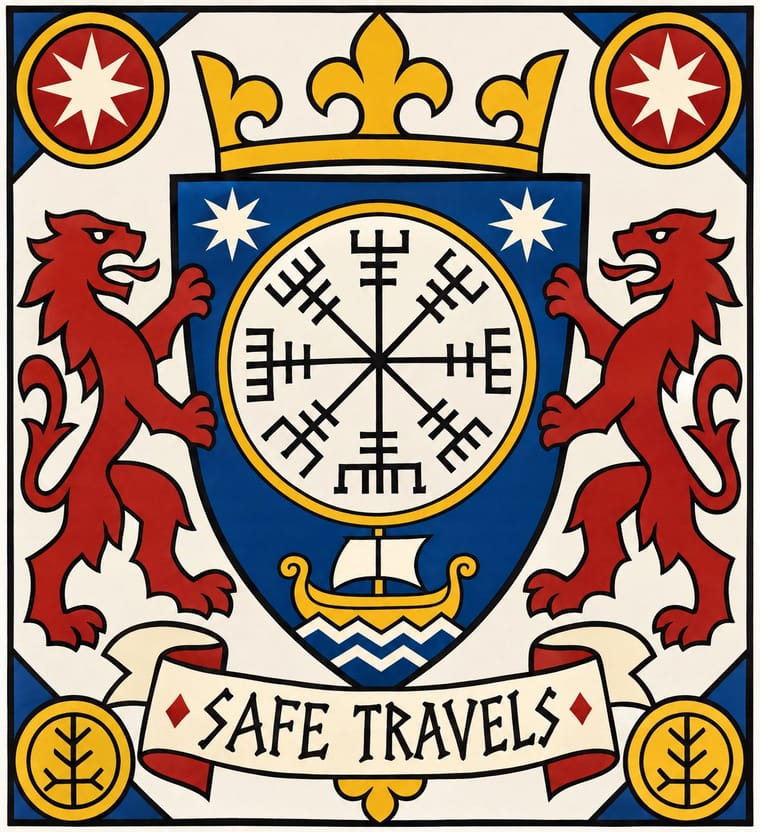
01
What each style brings
Each part of the design comes from the style with the stronger say in it, and each style gives at least two.
European Heraldry Icelandic Magical Staves (Galdrastafir)
- Type from Icelandic Magical Staves
- Colour from European Heraldry
- Form from European Heraldry
- Composition from Icelandic Magical Staves
- Surface from European Heraldry
02
The type
Open fonts standing in for each style’s own type, which is often hand-drawn or commercial.
Display · Icelandic Magical Staves
Atlas
VT323, standing in for Runic letters and rune-like bars used as terminals and in the instructions
Text · European Heraldry
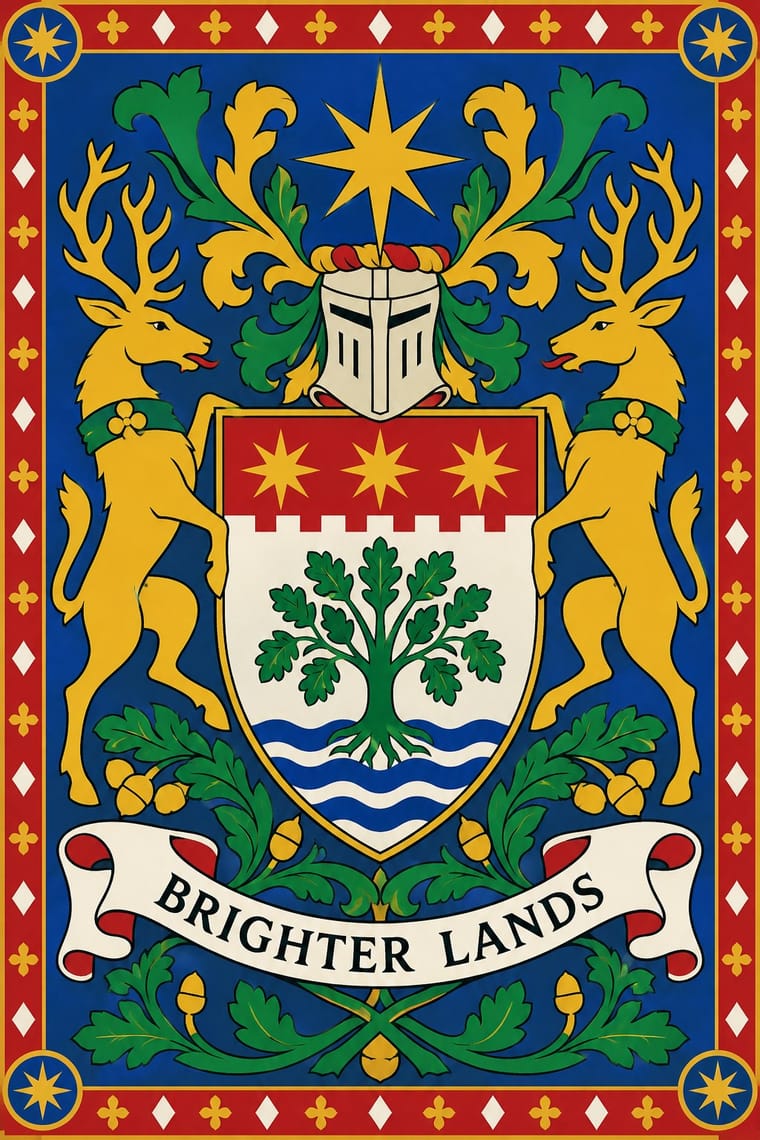
The hereditary identifying devices of medieval Europe's knights and seals, codified into a rule-bound grammar still used by states, cities, churches, universities and families. A coat of arms is defined by its written blazon, not by a drawing: a few flat tinctures (two metals, five colours and the furs) that keep metal off metal and colour off colour, a shield divided by bold ordinaries, and stylised charges in fixed poses, redrawn by every age in its own idiom and combined by impalement and quartering.
Libre Caslon Text; European Heraldry used Gothic book and cursive hands naming the bearer above or beside each shield in medieval rolls of arms and armorials, as 'die coninc van denmarke' beside the Danish flag in the Gelre Armorial and Mottoes lettered on a scroll beneath the shield
03
The colours
The ground and leading colours come from European Heraldry, with a counter-accent from Icelandic Magical Staves. The ink reads on the ground at 4.5:1 or more.
European Heraldry Icelandic Magical Staves (Galdrastafir)
-
#f4f1e8ground · 36% -
#141414ink · 14% -
#e8b923accent · 18% -
#8a2f26accent · 14% -
#b5121baccent · 10% -
#5b3a29accent · 8%
As CSS
:root {
  --ground: #f4f1e8;
  --ink: #141414;
  --accent-1: #e8b923;
  --accent-2: #8a2f26;
  --accent-3: #b5121b;
  --accent-4: #5b3a29;
  --font-display: "VT323", monospace;
  --font-text: "Libre Caslon Text", serif;
}
Use it with care
European Heraldry: A coat of arms belongs to a particular bearer, lineage or (in Polish heraldry) clan, not to everyone with a surname: in Scotland it can belong to only one person at a time and the Court of the Lord Lyon can fine those who usurp arms and have the offending items removed or destroyed, state arms are protected against unauthorised registration and use as trademarks under Article 6ter of the Paris Convention, and many European cities and universities protect their arms as trademarks. Design new arms by the rules of the tradition rather than copying a real family's, city's or state's arms for decoration or branding, and do not present invented arms as a family's historic coat of arms. Crusader and Templar shields and knights with crosses on their chests or shields have also become far-right insignia (Charlottesville 2017, the US Capitol 2021), and neo-Nazis use an eagle loosely based on German coats of arms, though not every eagle derives from it; check how a cross, an eagle or a crusading knight will read before using it, and avoid pairing them with militant or ethnic-nationalist themes.
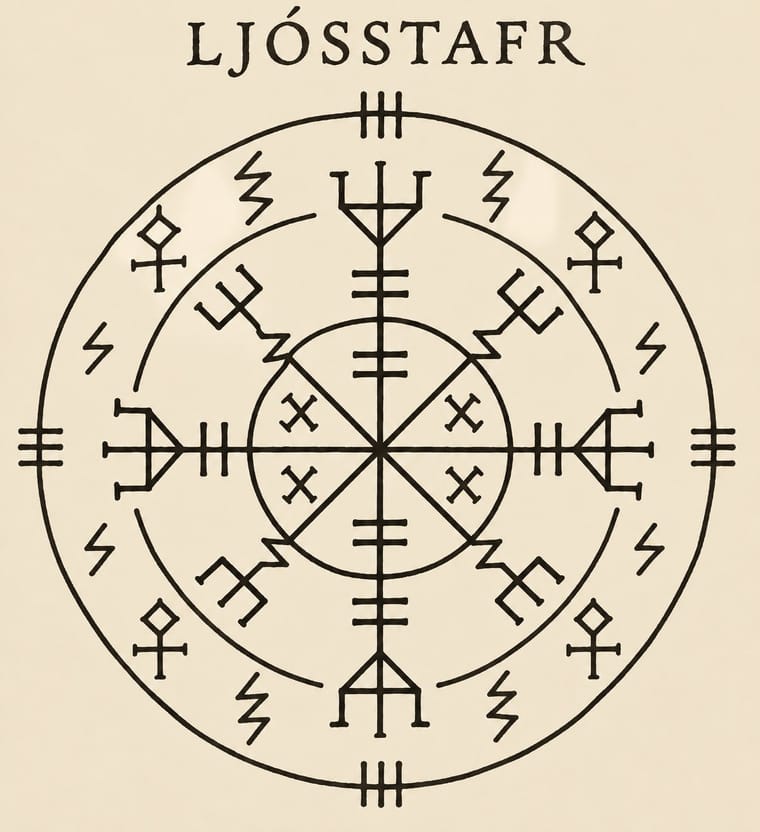
Icelandic Magical Staves (Galdrastafir): Icelandic magical staves are historically real occult practice, recorded in grimoires, and are now a living part of Icelandic heritage and of Nordic neo-pagan practice. The Vegvísir has no known attestation before 1860 and is often falsely sold as a Viking compass, and the Ægishjálmur has been taken up by some extremist groups, including in the logo of a Swedish party. Do not present them as Viking Age symbols, do not use them as neutral decoration for brands tied to hate or far-right politics, credit the manuscripts and Icelandic sources, and do not invent new staves and claim they work. Date it honestly: these are a post-Reformation Icelandic book tradition, not a Viking Age emblem.
04
The two styles
05
More combinations
With European Heraldry
- Hipster Artisanal Revival Contrasts · The craft badge borrows heraldry's air of lineage with an 'Est.' date and crossed arrows on kraft paper, while a real coat of arms is a granted or inherited, blazoned identity in strong tinctures; set the two side by side to show the difference between quoting heritage and holding it.
- Corporate Identity Modernism Pairs well · A coat of arms already is an identity defined by a specification rather than one drawing, applied to seals, banners, buildings and documents; Finnish municipal arms of the 1950s show how its flat two-tincture discipline reads as a modern mark, so use blazon-like rules to write a logo that can be redrawn without losing itself.
- Gothic Blackletter & Fraktur Tradition Pairs well · Medieval armorials name their shields in Gothic hands and German heraldic artists such as Otto Hupp also drew Fraktur; pair a flat Gothic shield with a blackletter name or motto for a certificate, diploma or civic document, checking how the broken script will read politically.
- Kamon (Japanese Family Crests) Contrasts · Both are hereditary emblem systems that began in the twelfth century and mark kinship by small codified variations, but a mon is a single-colour silhouette drawn round a centre while a coat of arms is a shield of contrasting tinctures read by the rule of tincture; compare them to choose between a one-ink crest and a coloured, partitioned one.
- Ultras Graphics (Curva Banners and Tifo) Contrasts · Both raise colours and emblems over a fighting company, but heraldry codifies one bearer's arms by rule, while a curva borrows the city's arms, a skull or a film villain for one afternoon and paints it the size of a stand; choose between a fixed blazon and a crowd-made, temporary emblem.
- Tarot de Marseille Woodcut Cards Pairs well · The Emperor's and Empress's eagle shields and the maker's escutcheon on the 2 of Coupes come from armory; pair heraldic tinctures and charges with a tarot figure for a crest-like card or label.
- French-Pattern Playing Cards (Court Cards and Indices) Pairs well · Flat tinctures, emblems and mirrored figures give a court card its crest-like look; pair heraldic charges with a double-headed court for an armorial deck or label.
- Natural Wine Label Art Contrasts · The crest is the device of the classic château label that natural wine replaced with a face or an animal; put one heraldic charge beside a doodle to show which side of the wine world a bottle stands on.
With Icelandic Magical Staves
- Thai Yantra (Yant) Diagrams Pairs well · Both are protective diagrams copied by hand for a named use; a yantra packs script into closed shapes, while a stave is one open line, so set them side by side to see how each encodes purpose.
- Viking Age Animal Styles (Borre, Jellinge, Mammen, Ringerike, Urnes) Contrasts · Animal styles are medieval carved interlace; staves are later, written, linear and have no animals, so do not blend them to make a Viking look.