Style combination · Pairs well
Adinkra × Thai Yantra Diagrams
Both are symbol systems printed on cloth whose meaning is read through convention; set them side by side to study how coded signs travel between cloth, body and building.
01
What each style brings
Each part of the design comes from the style with the stronger say in it, and each style gives at least two.
Adinkra & Kente Symbol Systems Thai Yantra (Yant) Diagrams
- Type from Thai Yantra Diagrams
- Colour from Adinkra
-
Thai Yantra Diagrams avoids full polychrome: this is where the two pull against each other.
- Form from Adinkra
- Composition from Adinkra
- Surface from Thai Yantra Diagrams
02
The type
Open fonts standing in for each style’s own type, which is often hand-drawn or commercial.
Display · Thai Yantra Diagrams
Halo
Yatra One; Thai Yantra Diagrams used Khom Thai (akson khom), the Khmer-derived script used for Pali formulae and heart syllables and Mul (round) Khmer script in Cambodian-lineage yantras, distinguishable from Khom only by small variants
Text · Adinkra
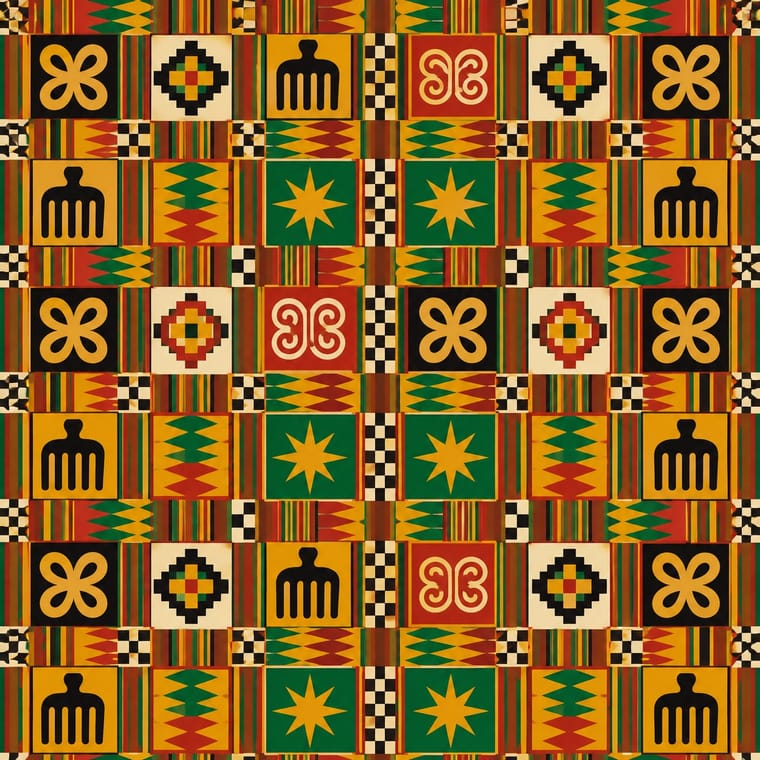
The Akan textile languages of Ghana. In adinkra, named symbols carrying proverbs (Gye Nyame, Sankofa, Dwennimmen) are stamped in black with carved calabash stamps on cloth ruled into squares; kente is narrow-strip cloth woven in named warp-faced blocks of gold, green, red and blue and sewn into checkerboards. Pattern is a vocabulary: each motif and colour is chosen for its meaning.
Archivo; Adinkra used Adinkra stamped glyphs as a pictographic set and Ghanaian hand-painted sign lettering for accompanying text
03
The colours
The ground and leading colours come from Adinkra, with a counter-accent from Thai Yantra Diagrams. The ink reads on the ground at 4.5:1 or more.
Adinkra & Kente Symbol Systems Thai Yantra (Yant) Diagrams
-
#efe2c4ground · 36% -
#151412ink · 14% -
#e3a51caccent · 18% -
#d9b44aaccent · 14% -
#b52a1faccent · 10% -
#7d3a1faccent · 8%
As CSS
:root {
  --ground: #efe2c4;
  --ink: #151412;
  --accent-1: #e3a51c;
  --accent-2: #d9b44a;
  --accent-3: #b52a1f;
  --accent-4: #7d3a1f;
  --font-display: "Yatra One", cursive;
  --font-text: "Archivo", sans-serif;
}
Use it with care
Adinkra & Kente Symbol Systems: Adinkra symbols and kente patterns are named, proverb-bearing Akan heritage, and some kente designs were historically reserved for the Asantehene and royal lineages. Learn each symbol's meaning before use, keep sacred signs such as Gye Nyame out of trivial or demeaning contexts, and commission or credit Ghanaian stampers and weavers (for example in Ntonso and Bonwire) rather than printing faux kente.
Thai Yantra (Yant) Diagrams: Yantras are consecrated Buddhist and Brahmanic protective diagrams in living use: their Khom formulae are incantations, sak yant are given by monks and ajarn within master–disciple lineages under precepts the wearer must keep, and pha yant are blessed objects hung high over doors. Do not use real or imitation yantras, Khom letters or Buddha images as texture, logos, fashion prints or tattoos without a master, do not place them low (on floors, footwear, seats) or crop and mirror them, do not invent pseudo-Khom, and work with Thai practitioners and readers of Khom rather than tracing designs from temples or tattoo photographs. Image models cannot write Khom and will invent letters: in generated images leave the cells blank or set legible secular Thai, and never present the result as a real or working yantra.
04
The two styles
05
More combinations
With Adinkra
- International Typographic Style Pairs well · A modular grid holds adinkra squares naturally; pair them with a neutral grotesque for contemporary Ghanaian institutional work.
- Bògòlanfini Mud Cloth Pairs well · Adinkra stamps dark signs on light cloth while bògòlan leaves light signs in a dark mud-dyed ground; use the reversal for a light and dark pattern pair, with each motif's meaning and makers credited.
- Ma & Wabi-sabi Aesthetics Contrasts · Saturated, meaning-dense repetition versus quiet emptiness: decide whether your message needs abundance or a single sign.
- Isotype Pictorial Statistics Pairs well · Treat adinkra as a consistent icon family on a strict grid, as Isotype did with pictograms, for wayfinding or data with local voice.
- Afrofuturist Design Pairs well · Afrofuturist identities draw on adinkra; render named symbols as glowing or metallic glyphs while keeping their meanings intact.
- Amazigh Sign System & Tifinagh Contrasts · Both are sign systems that carry meaning, but adinkra stamps named symbols into a ruled grid of squares. Amazigh weavers and tattooists vary the size and spacing of their signs by hand within bands and lattices, and share them with a script.
- Andean Woven Graphic Systems Contrasts · Adinkra stamps named symbols into ruled squares and kente joins woven strips, whereas Andean cells are woven into one garment and distorted toward its edges; keep the two languages distinct.
- Pacific Barkcloth (Tapa) Design Pairs well · Both are gridded ceremonial cloths of named motifs; borrow their shared square-by-square logic for a layout, while keeping each motif tied to its own culture and meaning.
With Thai Yantra Diagrams
- Ethiopian Ge'ez Manuscript & Haräg Illumination Pairs well · Ethiopian talismanic scrolls are the closest counterpart: protective scripts, frames and guardian figures made by clergy for a named owner; compare how each turns a sacred script into a frame.
- Islamic Geometric & Calligraphic Tradition Contrasts · Both make sacred script structural, but Islamic pattern repeats edge to edge without end while a yantra closes in on one centre, often inside nested text borders.
- Isotype Pictorial Statistics Contrasts · Both are diagrams built from rules: Isotype makes meaning legible to everyone, a yantra encodes it for initiates; the opposition is useful for thinking about who a diagram is for.
- Kamon (Japanese Family Crests) Contrasts · Both are one-colour, symmetrical signs on cloth governed by inherited rules, but a mon is a wordless emblem of a family, varied in small codified ways and read at a glance, while a yantra is built from sacred script and read by initiates.
- Roman-like Thai Typography (modern loopless Thai) Contrasts · Yantras keep hand-drawn Khom letters in sacred, protective diagrams; loopless Thai is secular, standardised and commercial, so never use a yantra as a decorative foil for it.
- Baybayin Revival Graphics Contrasts · Both put a Southeast Asian script on skin and cloth, but a yantra packs sacred formulae into a consecrated diagram, while a baybayin tattoo or shirt carries a word of identity rather than a consecrated formula; never borrow yantra structure or Khom letters for a baybayin design.
- Tibetan Woodblock Print Culture (Pecha & Prayer Flags) Pairs well · Both are consecrated Buddhist signs printed in one ink on paper and cloth and hung up for protection and fortune. The yantra's grid of cells and the flag's field of mantras round a central figure share a logic, so they suit a calm, devotional layout of text-as-pattern, made only with practitioners.