Style combination · Pairs well
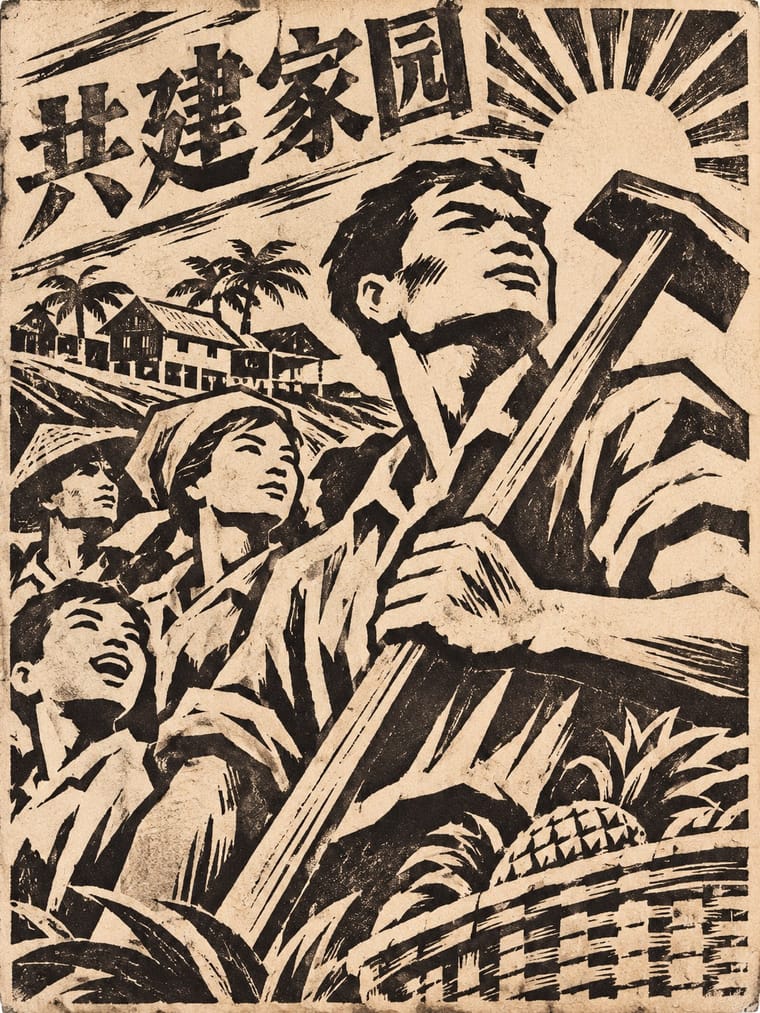
Chinese Modern Woodcut Movement × Singapore–Malayan Social Woodcut Graphics
Start from the mainland movement's carved contrast, then move the subject to Malayan labour, coast and street.
Mix them and make something Chinese Modern Woodcut Movement Singapore–Malayan Social Woodcut Graphics
01
What each style brings
Each part of the design comes from the style with the stronger say in it, and each style gives at least two.
Chinese Modern Woodcut Movement Singapore–Malayan Social Woodcut Graphics
- Type from Chinese Modern Woodcut Movement
- Colour from Singapore–Malayan Social Woodcut Graphics
- Form from Singapore–Malayan Social Woodcut Graphics
- Composition from Chinese Modern Woodcut Movement
- Surface from Chinese Modern Woodcut Movement
02
The type
Open fonts standing in for each style’s own type, which is often hand-drawn or commercial.
Display · Chinese Modern Woodcut Movement
Wake
Shippori Mincho, standing in for Brush-written kaishu titles on journal and book covers
Text · Singapore–Malayan Social Woodcut Graphics
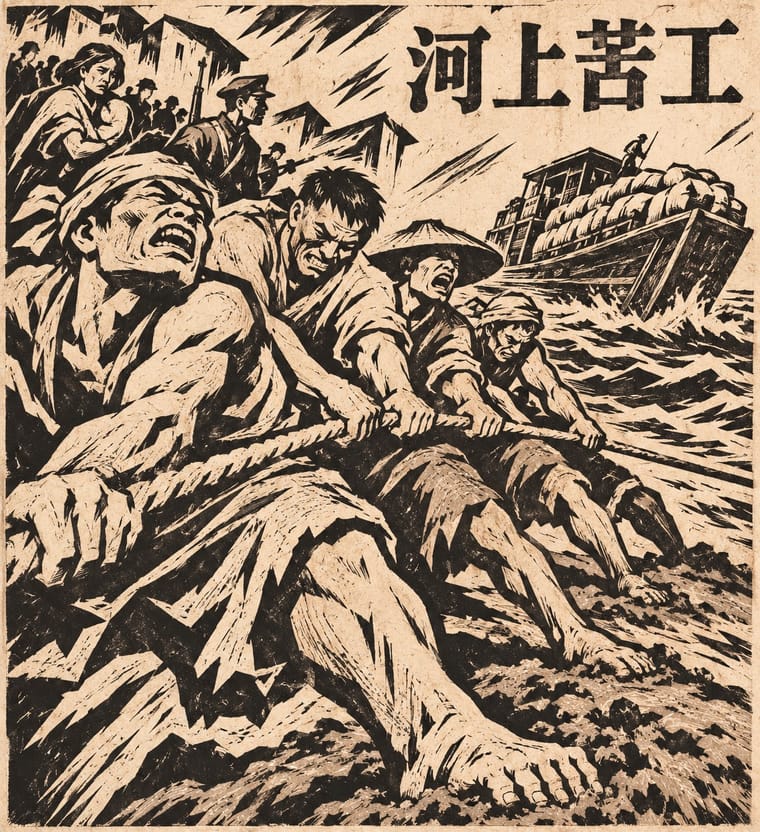
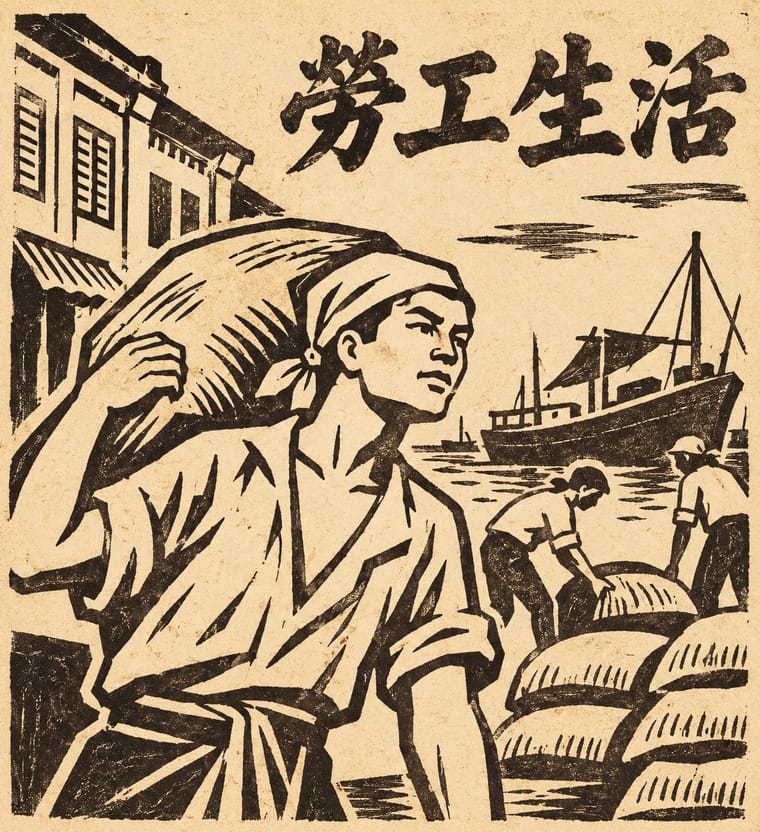
A regional sub-style of the Chinese modern woodcut: black-and-white woodcuts made by Chinese-educated artists in Singapore and Malaya from the 1930s to the 1960s, printed in Chinese-language newspaper supplements and literary magazines. They moved from war-relief fundraising and the plight of the lower classes to political satire under colonial censorship, and in the 1960s toward sea, landscape and still life. Quieter and more narrative than its agitational parent, with few figures and a story that reads at first glance.
Newsreader; Singapore–Malayan Social Woodcut Graphics used Brush-lettered Chinese titles on newspaper supplements and magazine covers and Chinese characters set within the picture, as on a seascape print
03
The colours
The ground and leading colours come from Singapore–Malayan Social Woodcut Graphics, with a counter-accent from Chinese Modern Woodcut Movement. The ink reads on the ground at 4.5:1 or more.
Chinese Modern Woodcut Movement Singapore–Malayan Social Woodcut Graphics
-
#efe6d2ground · 36% -
#141210ink · 14% -
#8c7b62accent · 18% -
#e0b23aaccent · 14% -
#3b3228accent · 10% -
#b8312faccent · 8%
As CSS
:root {
  --ground: #efe6d2;
  --ink: #141210;
  --accent-1: #8c7b62;
  --accent-2: #e0b23a;
  --accent-3: #3b3228;
  --accent-4: #b8312f;
  --font-display: "Shippori Mincho", serif;
  --font-text: "Newsreader", serif;
}
Use it with care
Singapore–Malayan Social Woodcut Graphics: Rights are uncleared. Much of the work was published under colonial censorship and some artists used pseudonyms; the artists and the 1966 show (deliberately apolitical, nation-building) differed in outlook, so do not present it as one political movement.
04
The two styles
05
More combinations
With Chinese Modern Woodcut Movement
- Shanghai Modern & Yuefenpai Contrasts · Same city, same decade: airbrushed calendar glamour against gouged black refugees shows two opposite promises of modern China.
- Taller de Gráfica Popular Pairs well · Mexico and China built woodcut movements in the same years for the same publics; mix their imagery for internationalist solidarity prints.
- Nianhua & Chinese Folk Print Pairs well · Yan'an artists fused the two; add New Year print outline and flat colour to a woodcut when warmth matters more than shock.
- Expressionist Woodcut Graphics Pairs well · Its parent: borrow the German gouge and distortion, then point them outward at a shared cause instead of inner anguish.
- Republican Chinese Book Cover Design (Lu Xun & Tao Yuanqing) Pairs well · Lu Xun launched the woodcut movement in 1931 and edited woodcut books such as Yinyu ji; a black carved print on a pale cover with a drawn title joins the two.
- Lianhuanhua Picture-Story Books Pairs well · Woodcut picture-stories and lianhuanhua share the one-image-per-page sequence; mix carved frames with drawn ones for documentary storytelling.
- Minjung Woodcut Graphics (Korean People's Art) Pairs well · MMCA names it as a source; keep its self-cut black line but trade the gouged diagonal shock for Minjung's frontal, dancing figures.