Style combination · Pairs well
Chinese Modern Woodcut Movement × Nianhua
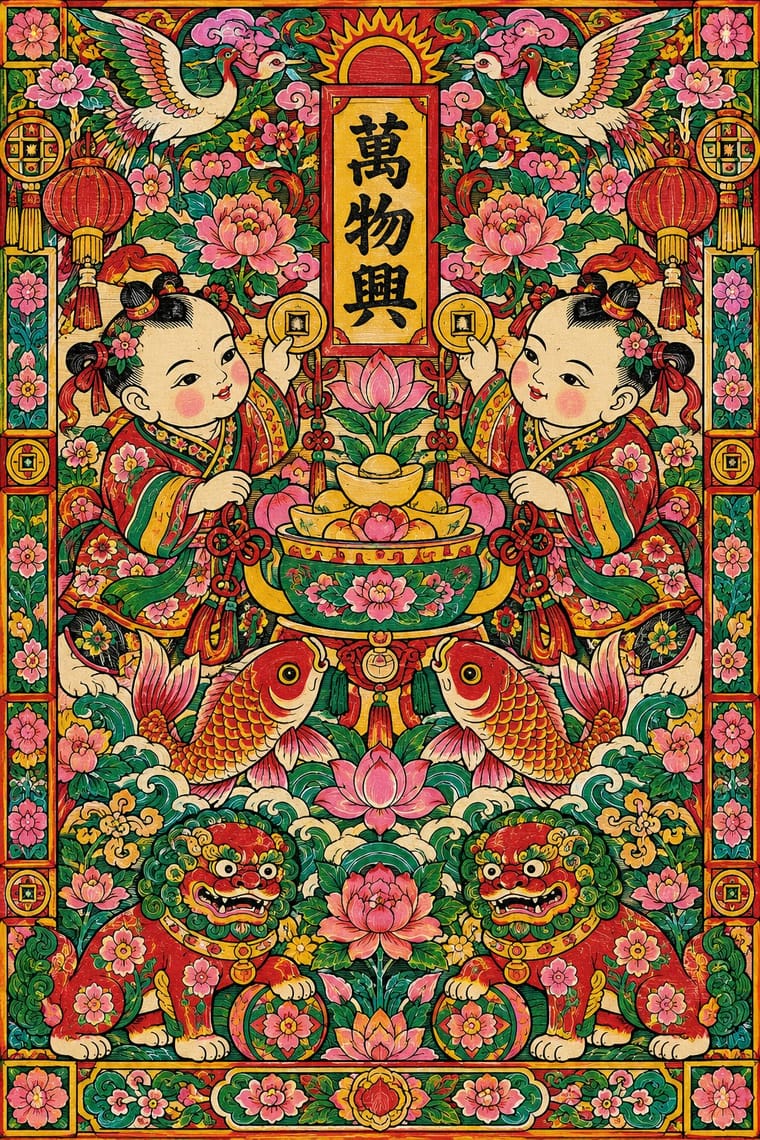
Yan'an artists fused the two; add New Year print outline and flat colour to a woodcut when warmth matters more than shock.
Mix them and make something Chinese Modern Woodcut Movement Nianhua
01
What each style brings
Each part of the design comes from the style with the stronger say in it, and each style gives at least two.
Chinese Modern Woodcut Movement Nianhua & Chinese Folk Print
- Type from Chinese Modern Woodcut Movement
- Colour from Nianhua
- Form from Nianhua
- Composition from Chinese Modern Woodcut Movement
- Surface from Chinese Modern Woodcut Movement
02
The type
Open fonts standing in for each style’s own type, which is often hand-drawn or commercial.
Display · Chinese Modern Woodcut Movement
Together
Shippori Mincho, standing in for Brush-written kaishu titles on journal and book covers
Text · Chinese Modern Woodcut Movement
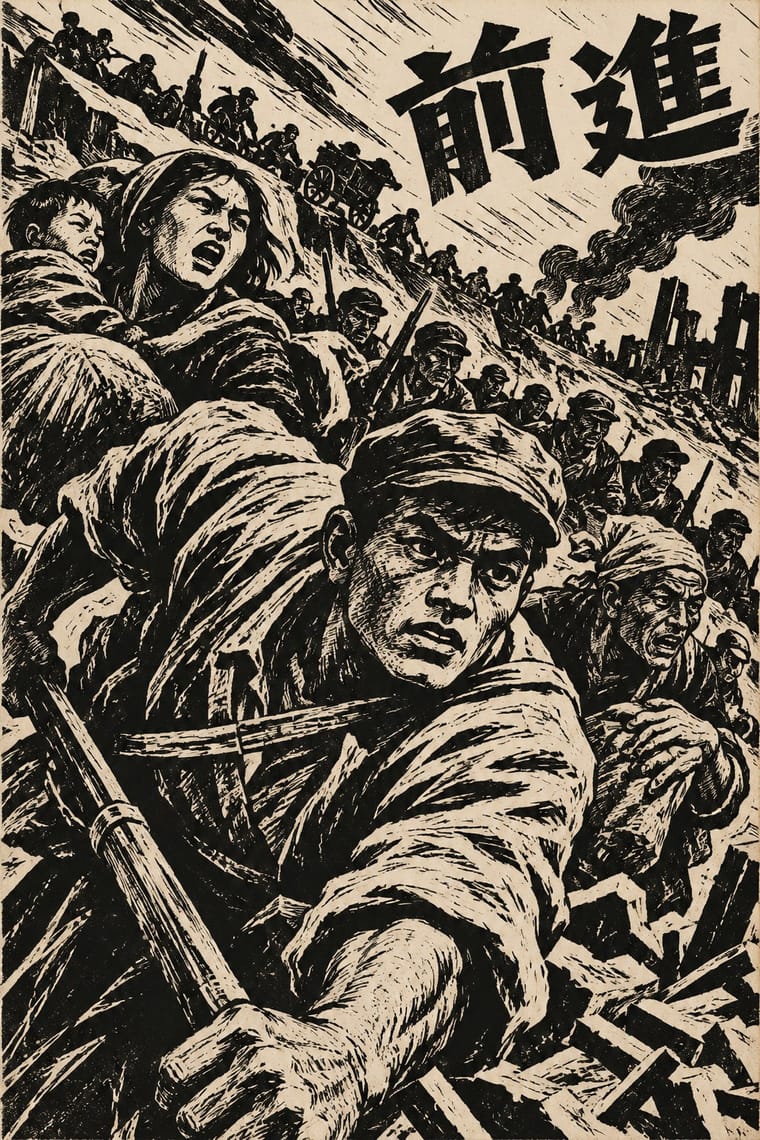
The leftist print movement launched by Lu Xun's 1931 Shanghai woodcut workshop, which made the self-cut black-and-white woodcut China's art of national crisis and revolution. Young artists learned from Käthe Kollwitz, Frans Masereel and Soviet woodcuts to gouge close-up, diagonal images of workers, refugees and resistance for journals, books and travelling exhibitions; in Yan'an after 1942 they adopted New Year print outlines and colour for peasant audiences.
Shippori Mincho; Chinese Modern Woodcut Movement used Hand-cut Chinese characters carved into the block and Brush-written kaishu titles on journal and book covers
03
The colours
The ground and leading colours come from Nianhua, with a counter-accent from Chinese Modern Woodcut Movement. The ink reads on the ground at 4.5:1 or more.
Chinese Modern Woodcut Movement Nianhua & Chinese Folk Print
-
#f1e6cfground · 36% -
#1a1a1aink · 14% -
#f2c230accent · 18% -
#c8252caccent · 14% -
#e5739aaccent · 10% -
#2f8a4eaccent · 8%
As CSS
:root {
  --ground: #f1e6cf;
  --ink: #1a1a1a;
  --accent-1: #f2c230;
  --accent-2: #c8252c;
  --accent-3: #e5739a;
  --accent-4: #2f8a4e;
  --font-display: "Shippori Mincho", serif;
  --font-text: "Shippori Mincho", serif;
}
04
The two styles
05
More combinations
With Chinese Modern Woodcut Movement
- Shanghai Modern & Yuefenpai Contrasts · Same city, same decade: airbrushed calendar glamour against gouged black refugees shows two opposite promises of modern China.
- Taller de Gráfica Popular Pairs well · Mexico and China built woodcut movements in the same years for the same publics; mix their imagery for internationalist solidarity prints.
- Expressionist Woodcut Graphics Pairs well · Its parent: borrow the German gouge and distortion, then point them outward at a shared cause instead of inner anguish.
- Republican Chinese Book Cover Design (Lu Xun & Tao Yuanqing) Pairs well · Lu Xun launched the woodcut movement in 1931 and edited woodcut books such as Yinyu ji; a black carved print on a pale cover with a drawn title joins the two.
- Lianhuanhua Picture-Story Books Pairs well · Woodcut picture-stories and lianhuanhua share the one-image-per-page sequence; mix carved frames with drawn ones for documentary storytelling.
- Minjung Woodcut Graphics (Korean People's Art) Pairs well · MMCA names it as a source; keep its self-cut black line but trade the gouged diagonal shock for Minjung's frontal, dancing figures.
With Nianhua
- Shanghai Modern & Yuefenpai Pairs well · Yuefenpai calendar posters grew from nianhua; mix its auspicious symbols with Shanghai's airbrushed modern figures.
- Indian Calendar & Bazaar Art Pairs well · Both are devotional bazaar prints; share frontal deities, saturated colour and decorative frames across a festive campaign.
- Socialist Realist Propaganda Poster Pairs well · The 1950s 'new New Year pictures' show how nianhua symmetry and colour can carry a contemporary message without losing folk warmth.
- Lubok Popular Print Pairs well · Russia's lubok is nianhua's closest counterpart, a hand-coloured market woodblock with captions and satire; share flat folk figures and rhymed text across a festive print series.
- Minimalist Graphic Design Contrasts · Isolate a single nianhua motif, such as a carp, on a blank minimalist ground to turn abundance into an emblem.
- Guochao (China-Chic National Trend) Pairs well · Redraw door gods, carp and auspicious babies as clean vector characters for limited-edition packaging, keeping each rebus's meaning intact.
- Tibetan Woodblock Print Culture (Pecha & Prayer Flags) Contrasts · Both are popular devotional woodblock prints pasted or hung for good fortune. Nianhua floods the paper with saturated figure scenes, whereas the Tibetan print keeps to one ink and lets the dyed cloth or the lines of script carry the effect.
- Taiwan Floral Cloth (Huabu) Pairs well · Both use saturated red, pink and green and the same auspicious peony, phoenix and treasure vocabulary; set a nianhua-style figure or couplet on a plain panel over a floral-cloth ground for festive New Year packaging.