Style combination · Pairs well
Chinese Modern Woodcut Movement × Taller de Gráfica Popular
Mexico and China built woodcut movements in the same years for the same publics; mix their imagery for internationalist solidarity prints.
China's 1930s–40s woodcut movement ran in parallel with the TGP; combine the two black-line traditions for prints about labour and resistance across continents.
Mix them and make something Chinese Modern Woodcut Movement Taller de Gráfica Popular
01
What each style brings
Each part of the design comes from the style with the stronger say in it, and each style gives at least two.
Chinese Modern Woodcut Movement Taller de Gráfica Popular
- Type from Taller de Gráfica Popular
-
Chinese Modern Woodcut Movement avoids condensed display: this is where the two pull against each other.
- Colour from Taller de Gráfica Popular
- Form from Chinese Modern Woodcut Movement
- Composition from Chinese Modern Woodcut Movement
- Surface from Chinese Modern Woodcut Movement
02
The type
Open fonts standing in for each style’s own type, which is often hand-drawn or commercial.
Display · Taller de Gráfica Popular
Wake
Inter Tight, standing in for Letterpress grotesque and slab-serif captions
Text · Chinese Modern Woodcut Movement
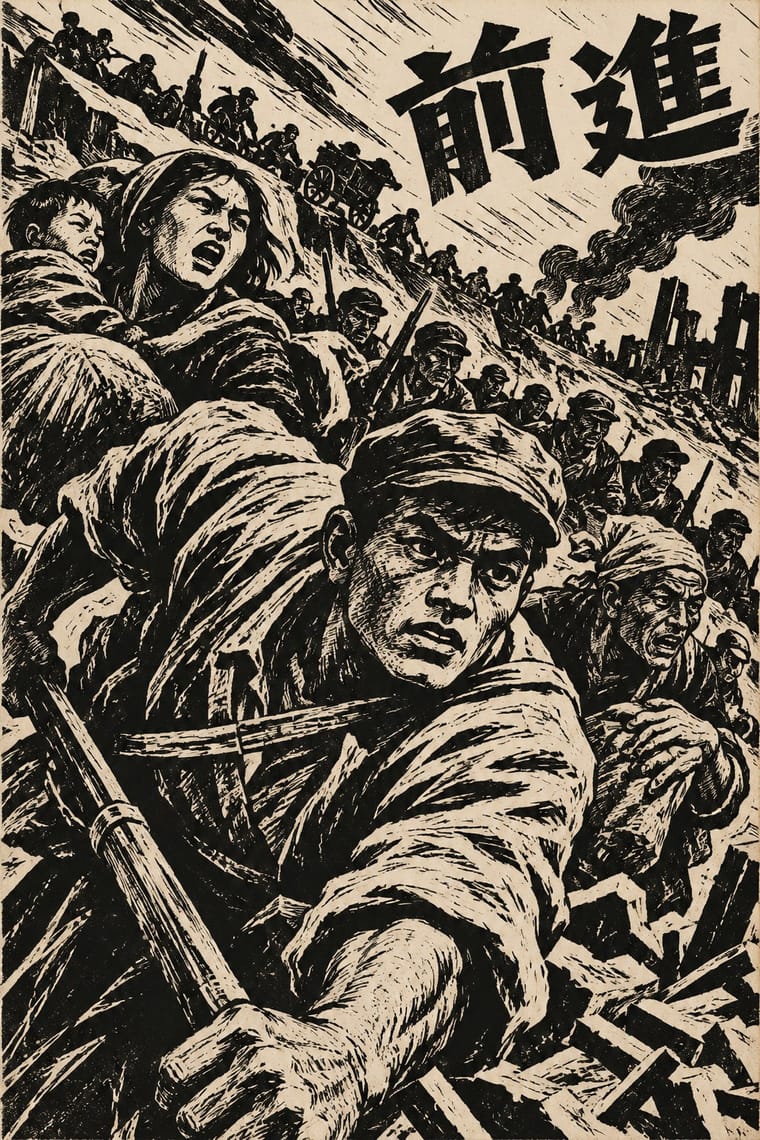
The leftist print movement launched by Lu Xun's 1931 Shanghai woodcut workshop, which made the self-cut black-and-white woodcut China's art of national crisis and revolution. Young artists learned from Käthe Kollwitz, Frans Masereel and Soviet woodcuts to gouge close-up, diagonal images of workers, refugees and resistance for journals, books and travelling exhibitions; in Yan'an after 1942 they adopted New Year print outlines and colour for peasant audiences.
Shippori Mincho; Chinese Modern Woodcut Movement used Hand-cut Chinese characters carved into the block and Brush-written kaishu titles on journal and book covers
03
The colours
The ground and leading colours come from Taller de Gráfica Popular, with a counter-accent from Chinese Modern Woodcut Movement. The ink reads on the ground at 4.5:1 or more.
Chinese Modern Woodcut Movement Taller de Gráfica Popular
-
#f0e8d6ground · 36% -
#151515ink · 14% -
#c0392baccent · 18% -
#e0b23aaccent · 14% -
#d9c39aaccent · 10% -
#8a6e4baccent · 8%
As CSS
:root {
  --ground: #f0e8d6;
  --ink: #151515;
  --accent-1: #c0392b;
  --accent-2: #e0b23a;
  --accent-3: #d9c39a;
  --accent-4: #8a6e4b;
  --font-display: "Inter Tight", sans-serif;
  --font-text: "Shippori Mincho", serif;
}
04
The two styles
05
More combinations
With Chinese Modern Woodcut Movement
- Shanghai Modern & Yuefenpai Contrasts · Same city, same decade: airbrushed calendar glamour against gouged black refugees shows two opposite promises of modern China.
- Nianhua & Chinese Folk Print Pairs well · Yan'an artists fused the two; add New Year print outline and flat colour to a woodcut when warmth matters more than shock.
- Expressionist Woodcut Graphics Pairs well · Its parent: borrow the German gouge and distortion, then point them outward at a shared cause instead of inner anguish.
- Republican Chinese Book Cover Design (Lu Xun & Tao Yuanqing) Pairs well · Lu Xun launched the woodcut movement in 1931 and edited woodcut books such as Yinyu ji; a black carved print on a pale cover with a drawn title joins the two.
- Lianhuanhua Picture-Story Books Pairs well · Woodcut picture-stories and lianhuanhua share the one-image-per-page sequence; mix carved frames with drawn ones for documentary storytelling.
- Minjung Woodcut Graphics (Korean People's Art) Pairs well · MMCA names it as a source; keep its self-cut black line but trade the gouged diagonal shock for Minjung's frontal, dancing figures.
With Taller de Gráfica Popular
- Punk & DIY Zine Pairs well · Both favour cheap, direct, monochrome reproduction; a linocut figure with photocopied type gives protest graphics hand-made urgency.
- Cuban Revolutionary Poster (OSPAAAL & ICAIC) Pairs well · Combine TGP's black linocut figures with Cuban flat colour for politically engaged posters with a hand-made Latin American lineage.
- Art Deco Contrasts · Glossy Deco glamour versus gouged, populist black and white: use the contrast to separate luxury from solidarity.
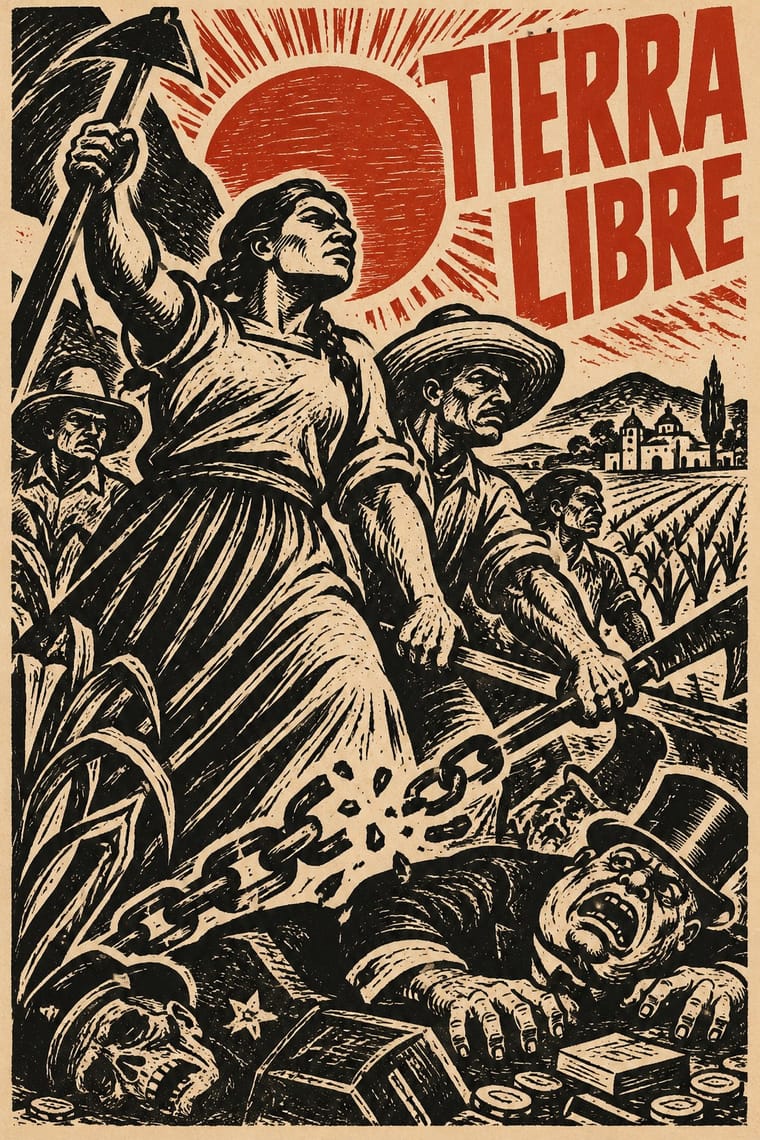
- Minjung Woodcut Graphics (Korean People's Art) Contrasts · Nearest in the atlas, and the closest Mexican print lineage to the Mexican Muralism that MMCA names as a source: both cut black-line people's prints for movements, but TGP sets condensed Latin capitals and lithographs, while Minjung prints carry short Hangul slogans and dancing, ritual-derived figures, and are scaled up to geolgae banners.
- Brazilian Concrete Design Contrasts · Mexico's figurative, militant linocuts are Latin America's other modernism; contrast them to choose between abstraction and narrative.
- Vicente Rojo & Mexican Editorial Modernism Pairs well · Rojo set Leopoldo Méndez's engravings in the Revista de la Universidad de México (no. 3, 1971); a black linocut framed by fine rules on a white page joins Mexico City's militant print culture to its editorial modernism.
- Mexican Popular Graphics (Posada) Pairs well · The TGP took Posada as its ancestor; combine his calavera satire with linocut political posters for socially engaged print.
- Estridentismo (Stridentist) Graphics Pairs well · Leopoldo Méndez carried the Stridentist woodcut into the Taller de Gráfica Popular in 1937; give a TGP print a radio mast or a skyline on a steep diagonal and one bright ink to bring back the machine-age optimism.