Style combination · Pairs well
Bitmap × Diné Weaving Design
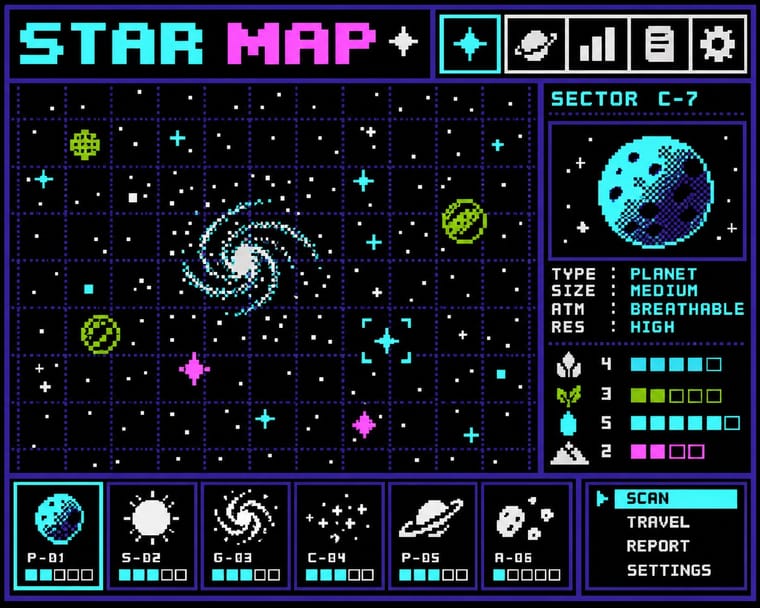
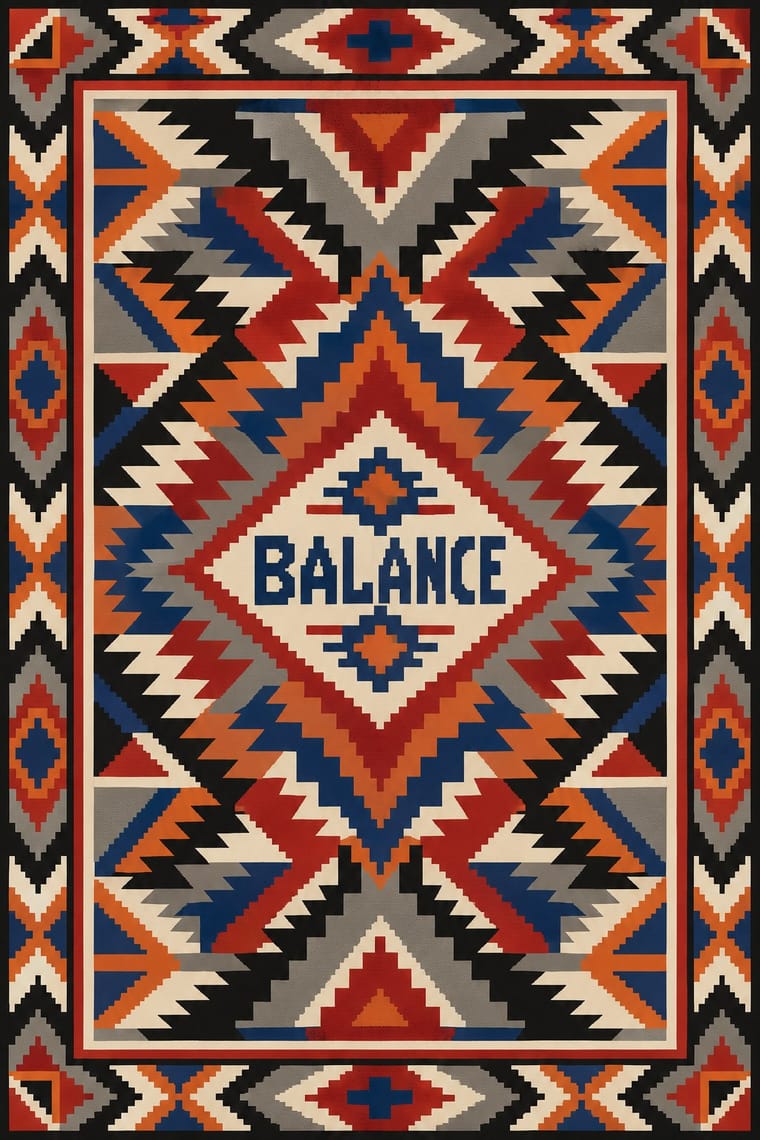
The weft step and the pixel are the same constraint. Draw icons and letters with stepped diagonals on a square grid, and credit the weaving logic rather than lifting particular rug designs.
01
What each style brings
Each part of the design comes from the style with the stronger say in it, and each style gives at least two.
Bitmap & Pixel Graphics Diné (Navajo) Weaving Design
- Type from Bitmap
- Colour from Diné Weaving Design
- Form from Diné Weaving Design
- Composition from Bitmap
-
Diné Weaving Design avoids modular grid: this is where the two pull against each other.
- Surface from Bitmap
02
The type
Open fonts standing in for each style’s own type, which is often hand-drawn or commercial.
Text · Diné Weaving Design
The tapestry-woven design tradition of Diné (Navajo) weavers, recorded in Spanish sources from the early 18th century. Each design is planned as one symmetrical field and built weft by weft, so every diagonal steps. Striped blankets came first, some with terraced diamonds by 1804. After Bosque Redondo came eyedazzlers, Saltillo-derived serrated diamonds in bright Germantown yarn. Then came bordered trading-post rugs, some modelled on Oriental rugs, in regional codes such as Two Grey Hills and Ganado red. Contemporary tapestry artists such as DY Begay extend it into landscape and abstraction.
Oswald; Diné Weaving Design used Stepped capitals built on the weft grid when a title has to share the woven field, such as Silkscreen or another pixel face drawn on the same square grid and Diné bizaad text with full orthographic support (ą, ł, ʼ, nasal and high-tone marks such as ą́), set in a sturdy sans such as Noto Sans
03
The colours
The ground and leading colours come from Diné Weaving Design, with a counter-accent from Bitmap. The ink reads on the ground at 4.5:1 or more.
Bitmap & Pixel Graphics Diné (Navajo) Weaving Design
-
#ede6d6ground · 36% -
#1c1814ink · 14% -
#d8682aaccent · 18% -
#9bbc0faccent · 14% -
#a3201caccent · 10% -
#ff55ffaccent · 8%
As CSS
:root {
  --ground: #ede6d6;
  --ink: #1c1814;
  --accent-1: #d8682a;
  --accent-2: #9bbc0f;
  --accent-3: #a3201c;
  --accent-4: #ff55ff;
  --font-display: "Pixelify Sans", monospace;
  --font-text: "Oswald", sans-serif;
}
Use it with care
Diné (Navajo) Weaving Design: Diné weaving is a living craft, taught within families and tied to the Diné account of Spider Woman, who taught the first weavers to build the loom. It has also been suggested that the Diné learned weaving from Pueblo neighbours, though how far is uncertain; give the Diné account first. Yeibichai and sandpainting designs depict Holy People from healing ceremonies, and weaving them was controversial within the Navajo community even when Hastiin Klah, himself a ceremonial singer, did it. Do not reproduce Yei or sandpainting imagery. Diné weavers may leave a spirit line (Ch'ihónít'i), a deliberate break through a border that gives spiritual elements a way out of the textile; it is their practice, so do not add a spirit line or any 'meaning' to a design as decoration. Do not sell printed or machine-made 'Navajo pattern' as Indian-made: the US Indian Arts and Crafts Act of 1990 prohibits that. The Navajo Nation also holds trademarks in the name 'Navajo', registered since 1943. It sued Urban Outfitters in 2012 over 'Navajo' and 'Navaho' product lines, and the case was settled in 2016 with a supply and licence agreement. Do not label non-Diné products or patterns 'Navajo'; the Nation expects companies to ask its permission before using its name, designs or motifs. Commission, pay and credit Diné weavers by name rather than copying their rugs, for example through the Crownpoint Rug Auction, run since 1968, with breaks, by a community organisation of weavers and volunteers.
04
The two styles
05
More combinations
With Bitmap
- Andean Woven Graphic Systems Pairs well · The woven cell of Andean tapestry is a pre-digital pixel grid; draw pixel icons with its stepped diagonals, but credit weaving communities rather than copying their motifs.
- Skeuomorphic UI Contrasts · Photoreal leather and glass are the opposite pole of 1-bit honesty; jump from one to the other to tell a story of interface history.
- International Typographic Style Pairs well · Snap pixel type and icons to a strict Swiss grid for a rational, screen-native take on modernist order.
- Art Nouveau Contrasts · Whiplash curves cannot survive a coarse pixel grid; staging that clash makes a memorable, deliberately jagged ornament.
- Kawaii Design Pairs well · Sprite-scale characters and kawaii roundness merge naturally; keep the palette limited so pixel mascots stay crisp.
- Demoscene Graphics (Cracktros, Demos & Text-Mode Art) Contrasts · Bitmap graphics is the legible, flat pixel of icons, sprites and system fonts; scene graphics spend the same pixels on chrome, gradients and motion for show. Pick the icon grid for an interface and the scene logo for a title screen.
- Square Kufic (Bannāʾī) Pairs well · Both build letters from square units, and Sakkal compares building bricks to large pixels; set a bitmap Latin wordmark on the same cell size as a square-Kufic mark for a bilingual identity, but keep sacred formulas out of jokey, game-like pixel contexts.
- Isometric Pixel Art Contrasts · Same hand-placed pixels, but front-on icons and sprites under hardware limits against a crammed, full-colour 2:1 city made as a picture.
With Diné Weaving Design
- Andean Woven Graphic Systems Contrasts · Both build stepped geometry on the thread grid. Andean cloth repeats and distorts a figure across cells and columns, while a Diné rug is one planned symmetrical field around a centre, so choose one structural logic.
- Northwest Coast Formline Design Contrasts · Both are North American Indigenous systems. Formline is figurative, curvilinear and built on crests, and Diné weaving is abstract, angular and terraced. Never merge them into a generic 'Native' pattern.
- Op Art Graphics Contrasts · Eyedazzlers vibrate because stepped tapestry edges meet saturated yarn colours, not because printed lines are modulated mechanically. Do not confuse the two, and keep the slightly irregular handwoven step.
- Amazigh Sign System & Tifinagh Contrasts · Both are rug-weaving traditions of stepped geometry, made largely by women. Amazigh weavers share a repertoire of protective signs with pots, silver and tattoos, and let a lattice drift or break off by hand, while a Diné rug is one field planned and mirrored around a centre, in a grammar and palette set by period and region. Do not merge them into a generic 'tribal rug'.